Follow us on Instagram (@slowdown.media) and subscribe to our weekly newsletter to receive behind-the-scenes updates and carefully curated musings.
TRANSCRIPT
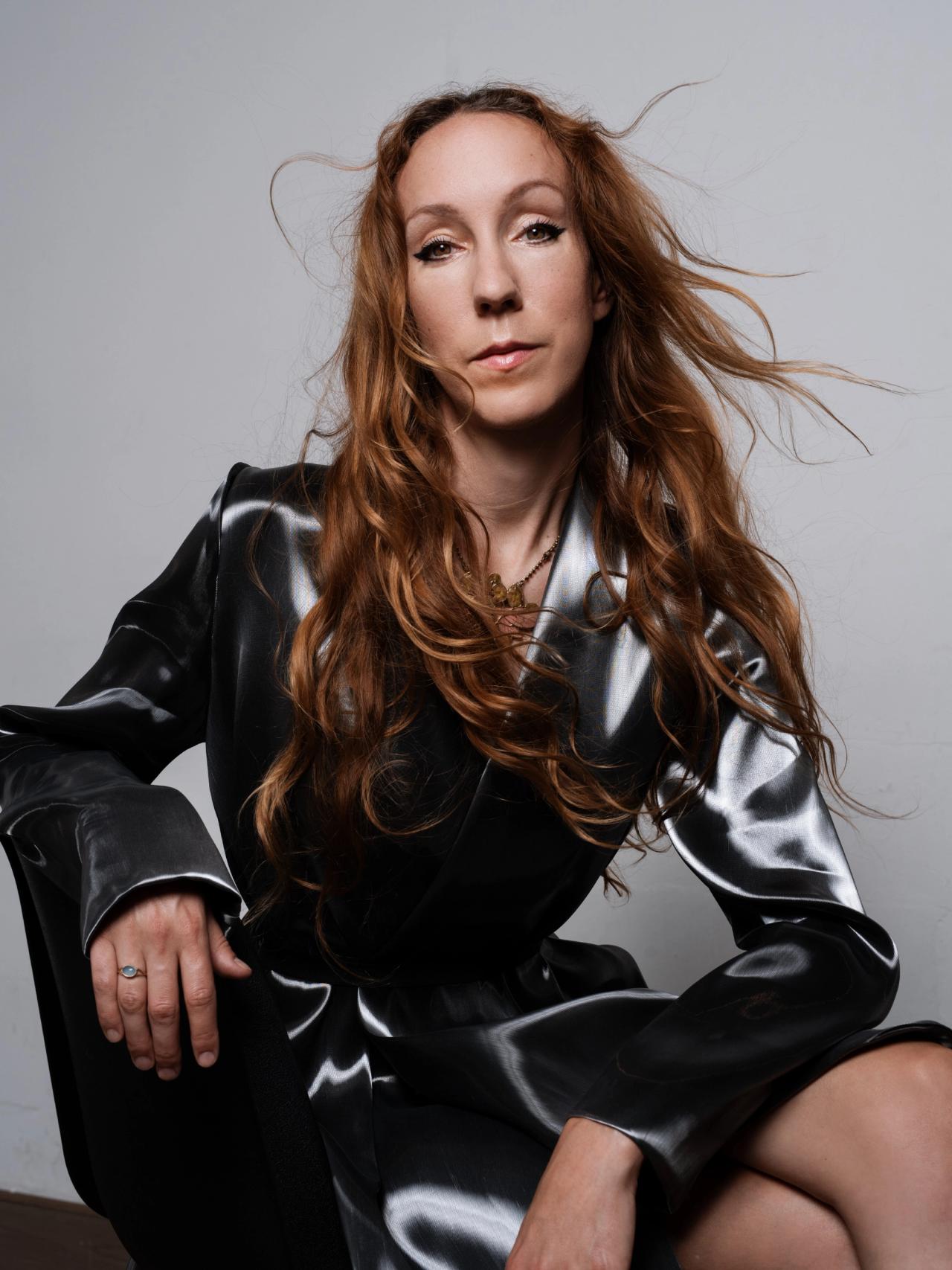
Iris Van Herpen. (Photo: Robin de Puy)
SPENCER BAILEY: Hi, Iris. Welcome to Time Sensitive.
IRIS VAN HERPEN: Thank you.
SB: We’re experimenting today, I should say. This is our first-ever video episode of Time Sensitive. I’ve always found it meaningful to have these conversations without the cameras on. It’s interesting having them on. I can tell they’re present. So, I wanted to state up front that there’s this certain intimacy that occurs when it’s just mics, and it’s shifting, and I want to experiment and see how this goes. But I feel like if there’s anyone to innovate with, it’s probably you.
IVH: I’m all up for experimentation. It’s always good to shift and change things around.
SB: As I was preparing for this conversation, it struck me that your work—and we should start with time…. I feel like it’s the place to begin this. Your work exists on all these temporal scales. A couture piece may require thousands of hours, even maybe years. Scientific research or material innovation might take years or decades before it even appears in a collection. Then there’s this longer horizon that you consider. You’ve spoken beautifully about how what you make, you hope it will still have meaning a hundred or two hundred years from now. It made me wonder whether, in some sense, you think about time itself as one of your materials. If so, could you talk about that? How does time enter your work?
IVH: Time is a really important part of the process, and I’ve learned through time to take the time. Couture is really about slowing down, and one look can take four to five to six to seven months of making, multiple people at the same time. Sometimes, indeed, it can even take a year, with all the research and development. When I think of all the material developments and the collaborations with scientists and architects, they sometimes take a year or two years. I’m trying to combine the different timelines into the process, which is one of the harder parts of the process, because I’m in the fashion system. Before, I would do two shows a year, and now it’s one show. That’s really the time that we have. But the complexity and the collaborations that we’re doing actually require a lot more time. So it’s always this battle.
I’m trying to have the research and development always continue, even though I know it’s not going to be ready for the next show, but it might be ready for, I don’t know, one or two years in the future. It’s always these multiple ways of thinking happening simultaneously. I think it also reflects what the work is about, because if you look at my work, it’s often a combination of traveling to the past, because there’s a lot of historic references in it. But it’s also traveling to the future, always. I think I’m trying to create this new sense of time by focusing on this unknown world of the future and to imagine that in relation to everything that’s happened within craftsmanship in the past. It’s really about bringing those different timelines together.
SB: In some cases, too, I would argue almost a timelessness. Time almost disappears.
IVH: I wish. No, I think I’m very much dependent on time, but I play around with it.
SB: There’s speed and slowness here—you alluded to that. You exist in this fashion system that’s quick. You’ve even recognized that it’s important to put a little pressure on creativity. A deadline’s a good thing.
IVH: Absolutely.
SB: But you’ve deliberately structured your practice around depth, which, by its very nature means slowness, which means taking the time to realize the thing.
“I realize that I’m doing more by going slower, because I’m going a lot deeper into the work.”
IVH: It’s interesting. Going slower doesn’t... well, this is strange to think of. I realize that I’m doing more by going slower, because I’m going a lot deeper into the work. It’s just becoming much more layered. I don’t necessarily think if you do things fast—like within fashion, where a lot of brands are making a lot of collections at the same time—you’re actually doing more. Because if you’re doing more of the same thing, are you really doing more?
SB: Exactly. I think fashion almost creates the illusion that there’s constant change.
IVH: Yeah.
SB: Even though actually not much is changing at all. In fact, it’s often replicating itself.
IVH: It’s a paradox. It’s as if the faster you run, the more you stand still.
SB: What’s your personal approach to time management, if I could call it that?
IVH: Time management, wow. I do everything by intuition, but one of the hardest parts in the process is to predict what you can still do in the time that you have left. So, let’s say we have five months to work on a collection. When I’m in a flow, I get more and more ideas, and that continues all the way up to the show. But it often happens that, like two months before the show, I have this concept in my mind and I know it’s something that I really want to do. But I also know that it’s very risky to start working on it, because if you don’t finish it on time, then you throw away a lot of other possibilities that you could have done in that same amount of time. That always breaks my heart to stop with something that I know actually should happen at that moment in time. But then I have to save it for later.
I can get very enthusiastic about an idea when it comes. I have to put myself to it; to put it into a fridge for a few months and then to work on it. It’s so interesting how that process works.
SB: You’ve spoken a lot about how to be in your atelier is to be in a meditative state. Time really starts to slow when you’re sewing. In this Brooklyn Museum show [“Iris van Herpen: Sculpting the Senses”], you’ve set up a version of your atelier as the hub, the center point, almost, of the show.
IVH: Yeah.
SB: You’ve described your atelier time as intuitive, collaborative, embodied, protected, and partly subconscious. What is it about that space, do you think, that allows time to shift for you? Do you lose your sense of chronological time?
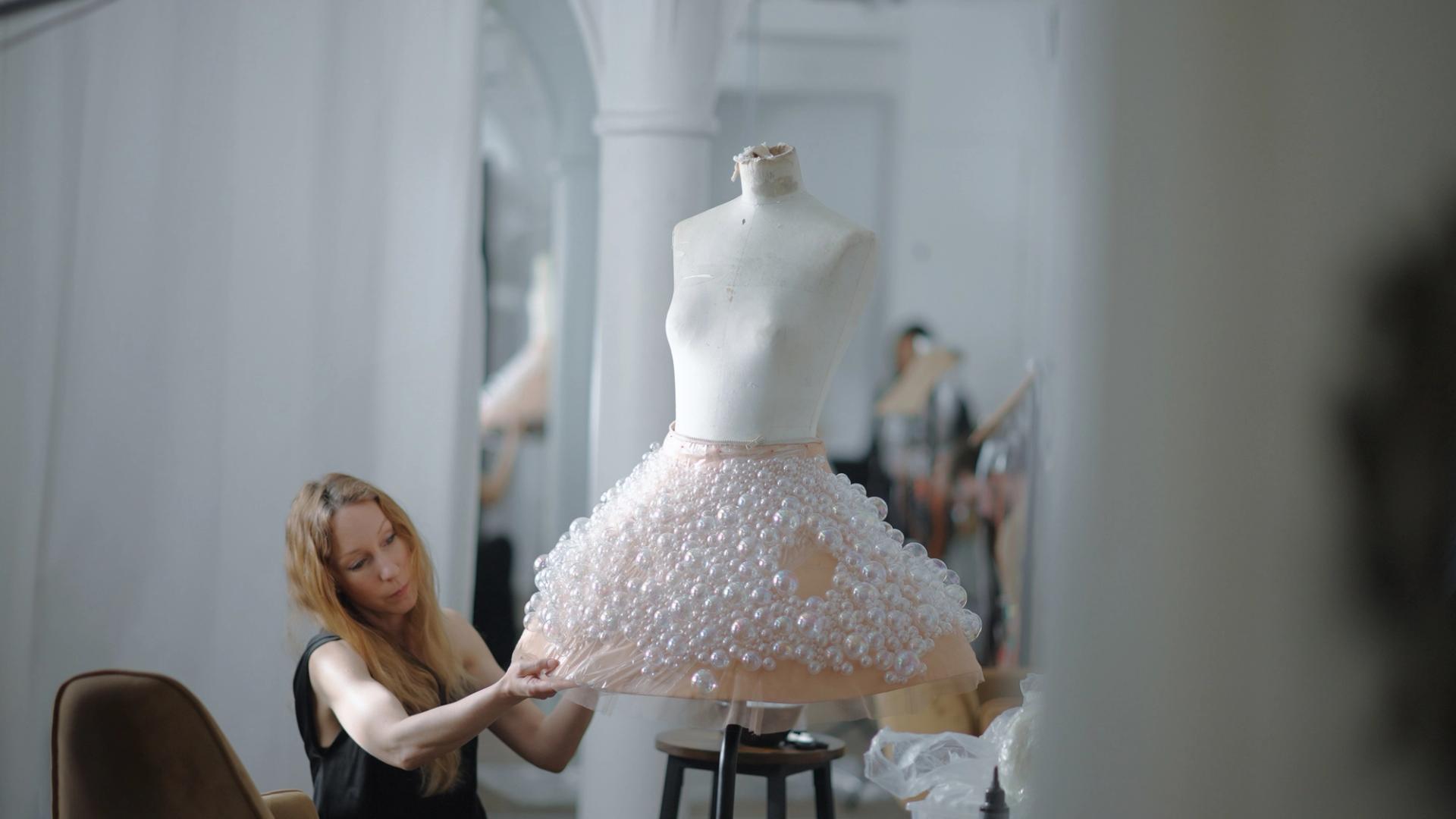
Van Herpen at work on her custom “Airo” dress, worn by Olympian Eileen Gu to the 2026 Met Gala. (Photo: Ryan McDaniels)
“When I design in the atelier, it’s a very intuitive process, and it’s indeed a meditative state. I need to be alone for that.”
IVH: Definitely. When I design in the atelier, it’s a very intuitive process, and it’s indeed a meditative state. I need to be alone for that. I really need a certain amount of focus, and it needs to be at least one day. I cannot be interrupted with any other things. I go into a very unfamiliar space in my mind where I feel a certain amount of freedom and I feel, strangely, less connected to reality. It’s hard to describe, but it’s a good place to be. I really need to protect that space. I wanted to bring that sense of the atelier into the exhibition, as well, that feeling of meditation, but also to open up the real creative process, which is the draping, and that is so intuitive and so magical at the same time.
I decided to start working on the look in the museum through draping and through pleating, to really show what that process embodies. It has been very much out of my comfort zone, because I normally don’t like to have anyone around when I drape.
SB: It’s kind of on a stage now.
IVH: It was an experiment.
SB: The cameras are on.
IVH: I know! People were all around, of course, filming. There was this buzz. It felt really good to share that with the audience, because that never happens.
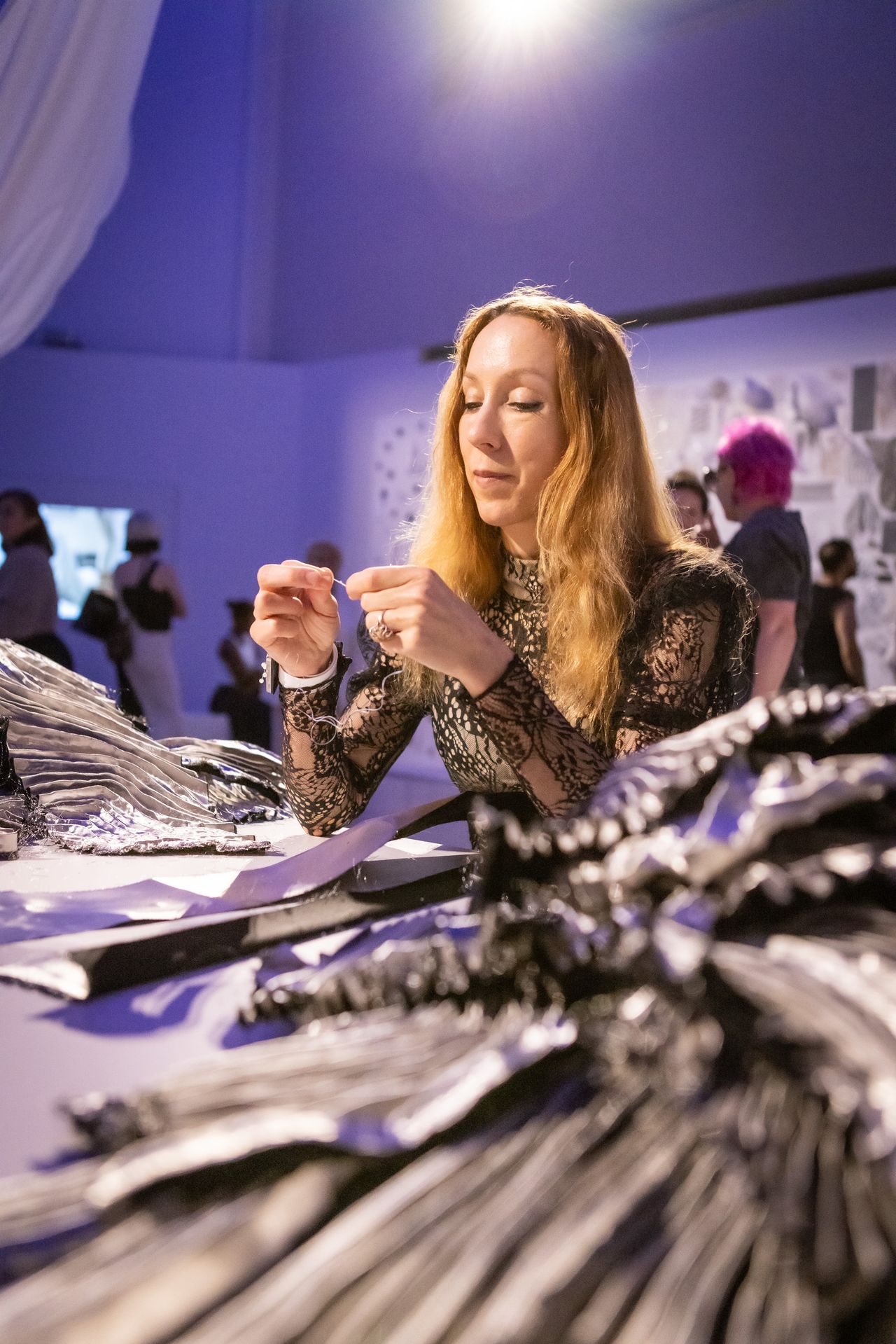
Van Herpen working on a new piece at her recreated atelier as part of her “Sculpting the Senses” exhibition on view at the Brooklyn Museum. (Photo: Steven Sierra)
SB: So you’ll be visiting the show multiple times to realize this piece?
IVH: I’m hoping to finish the whole design process in the atelier. I’ve done six days now. I’m hoping to do a few more days and then to have finished the draping.
SB: What’s the vision for the piece, if you can share?
IVH: It’s changing. And that’s the beauty of the draping process. When I started on it, it was very much in the direction of coral structures. It’s a combination of three different types of fabrics. It really depends on how I combine the three. Now it starts to look like lava. So, it’s changing all the time.
SB: Biomorphic.
IVH: Absolutely.
SB: For those listening—or watching—who aren’t familiar with your work, I think it’s important to state that you’re as much an artist and fashion designer, I would say, as you are—at least through your collaborations—a technologist. Your work is very innovative in that sense. You’re constantly pushing these boundaries of what we think fashion should or could be. You’ve called a concept of your practice, or a main conceit of your practice, “craftolution,” which is this idea of an across-time, long-arc view that what you’re doing now is intimately connected to the invention of the sewing needle, sixty thousand or so years ago. Could you just describe this a little bit more? Do you see the many tools you’re using now as modern-day versions of that sewing needle?
IVH: I see it as a natural evolution of craftsmanship to use the tools that are available today and to create hybrids with the existing tools from the past. It’s interesting that, when we think about craftsmanship today, we often think about it as something that was frozen in time in the past, like a certain technique.
“When you look back to the history of craftsmanship, it has always been in an evolution.”
We just continue doing that same technique, but we don’t add new techniques to it, which I find strange, because indeed when you look back to the history of craftsmanship, it has always been in an evolution. There have been so many innovations within craftsmanship, and we shouldn’t stand still within time. To me, the most interesting techniques start to happen when this modern-day knowledge is combined with knowledge from the past. It’s really about keeping the knowledge of the past alive as well, because it’s as valuable as the modern-day knowledge. It’s about creating these new hybrids. And that’s how I refer to “craftolution.” It’s really the evolution of craftsmanship.
SB: It almost feels, too, the way you’re describing it, that it’s like a feedback loop. One begets the other, right? And so—
IVH: Absolutely.
SB: ... the modern technology might reshape how we think about a traditional craft and vice versa.
IVH: And vice versa. Absolutely. I really feel that I’m able to transcend the contemporary techniques with the knowledge from the earlier techniques. They really enhance each other.
SB: This might sound random, but I wanted to bring up your kimono collection here.
IVH: Nice.
SB: You have these twenty or so Japanese kimonos, one of which, at least, dates back to the 1800s. Could you just share a little bit about this collection and how you view it in the context of craftolution?
IVH: Well, the craftsmanship is extraordinary in these pieces and that’s why I think I also fall in love with them each time. It’s the embroidery techniques, the three-dimensional embroidery techniques. Some techniques that are in the kimonos are just not used anymore. Also the way the silks have been woven and the silver threads within them... I also really like the symbolism. Each kimono often has a story in the artwork that is in there, much like paintings have. Like the crane birds, they stand for so many aspects within life and fortune. It’s beautiful to hear the stories behind them. Also, one reason that I collect them is just because I love to embody them. I just feel— [Pauses] I don’t know. I believe in past lives, and there is a connection with me and kimonos. I don’t know what it is.
SB: It’s also interesting in the context of some of the work that you’ve done in the Brooklyn show. There are several kimonos, or kimono-style, pieces in it. Share a little bit about those, how you view that work in relation.
IVH: The pattern-making of the kimonos is really beautiful. The simplicity of it. Some of the looks in the collection, or in the exhibition, are inspired by that way of pattern-making. It’s very graphic silhouettes, but we like to make them into very ephemeral materials. If you have some knowledge about garments and kimonos, you’ll recognize some elements. But I think most people don’t even recognize it, even though the pattern-making is in there, just because of the transparency and then the three-dimensional embroidery on it.
SB: They’re not your usual kimono. [Laughs]
IVH: No.
SB: Tell me about some of the tools and technologies you’re most excited about right now. Where do you see some of the things you’re playing around with heading in the next decade?
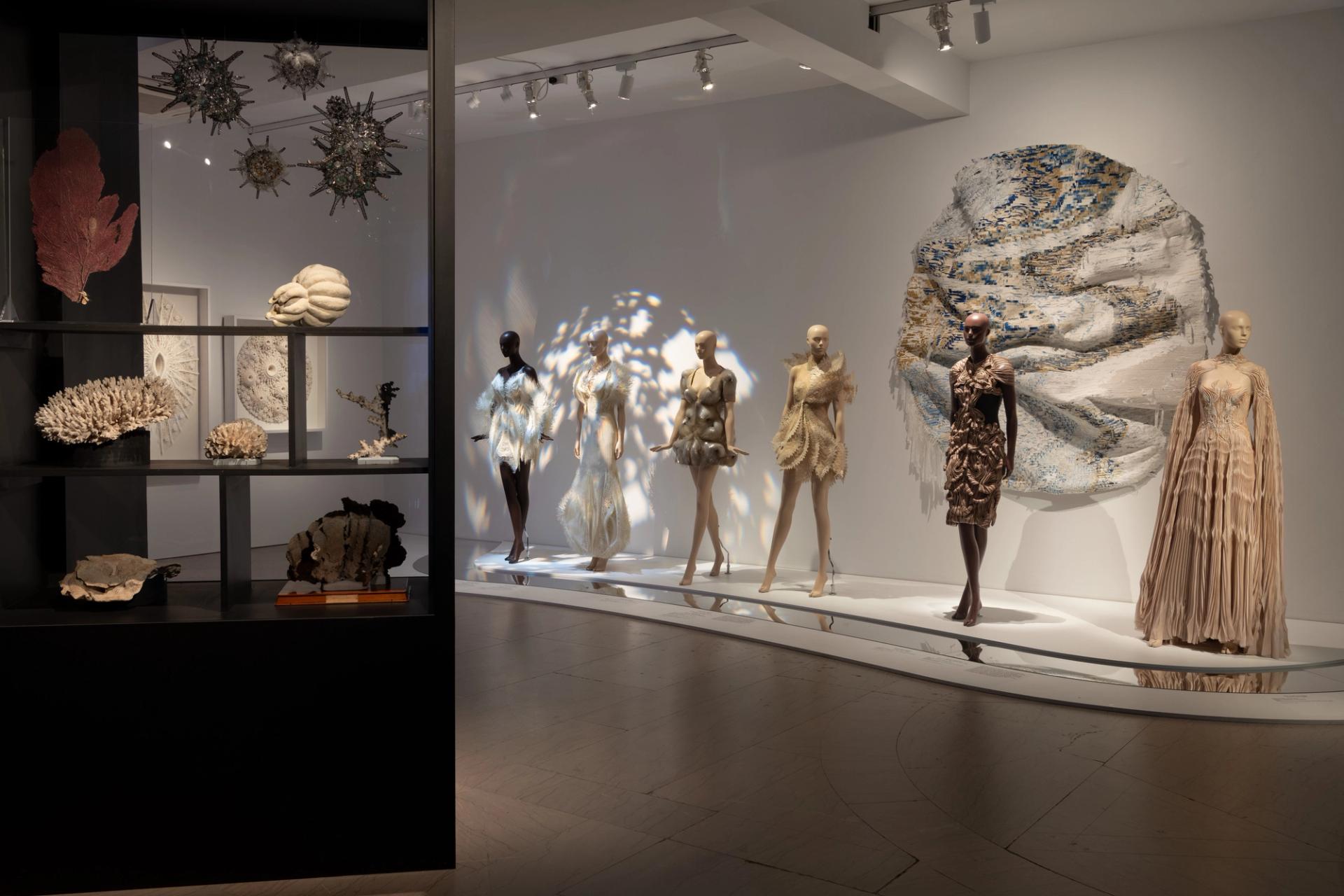
Installation view of van Herpen’s “Sculpting the Senses” exhibition. (Photo: Paula Abreu Pita)
“I really feel that I moved one step closer to this vision that I’ve had for a long time to create an immaterial dress that is just an energy or an atmosphere alone.”
IVH: Ooh, that’s a big question. For my Sonic Starquakes collection, I’ve been experimenting with these very unusual materials. One of them was plasma, which is the fourth state of metal. I’ve been experimenting with a lot of types of materials—of course, solids, but also liquids and also gases. Even for the Met Gala look, there was helium inside to go against gravity. For the latest collection, I really feel that I moved one step closer to this vision that I’ve had for a long time to create an immaterial dress that is just an energy or an atmosphere alone. It’s not there yet, but it’s one step closer. Also plasma is really rare on earth. We know it through auroras or through lightning, but it’s the material that the universe is made of, like the stars and the suns.
It was really my goal to bring the rarity of this material into the collection and to experiment with it, with something that I cannot control. There is a beautiful story behind it, because we also created this look that is called the Lichtenberg look. It’s made through plasma and it’s one of the most scientifically complex looks that I’ve done so far. So we created this mold and then it went inside a particle accelerator. Then it was cryogenically preserved to minus a hundred [degrees Celsius]. The whole plan was to do this because, when you do that, billions of electrons are charged inside the dress and they want to go out. The plan was to discharge the dress during the show. That creates these amazingly beautiful Lichtenberg patterns, which are these universal patterns that you see everywhere in nature, right? From the storms in the sky, to the fungi in the ground, to the trees that are growing. Basically, if you want to see it, you start to see it everywhere. Even in our own blood vessels, it’s the same pattern, the same mathematical logic behind it.
We wanted to create this Lichtenberg pattern by discharging the dress on the runway. But then two days before the show, the dress started to de-charge itself. No one was there. We still do not understand how it had happened or how it was possible. Of course, it was frustrating at first, but then I woke up the next morning realizing that it’s so perfect. It was exactly [what] the collection was about, about inviting these universal forces that we don’t have control of. The plan for me, in the coming years, is to invite these very unfamiliar forces more into my work, because I’m a control freak and I like to, within couture, decide about every little millimeter. It’s a really interesting dialogue for me in the creative process to also invite nature and randomness and chaos and forces that are larger than life.
That’s what I’m really excited about. It also relates to a look that we made for the collection before, which was the “living look,” [for] which we used the bioluminescent algae. That was also by disrupting the creative process. So, fundamentally, it brings me into a whole new way of thinking and working. At the moment I’m really attracted to bringing this entropy into my work, I would say. It’s not necessarily about technology. It’s much more about bringing unknown forces into my work.
SB: We’re talking about fashion. [Laughs]
IVH: Yeah, we are. We still are talking about fashion.
SB: I think it’s easy to forget that, right?
“In my world, fashion relates or has a dialogue with science, with art, with philosophy, with dance, with all the layers of life. I don’t think in boxes. I don’t like to close off the word fashion.”
IVH: Yeah. But, in my world, fashion relates or has a dialogue with science, with art, with philosophy, with dance, with all the layers of life. I don’t think in boxes. I don’t like to close off the word fashion.
SB: Well, let’s stay on your algae dress for a minute because this garment contains a hundred and twenty-five million living algae, which emit this bioluminescent light in response to movement. You literally have to— It’s not just like, “Oh, we’re caring for the dress.” You literally have to care for the dress or it will die. So it’s being cared for as if or like the living organism that it is.
IVH: It’s a being. It’s a living being. An individual algae doesn’t have a long life, but as it’s a community, it’s like an organism as a whole. They reproduce. It can live for a really long time and no one knows exactly how long that is.
SB: It’s a totally different … Back to time, right? Such a different way of thinking about time.
IVH: Back to time. And that’s really interesting that you connect to that question, because it’s interesting in my mind as a designer to create something that lives beyond the moment of creation. Because normally when we are finished with a look, then it sort of stops. The evolution stops. The transition or the metamorphosis stops. And with this look, it actually continues. It surprises us.
SB: It’s sort of like a flame or something, right?
IVH: Yeah.
SB: Like this idea of lighting a flame and it keeps going across centuries or something.
IVH: Absolutely.
SB: This is a big question, but I feel like your work kind of sits at the crux of it. What do you think happens when fashion time, scientific time, architectural time, and biological time meet in a single garment?
IVH: Oh, that’s a beautiful question. I’m trying to imagine what would happen if all these different times came together. I think the world would implode. [Laughter] Going into more detail, fashion tends to be really quick. Scientific time is so much slower, because it’s about redefining our sense of reality in how we understand the world around us. It’s just an ongoing transition that we’re going through, right?
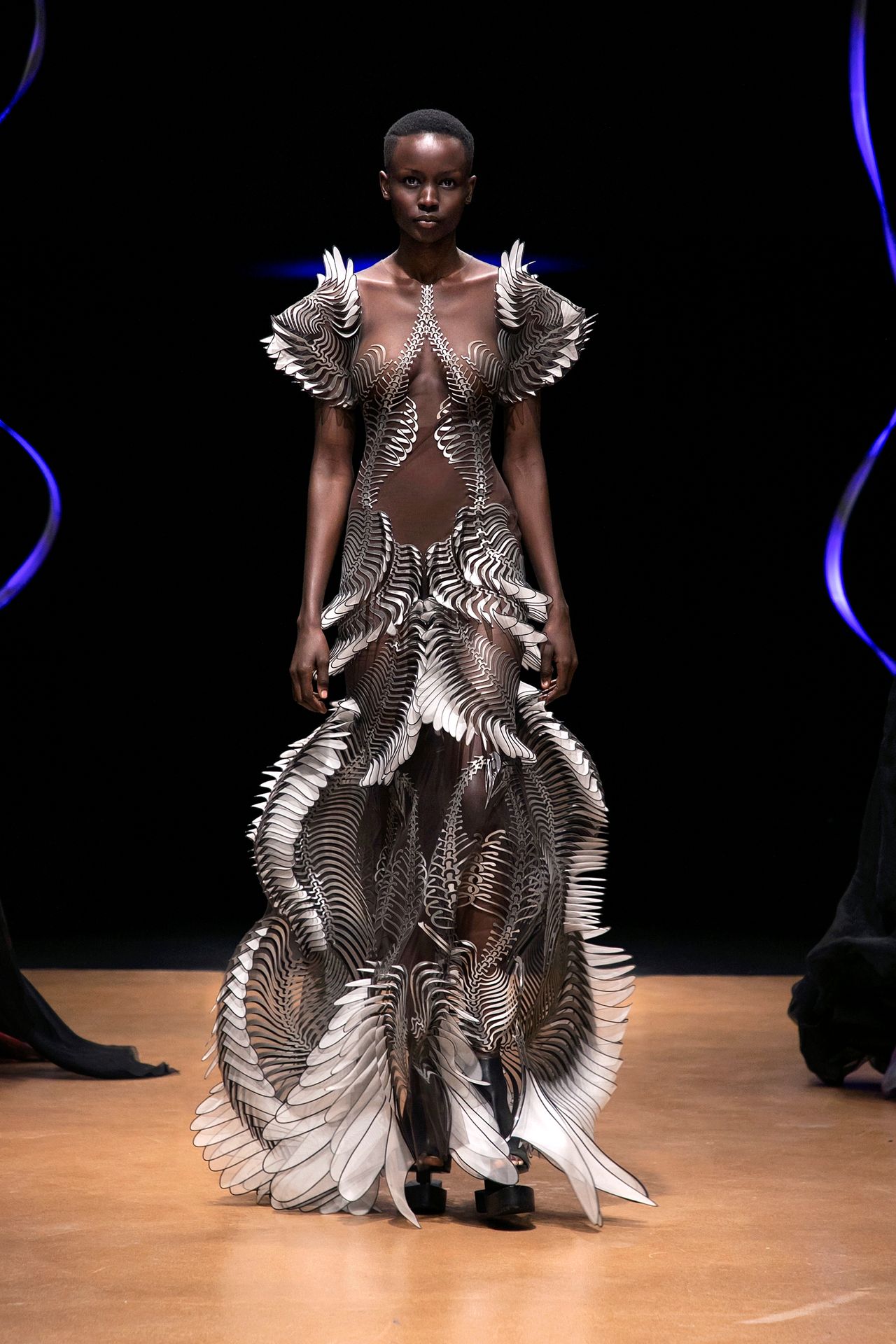
Van Herpen’s Labyrinthine Kimono Dress from her 2020 “Sensory Seas” collection shown as part of Paris Haute Couture Week. (Courtesy Iris van Herpen)
That’s maybe why I feel it’s interesting when fashion and science meet, when they start a dialogue. One of the things that I’ve discovered working with scientists is that a lot of the concepts that they’re working with are so abstract that it is really hard to visualize the concept that they’re working with. Sometimes—it’s rare, but sometimes—we manage to give that glimpse of a concept into something physical, something that you can see. It can help a scientist to have that image, because some people think of science not being creative, but it is. It relies on imagination as much as artists do. I think that dialogue is really interesting when that happens. I learn a lot from scientists, but I really believe that artists are also valuable, the other way around. I don’t think I can really answer your question, but this is what came up: the beauty that happens when these very unfamiliar worlds come together.
SB: Do you view yourself, in some sense, as a scientific translator? Because I think what you’re doing is giving a platform to some very hard-to-grasp concepts or theories.
IVH: Maybe. It’s hard to define, sometimes, how it can change our perspective towards fashion. But I do believe that by bringing in science into the work or even architecture or engineering, it opens up to so many more people. That’s also what I find really beautiful in the exhibition. Often a fashion exhibition attracts people that are interested in fashion and the gravity is more toward female, as well. But this exhibition is so different. It attracts scientists, engineers, architects, people with so many different backgrounds. That’s because the work relates to all these different disciplines, and that makes it so much deeper.
If I think of what the meaning of fashion has been in the past, where it was often also used to communicate to something beyond us, maybe a higher spirit, that’s what I believe can happen as well when you bring science into the work today. I believe it can speak to a very unfamiliar world that we all know is there.
SB: Yeah. And fashion is this thing that’s—
IVH: It’s the embodiment. It’s the transition of it.
SB: Walking through the show—and I was mentioning this before we started recording—I was so struck by how people were really reacting to the works, not as spectacle, but as something deeply felt. There is a hush and a quiet as you walk through the show. People are just sort of in... It’s a form of awe. Part of that is because your work gives a physical form to so many things we don’t normally see. These invisible forces or hidden systems, things like that. So why has that been such a central fascination of yours, the sorts of things we can’t see?
IVH: In my work, I’m often visualizing the invisible and it’s really about showing the different layers of reality around us, because we tend to be distracted by our lives and by our one dimension, of practicality, of our modern day. I feel so much is missed. There are so many ways that you can experience life through your different senses, as well. That’s an important part of the exhibition.
SB: “Sculpting the Senses” is the title.
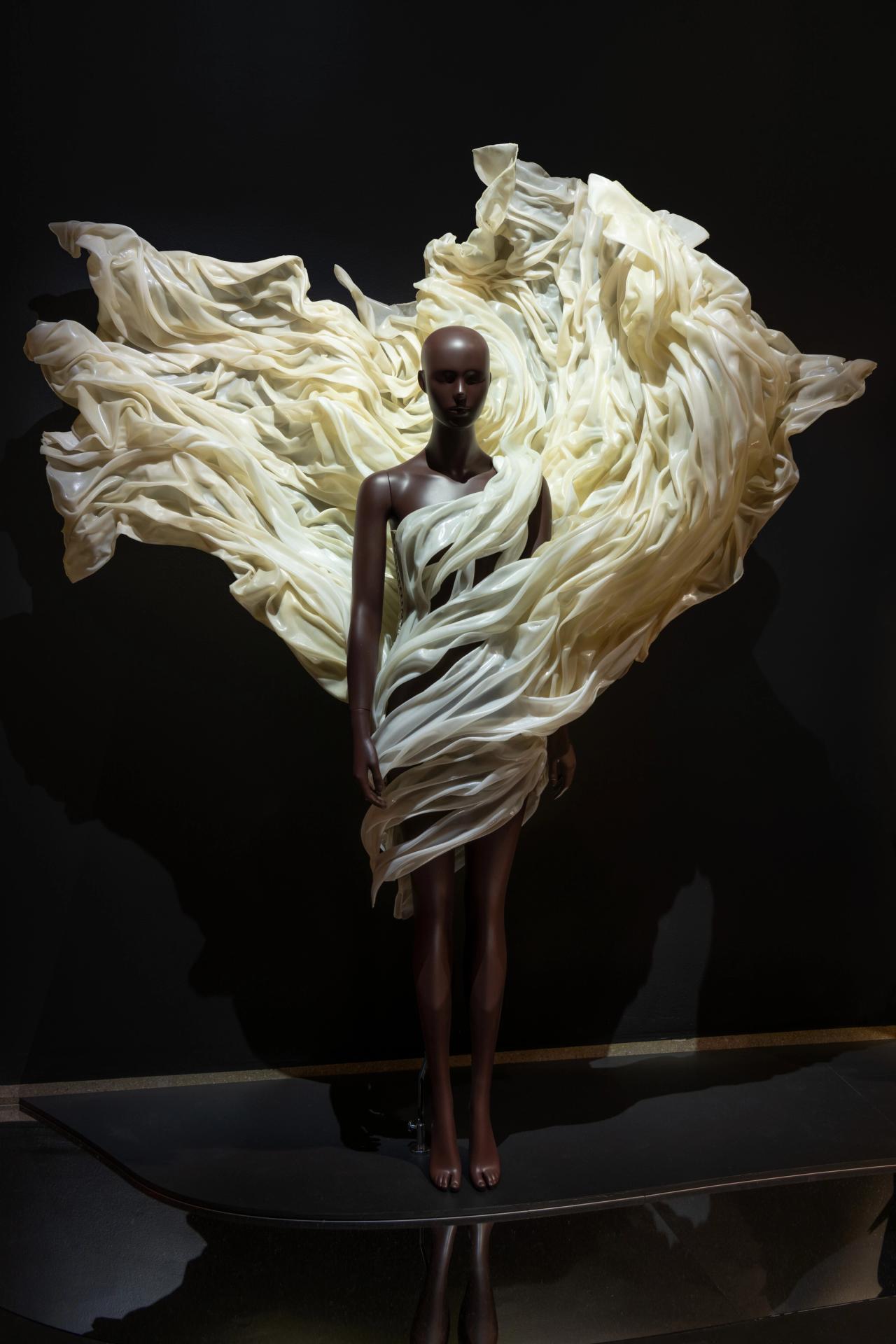
Van Herpen’s Loïe Dress from her fall/winter 2025 “Sympoiesis” collection, on view as part of her “Sculpting the Senses” exhibition. (Photo: Paula Abreu Pita)
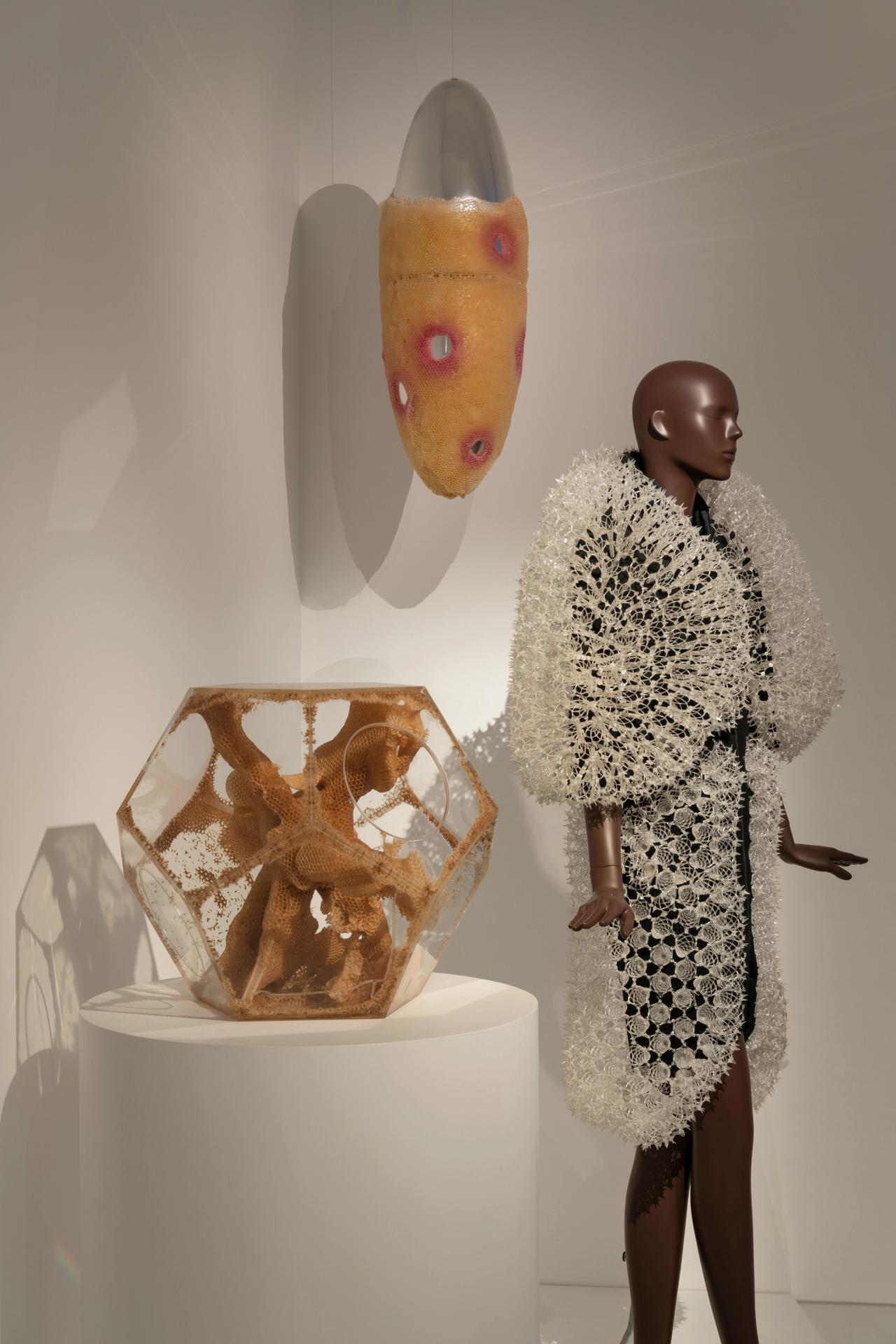
Van Herpen’s Radiography Dress from her Sept. 2014 “Magnetic Motion” collection, on view as part of her “Sculpting the Senses” exhibition. (Photo: Paula Abreu Pita)
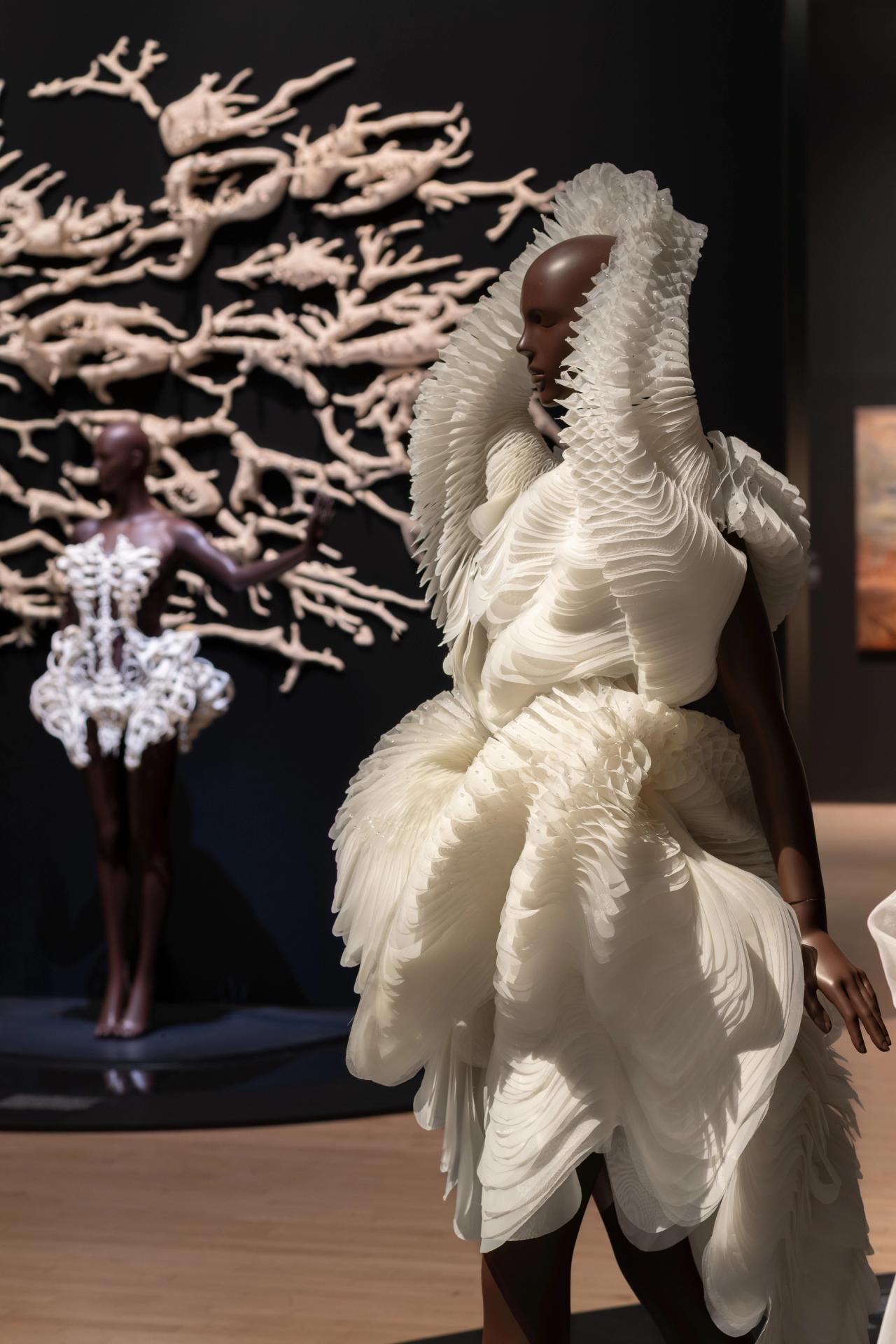
Van Herpen’s “Morphogenesis Dress” from her 2020 Sensory Seas collection, made in collaboration with Philip Beesley, on view as part of her “Sculpting the Senses” exhibition. (Photo: Paula Abreu Pita)
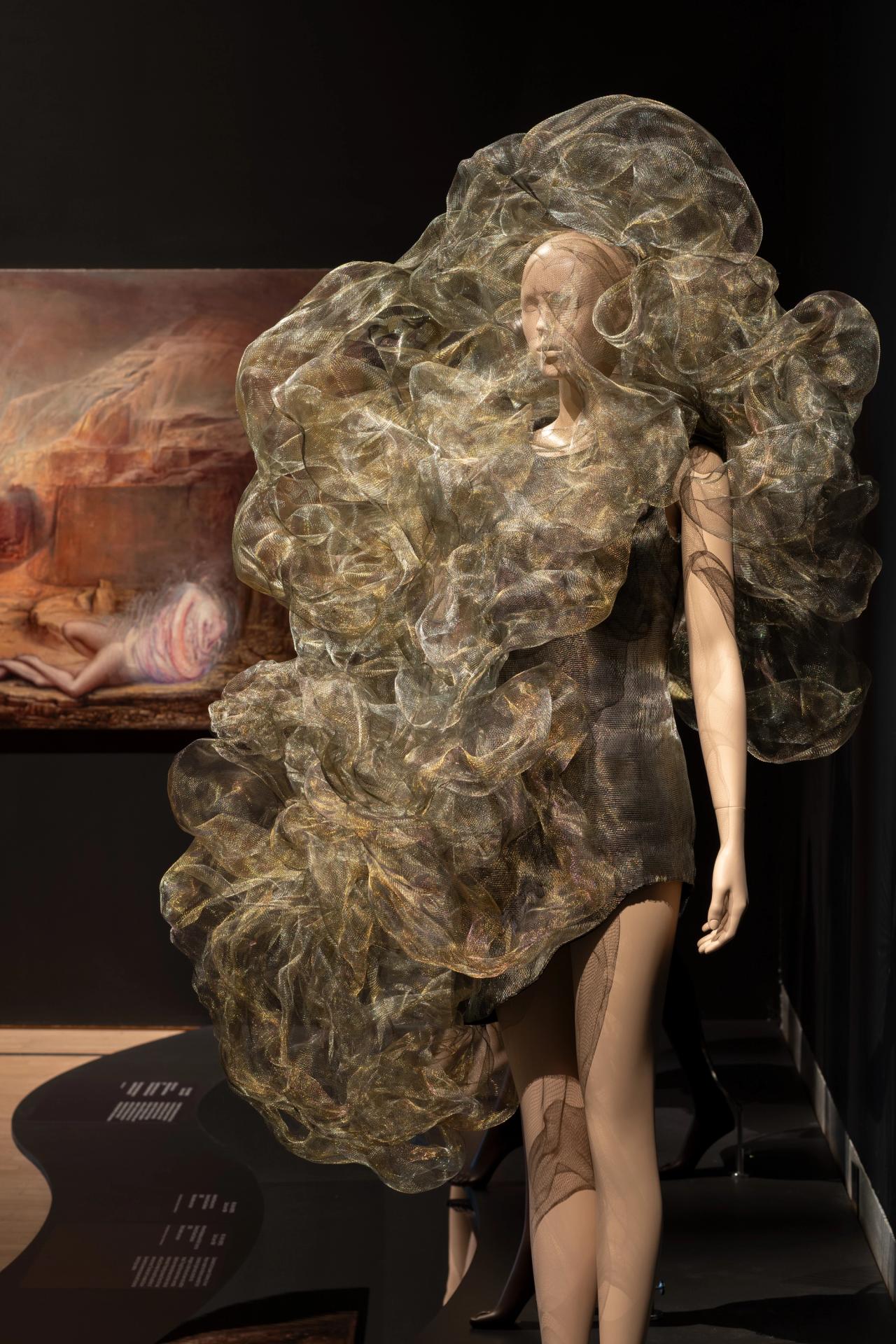
A look from van Herpen’s fall/winter 2025 “Sympoiesis” collection, on view as part of her “Sculpting the Senses” exhibition. (Photo: Paula Abreu Pita)
Van Herpen’s Loïe Dress from her fall/winter 2025 “Sympoiesis” collection, on view as part of her “Sculpting the Senses” exhibition. (Photo: Paula Abreu Pita)
Van Herpen’s Radiography Dress from her Sept. 2014 “Magnetic Motion” collection, on view as part of her “Sculpting the Senses” exhibition. (Photo: Paula Abreu Pita)
Van Herpen’s “Morphogenesis Dress” from her 2020 Sensory Seas collection, made in collaboration with Philip Beesley, on view as part of her “Sculpting the Senses” exhibition. (Photo: Paula Abreu Pita)
A look from van Herpen’s fall/winter 2025 “Sympoiesis” collection, on view as part of her “Sculpting the Senses” exhibition. (Photo: Paula Abreu Pita)
“When you start opening up, and when you start to become more sensitive and aware and present of things that you normally miss, it really feeds you, spiritually.”
IVH: Yeah. Sculpting the senses, to be connected with all of your senses, maybe a synaesthetic presence, as well. So, I feel the work tries to make you connect to various forms of reality and to make you feel alive in that sense. Because when you start opening up, and when you start to become more sensitive and aware and present of things that you normally miss, it really feeds you, spiritually, I would say. Not physically, but spiritually.
SB: I did want to ask you about that title, “Sculpting the Senses.” Do you view yourself as a sculptor somehow?
IVH: I do. I feel fashion is a form of art. It’s a tactile form of art that you step into. So your body relates to the artwork. It also brings life into it, but also an identity, and the two speak to each other. That’s a beautiful language that I’m just fascinated by. So, yeah, I see them as sculptures, but they are transformative sculptures because they really respond to the movement of the body.
SB: There are several ethereal, I would say, or floating installations, sculptures, artworks—whatever you want to call them. Not quite clothes—you wouldn’t wear them—that are in the show. They go beyond fashion. One of them from 2024 is titled “Unfolding Time.” And the wall text for this piece reads, “In an ever-accelerating world, van Herpen reminds us of the value of slowing down.” How did you land on that title for the work? What does that piece or this new direction, this non-wearable direction, say? What are you exploring through that?
IVH: It actually comes out of the exhibition, I would say, because I was working on the exhibition for multiple years. And somehow after the first opening, I started working on some aerial sculptures. I really believe that it comes out of the whole experience of working on the exhibition, like, wanting to go into that space. It’s very subconscious that it started to happen, but I really felt like going up into the air and to explore what it does when I work with my materials aside from the body and the skin.
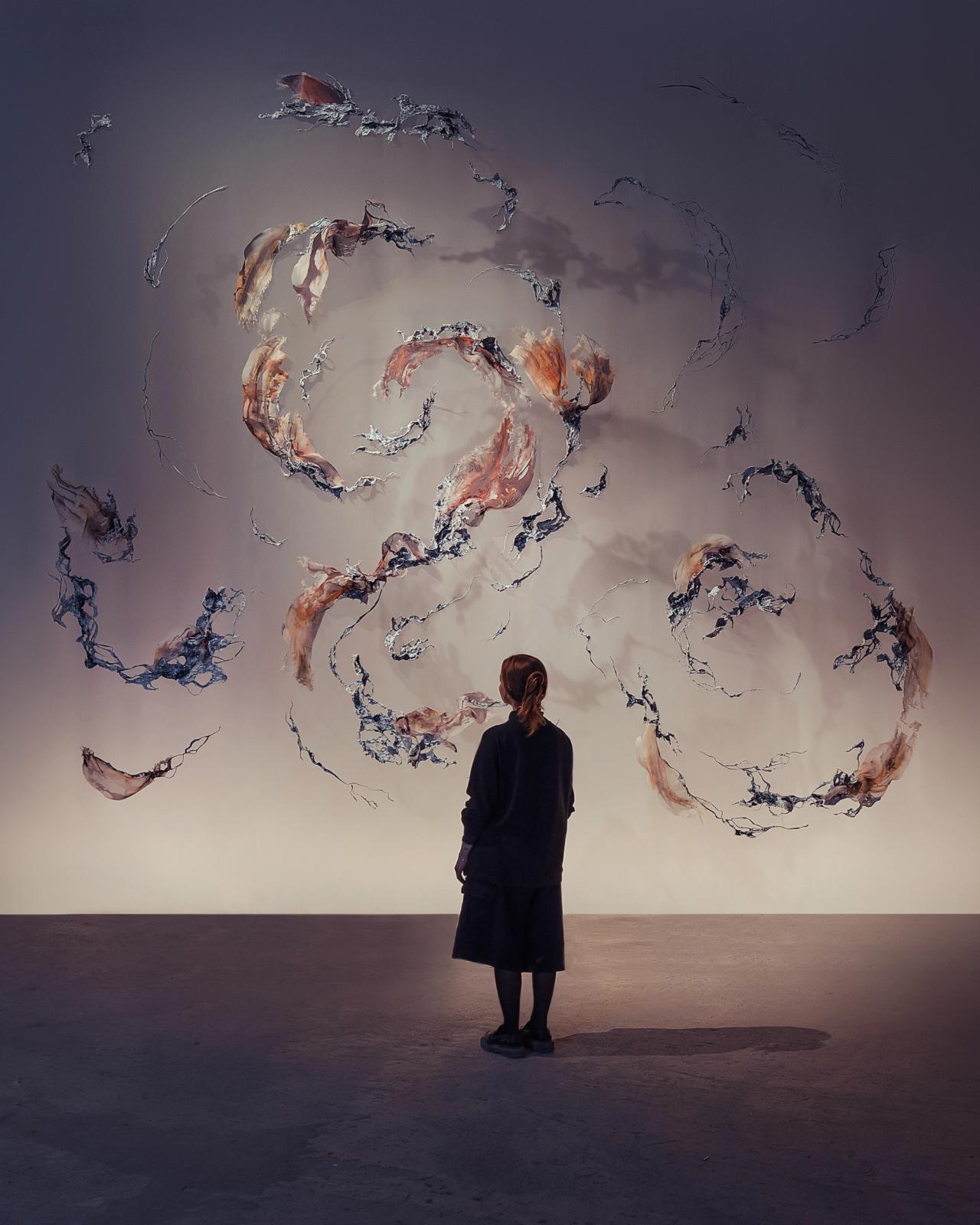
Installation view of “Weightlessness of the Unknown,” an aerial sculpture shown alongside couture looks as part of van Herpen’s 2023 Hybrid show. (Photo: Franck Bohbot)
So I refer to them as “aerial sculptures.” They’re sort of floating. They’re really lightweight, but they are all around you. “Unfolding Time,” that sculpture started to happen when I just moved outside of the city. My studio is in Amsterdam, but I live just outside of Amsterdam now. It’s a beautiful nature area. I started to experience time slightly differently. It felt as if I had a lot more time, which is strange, because nothing changed except my own perception of time. I think it has to do with being outside much more, being in nature much more, and therefore attuning to the seasons and to the details changing around me. I started to translate that feeling of time into the sculpture. And that’s why it’s called “Unfolding Time.”
SB: I learned there’s this ritual you and your partner do every morning, too, right? You walk through this… You basically live next to a bird sanctuary.
IVH: Yeah. It’s a big lake and a bird sanctuary. So it’s a hundred and twenty different types of birds living there. And the Netherlands is also on a migration route. It’s a delta environment with lots of water. It’s an amazing place for migrating birds to stop over. It’s really inspirational.
SB: You’re giving yourself this ritual of forty-five minutes a day to—
IVH: Yeah, at least. It’s usually an hour that we do, the walking in the early morning, and it’s the perfect way to wake up. I used to have those walks in the city, but the soundscape is so different. I think you have to wake up quicker when you’re surrounded, when you’re in the city. I really enjoy both environments next to each other.
SB: Speaking a little bit more to this Brooklyn Museum show, it’s the latest iteration of what has been this evolving exhibition. It’s been on view in Paris, Australia, Singapore, and the Netherlands. And in contrast to a runway show, it’s something that I feel like is much less ephemeral—or quick-hit, let’s say. It allows for these slow encounters with the work and interesting juxtapositions, unexpected adjacencies across time. What role do these exhibitions now play in your practice? How do you view them in relationship to the shows?
IVH: The exhibitions are really important to me. First of all, because they create so much freedom in how I express the work. Indeed, it’s a much slower encounter with the work. With a show, you’re not able to see the craftsmanship that is inside. You’re not able to see or understand the concepts that are within them, or the research, or even the collaborations that go into all the works. They are really visible in the exhibition and they are understood; they are felt. What I hear from people is that they spend hours in the exhibition—because it’s a big one. So many people also come back to it multiple times, because it’s really rich in the amount of works, but also the relationships between the works and the concepts that are embodied within each room.
I feel the closest you can get to my work is really the exhibition. Everything that is inside my mind is in there. It’s a really personal one, as well. I’ve been working on it for so many years, and everything that I want to express and that is important in the process is in the exhibition. That’s why the main space of the exhibition is the atelier. You see the hundreds of material experiments and the draping process. It’s the closest you can get to the work.
SB: As a museumgoer, you get to do the thing you very rarely get to do, which is touch some of the art.
IVH: Exactly. My work is really tactile and touch is such an important part to understand the work. What I know, as well, is that once people have touched the samples, they go back to the works that they saw before, but they understand it in a different way. You relate to the material. Your body understands it rather than your mind.
SB: This is where I want to turn back to your upbringing. Particularly how fashion entered the picture for you because I know there’s the story you’ve told about how your grandmother had these costumes and fashion, clothes, wigs, shoes, things that you would put on and it was this transformative thing. You would almost become someone else.
IVH: You step into a character.
SB: And travel through time, right?
IVH: Absolutely.
SB: So this, in a way, was also its own kind of dance. I mention dance here, obviously, because you trained in classical ballet, and that was a big part of your upbringing. Could you speak to these two experiences—the trying on the clothes and the dance—and how you see them in the evolution of what you do today?
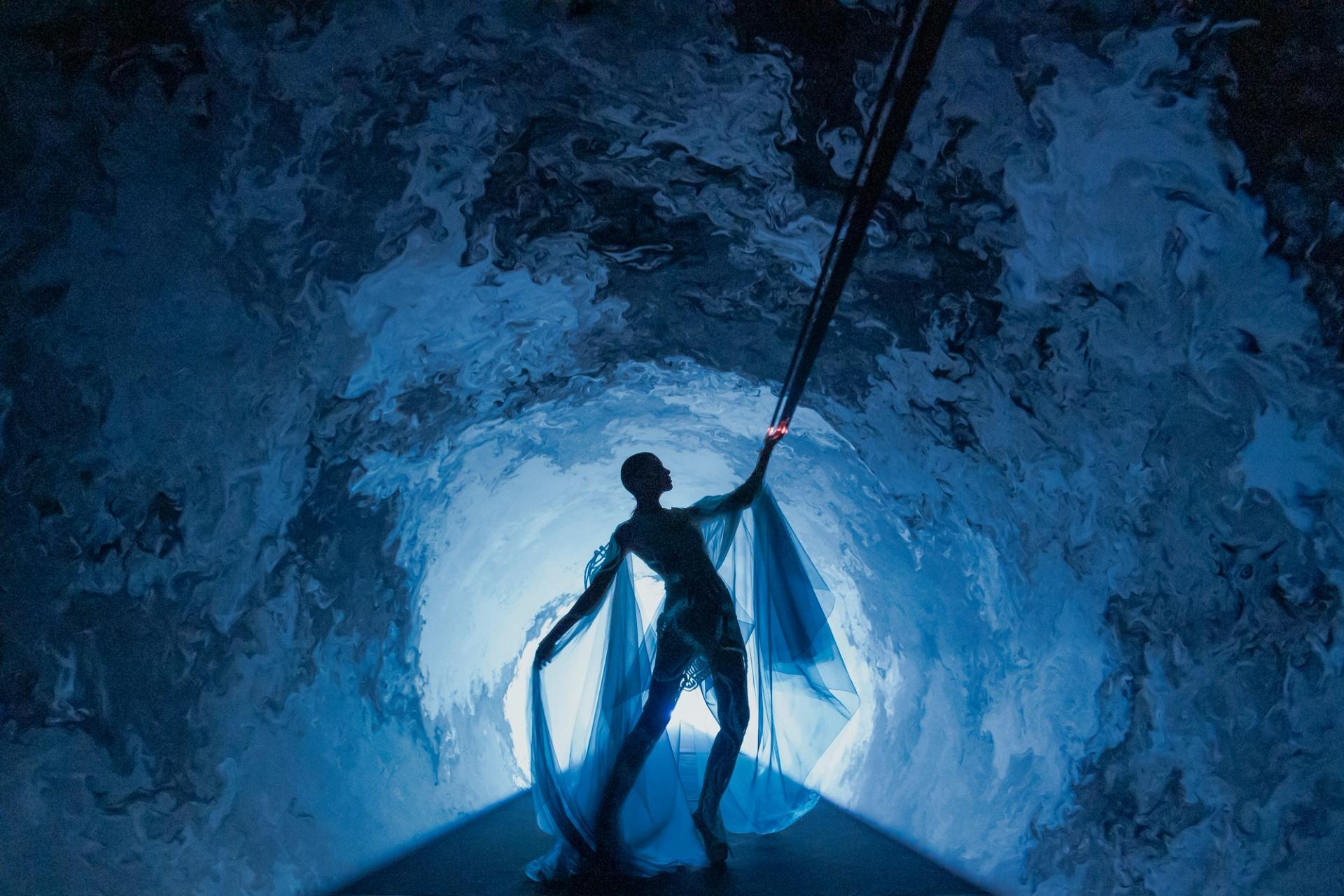
Van Herpen’s Living Look, a bioluminescent algae dress, shown as part of her 2025 “Sympoiesis” collection. (Courtesy Iris van Herpen)
IVH: Oh, that’s an interesting combination. I like that. My grandma had this amazing attic full with costumes, but also historic garments and accessories, wigs, everything you can imagine. I was going there when I was little all the time. It was my playground to put on, like, a big wedding dress and to have a whole story come to life, right? Who you are and what your life is like. It’s really a transformation that you’re going through, like an actor would step into a different life. I was feeling the impact of a garment back then without, of course, realizing it in detail, but it’s a transformation that I’m still looking for when I’m working today.
“One of the most beautiful parts in the process when I work on a garment for someone is the first time that they step into it. It can be really emotional. It’s like embodying a portrait of yourself.”
One of the most beautiful parts in the process when I work on a garment for someone is the first time that they step into it. It can be really emotional. It’s like embodying a portrait of yourself. It’s that early experience that I’ve had as a kid that I’m still trying to grasp upon in the process today.
Within all of that, dance is such an essential part of the transformation. It’s so powerful as a dancer in what you can do with your body and how you can transform both your mind and your body at the same time and how that relationship between the two is also evolving. I like to think about the body memory that a dancer has. I refer to that also in the material memory that I’m working with in the garments. I like to think of some of the looks—not all of the looks—but some of the looks as micro dances around the body, because the more control I get on the materials and the techniques, the more I become like a choreographer. I know exactly which part will behave in which way, depending on which body movement. It really becomes like being a choreographer of the space around the body rather than the body itself.
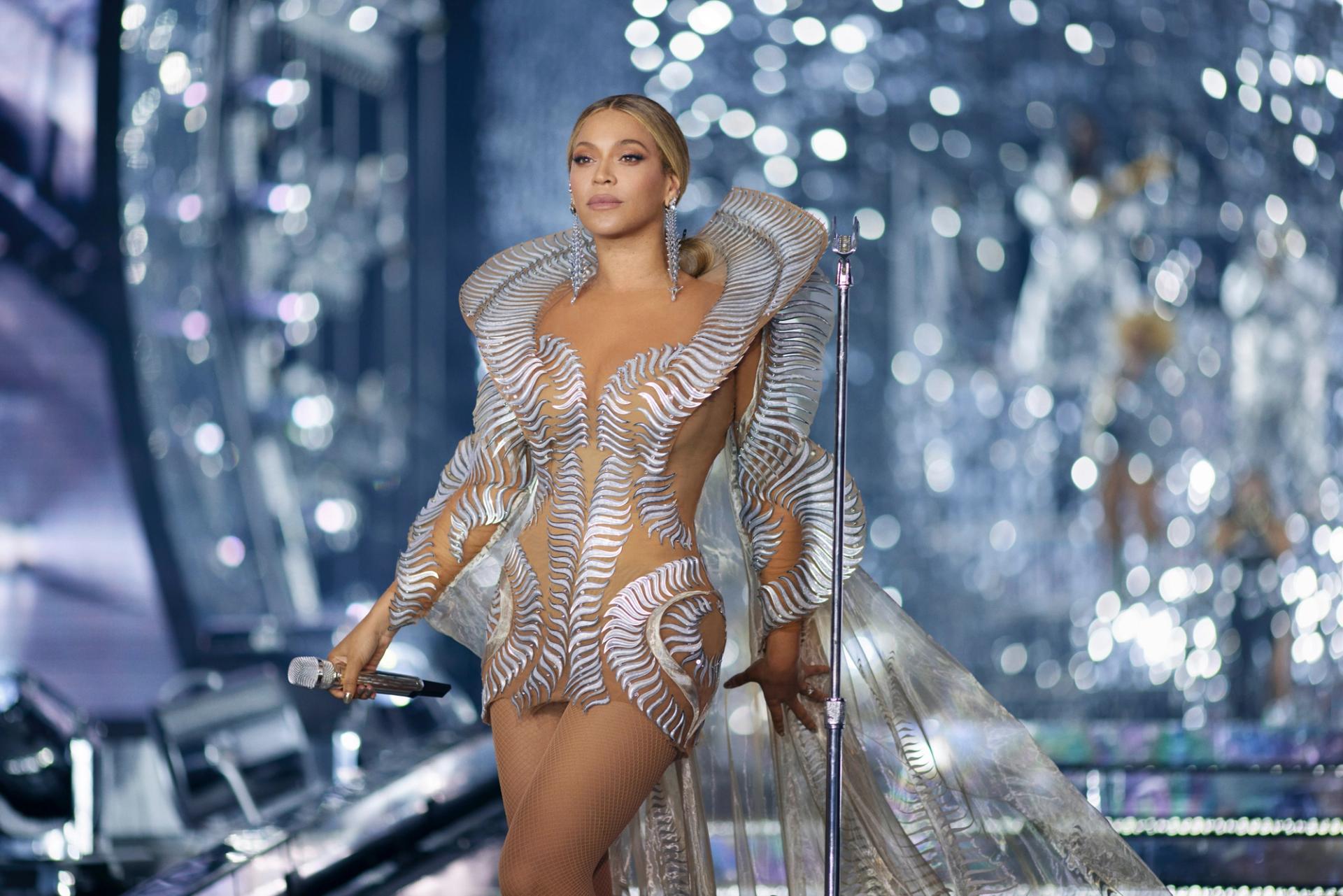
Beyoncé wearing the Heliosphere Dress, a custom look designed by van Herpen, during a stop on her Renaissance World Tour. (Photo: Andrew White)
SB: Do you remember some of the first things you ever sewed?
IVH: I do. My mom used to make clothes for me and my sister when we were young. I still have some photos from that. But I also remember helping her sometimes. And those were the very early moments where I was cutting fabric, helping her with patterns, doing a little bit of sewing. I don’t really remember what age I was. I should ask her, but it’s probably like 6, 7. And then it stopped for a while.
And then, in high school, I started sort of reconstructing existing garments that I was collecting. Like my grandma, I was collecting garments from everywhere. I love fabric, so I was always collecting and searching. I would deconstruct certain garments and make hybrids so you don’t have to understand the full pattern-making. It was sort of an easy way into understanding how the construction works. Then, after that, I went to the art academy [at ArtEZ University of the Arts in Arnhem, The Netherlands] and I got the proper understanding.
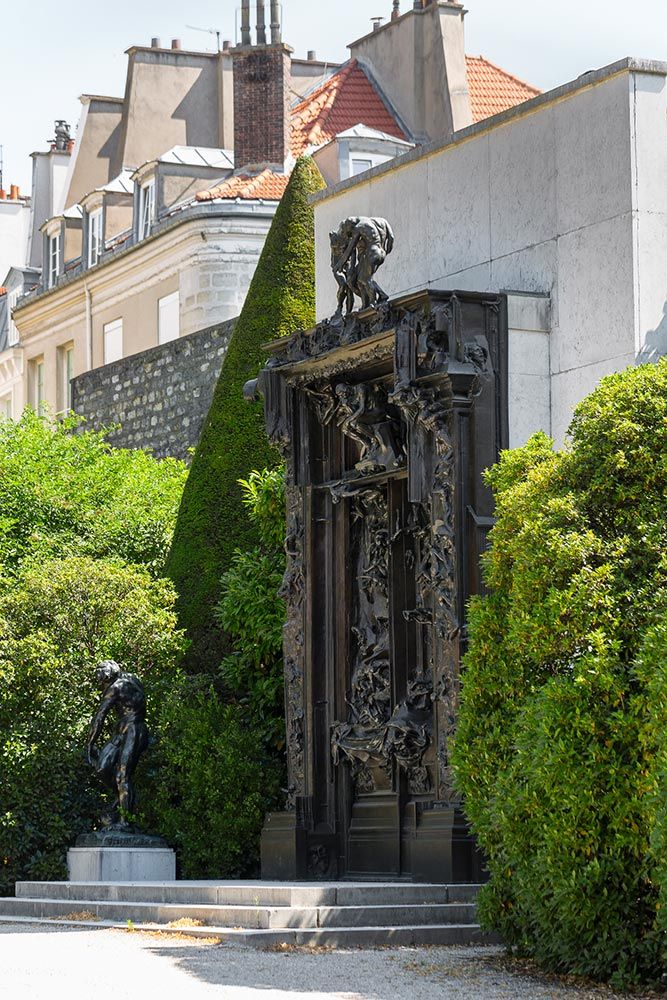
Rodin’s “The Gates of Hell” at the Musée Rodin in Paris. (Copyright Agence Photographique du Musée Rodin/Photo: Pauline Hisbacq and Jérome Manoukian)
SB: Also in your youth, you had at least one or two very formative art experiences that I was able to come across in my research. One I wanted to mention was when you saw Rodin’s “The Gates of Hell.” I was actually just in Paris at the Musée Rodin standing in front of that, and it’s so powerful.
IVH: It is.
SB: I can imagine a 10-year-old Iris... It’s interesting, because I was seeing it before interviewing you, not really thinking about the relation to the work. But you look at that work and you can totally see a sense of fluidity, a sense of awe, of wonder, of trying to figure out what’s going on. All the parts that are so connected in some sense to your work.
IVH: Yeah. It’s this portal to another dimension that we all have a vision of, but no one knows what it is. I remember standing there in front of it, and I was so overwhelmed. Somehow, all the human emotions are visible in the figures around that gate. At least, that’s what I got from it. You see just all the human emotions in there in the figures. It’s hard to put it into words, what it did to me, but it definitely made it one of the most powerful art experiences that I’ve had.
SB: I’d put it up there with [Hieronymus Bosch’s] “The Garden of Earthly Delights,” at the [Museo Nacional del] Prado.
IVH: Absolutely.
SB: You’ve described your time at art school as a turning point. And I wanted to ask, what happened there that shifted your way of thinking about art or fashion or making technology—all these things?
IVH: It’s interesting. It was a really great academy for me, because I learned about all the techniques. At the same time, I also learned to free myself from a lot of the rules. And I think that has maybe even been more important as a lesson. And that’s the reason I started my own studio right after the academy, because I’m so stubborn and I’m so particular in my way of working. I needed that freedom to work on things without anyone interfering or telling me in what way I should do it. That’s one of the things I learned.
SB: That’s such a massive leap though, right? You have to have a lot of... “Self-confidence” isn’t the right term, but it’s like internal...
IVH: It’s really intuition, I must say. Maybe also naïveté. I wouldn’t say confidence.
SB: You were quite shy.
IVH: If I look back, I had no plan and I had no idea that I would be doing this now, like, almost twenty years later. I didn’t think I had much more than a few months, I can honestly say. But it was this really deep urge to keep on creating and to have complete freedom in it. It’s just that feeling that made me start.
SB: Well, I mentioned the shyness, but I should say after university, collaboration became such a central component of how you think, and work, and make, and do. You’ve worked with architects, scientists, engineers, artists, choreographers, musicians, bio designers, athletes, material researchers, and universities on so many different projects. I wanted to bring up two of your long-lasting collaborators here in particular, the architect and designer Philip Beesley and Björk.
Let’s start with Philip. How do you two meet? Walk me through that collaboration. Anyone who goes to see your Brooklyn Museum show will see his name throughout the exhibition.
IVH: Multiple times. He’s really interwoven in the exhibition, because we’ve been collaborating for probably twelve years, or maybe even more now. It’s special how that came about, because at that time, I wasn’t collaborating so much yet. It took me a few years before that collaborative spirit really started to take off. Because in the early years, I was really focused on the traditional craftsmanship within couture until I was asked by some architects to design a look for a new museum that they have created. And I had this vision of creating a water dress. There was just no way of doing that with the traditional method. So that brick wall made me go into this very unfamiliar space of 3-D printing and experimentation. Once that brick wall was gone, I started to realize how valuable those collaborations are in sharing knowledge on different techniques and materials.
Philip was in a very early stage when I was just starting to collaborate. It didn’t come up in my mind to ask him for collaboration. I just felt really inspired by his work, because he was working on living architecture already for a long time while that is really taking space now within the field of architecture. He was really ahead of his time. I was really inspired by his way of working with meta materials and kinetic, living textures—
SB: Things that move.
IVH: And interact with the human body. Very delicate, as well, for architecture.
So I created a collection, “Hybrid Holism,” inspired by his work. And he saw that online and he approached me and he flew to Amsterdam to meet me. And the moment he was in the atelier, it felt as if I had known him for many, many years. There was so much shared interest and connection. He brought multiple suitcases full of samples. So it was like heaven for me. We started sharing all of the ideas of his samples. And, of course, my samples were in the atelier and it was just this explosion of ideas. We started to collaborate straight away.
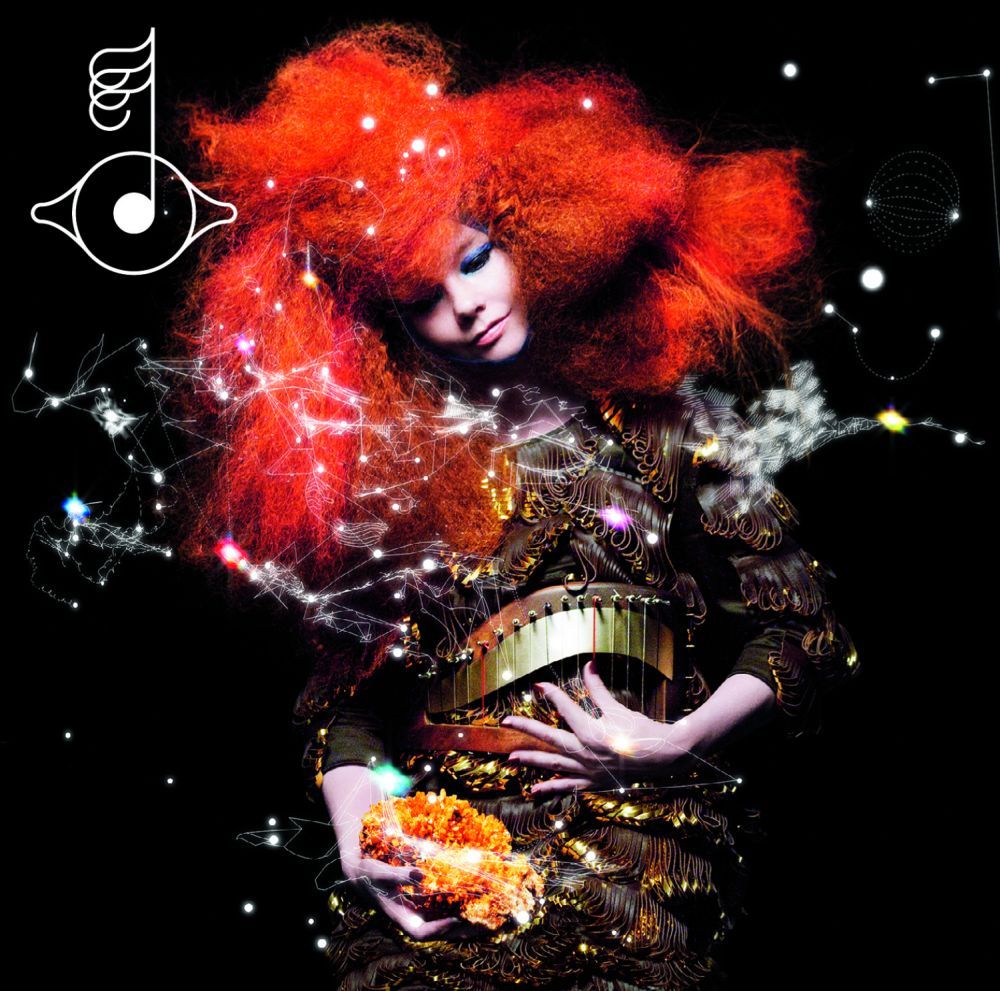
The cover of Icelandic singer Björk’s 2011 album Biophilia, featuring a custom look designed by van Herpen. (Photo: Inez and Vinoodh)
SB: And what about Björk? You’ve called her your style icon and “like a bird of paradise.”
IVH: She is.
SB: What has having her as a big or primary collaborator been like? And what’s your process like when you work with her on a piece?
IVH: It’s really personal. Björk is a really collaborative spirit. She really involves me in her creative process when she works on something when I collaborate with her, already from the early stages. I love that, because then you see the transitions that someone is going through. She has such a multidisciplinary way of thinking, as well. She can connect sound to texture, for example. So, it’s a really special way of… The way we can talk about the designs, it’s very synaesthetic, as well.
For me as a young artist, when I started working with her, it was also really special because she was one of the early VIPs, like Lady Gaga, to really embody the work. I think she definitely is an influence on the universe that I’ve been building, because hers is so singular and she has stayed true to her work throughout time so strongly. I’ve put a lot of time also in the early years to really focus on creating my own creative DNA. That’s one of the lessons I took from her way of working as well.
SB: I was thinking about that. Like Björk, you’re radically independent, I would say. And you resist mass production. You’re very meaningful in terms... Or, the collaborations you choose are very meaningful. They’re not frivolous or marketing.
IVH: No.
SB: You’re controlling the pace at which you’re creating things—as much as you can, anyway. You pursue research without obvious commercial outcomes, most of the time. And you’re working across all these disciplines that normally don’t work together, and you’re making decisions for the long term. But I feel like so much of that has to come with saying no. Could you speak to how you protect that time? How do you decide what to fill your time and space with, and how do you decide what to say no to?
IVH: One of the hard parts—and I’m really grateful that that worked out—was to define my own rhythm within the fashion industry. And as a designer, you’re supposed to do at least two shows a year. And I’m part of the Fédération de la Haute Couture et de la Mode, so there are rules involved. For eighteen years, I’ve done two shows a year. But with my way of working and the intensity of the collaborations, and the scientific research, that’s sort of impossible. Don’t ask me how I did it, because I have no clue. But I did realize that a lot of the ideas that went further deep down were just not possible because of the two shows a year.
One and a half years ago, I made the decision to do one show a year. That’s quite radical within fashion. I feel grateful that the Fédération is supportive of it and that I can do it this way, even though the other houses are doing multiple shows. I also had no idea how the media would respond to it or even the clients or, like, everyone who expects something from you. But it’s been really amazing because people understand it so well, and it makes so much sense with my work. I can double down the amount of research now. That’s why I’m able to do the things like “living look” or the plasma materials or the Lichtenberg. None of that would have been possible with the shorter timeframe.
I feel I’ve made a big step forward by taking one step back. I’m able to go much deeper into the soul of my work, which is really to experiment and to bring fashion forward and to discover all the unseen materials and techniques that are so valuable.
SB: Was there a moment when you realized, basically, that protecting your time is almost as important as expressing it?
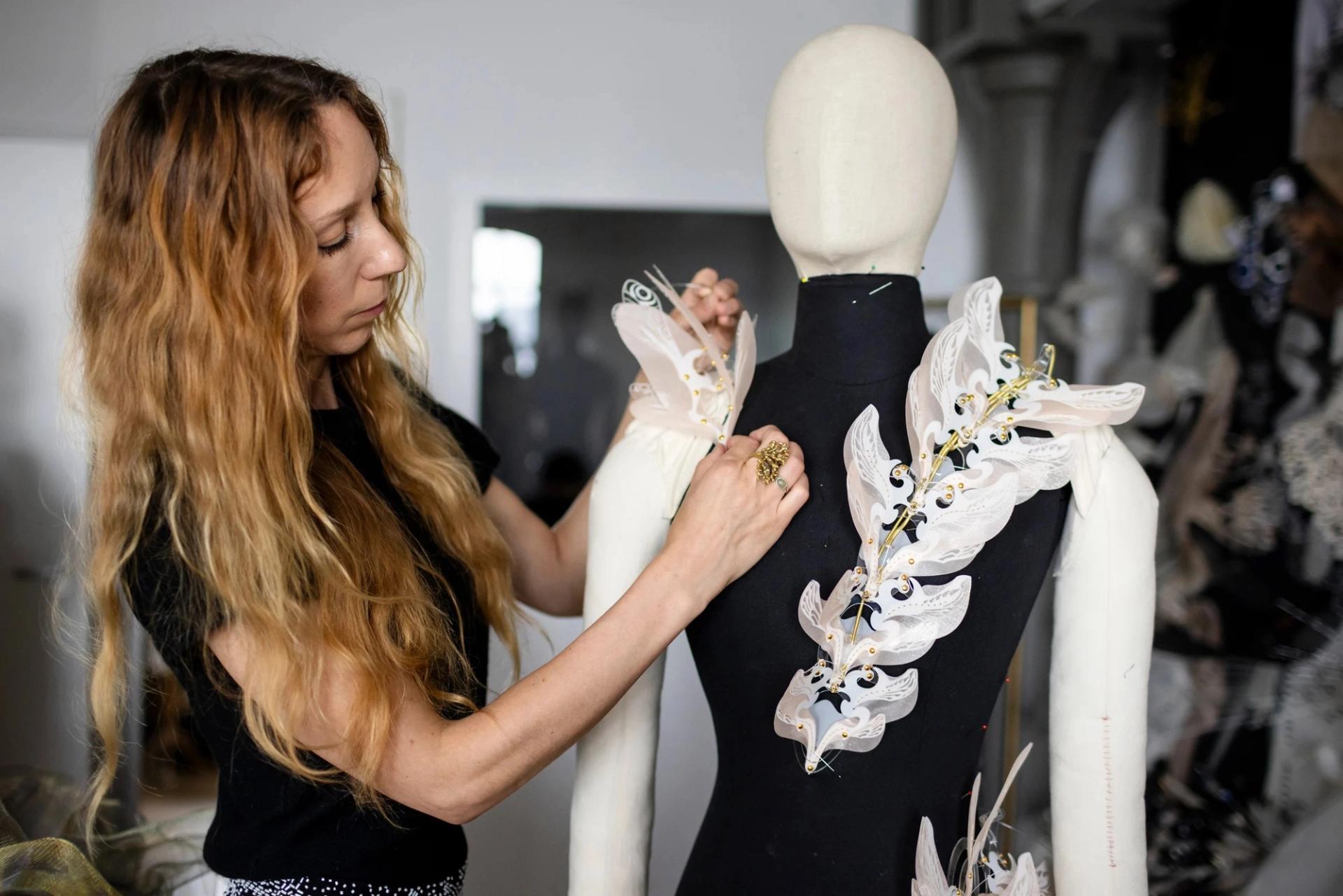
Van Herpen at work on a look for her 2025 “Sympoiesis” collection. (Photo: Ilvy Njiokiktjien for Nature magazine)
“Creativity is something that is fragile and that needs to be protected.”
IVH: I learned that creativity is something that is fragile and that needs to be protected. And it has to do with time, at least for me. It’s a balance because, as you said before, I need deadlines. Don’t give me four years to work on something because I would just keep on changing and evolving the techniques. I need the deadlines. At the same time, I need enough time in order to feel that I’ve gone as deep as I need to go. So for now, the one show a year is a really good timeline because next to that I’m doing the exhibitions and a lot of other projects. So it feels like the sweet spot. But I’ll keep on exploring the ideal timelines and how I can protect that creativity, as well.
SB: I think couture, it should be said, is a very different model than ready-to-wear; most—
IVH: It’s the opposite.
SB: Most fashion models. You’re prioritizing time, labor, and value in just such a different way.
IVH: It’s really shedding quality over quantity. It’s really about that.
SB: From a perspective of future materials or ecological thinking or even new modes of creation, where do you see couture in that? And what does couture offer you, I guess?
IVH: Well, couture is multiple things for different people, but for me, it’s a laboratory of bringing fashion forward to invite new ways of working, new materials, and also the time and the space to create sustainable alternatives, both for materials and techniques. And even for the people that are wearing or embodying the couture, it’s a different mindset of attaching to something for their whole lives, basically. Couture is something you acquire and you’ll keep for the rest of your life. You’ll embody it in that way, and then it’s passed on to the next generation —or to a museum. But it’s created to last for a really long time. And, in that sense, it’s the same as an artwork. It’s a certain decision process of the clients, as well, I would say. And I think it’s such a pure system. We only create on demand. That makes it so pure and so simple that there is no... Nothing ends up in a landfill because it’s too precious. It’s art, and you connect to it for the rest of your life.
SB: Or if it’s algae, it could live on forever or fold back into the earth.
IVH: Theoretically, we could place the dress back into the ocean and it continues to live, yeah.
SB: We didn’t talk about 3-D printing, but we could kind of skip over that. You’ve spoken so much about it over time. But 4-D printing, I feel like we should at least mention. I am not very familiar with it. I’ve learned most of what I know about it through listening to interviews with you. What is 4-D printing? What could it look like? How could it potentially evolve and impact the work that you do?
IVH: 4-D printing is like the next iteration of 3-D printing. You can bring a memory into a material. And an example is that one material knows different shapes and you can tell the material to be activated through different impulses. It can be heat, it can be light, it can be moist[ure]. It can be anything that you can imagine and the material will change its form. That’s one example that is closest to something that I get triggered by because... And it relates to the bioluminescence look. I’m fascinated to think of garments that evolve through time.
My partner is a musician and I’m always jealous of him because he can create something that evolves over time. I’m in love with the creative process because the works are evolving through time when we’re working on them. They become these living beings. And when we are finished with them, they don’t evolve anymore, which I find is really... It’s a missed opportunity because we as persons change throughout time.
My ideal work is something that changes with the people that I’m creating for. Even if it’s Björk who we spoke about, I would love to create a work that evolves with her. And 4-D printing is not there yet, but it’s a technique that has a lot of potential to tackle that evolution of time in the creative process.
SB: So, what could that look like? Would it change the form of the garment?
IVH: Yeah. It would change the textures. It would change the forms, the silhouettes.
SB: So if your grandma had a 4-D printed dress and you put it on, it could evolve with you.
IVH: Exactly.
SB: Wow.
IVH: Yeah.
SB: In the time we have left, I wanted to ask about this extreme slowness that’s tied to couture, and if you think it can offer lessons to the wider fashion system, and what would those be? What sort of impact do you think couture could have?
IVH: Couture is indeed about slowing down. It seems as if the world is going faster and faster. Every year. And still collections are becoming bigger and the iterations of when they come out become faster.
I remember, within Covid, there was a lot of talk about slowing down, also within the ready-to-wear system. I really believe it’s possible when the devotion is there, because the amount of garments that are being produced nowadays, it’s not even possible for people to buy them all. It’s just there’s too much of it. I definitely know that couture can be an example for ready-to-wear. I also believe in the balance between the two—because couture is, of course, not for everyone. It’s a very slow process and therefore it’s also costly. So it’s really the art of fashion, and it’s not realistic to think that everything has to be couture, but I believe—
SB: It’d be an interesting world if it was. [Laughs]
IVH: It would be an interesting world. A beautiful one, but maybe not a realistic one.
But I believe in a balance between the two. I think ready-to-wear can become a system that also creates on demand rather than pre-producing all the collections and then seeing what the audience actually wants. There are also innovation tools to think of [with which] brands can first pitch the looks and the designs with the audience and their customers before going into production. That would already align the needs and the will of people much more with what is being produced. There are more examples to think of. But yeah, I really believe that there is a balance to find within the two, and that ready-to-wear can slow down, at least partly.
SB: All right. Taking a total jump. One of the things I find most refreshing about your work is you’re a risk-taker.
IVH: Mmm.
SB: But I say this with the caveat that you’re doing it in the same way that I would say you like to go skydiving. You know the parachute’s at the ready, right? But you take risks. A lot of what you do involves this letting go—of certainty, of control, of even established ideas of what fashion even is. You’ve said, “I need the unknown.” It made me think of your description of skydiving, actually, which is something you’ve done several times and like to do, that skydiving is this form of spiritual surrender. Is each new collection—?
IVH: Did I say that? It makes sense. I didn’t remember that. Good research.
SB: I found it somewhere. But is each new collection a bit like that? This leap into the unknown?
IVH: Absolutely.
SB: You’re up in the air and you’re about to jump out?
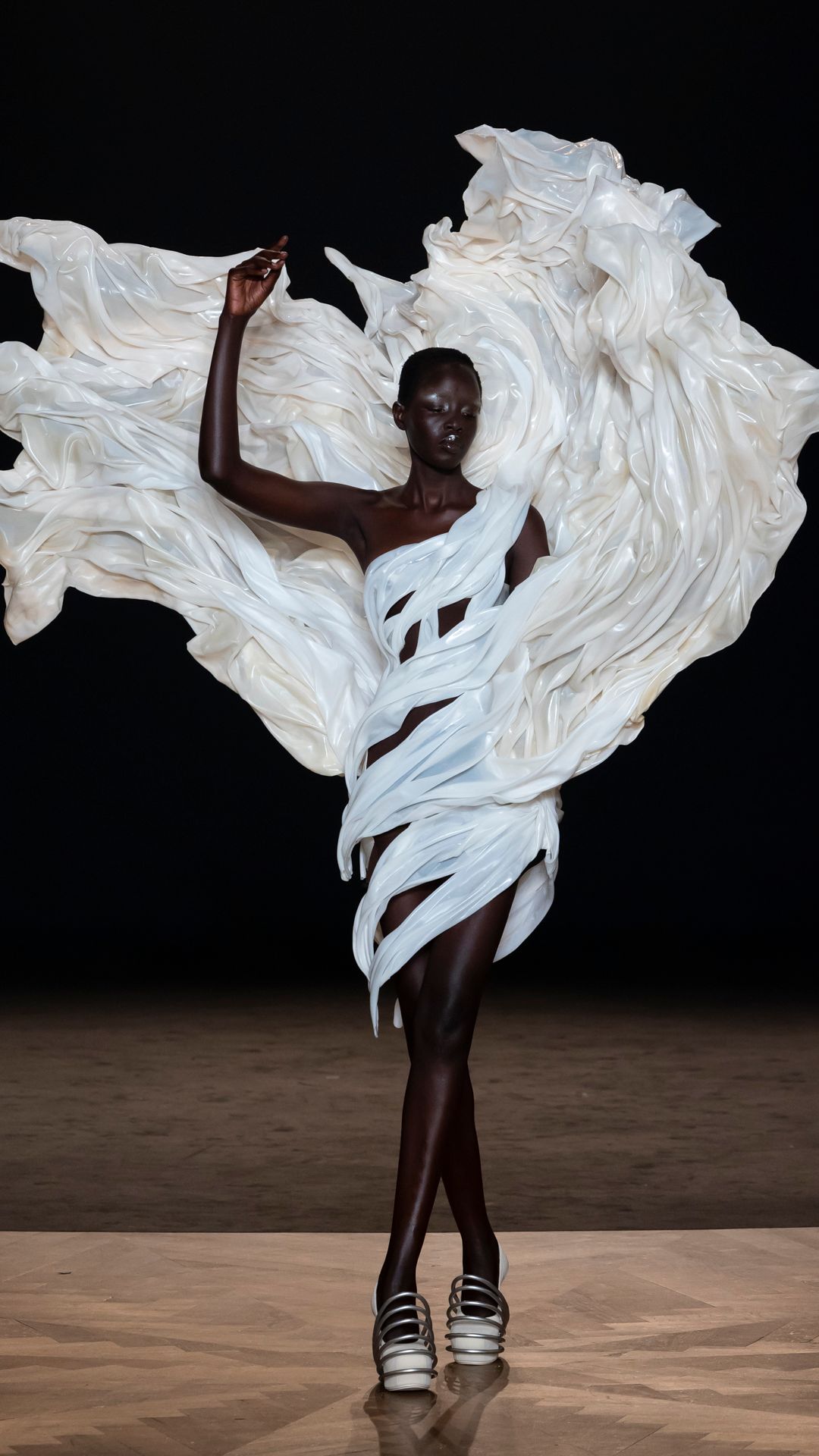
A look from van Herpen’s fall/winter 2025 “Sympoiesis” collection, shown as part of Paris Haute Couture Week. (Courtesy Iris van Herpen)
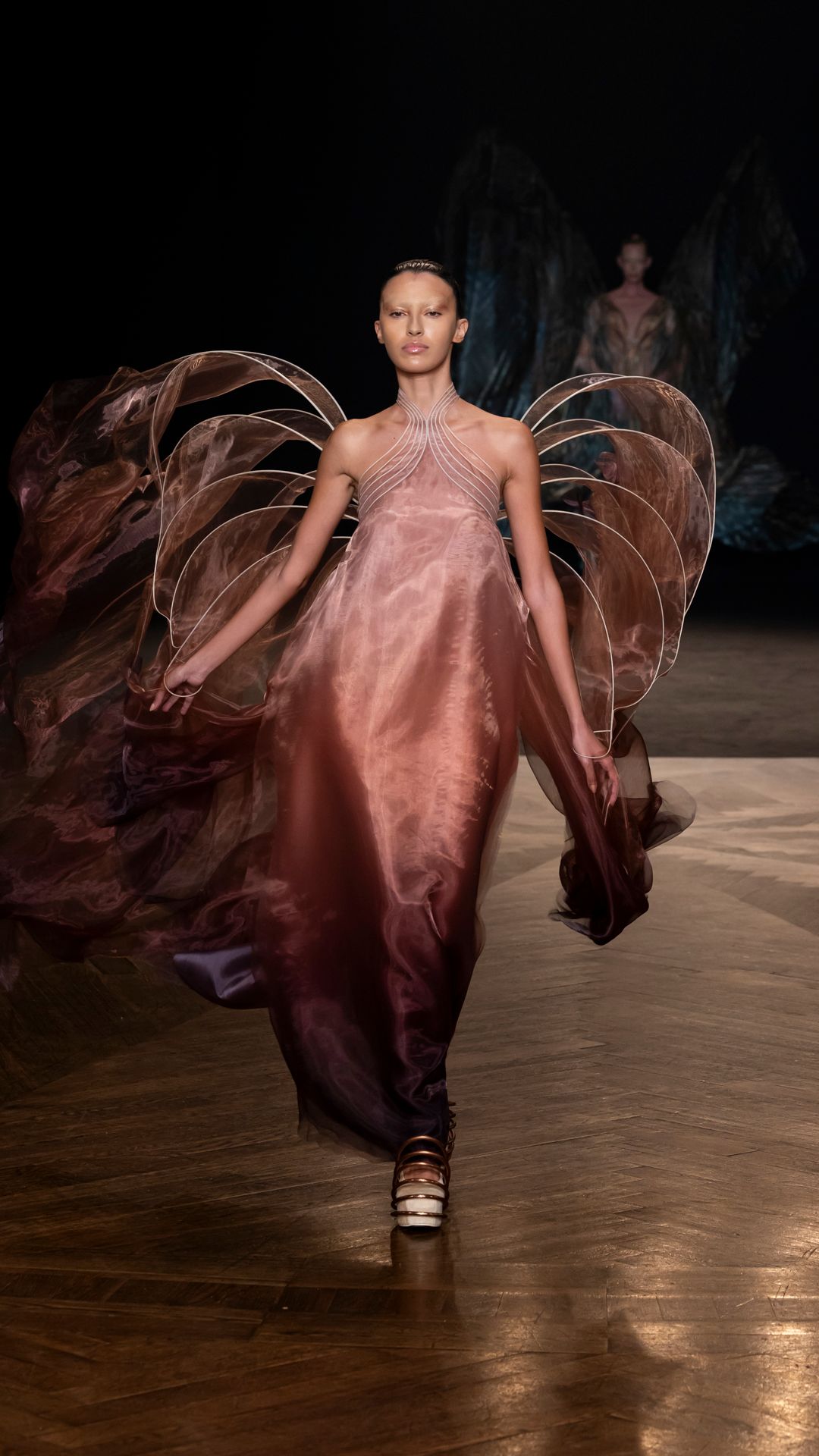
A look from van Herpen’s fall/winter 2025 “Sympoiesis” collection, shown as part of Paris Haute Couture Week. (Courtesy Iris van Herpen)
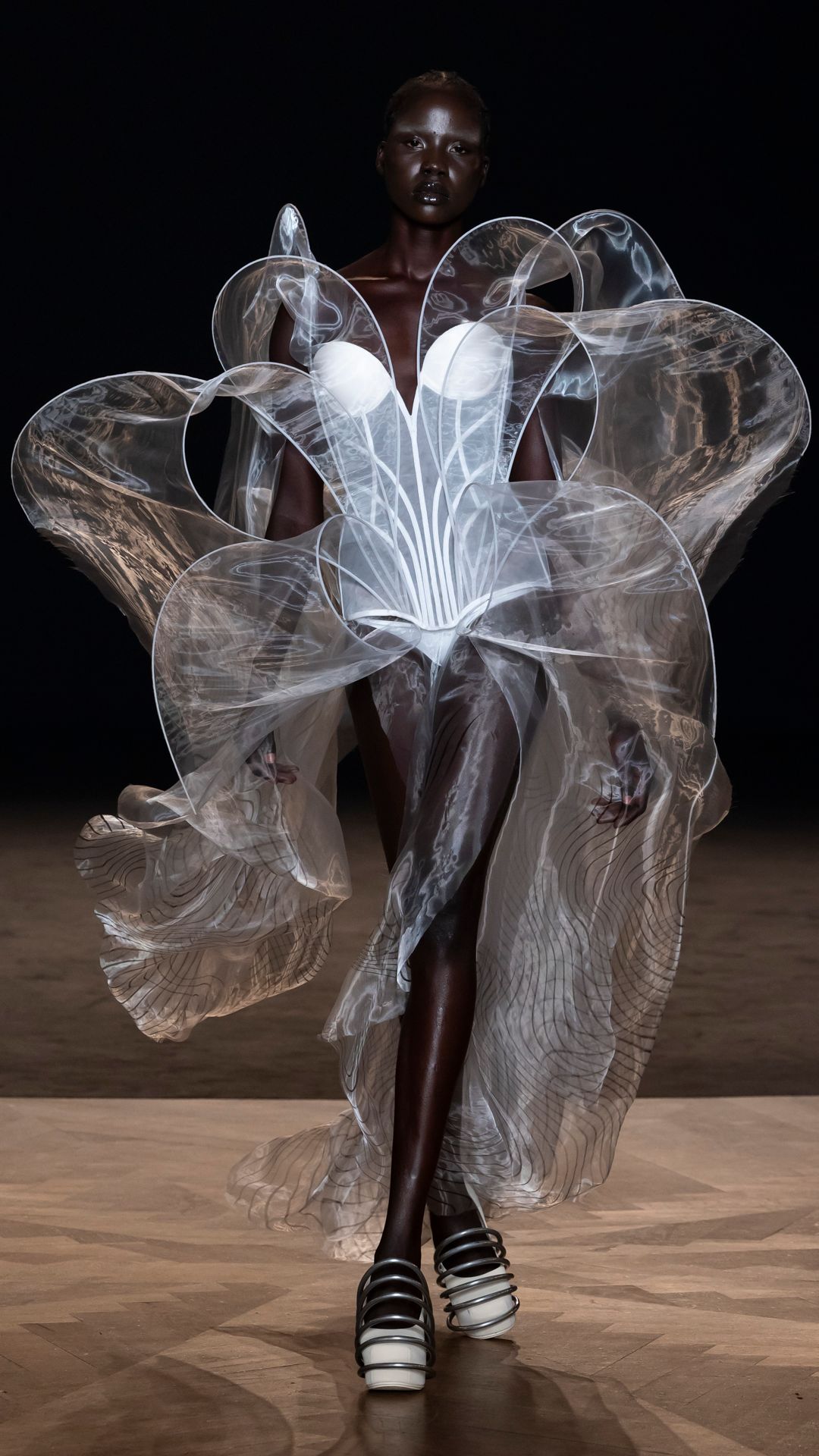
A look from van Herpen’s fall/winter 2025 “Sympoiesis” collection, shown as part of Paris Haute Couture Week. (Courtesy Iris van Herpen)
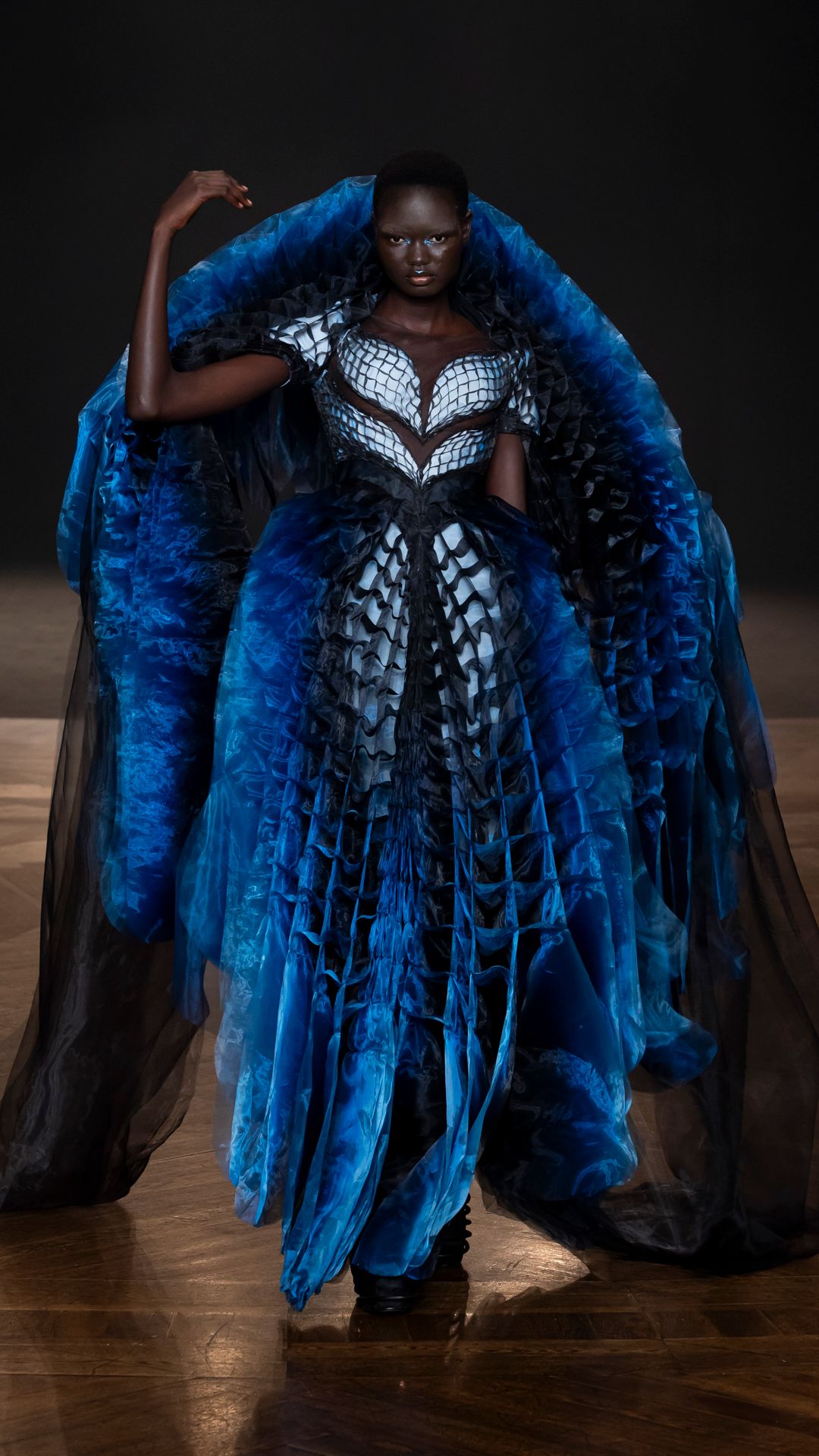
A look from van Herpen’s fall/winter 2025 “Sympoiesis” collection, shown as part of Paris Haute Couture Week. (Courtesy Iris van Herpen)
A look from van Herpen’s fall/winter 2025 “Sympoiesis” collection, shown as part of Paris Haute Couture Week. (Courtesy Iris van Herpen)
A look from van Herpen’s fall/winter 2025 “Sympoiesis” collection, shown as part of Paris Haute Couture Week. (Courtesy Iris van Herpen)
A look from van Herpen’s fall/winter 2025 “Sympoiesis” collection, shown as part of Paris Haute Couture Week. (Courtesy Iris van Herpen)
A look from van Herpen’s fall/winter 2025 “Sympoiesis” collection, shown as part of Paris Haute Couture Week. (Courtesy Iris van Herpen)
A look from van Herpen’s fall/winter 2025 “Sympoiesis” collection, shown as part of Paris Haute Couture Week. (Courtesy Iris van Herpen)
A look from van Herpen’s fall/winter 2025 “Sympoiesis” collection, shown as part of Paris Haute Couture Week. (Courtesy Iris van Herpen)
A look from van Herpen’s fall/winter 2025 “Sympoiesis” collection, shown as part of Paris Haute Couture Week. (Courtesy Iris van Herpen)
A look from van Herpen’s fall/winter 2025 “Sympoiesis” collection, shown as part of Paris Haute Couture Week. (Courtesy Iris van Herpen)
“When I start, I have no idea where I will end up. And it’s kind of scary.”
IVH: Absolutely. The process of a collection is really like that. When I start, I have no idea where I will end up. And it’s kind of scary because I have expectations, of course. And we take a lot of risks in the experimentations that we do. There are a lot of failures as well, as part of the process. If I couldn’t handle the failures, I wouldn’t be able to do what I’m doing. But it’s something that I had to learn throughout time—to embrace them and to really know that they are part of the process and that I am not able to go forward if I don’t sometimes do something that just doesn’t work out. And I like to tell myself that it’s just that the time wasn’t ready.
One of the special parts of the exhibition is all the samples on the boards in the atelier. I would say at least half of all those samples that you see, there are experiments that didn’t end up in a collection. Yesterday, I actually went to the museum, like an hour before I started working on the dress, to go through all the samples, and to brainstorm on new ideas. It’s beautiful how it works, because the successful samples are not the inspiration of a new idea. It’s actually the ones that didn’t work out that give you a new idea. That’s really interesting. That’s why I like to keep all the failed—I don’t know if that’s even the right word—but all the samples that didn’t end up going into collection. I love holding onto them because sometimes it just takes a few years in order to realize this is what needs to be done. It’s like traveling time.
SB: Yeah. Failure is actually a success.
IVH: Absolutely.
SB: Maybe sometimes even a success is a failure.
IVH: Yeah. The only difference is time. It just needs to be the right time with the right connection that is made in your mind of understanding what that sample needs.
SB: So, at the end of the day, do you think your work is really about dissolving boundaries more than it is about fashion? I was thinking about this—it’s not art and it’s not science, it’s not nature, it’s not technology, it’s not craft, it’s not innovation. It’s all those things, boiled together. Or even the visible and the invisible. Big question, but as you look across the hundred and forty or so pieces in the exhibition, or all of your collections to date, what do you think you’ve been exploring all these years?
Because it’s not fashion, right? It is, but… Fashion’s the vehicle.
IVH: Personally, I’m looking to connect to the world around me. I’m doing that through making these pieces. I’m evolving myself. That’s really interesting. That’s only something that I realized a few years ago, where the relationship the other way around is obvious that I’m evolving the work. But it’s so prominent how the work is actually evolving me.
I’m looking for that connection to the world around me—but the real world, not this superficial layer—all the complexity of life around me, and also a fundamental relationship that we’ve always had that is not as prominent today, which is our relationship with all the other beings around us within nature. All these different types of consciousness, different beings that carry knowledge that we used to be in tune with, in which we’ve lost a lot of language. That is a language that I’m trying to look for within my work. I’m hoping to pass that on to people that, when they explore the work, they feel that connection to this infinite web of interdependence. I think we all feel it, but it’s so easy to not realize it. My work is really about feeling that interconnectedness. It feeds the soul when you feel connected to all these different beings. That’s what I hope that the work can bring to myself, but also to other people.
SB: Iris, thank you. It was so nice having you here today.
IVH: Thanks so much. It’s a pleasure.
SB: A good experiment.
IVH: Absolutely. And I loved the questions. Amazing.
SB: Thanks.
IVH: Thank you.
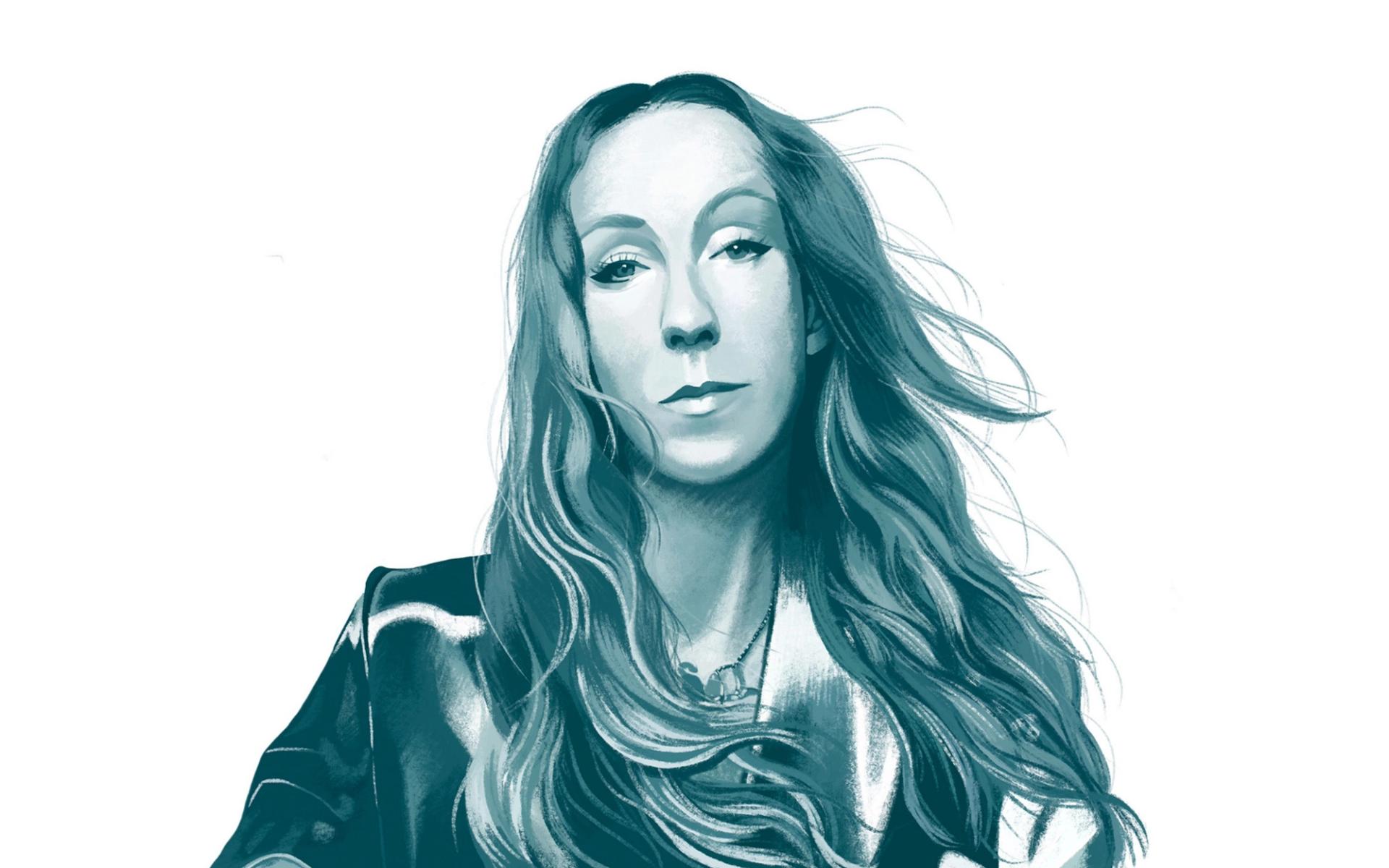
This interview was recorded in The Slowdown’s New York City studio on Monday, July 27. The transcript has been slightly condensed and edited for clarity. The episode was produced by Olivia Aylmer, Ramon Broza, Mimi Hannon, Desta Wondirad, Colin Lee, and Johnny Simon. Illustration by Paola Wiciak based on a photograph by Robin de Puy.
Watch Ep. 157 in full on our YouTube channel.