Follow us on Instagram (@slowdown.media) and subscribe to our weekly newsletter to receive behind-the-scenes updates and carefully curated musings.
TRANSCRIPT
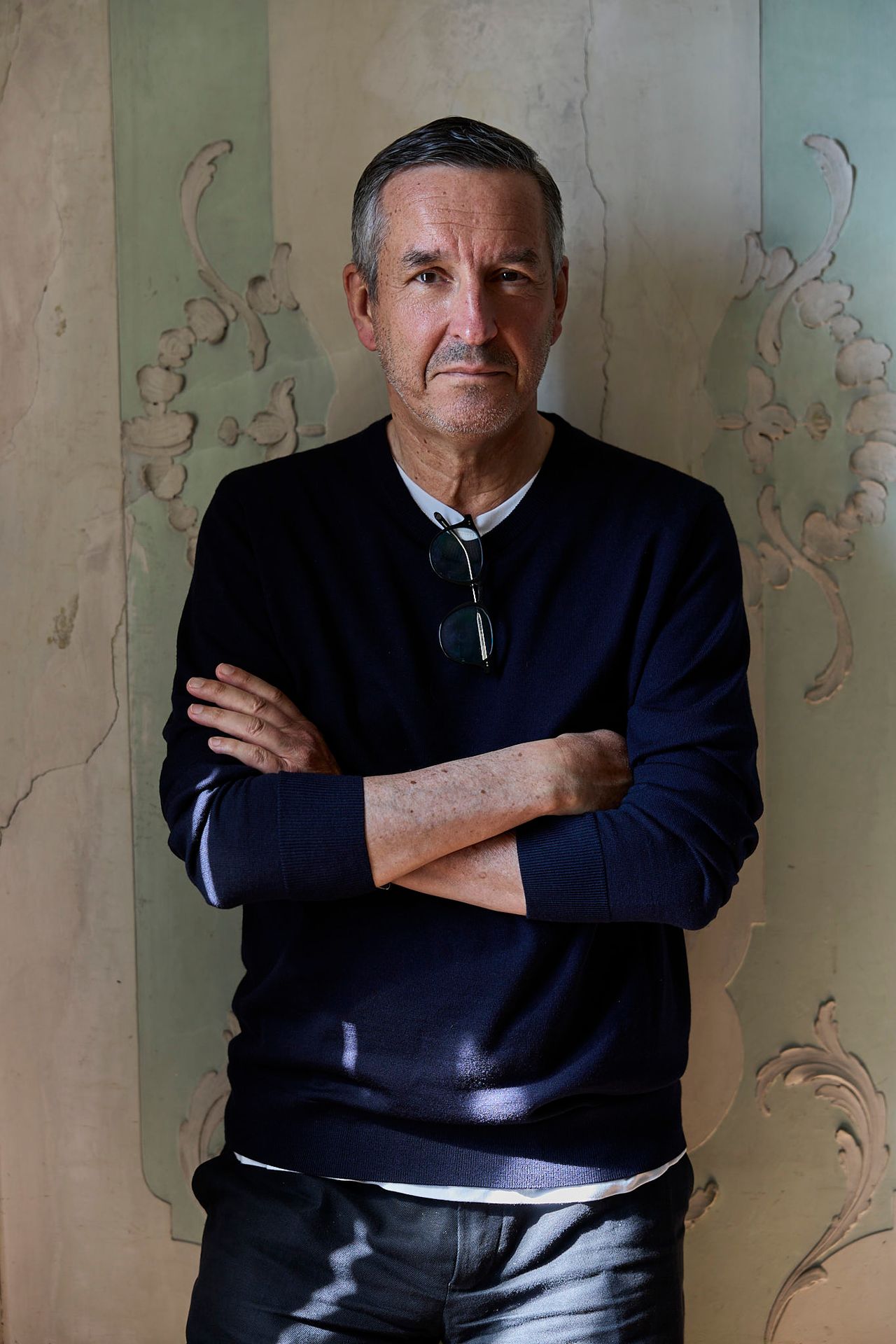
Dries Van Noten inside his foundation in Venice, Italy. (Photo: Antonio Campanella for The Slowdown)
SPENCER BAILEY: Hi, Dries. It’s a pleasure to be here in Venice with you. Thanks for letting our team into your space.
DRIES VAN NOTEN: You’re really welcome here in Venice.
SB: Let’s start with this palazzo itself. Tell me a bit of its history. How did you come to acquire it?
DVN: Oh, it’s quite a history. My partner [Patrick Vangheluwe] and I, when we retired as fashion designers of our brand, we really wanted to start our fondazione, but not in Belgium, because we lived our whole life in Belgium. For a new life, it would also be more interesting and more drastic to move countries. First, we thought about Rome or Florence, because we always thought that in Venice there were too far too many fondaziones, too much art, too many things happening, and too many tourists. Until, by coincidence, we arrived in Venice in the apartment of a friend for two weeks, and we discovered a completely different city. A lot of young people, very good schools, a lot of things happening and bubbling, new co-working spaces. Okay, a lot of tourists, but also very passionate and fantastic Venetians, Italian and international Venetians, who were very open and invite you to their house for an aperitivo. They presented me to other people.
We really fell in love with Venice. We decided, okay, the place is going to be Venice. Then we were looking for a space which was not too big, not too complicated, and not too decorated. For a fondazione, of course, you want white walls or white cube. We looked around to industrial spaces in Cannaregio, in Castello, those places. But then we didn’t really find what we wanted. Then one of the brokers which we worked with said, “Why don’t you go to Pisani Moretta?” I said, “Forget it, it’s far too big, and it’s too decorated and everything.”
SB: Yeah, this place is forty-three thousand square feet.
“It became clear that to do a fondazione about craftsmanship, this palazzo would be the perfect backdrop.”
DVN: Yeah, it’s quite generous, let’s say. Then we discovered a beautiful palazzo in good condition, which is also, of course, important in Venice. We fell in love with the owner; he is an incredible guy, 83 years old. The palazzo is four hundred years in the same family. He really gave his life, in fact, to restoring the palazzo, to keep it up in perfect condition and everything. First, it became clear that to do a fondazione about craftsmanship, this palazzo would be the perfect backdrop, because everything is done here in such an incredible way.
SB: And this eighteenth-century aristocrat Chiara Pisani herself was a craft collector.
DVN: Very craft-minded. The palazzo dates from 1480, was sold to the Pisani family in 1650, inherited by Chiara Pisani in 1730, 1725 or ’30. She decided to rebuild it. She kept the façade. She added a staircase in rococo style, and she invited the best craftsmen of Venice to decorate the full palazzo. She also added two floors on top, so the size is because of her. The craftsmen, in fact, did really marvelous things here. The marbles, the doors, all the bronze and the brass details, the chandeliers, all [Giuseppe Lorenzo] Briati—it’s really the best people who worked here and that’s fantastic, of course.
SB: Do you have any early-life memories of Venice? Do you remember your first trip, coming here?
DVN: I think, like everybody, I came to Venice for the first time with school. A school trip in Belgium, you had a habit that you have to do when you’re 17, you go on a trip to Italy and visit the most important cities. That was one day in Venice, so it’s not really a good introduction. But then afterwards, I came, I think like everybody, like every one or two years for two or three days to Venice, to see the Biennale, to see some exhibitions and things like that. But, of course, when you come to Venice and you stay in a hotel, it’s a completely different city. Now, when you live here, you go to the market, you go to all those fantastic shops who sell the best products, and the butcher and the bakery and all those—a different life.
SB: Since you’ve moved here, what is your pace or ritual, or how has time shifted for you? Have you found time different in Venice?
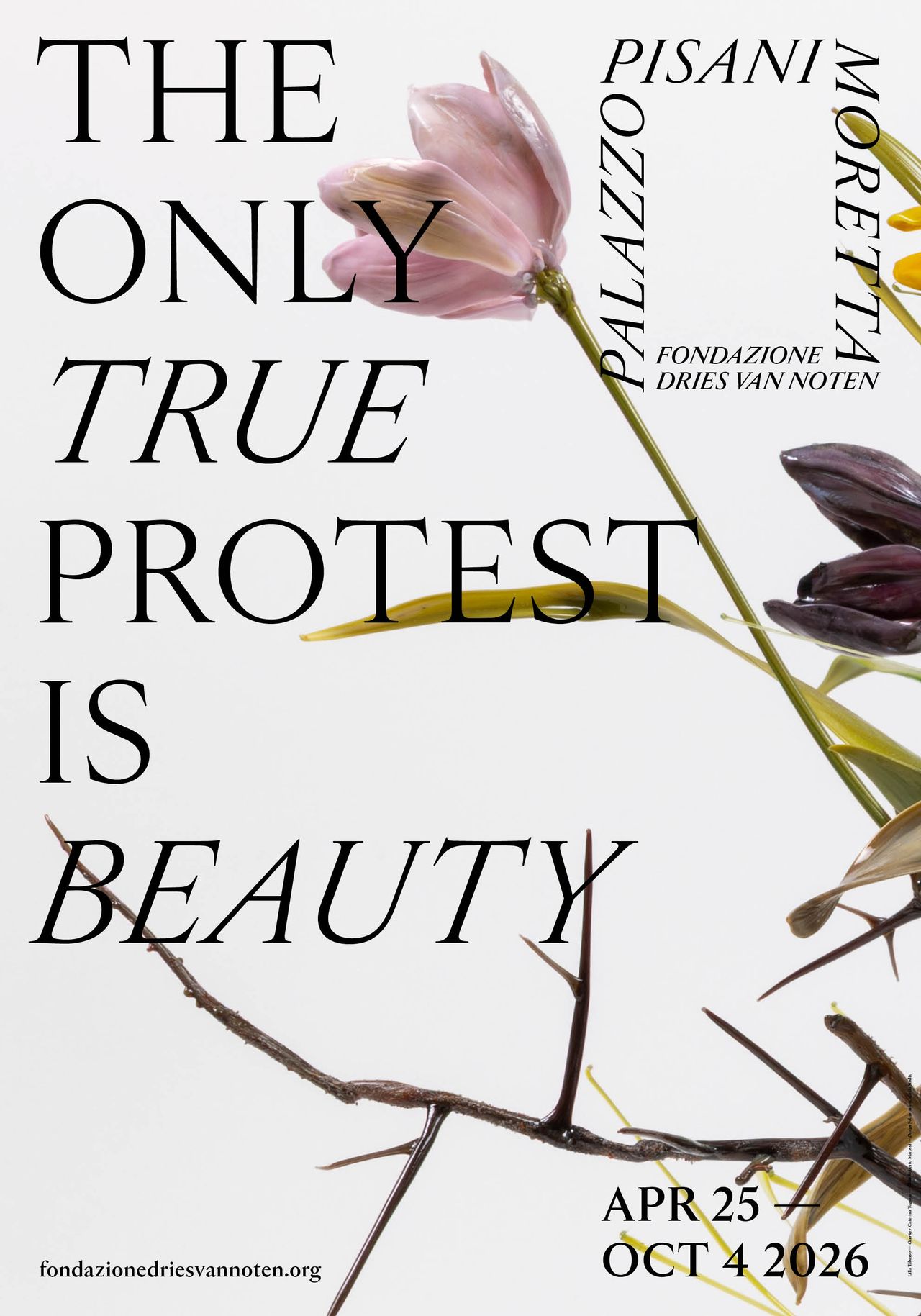
Poster for “The Only True Protest Is Beauty” exhibition. (Courtesy Fondazione Dries Van Noten)
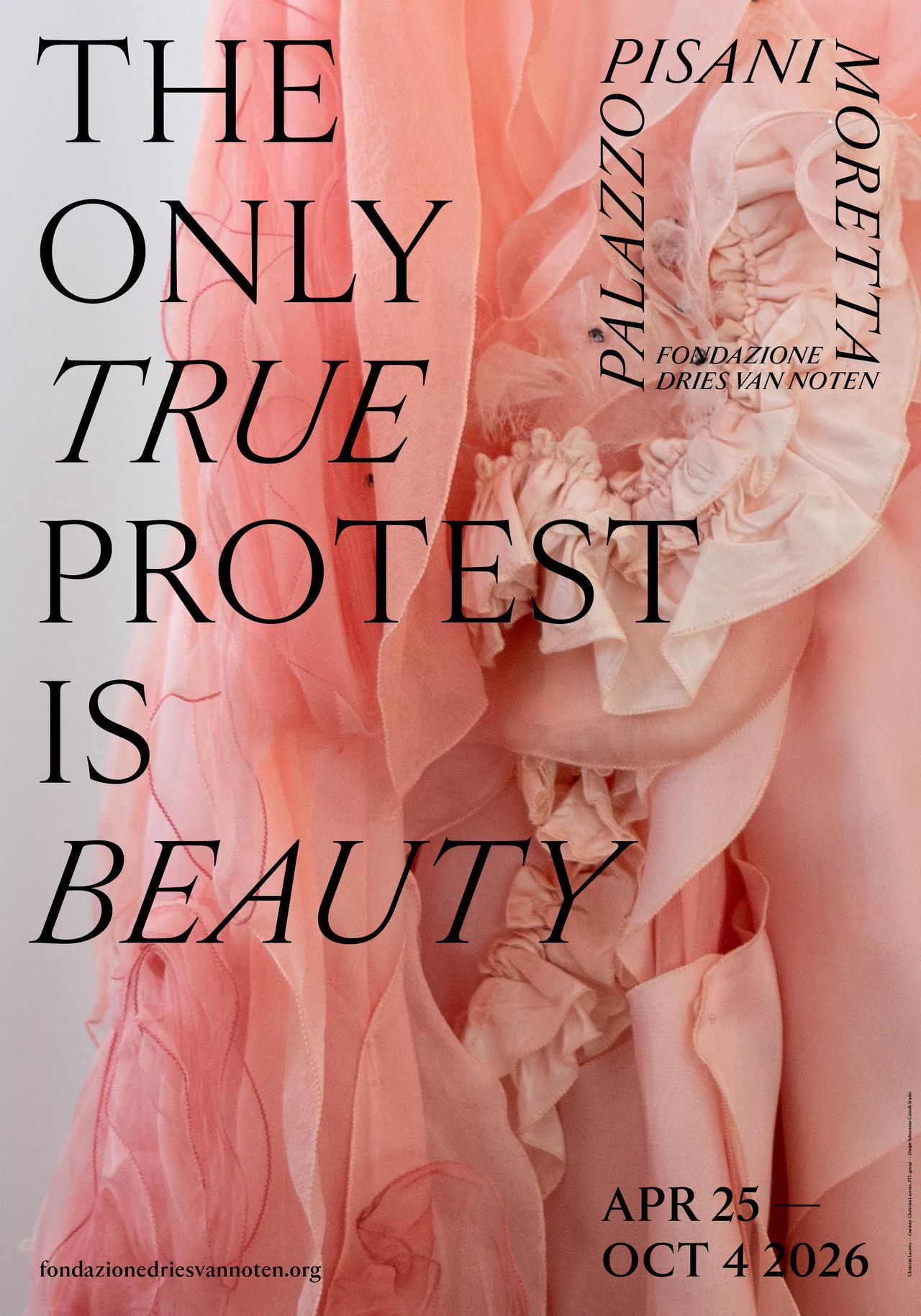
Poster for “The Only True Protest Is Beauty” exhibition. (Courtesy Fondazione Dries Van Noten)
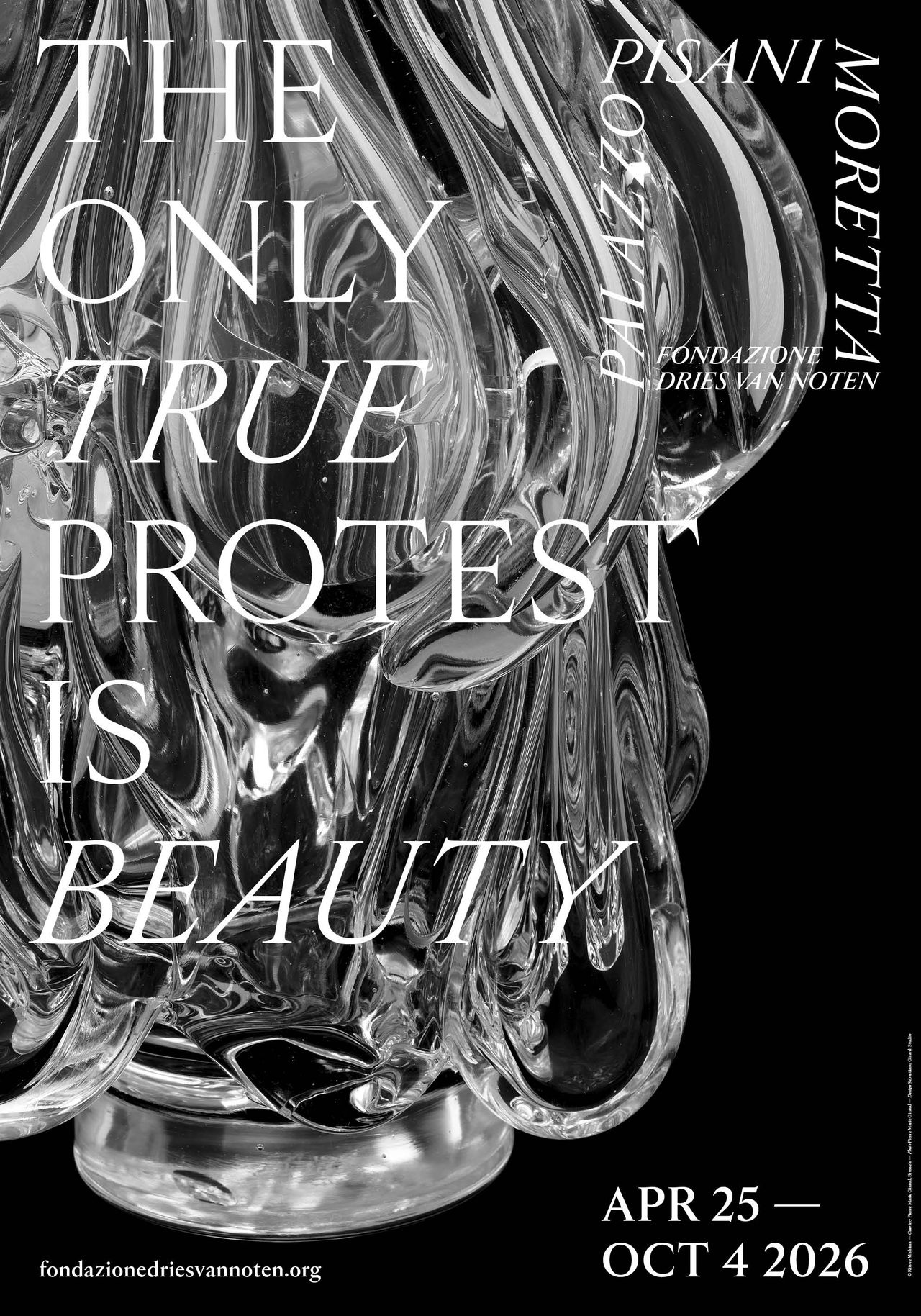
Poster for “The Only True Protest Is Beauty” exhibition. (Courtesy Fondazione Dries Van Noten)
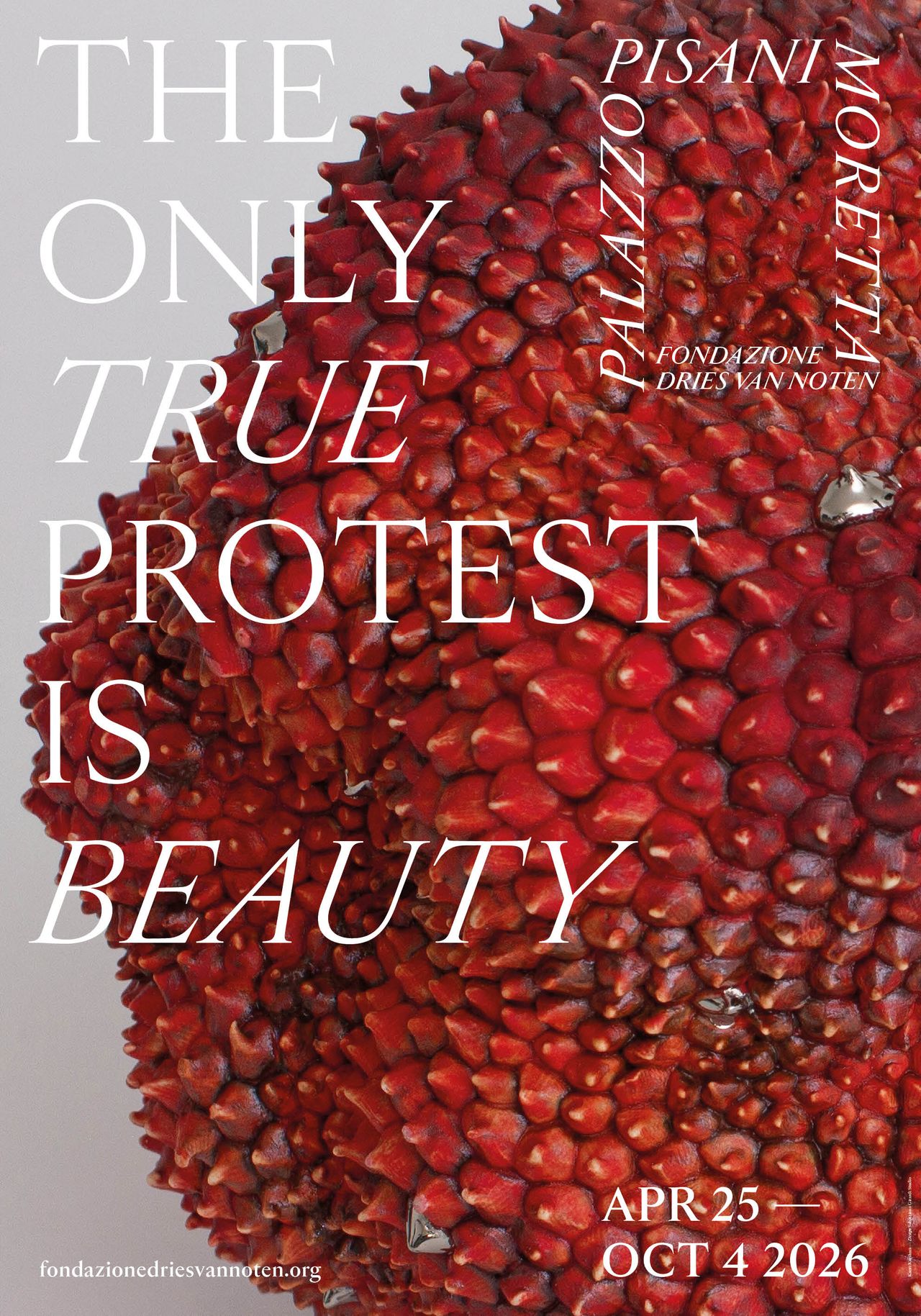
Poster for “The Only True Protest Is Beauty” exhibition. (Courtesy Fondazione Dries Van Noten)
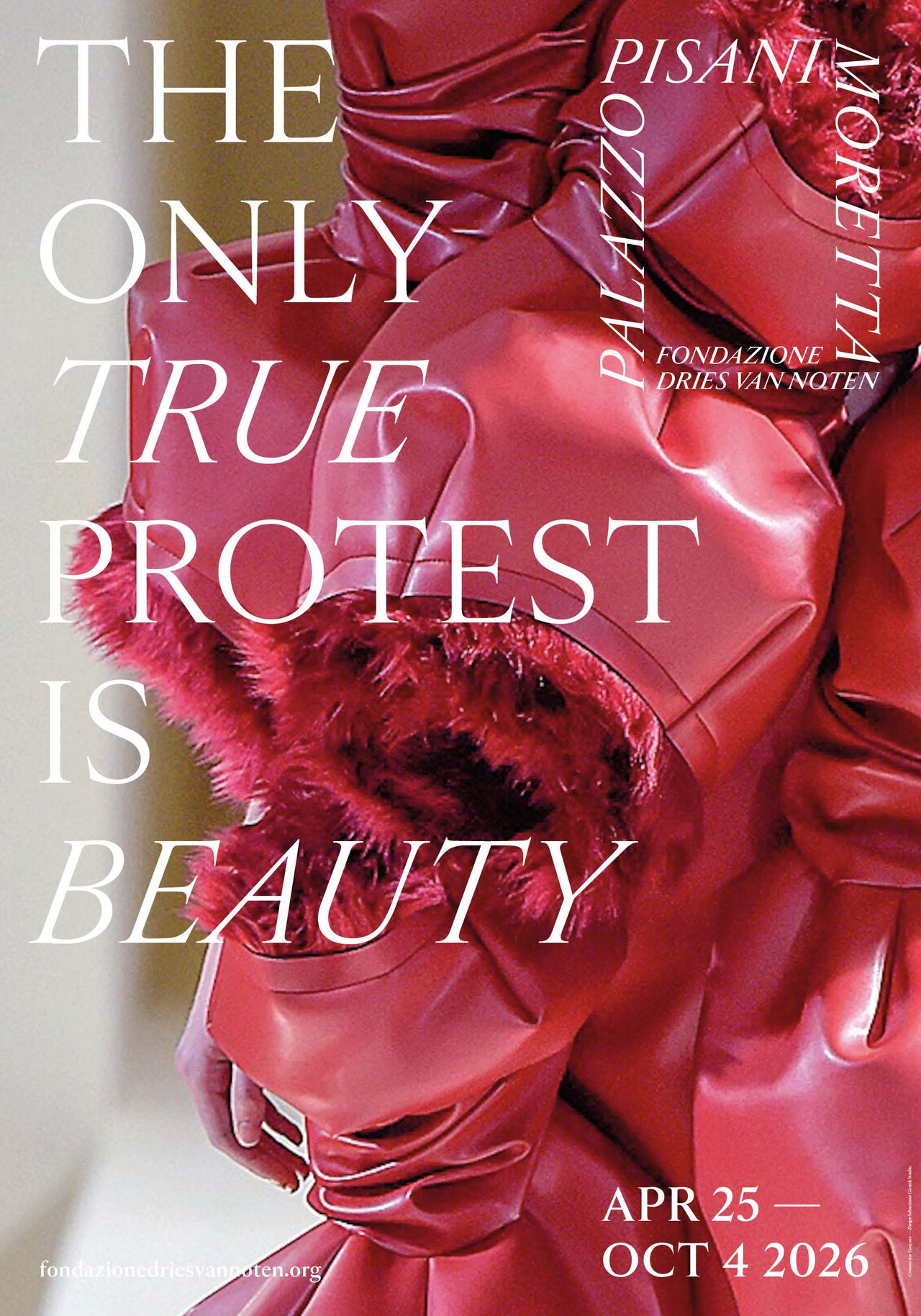
Poster for “The Only True Protest Is Beauty” exhibition. (Courtesy Fondazione Dries Van Noten)
Poster for “The Only True Protest Is Beauty” exhibition. (Courtesy Fondazione Dries Van Noten)
Poster for “The Only True Protest Is Beauty” exhibition. (Courtesy Fondazione Dries Van Noten)
Poster for “The Only True Protest Is Beauty” exhibition. (Courtesy Fondazione Dries Van Noten)
Poster for “The Only True Protest Is Beauty” exhibition. (Courtesy Fondazione Dries Van Noten)
Poster for “The Only True Protest Is Beauty” exhibition. (Courtesy Fondazione Dries Van Noten)
Poster for “The Only True Protest Is Beauty” exhibition. (Courtesy Fondazione Dries Van Noten)
Poster for “The Only True Protest Is Beauty” exhibition. (Courtesy Fondazione Dries Van Noten)
Poster for “The Only True Protest Is Beauty” exhibition. (Courtesy Fondazione Dries Van Noten)
Poster for “The Only True Protest Is Beauty” exhibition. (Courtesy Fondazione Dries Van Noten)
Poster for “The Only True Protest Is Beauty” exhibition. (Courtesy Fondazione Dries Van Noten)
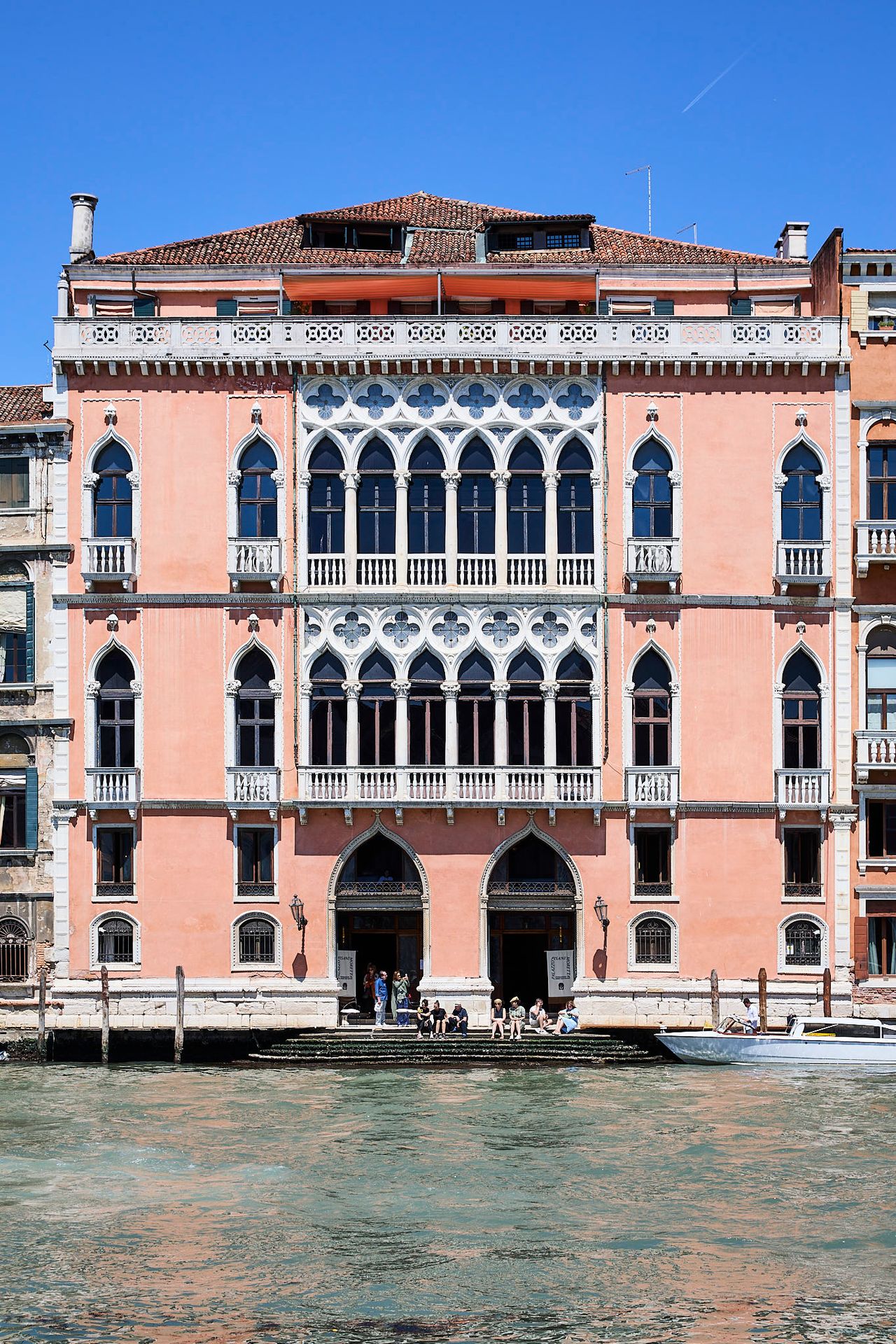
View of Palazzo Pisani Moretta’s facade from across Venice’s Grand Canal. (Photo: Antonio Campanella for The Slowdown)
DVN: Honestly, it’s quite busy. Because, of course, buying a palazzo has all these consequences. We did a big commitment here in Venice, because we didn’t only buy the palazzo. I maybe can tell now already that the negotiations about the palazzo took quite a long time, because the lawyer of the family was super complicated. I think if we would have worked directly with the family, it would have been done in two months. But there was a lawyer and he really wanted to make our life difficult. So, after six months, we stopped the negotiations. We said, “It’s not going to happen.” By coincidence, that week another property came for sale and I jumped on it and I immediately bought it. The day that we signed, we get a phone call from the family to say, “Look, we want to negotiate again.”
SB: So you end up with two palazzos. [Laughs]
DVN: No, it’s not [a second] palazzo. No, thank you. It’s another space, which is also a nice size, and it’s kind of the basement, the ground floor, the ground floor of a palazzo, which was always used as a studio and a more industrial look, but still with Byzantine columns and a beautiful view of the canal and everything. We are restoring this now, so when we close the palazzo for the restoration, what we’re going to do, it’s not really restoration, it’s really we have to put some techniques, a new elevator, these types of things. Then we [will] move there, so the palazzo is going to be closed for one year, and then we are in the Studio San Polo, as we call it. It’s just around the corner.
SB: Oh, great. So you’ll have two locations.
DVN: We are going to have two locations. Which is good. The palazzo is very decorated, and then the other one is just going to be a very simple concrete floor, white walls.
SB: Like a project space. I know to make the updates here is complicated; it’s going to take time. I found it interesting that you decided, before you do that, to open it up to the public, to let the public in here to experience it before you did the “back-of-house” renovations, roughly.
DVN: Several reasons, in fact, because of course I’m quite impatient, and also knowing that if we would have to start the works, we needed one year after we acquired it, to do the plans, permissions, the authorizations. All those type of things. We knew that would take a year. Then, when we bought it, we also took over the contracts, what the owner made, because he used it quite often as a venue for events. Until March, anyway, there were events, so we couldn’t start to work. That gave us that gap of like five months. I said, “Okay, how are you going to fill it in, continue events?” I said, “Definitely not. Why don’t we do an exhibition?”
We said it’s a perfect kind of a tryout. We’re going to learn so much, and we did. We’re going to learn so much, in fact, of how can we use this space, how do we have to treat it when we put art in it and beautiful pieces of craftsmanship? How can this kind of a narrative with the palazzo around it?
SB: I really admire that, because I feel like a lot of foundations, they spend so much front-end time defining what they’re going to be, and you’re sort of letting it become.
DVN: It’s also in this way because we didn’t really have time to build our network. So, we said, “Okay, we’ll concentrate the first six months on building the exhibition, and then during the exhibition, we’re going to start to work with our network to see what is going to be the future.” Because, of course, now we have here this exhibition. But I don’t know that [with] the resources we have, if it’s more interesting to spend it on education. Is it more established designers with young designers? Is it more artists-in-residence, all those things? Or is it a mixture of all those things? We’ll see.
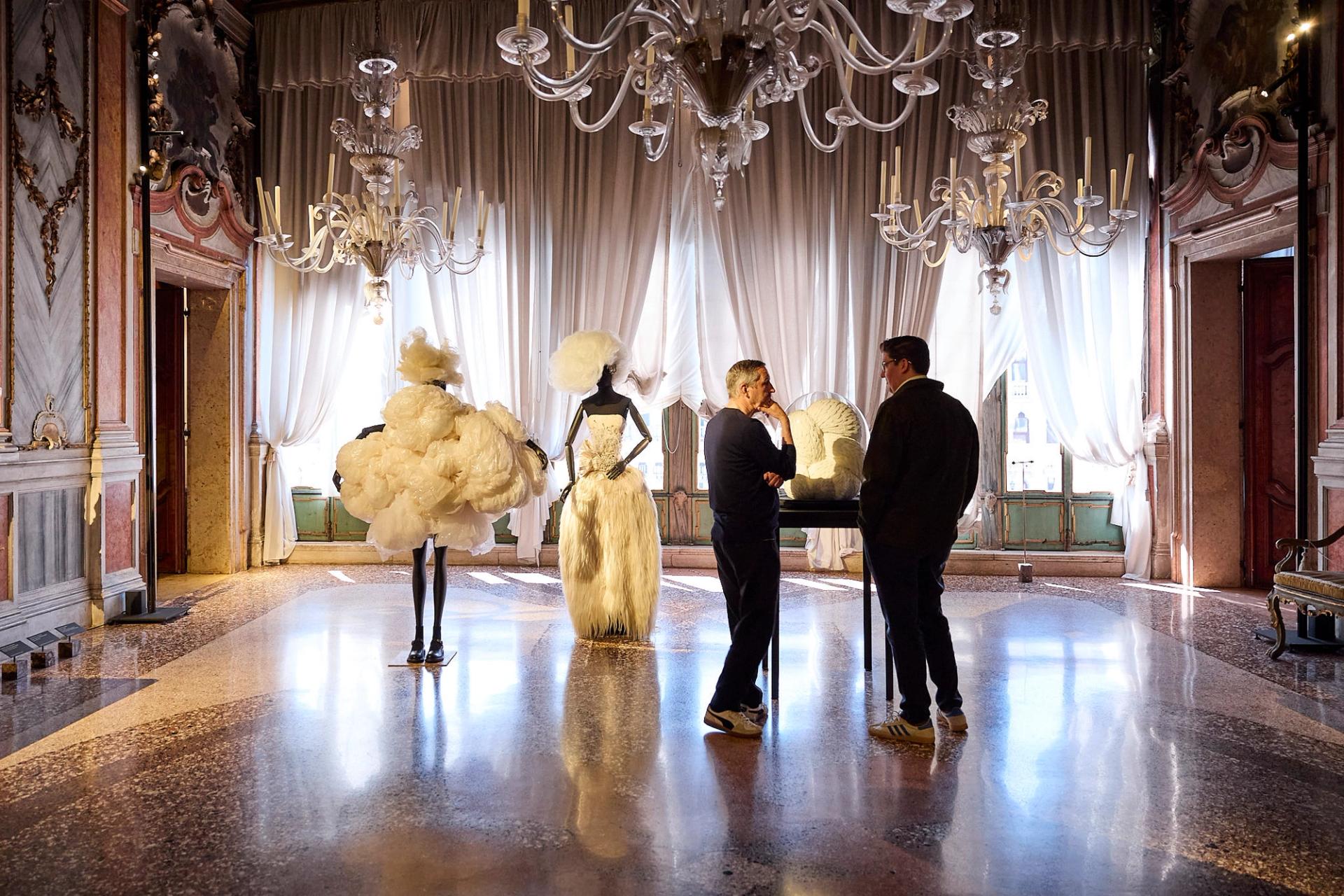
Van Noten, left, and Spencer Bailey tour the exhibition “The Only True Protest Is Beauty.” From left: Comme des Garçons headpiece by artist Julien d’Ys (spring/summer 2025); Christian Lacroix headdress arrangement by Fabio Petri (haute couture fall/winter 2004); “Stifle,” (2008) a mixed-media work by Kate MccGwire. (Photo: Matteo de Mayda)
SB: Tell me about this first exhibition titled “The Only True Protest is Beauty.” And this was after a song by the political activist Phil Ochs. What does this phrase—”the only true protest is beauty”—mean to you?
DVN: The full sentence is, “In such ugly times, the only true protest is beauty.” When I started to work on the idea of an exhibition that happened already, I think beginning last year, I thought, Okay, it’s a perfect working title. I saw the phrase passing by somewhere on social media, and I thought, it’s the perfect starting point for an exhibition for me. We started to work on it, and I said the moment that we’re going to put up the exhibition, the world is going to be a much better place. I was going to change the title to something more neutral. I couldn’t have known that it was even more relevant now than when I started to work on it. [Laughter]
The only thing we did is we dropped the first part of the sentence, because, for me, as I said, I don’t want to work here six months again when the exhibition is open, on something which is so negative, and to be reminded every day what a bad place of world is, for the moment. I think that when you have the sentence and you have the word protest in it, you know that you protest against something. For me it was clear with just the second part of the sentence.
SB: What’s your personal definition of beauty? What does beauty mean to you?
“What I appreciate about beauty is that it’s something deeply personal.”
DVN: What I appreciate about beauty is that it’s something deeply personal. It’s really, I think, what’s beautiful for me is not beautiful for you. Beauty also has an evolution. For me, beauty can be nearly the opposite of prettiness. For a lot of people, beauty is prettiness, it’s cute, it’s nice, kawaii, all those things. No, for me, beauty is something that you need. It can be the sun hitting something in your bedroom the moment you open your eyes, and you say, “Wow, I have already seen enough beauty for today, that gives me enough energy to get through the ugly world.” It’s a lot of things for me. You have to work on the concept of beauty, because I think your life is getting much more interesting when you work on beauty, and that you let it evolve. Beauty can hurt, beauty can shock, beauty can be revolting, beauty can surprise. Yeah, it’s all these different things.
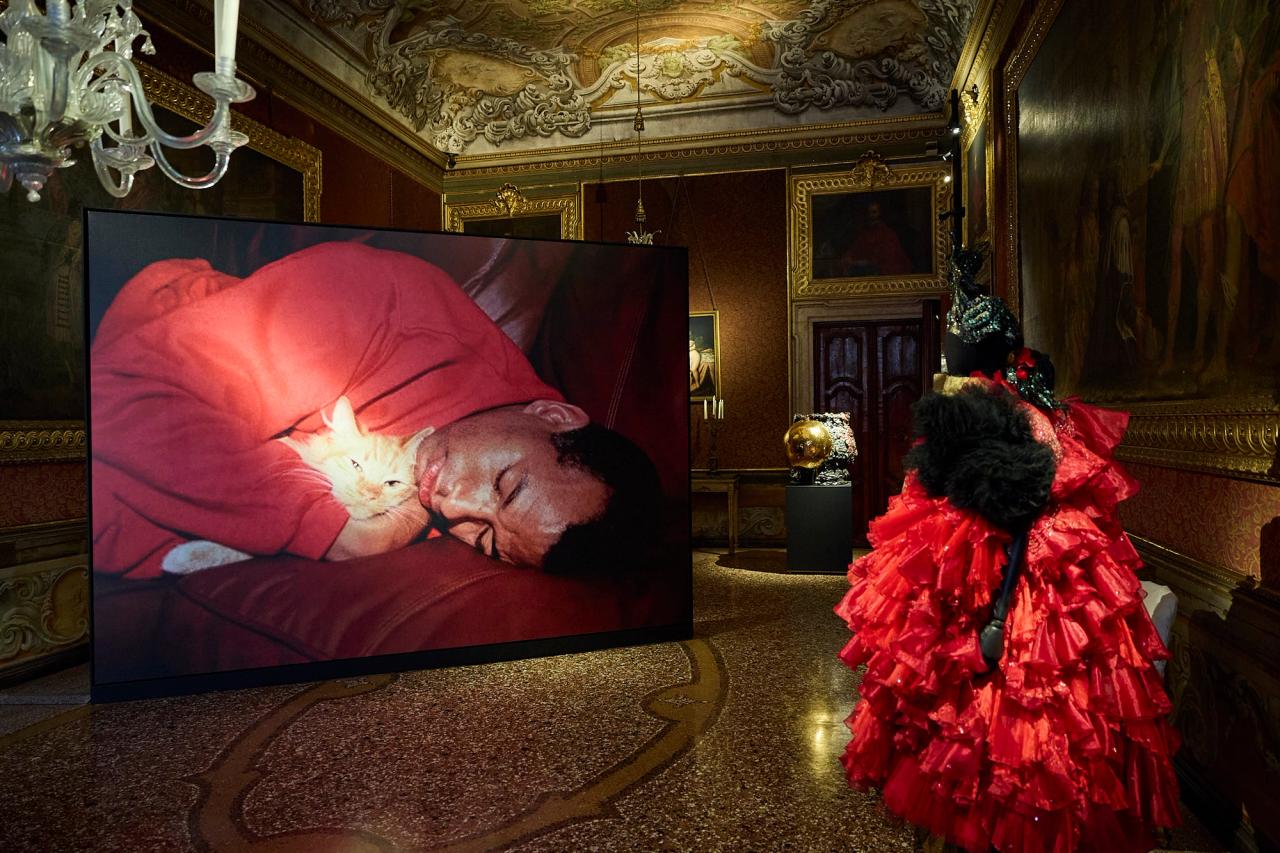
View of Room 2. From left: Steven Shearer’s photograph “Whiskered Sentinel” (2024); Takuro Kuwata’s “Chawan (A25 - 054)” (2025); Comme des Garçons headpiece by artist Julien d’Ys (fall/winter 2018). (Photo: Antonio Campanella for The Slowdown/Copyright Steven Shearer/Courtesy the artist, Galerie Eva Presenhuber, and David Zwirner; Courtesy Pierre Marie Giraud Gallery; Courtesy Comme des Garçons;)
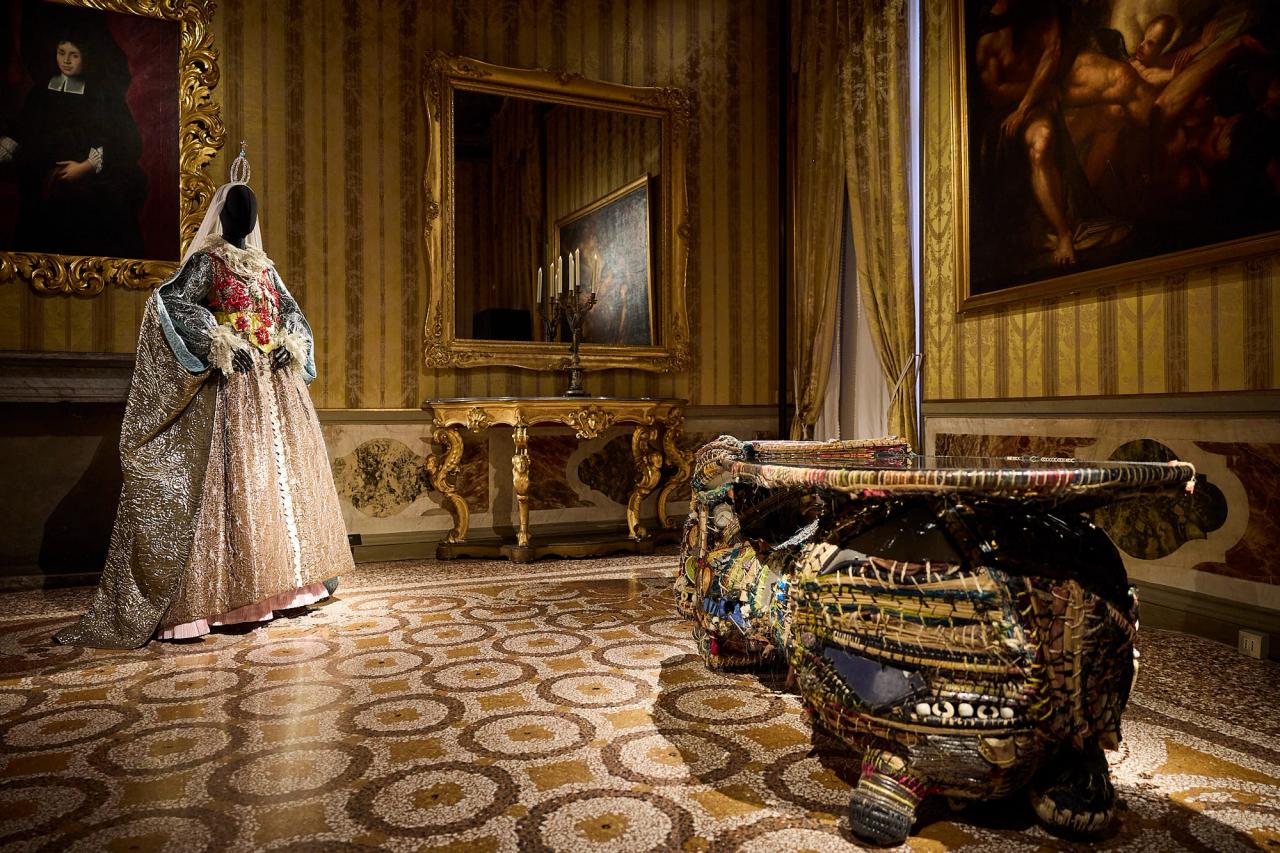
View of Room 14. From left: Christian Lacroix headdress arranged by Fabio Petri (haute couture fall/winter 2001) and Misha Kahn’s “An Uncertain Task” (2018). (Photo: Antonio Campanella for The Slowdown/Courtesy Christian Lacroix, STL group; Courtesy Friedman Benda and Misha Kahn)
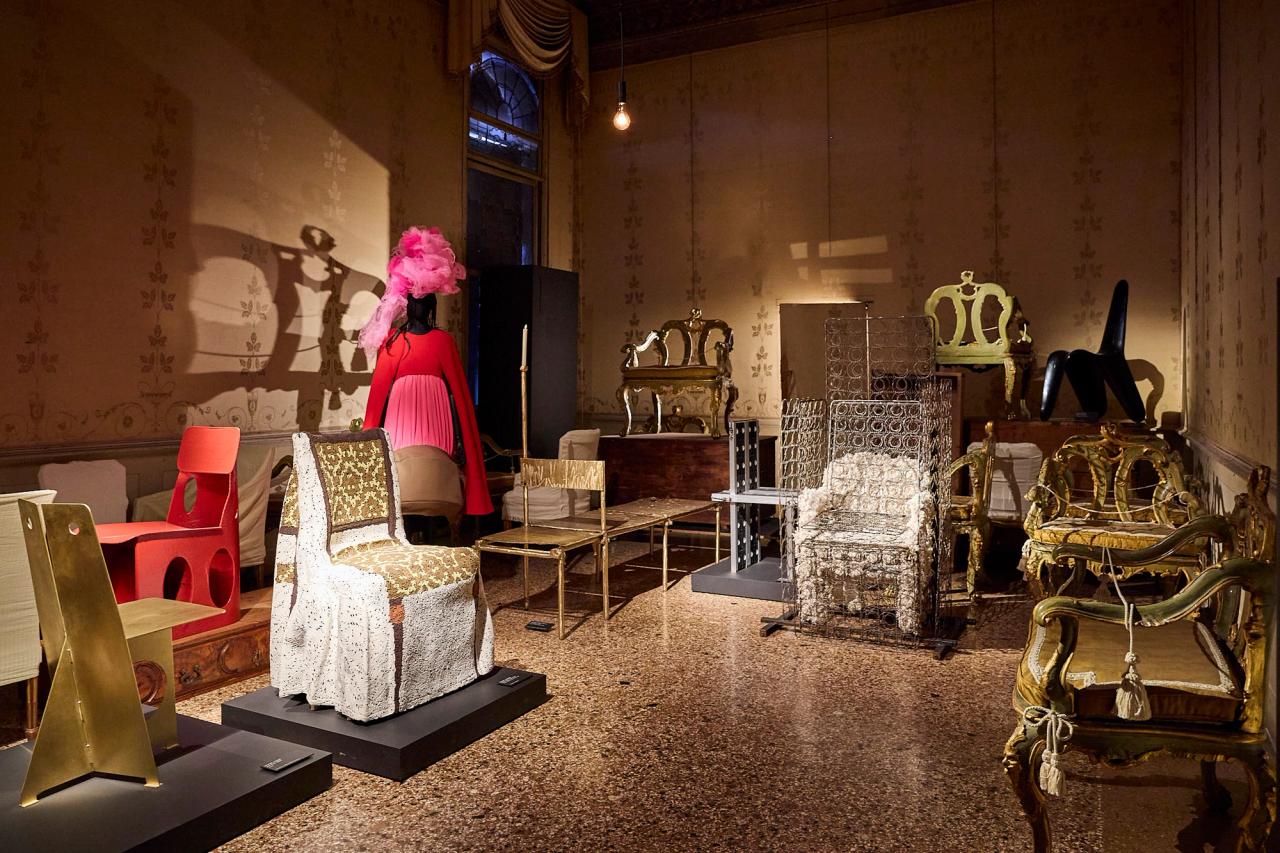
View of the room themed “Chairs: Variations and Deviations.” From left: Lionel Jadot’s “Jam Brass” (2025); Wendy Andreu’s “Empire Ghost Chair” (2024); Seongil Choi’s “Hardened Mesh Chair, Red” (2026); Comme des Garçons headpiece by artist Julien d’Ys (fall/winter 2020); Nifemi Marcus-Bello’s “The Daybed” (2026). Lionel Jadot’s “SLV Chair” (2020); Lionel Jadot’s “Spring Swab” (2020), an old chair used by Jadot’s grandmother to have her morning coffee. (Photo: Antonio Campanella for The Slowdown/Courtesy Objects With Narratives; Courtesy Uppercut; Courtesy Uppercut; Courtesy Comme des Garçons; Courtesy Nifemi Marcus-Bello and Side Gallery; Courtesy Objects With Narratives; Courtesy Galila's Collection, Belgium)
View of Room 2. From left: Steven Shearer’s photograph “Whiskered Sentinel” (2024); Takuro Kuwata’s “Chawan (A25 - 054)” (2025); Comme des Garçons headpiece by artist Julien d’Ys (fall/winter 2018). (Photo: Antonio Campanella for The Slowdown/Copyright Steven Shearer/Courtesy the artist, Galerie Eva Presenhuber, and David Zwirner; Courtesy Pierre Marie Giraud Gallery; Courtesy Comme des Garçons;)
View of Room 14. From left: Christian Lacroix headdress arranged by Fabio Petri (haute couture fall/winter 2001) and Misha Kahn’s “An Uncertain Task” (2018). (Photo: Antonio Campanella for The Slowdown/Courtesy Christian Lacroix, STL group; Courtesy Friedman Benda and Misha Kahn)
View of the room themed “Chairs: Variations and Deviations.” From left: Lionel Jadot’s “Jam Brass” (2025); Wendy Andreu’s “Empire Ghost Chair” (2024); Seongil Choi’s “Hardened Mesh Chair, Red” (2026); Comme des Garçons headpiece by artist Julien d’Ys (fall/winter 2020); Nifemi Marcus-Bello’s “The Daybed” (2026). Lionel Jadot’s “SLV Chair” (2020); Lionel Jadot’s “Spring Swab” (2020), an old chair used by Jadot’s grandmother to have her morning coffee. (Photo: Antonio Campanella for The Slowdown/Courtesy Objects With Narratives; Courtesy Uppercut; Courtesy Uppercut; Courtesy Comme des Garçons; Courtesy Nifemi Marcus-Bello and Side Gallery; Courtesy Objects With Narratives; Courtesy Galila's Collection, Belgium)
View of Room 2. From left: Steven Shearer’s photograph “Whiskered Sentinel” (2024); Takuro Kuwata’s “Chawan (A25 - 054)” (2025); Comme des Garçons headpiece by artist Julien d’Ys (fall/winter 2018). (Photo: Antonio Campanella for The Slowdown/Copyright Steven Shearer/Courtesy the artist, Galerie Eva Presenhuber, and David Zwirner; Courtesy Pierre Marie Giraud Gallery; Courtesy Comme des Garçons;)
View of Room 14. From left: Christian Lacroix headdress arranged by Fabio Petri (haute couture fall/winter 2001) and Misha Kahn’s “An Uncertain Task” (2018). (Photo: Antonio Campanella for The Slowdown/Courtesy Christian Lacroix, STL group; Courtesy Friedman Benda and Misha Kahn)
View of the room themed “Chairs: Variations and Deviations.” From left: Lionel Jadot’s “Jam Brass” (2025); Wendy Andreu’s “Empire Ghost Chair” (2024); Seongil Choi’s “Hardened Mesh Chair, Red” (2026); Comme des Garçons headpiece by artist Julien d’Ys (fall/winter 2020); Nifemi Marcus-Bello’s “The Daybed” (2026). Lionel Jadot’s “SLV Chair” (2020); Lionel Jadot’s “Spring Swab” (2020), an old chair used by Jadot’s grandmother to have her morning coffee. (Photo: Antonio Campanella for The Slowdown/Courtesy Objects With Narratives; Courtesy Uppercut; Courtesy Uppercut; Courtesy Comme des Garçons; Courtesy Nifemi Marcus-Bello and Side Gallery; Courtesy Objects With Narratives; Courtesy Galila's Collection, Belgium)
SB: Across twenty rooms, you’re showing this constellation of more than two hundred craftspeople or pieces, works. Everything from furniture by Misha Kahn and Ettore Sottsass, to Pisani Moretta family’s historic glassworks collection, through to contemporary makers. What was your curatorial process? How did you bring this assemblage together?
DVN: It happened all quite in an organic way. So of course, the first thing we knew is that the palazzo would play a role in the whole exhibition. Secondly, I never made a difference between art and craft, and I think that’s also going to be a little bit the role of the Fondazione. So for us now, I think for me, the difference is much more that you have one thing which is made by humans, made by people who work, who think, who use their brain, their soul, their hands, to create things. However, there is space for coincidence, creativity, inspiration. That is one thing for me. Then, on the other side, you have A.I. So where everything is really made for following a formula, and I think a formula is the opposite of creativity. And that was the first start to work with.
Then of course knowing this, that for me, there’s no difference between art and craftsmanship. I said, “Okay, I want to have fashion, because I’m still a fashion designer in my soul. I want fashion, but not my own.” And then we said, “Okay, there are quite a lot of old loves,” like things which I saw somewhere and that I remember. I have a very visual memory, and I went back then, okay, I saw somewhere the big pictures, Steven Shearer, which I really loved, and I started to make compositions. The moment we had fifty percent of the elements, then I started to install them in the room. I started to make the collages, room by room, and then I started to add things to see that we have all the different disciplines, going from woven artworks to braided crochet, glass in all different aspects, metal, ceramics in all different aspects, that we really had a very wide group of people. Then, of course, the established designers, but also the people who just came out of school from last year.
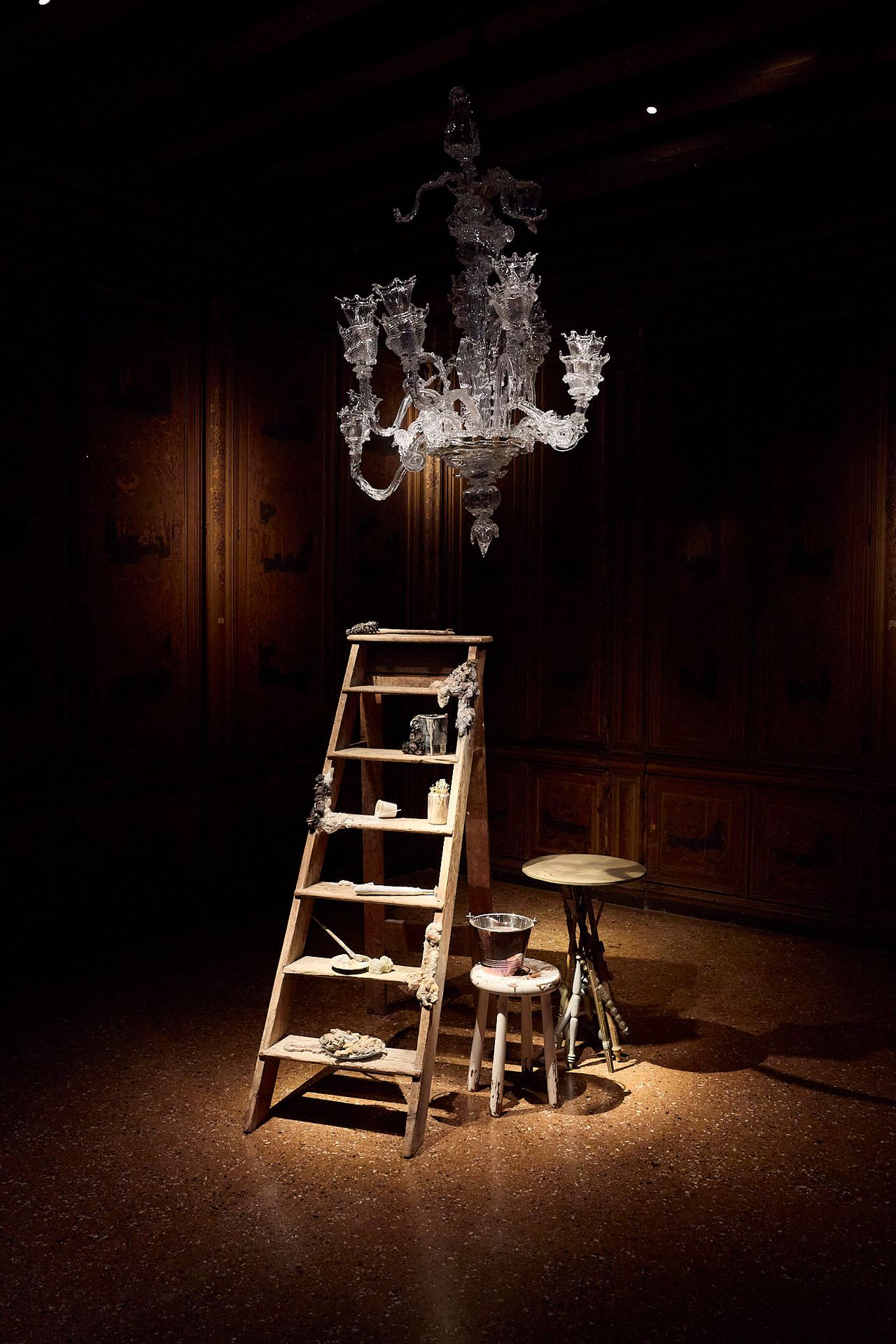
View of the “Precious Ordinary”–themed second floor featuring “Trompe l’oeil” (2026) by Atelier Lachaert Dhanis and, on the ceiling, “Chandelier” (2025) by Alexander Kirkeby. (Photo: Antonio Campanella for The Slowdown/Courtesy Atelier Lachaert Dhanis/Courtesy Alexander Kirkeby and Uppercut)
SB: You’ve always had this great respect for the past, but not in a nostalgic way. Would you say that’s reflected in this show, this forward-looking element of craft?
DVN: I really hope so. I think it’s what I’m the most happy with. When people walk through it, they don’t make any difference anymore between an artwork of a famous artist or an Ettore Sottsass piece of furniture, or a Lionel Jadot chandelier, which is hanging there, which is a few old garden chairs plonked together with some stoppers from wine carafes, and some dog masks. For them, now placed here in the palazzo, I’m happy that people think it makes sense. It’s not like alien elements put together, but there’s really a narrative, and people are very open to that. And this for me is a very happy surprise.
SB: What creates or comes out of that is an atmosphere that extends even beyond the palazzo—there’s an alchemy happening between the works themselves and the space they’re situated in.
DVN: This was really a tryout. We didn’t know the space very well. Okay, some people are surprised that everything is so dark. It’s dark in two ways. First of all, there is that undercurrent of memento mori, vanitas, and there is a lot of, Oh, we poor human beings, we are rotting here on earth, and then beauty is escaping from us for eternal life, and the butterflies, everything. There are a lot of skulls, there is a lot of decay; also, in some clothes from Christian Lacroix, which visually fall apart, combined with Peter Buggenhout’s sculptures, we are rotting away, covered with blood and horsehair. So, you have that quite dark mood.
But on the other hand, it’s also presented in quite dark circumstances, because we covered all the windows of the palazzo with film, which takes ninety-five percent of the strength of light away. We simply had to do that, because as you show fashion, the maximum quantity of light, what you can show on fashion, is fifty lux, which is very low. We had to put the whole palazzo in a dark atmosphere.
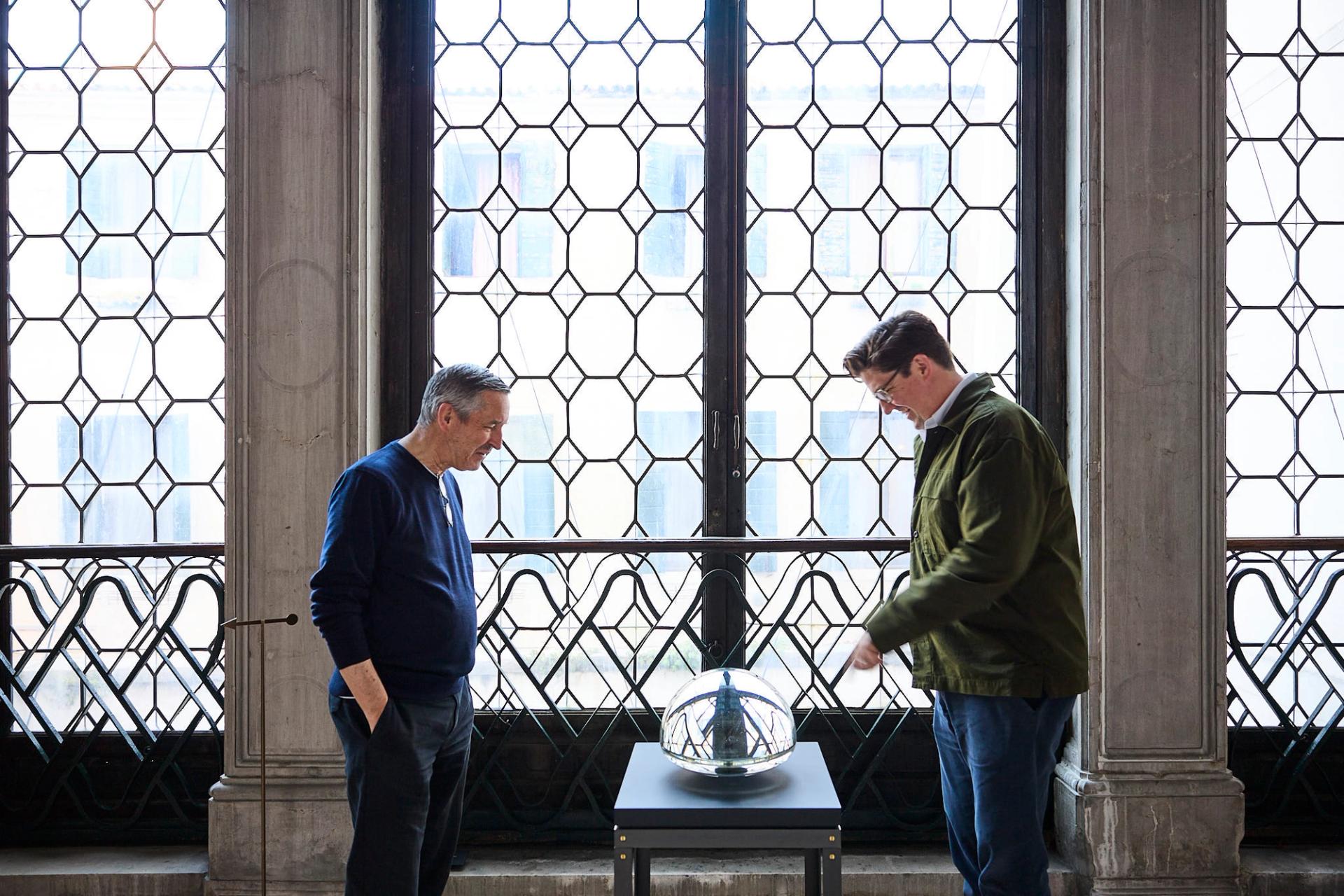
Van Noten, left, and Bailey with “Panorama” (2010), a clear optical glass sculpture by the late Czech artist Václav Cigler. (Photo: Antonio Campanella for The Slowdown/Courtesy Galleria Caterina Tognon, Venezia)
SB: In my research, I came across this interview that you gave about a decade ago, in which you said that art has always been a part of your research, but, “more in a poetic, emotional way.” In the case of this exhibition, how does that come alive for you, this idea of the emotional? How did you decide what to include, what to leave out? Was a lot of this curated through an emotional lens?
“Emotion, for me, is always one of the reasons why I select a piece or not. It has to talk to me, it has to surprise me, it has to shock me.”
DVN: Emotion, for me, is always one of the reasons why I select a piece or not. It has to talk to me, it has to surprise me, it has to shock me, definitely. On the other hand, you also want to make a complete story. It’s not that you have also the rational part, then who says, “Okay, now we have this, We need some contrasting there to make this thing speak in a more interesting way together.” Because I’m quite quickly bored. For me, the tension between pieces is very important to create that, and to avoid that in fact. And the narrative was important. That was really, at a certain moment, the narrative took over. It’s not that I said, “Okay, now because they fit in the narrative, let’s take this and this and this piece.” Not at all.
But if you do a story about wood, for me, you had, for instance, the chandelier which I already talked about, and the garden chairs, and the pieces of wood. But then you have Sottsass, an incredible cabinet from the eighties or nineties; it was nineties. Then you have Joris Laarman on the chairs, which, for me, are also quite symbolic, because you have those chairs standing there, made with all the most advanced techniques with 3-D printing, laser cutting, everything, what you would say, “Oh, is this craft?” But then they are done after all those pieces which are cut out of wood, are put together in a way which is absolutely beyond craftmanship. It’s incredible how it’s made.
For me, it’s important, because when people think about craftsmanship, very often they think, okay, we go two centuries back, and we use only very primitive material. That’s not the real craftsmanship. No, not at all. I think computers and everybody will send emails and make digital pictures. How beautiful then, also, vinyl records are, and things like that, but we listen to podcasts, while we are making craftsmanship.
SB: [Laughs] Yeah, exactly. The idea of craft was so embedded in the work you did in fashion over your thirty-eight-year career. I think so much of what could be felt in your work was the feeling of the maker. Through this exhibition, are you thinking about not just the hand of the maker, but the feeling of the maker? Obviously, you’re having your emotional response to it, but maybe the maker’s emotion has extended into it, as well.
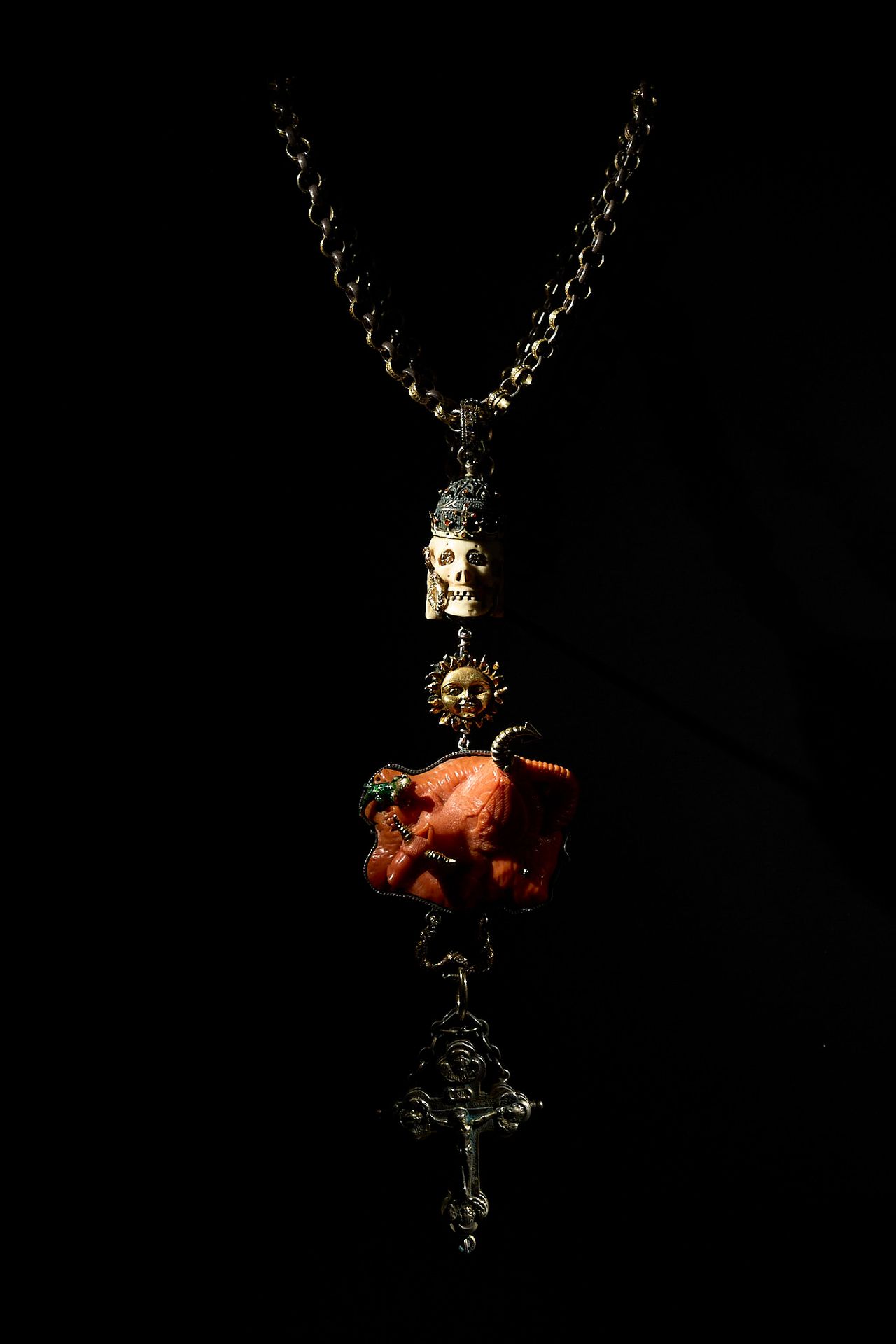
Necklace by A. Codognato with a crowned skull, a sun, a mythological Ophiotaurus, and cross pendant, made with 18-karat yellow gold and silver, mammoth bone, diamonds, sapphires, and antique coral. (Photo: Antonio Campanella for The Slowdown/Courtesy private collection)
DVN: No, of course, I think when you’re interested in craftsmanship and when you don’t really want just to just make machine-made pieces, automatically you feel the hand of the maker. I think that’s the beauty of it. The hand of the maker also sees that every piece is, in its way, really unique, because there’s always some irregularities. There’s always something that you see that… I talked already about coincidence, which, for me, is such an important factor in creativity, because everybody knows that when you make things, at a certain moment, it’s more interesting to stop, because you know that continuing to work on it is not going to make it better. So you have the most famous sculptures from the biggest artists from the past, where it’s like a piece of rock, where then only one leg is sculpted out and that’s the most strong thing.
A lot of creativity I compare with making food, cooking. I love cooking. Like everybody who loves cooking, you start with a recipe and then you look for the ingredients, and then one of the ingredients you don’t find, and then it starts, and you start to change and then you say, “Oh, cooking so long. No, no, I’m not going to cook it so long, I’m going to cook it shorter, higher temperature.” Then at a certain moment, coincidence also comes in and you go, “Oh, I still have this. Let’s throw this one, because I think it’s going to give a good result.” So that’s how you cook. I think I don’t know anybody who, when you have a recipe, follows it from the beginning until the end. That’s a little bit the same thing with making things. For me, it’s really very symbolic.
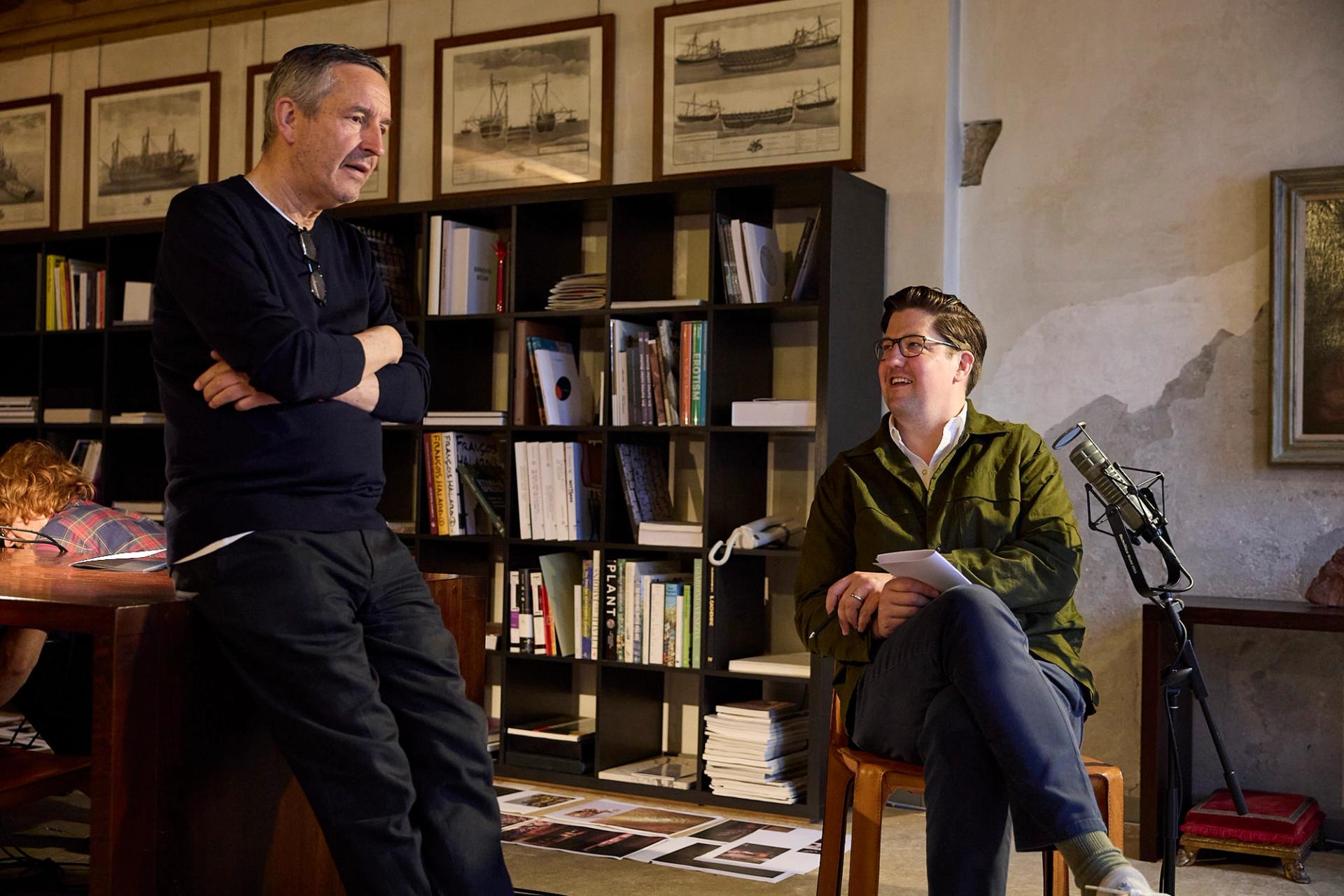
Van Noten, left, and Bailey inside the Fondazione Dries Van Noten in Venice, Italy, prior to the recording of Ep. 156 of Time Sensitive. (Photo: Antonio Campanella for The Slowdown)
SB: Now that the exhibition’s been on view for about a month, what’s the response been like? Have you been surprised by the reactions?
DVN: Yes, I’ve been surprised by the reactions. The team was hoping for good results and that people would love it. But the scenes that we had here during the opening week of the Biennale, we were not prepared for. My excuse to everybody was standing here outside in the gallery, and couldn’t get in, we were simply not ready for. Of course, the palazzo is a very fragile building, so we can’t have hundreds of people at the same time in the building. It’s limited.
Security-wise, that’s no problem because you’ve seen the staircase, we have a good staircase to escape, but it’s just that fragility. There are also some small rooms. In the twenty rooms, there are two, three rooms which are very, very, not really big. We just had the maximum capacity. But, of course, what is also most giving joy is reactions to it. The sparkles, what we have now for the future that we see, the reactions are good. I think also for us, it’s going to be easier after the success now of this exhibition, to move forward, because people know what we are standing for.
Because that was quite often our difficulty, where we had to contact the galleries and artists, we had to explain the project and said, “Yeah, but we liked what you do as a designer, but you’re a fashion designer. Are you now going to do something with art? You’re serious?” Then also, “And what is it exactly that you’re going to do? And is there another place in the world somewhere that you can say it’s going to be something like that?” I said, “No, I don’t think so. There is nobody who does something like this, mix all those elements in a palazzo. So you have to trust me.” I think it’s going to be easier now in the future to reach out to people and to get things done.
SB: I think, for those who know your work in fashion, though, they know that you were never really truly a part of the system in that way. You really worked your own independent path that was separate. What do you hope people walk away from the exhibition feeling or thinking? What do you hope they’re reflecting on as they leave the exhibition?
DVN: The reactions are very, very positive and are exactly what I was hoping for. People are quite silent when they come out, thinking about a lot of things, discovering, very grateful. Okay, it sounds maybe a little bit like, “Ooh, I did a great job,” but no, it surprises me, the reactions of people when they come out, when they did a whole walk through the exhibition, how they are often emotional and discovered something—what they lost, maybe. Everybody, at least for maybe half a day, looks through the world in a different way.
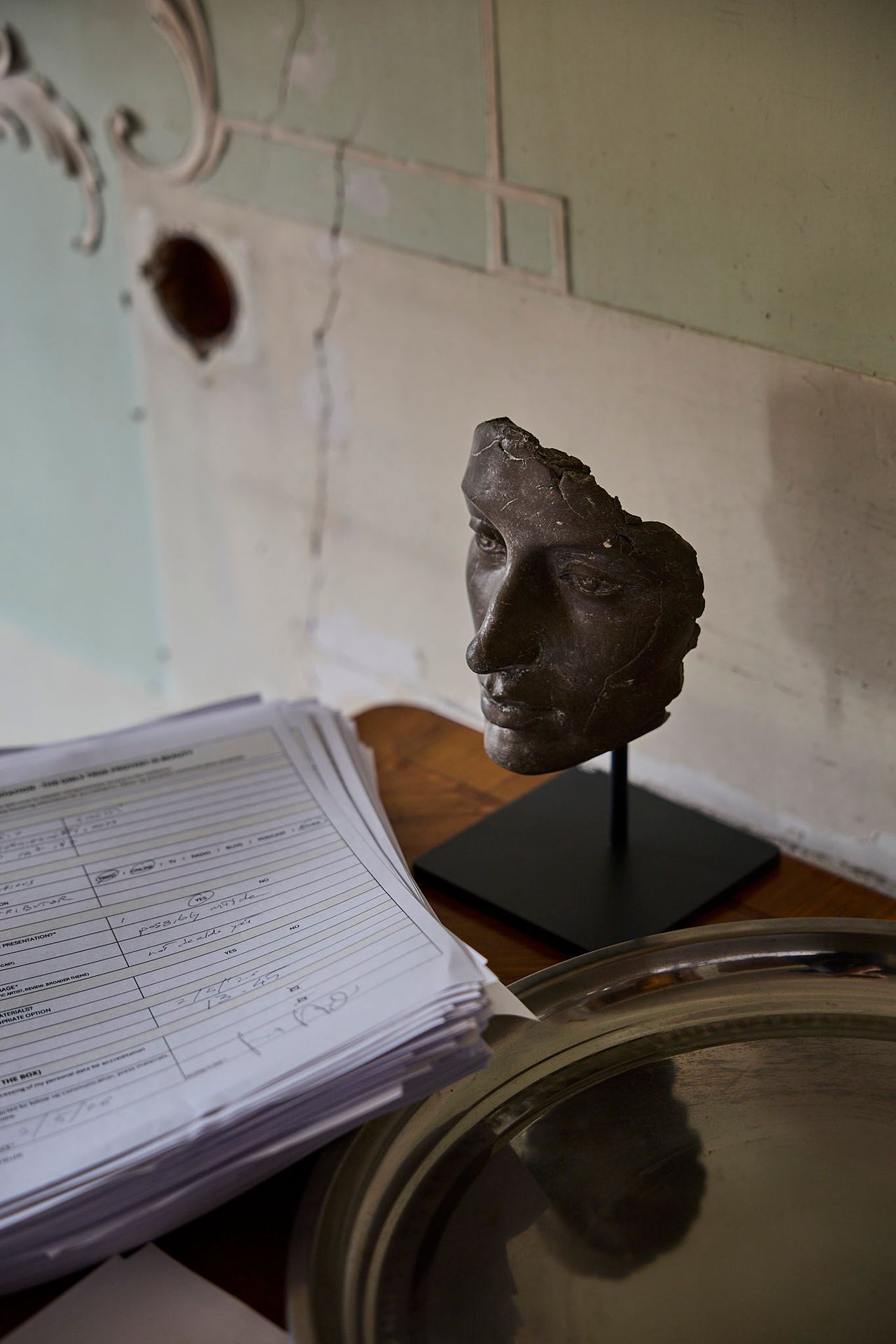
A table inside Van Noten’s office at his foundation. (Photo: Antonio Campanella for The Slowdown)
SB: I love that. I think that’s what great exhibitions should do, or great art or craft should do—change your perspective. I’ve always thought that if you understand how something’s made, or engage with an object in that way, everything else around you becomes much more illuminated.
DVN: Mm-hmm. For me, one of the most magical moments was that on one of the opening days. We did several openings days, because we wanted to invite a lot of people. After the opening, I walked through the exhibition again, oh, looking around, because everything was last-minute. I just wanted once to look again in a quiet way to what we’ve done. I find, on a staircase, three young guys who were serving at the opening party. They said, “Can I ask you something? Can we look at the exhibition?” I said, “Of course, come. I’ll give you a tour, and I’ll show you.” I showed them around because it was, for me, like, Oh, we want to do it to show young people in fact what craftsmanship is. Then I continued to talk with them and he said, “Yes, I’m studying pattern-making at the fashion school in Padova.” Another one was an art student here in Venice, and the other one was studying some hotel type of thing and Polimoda.
He said, “Can you give us advice for the future?” I said, “Always follow your heart.” Then the guy said, “Oh yes, indeed.” He pulled his T-shirt down. He said, “Look, I have a tattoo: ‘Follow your heart.’” [Laughter] It’s moments like this where I say, “Okay, this gives me energy to continue for a year.”
SB: Touching on your “fashion exit,” I guess you could say, you said fashion was an addiction and, much as you love it, that it could be too much at times. You’ve also said that leaving it for this new chapter hasn’t actually been all that difficult. Is craft or, in a sense, this atmosphere we were talking about earlier, is this kind of a continuation for you? What through line do you see between how you’re spending your time now and how you were spending it a few years ago?
“In this exhibition also, my eye, my taste, everything was shaped by all the people who I met.”
DVN: I think, of course, there are quite a lot of points in common, and I wouldn’t have been able to do this out of the blue without my education, what I had as a fashion designer for forty years. A lot of my knowledge and a lot of my experience, you see coming true now. In this exhibition also, my eye, my taste, everything was shaped by all the people who I met. My studio was always a very young team. I think that in fashion, the average age of our studio was always 28 or 29 years old. I need young people around me. I need the viewpoint of young people; they have to surprise me, to shock me, to explain me, to teach me.
It’s maybe also … not really selfish, but it was also out of the need. Because when people started to know that Patrick and I were going to retire, they said, “Oh, it’s great, because you’re going to have so much time for the garden, and for the plants.” I said, “Patrick, don’t do that to me. I don’t want to be there constantly with 70-year-old gardeners, talking about pruning and fertilizers and things like that. No, no, no.” We need to find something that, again, I can have young people around me. [Laughter] It works, because the opening week, we had all those young makers here, and it was a fantastic atmosphere.
SB: I want to turn to your upbringing. You were born in 1958, the last of four children. AYou were born into this line of retailers and tailors. Your grandfather founded what was once, if I have this correct, pretty much the only quality men’s shop in Antwerp?
DVN: Yeah.
SB: Your mother ran a Cassandre fashion franchise. Your dad had also taken over the business and opened his own shops. You grew up working in the store, surrounded by clothes, surrounded by fashion. Could you talk about that experience, how it shaped your views on craft, in particular?
DVN: For me, of course in that time I didn’t really make a difference between machine-made craft and all those things. It was just things, it was a magical world which I was part of and that I could look at and experience. Indeed, I loved fashion; I was 14 when I saw my first fashion show.
SB: 14?
DVN: 14, yes. I thought it was fantastic. And from 16 on, my father gave twice or three times a year a historic kind of a fashion show where I was already involved by helping, choosing music. I always had a lot of fun with all those things. For me, it was a very strange childhood, growing up in the middle of all those things. But I think I was 16 or 17 the moment that I really... Because the fashion business of my father was growing really fast. I got the responsibility for buying collections for the children’s department and the boutique department. I took the train, went to Brussels, to the showrooms and to all the things. For me, it was always a normal thing.
“I very quickly discovered that making fashion is much more fun than only buying and selling it.”
Going to fashion school was also the idea to continue the business of my father. But unfortunately I very quickly discovered that making fashion is much more fun than only buying and selling it. So, I went to my father I think after a few months in fashion school and I said, “Okay, sorry Dad, but I’m not going to take over the family business.” He was quite angry, and he said, “Okay, but then you can earn your own money. I’m not going to pay for your studies anymore.” In fact, in that way, that was really very good for me, because I had to earn my money, and I immediately, because of the contacts which I had with all those fabric ... all the manufacturers, I was able to design some collections for them to earn money.
SB: Were there any objects or experiences related to craft that stand out to you from your youth? Were there things in the home or in your father’s shops that you recall that were meaningful to you from a craftsmanship perspective?
DVN: My parents were always very attentive to how things were made. Strangely enough, in the family, both from the side of my father and my mother, they never bought furniture which was ready-made. All furniture in the houses—we moved a lot in my youth; I moved houses several times—all the furniture was always made to measure. I loved to go with my parents to the workshop to see how the cupboards were made and the chairs and everything were made. Everything was always designed. My mother also had always liked a lot of attention to dressing the table, the porcelain, the glasses, how the glasses were made, the lace tablecloths, because she loved lace and she had a beautiful collection of that.... Before we could start to eat, she started to describe, “Look, this is embroidered by the nuns in that cloister, in that year, and it was like this and it’s like this.” So it’s part of our education.
SB: Almost like osmosis for you, just like you were breathing and—
DVN: Yeah, absolutely.
SB: As you mentioned, you went to fashion school to study fashion at the Antwerp Royal Academy, in 1976, and it was there that you would meet all these other designers that formed this group, the Antwerp Six, as you were called. You’ve likened this to “one big creative soup.”
DVN: Yeah.
SB: Looking back, what do you make of the Antwerp Six time? Do you see that spirit alive here at the foundation in some way, this “creative soup”?
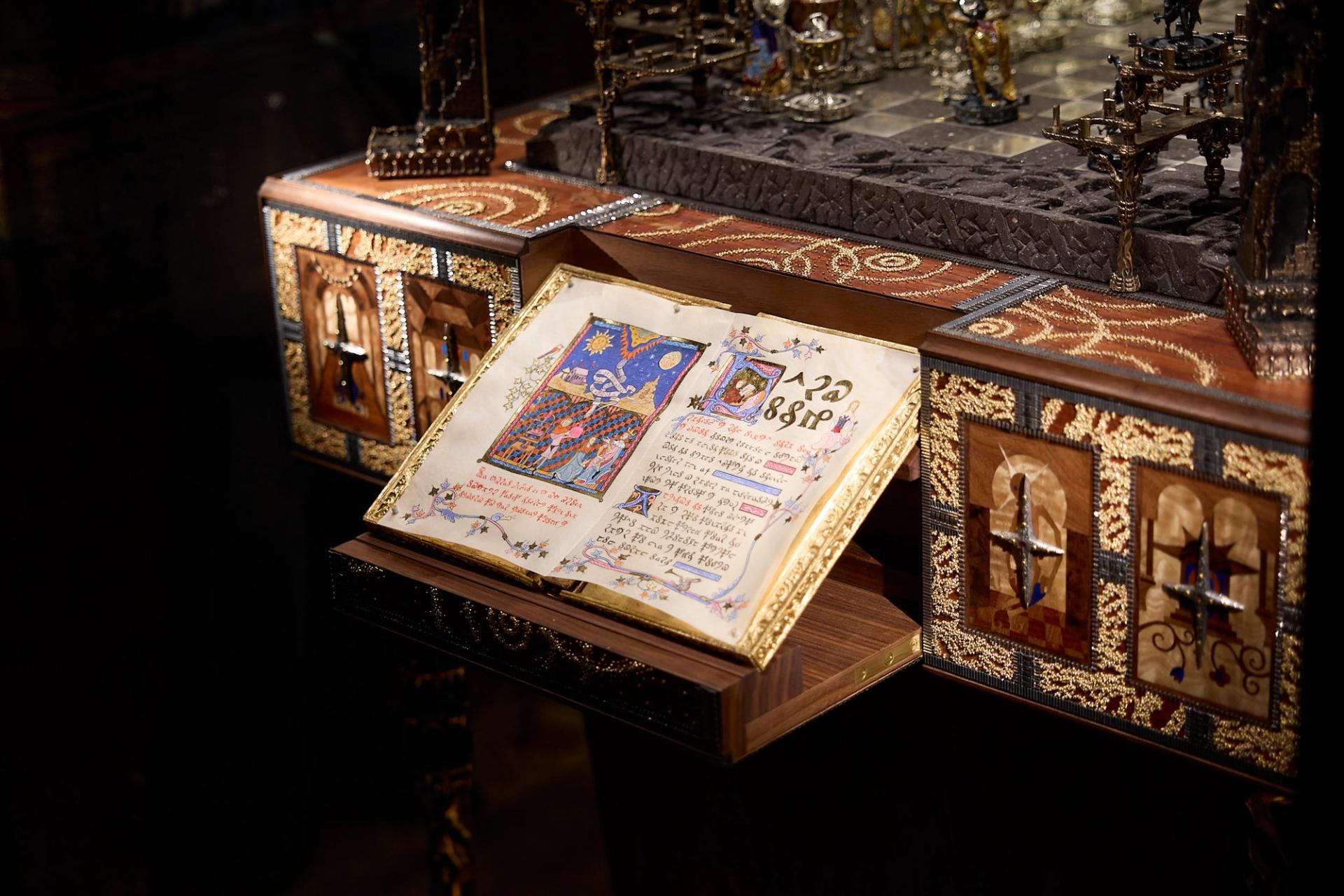
Detail of Joseph Arzoumanov’s “L'Échiquier des Songes” (2026) made with gold, silver, precious and semi-precious stones, mother of pearl, gold and silk embroidery, Armenian volcanic stone, wood marquetry, calfskin parchment, Murano glass, bronze, steel, robotic components. (Photo: Antonio Campanella for The Slowdown/Courtesy the artist)
“I want to continue, until I can’t anymore, to discover, to move forward, to question.”
DVN: I think creative soup for me is always the most inspiring. Because I told you already, I’m bored quite quickly, so I have to move forward constantly. My biggest fear, in fact, always is to arrive. My goodness, I can’t imagine that you say, “Now I arrived, and from now on I’m not going to do things anymore.” I want to continue, until I can’t anymore, to discover, to move forward, to question—
SB: Like a constant state of departure.
DVN: Yes. No, but I think that gives me the energy. But I think it’s also working on fashion in the late seventies in Belgium, a country which was, I think, the country what was known for quality, but definitely not for fashion. Because you have to see, creatively we’ve been as a group growing up in a time that was just the end of haute couture. It was the beginning of Italian fashion, so when you think about Armani and Versace, which was a revolution in fashion, leather menswear, linen, menswear for women, things like that were not really done before. That was ’75, ’76, and I started to study in ’76. Then immediately after, you had the French créateur, you had [Claude] Montana, [Thierry] Mugler, [Jules]-François Crahay, all those incredible names. Immediately afterwards, one year later you had punk, you had Vivienne Westwood, then you had immediately like 1980, Comme des Garçons, first fashion show, Yohji Yamamoto in Paris, then you had some Spanish designers.
In this time span of five, six years, you had kind of one revolution after the other. So when I explain that to young people in fashion, they say, “Yeah, the last twenty years, we didn’t have even one shift like that except like the arrival of the big groups, but that’s the only shift and that’s not the best shift maybe that fashion could make.” But it gives a kind of creative impulse that I think we still feel now in the way that we look to things.
SB: Do you think about some of the support you had, whether it was through the school, through this group, through other people who were around you, that helped build your profile early on? Is that something you’re hoping you can do here with this foundation, with different craftspeople, makers, designers?
DVN: I told you already that we are trying now to see what’s going to be the best thing to do for the Fondazione, and also again here. I’m a very curious person, so we’re going to do also things with music; next week we’re going to have a presentation of a guy [Xavier Mañosa] from Barcelona who does really beautiful ceramics. But I combined it then with young winemakers from the Veneto. You have to offer a drink at something like this, so we invited four young winemakers, and a guy who was making very interesting salsiccia, the sausages. It’s things like that, which I really like to do, so we’re going to see in fact what’s going to be the most effective, because for me it’s quite difficult now. We are contacted enormously by schools, but of course I don’t want to be the one who travels by schools and doing then always talks like the granddad knows it all and talks to the kids. No, that is not really my future, but we’re going to see where we’re going to end.
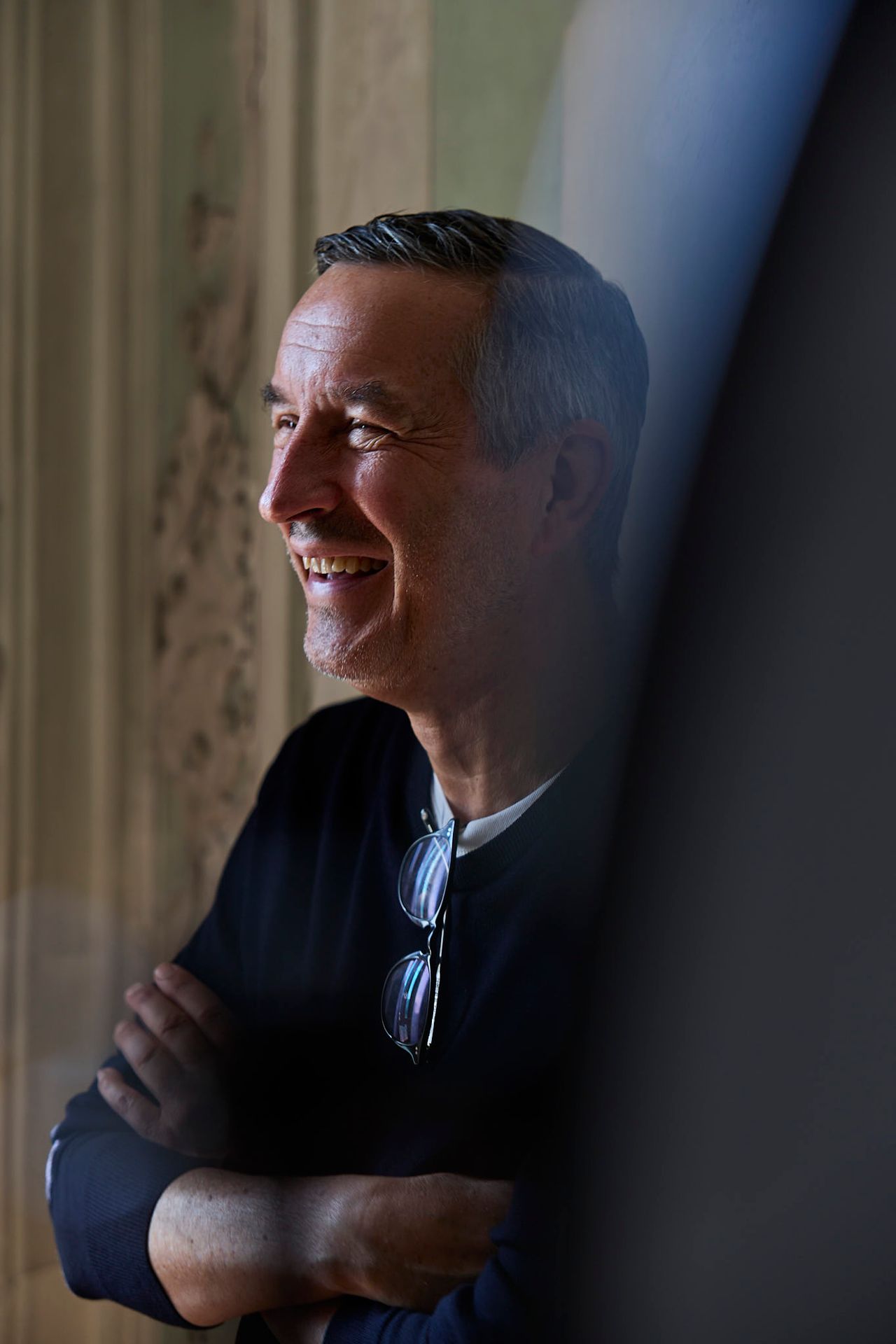
Van Noten at his new foundation in Venice during the recording of Ep. 156 of Time Sensitive. (Photo: Antonio Campanella for The Slowdown)
SB: It’s really interesting that in the eighties, this was this incubation period for you, because you only had your first runway show in ’91, right?
DVN: Yeah.
SB: In 1991. Obviously since then, you staged, if I have my numbers correct, I think a hundred and twenty-nine fashion shows, total.
DVN: The numbers are correct.
SB: From a time perspective, there’s something about fashion being so fast, the runway show in some sense being so ephemeral, but the experience of those fifteen minutes being so memorable and lasting—you really created these immersive worlds. Your reputation was for the clothes, yes, but also the feeling people got when they went to these shows. It was really about being in a room together. Could you talk about the hospitality that you were creating there? Do you hope for that spirit to come alive here? It sounds like you do.
DVN: The idea, of course, for me, receiving people is something important. I think when you invite people, you have to give them an experience, much more than just, “Look, that’s the clothes which I made the last six months,” and that’s it. For me, making a collection was always with the goal of how are we going to present it? What is the story? It’s more like a theater play. The only big difference between a theater play and a fashion show is that there are no rehearsals, which makes it really kind of even more kind of... The tension is very, very high. People feel that, also. People feel that if something goes wrong now, the magic is broken, and that creates even more that kind of, like, I’m witnessing here now something which is just an element of things which come together. It’s a huge group of people who work on a fashion show, because often there are more people, nearly, backstage or people who are involved by putting the show together, than people who are watching the ten minutes.
Of course, luckily enough afterwards with images and videos, that continues. But it’s a magical thing, and I was really addicted to that, to create together with Etienne those catwalks, to choose the spaces, think about inexpensive and small things to set the mood. We once did a fashion show with three hundred thousand Christmas lights or a hundred and twenty turning disco balls, which at the end are all quite inexpensive things, but by multiplying them, the quantity, we arrived to something which people are like, “Hey, I still remember the show; the room was covered in brown velvet,” and then people said, “Oh, this time it’s a sober show.” For the finale, the curtains opened, and it was all turning disco balls, and everybody really started to cry. It’s like, “Oh, what is this?” Also sometimes the choice of music can be so… If you do it right and you do the right mixture. I’m very grateful that we could work together with all those incredible people.
SB: Often you had musicians playing live, right?
DVN: Playing live and also we were kind of one of the few who had access to all the tapes from David Bowie to make a new version of “Golden Years” and “Heroes,” which is not easy to get. You had quite a good reputation by doing our soundtracks.
SB: Yeah. Going your own way.
DVN: Mm-hmm.
SB: Probably most famously, for your fiftieth show, you threw this infamous three-hundred-person dinner party.
DVN: Five hundred.
SB: Five-hundred-person dinner party.
DVN: Yeah. That was for a lot of people. Quite funny, because of course that image is in a lot of fashion lovers, on their brain. When we came here to the Pisani Moretta, you have that main room again with those incredible chandeliers. More than one person saw the connection.
SB: There’s so many connections though. If you really take a closer look at your shows, I’m thinking of Azuma Makoto, for example, the great Japanese floral artist who you had these installations in the middle of the runway by, or South American textile artists, the carpets that look sort of like a mossy garden.
DVN: Which we’re going to use quite soon. I’m very, very happy, because we still have them.
SB: Oh, wow.
DVN: It’s a little secret, which I tell you, but we’re going to do a music festival, end of October, and we’re going to roll them out in the salone upstairs.
SB: Okay, wow.
DVN: So you’re going to have the chandeliers to look at, and you can lay on your back, listening to music on the carpets.
SB: [Laughter] There were two places I wanted to bring up when I was looking at your fashion years, and thinking about how important India, especially, was to you. But I also wanted to talk about Japan, because you had this very formative trip to Japan early on with the Antwerp Six. You attended a Comme des Garçons show there, I believe you visited Rei Kawakubo’s studio, you saw the work of Issey Miyake, Mitsuhiro Matsuda, and Yohji Yamamoto. So could you just talk about the importance of that trip and Japan for you from a craft perspective?
DVN: It was important for us in two ways. We did two trips in fact to Japan in I think ’81 and ’83 or something like ... or ’82 and ’84. For us, it was such a new world which opened. It was not only the incredible fashion they were doing, but it was really the consistency of the whole message [of] what they did. The whole story of what they told. It was not only those beautiful collections, it was also the stores, the way that the shop staff was behaving, the music. Everything was really done in a very consistent way. That was unique, because, okay, you had Italian fashion, you had all the different types of fashion. But very often when you came to the stores, the stores were quite not neutral, but just designed, but not really telling the same story as the vision of the brand. That was fantastic to see the catalogs, the photography, everything that was.
SB: This holistic thing.
DVN: Everything mattered. It’s not like whatever. No, it was really one big vision, and this was something which we learned. It’s also not that everything had to be done very, very luxurious—because sometimes some sources were just making concrete, okay the most beautiful concrete, Tadao Ando, and things like that, but it was just concrete, it was not always automatically all made in marble and stainless steel and things like that.
SB: You’ve said that India made this huge impression on you. You said “the vibrancy of the color, the joy, and the sadness, the ugliness, and the beauty.” Tell me about working with the artisans there, these relationships that you built over the years, and what you learned about craftsmanship through your time in India.
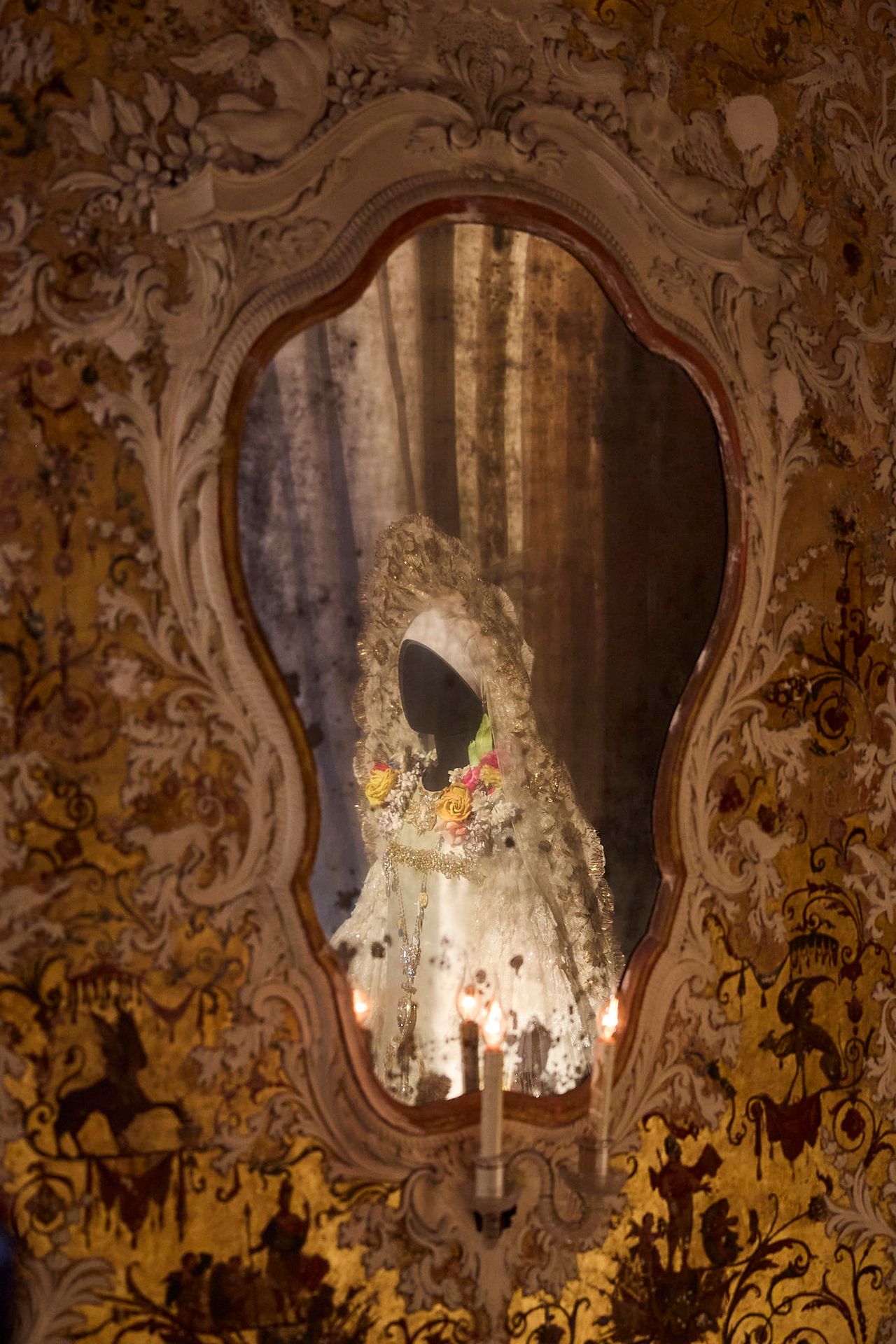
Reflection of a Christian Lacroix headdress arrangement by Fabio Petri (haute couture fall/winter 2009). (Photo: Antonio Campanella for The Slowdown/Courtesy Christian Lacroix, STL group)
DVN: India, of course, opened my eyes. I visited first a few times [in the] early eighties with a friend, and then very quickly I thought it was very interesting and challenging to see if we could also use their craftsmanship. On one hand, you saw that they were losing a lot of their knowledge, because there was the whole shift in the eighties that all the material, the beautiful materials for what they were used to, was changed in polyester. The gold became all brash. The biggest market they were working for were the Russian wedding dresses, so you can imagine, it was not always like in the eighties, so it was not always like the best taste. Starting to work with those ateliers was really trying to explain to them [so] that they started to appreciate again the beauty of their past and their knowledge, and that it was more interesting that gold had kind of a patina, and to see that you can do bullion and all those things and not everything just like the fastest and the cheapest possible.
SB: I know you built quite a large outfit out there in India during your time, correct?
DVN: Yeah. So we didn’t build it. We worked together with quite some people there, and I’m very happy that it was also manufacturers who had kind of clearly the vision to say, because already in that time we worked always with people—in that time it was called Calcutta—now it’s called Kolkata, and they saw already that it was important to keep the traditional life that really... Because most embroideries are made by men, so the knowledge was still passed on from father to son, and also that people could continue to live in the villages, that not everybody had to move to Kolkata, living in the factories. That was really the possibility that they could stay there. They developed a system [in which] prototypes were made in the factory, but then after the production pieces were really brought into the villages that people could continue to live in the countryside.
It was a very good system, but on the other hand, also for us as a brand, it was important that every season—again, we sold so many thousand pieces of embroidery—that we could keep those people working. Because it has no sense to say as a designer, “Oh, this year, you know something, I’m going to do a lot of embroidery, and the season afterwards. I did so many embroidery last season, let’s do something all plain or printed.” Now every season again we managed that we had so many thousand pieces of embroidery that those people could start to work. Often they were white on white, but that didn’t feel so much like visible embroidery. Sometimes they were all gold.
SB: I think what you’re saying, and what I think is so important to acknowledge about your work then, even to a certain extent now, is it’s really rooted in this sense of responsibility and respect for the maker. The clothes you worked on, from India to Leon to Lake Como, you worked with all these different factories and makers and fabricators. Do you see this foundation on some level connecting to that level of at least respect for the maker? Is it almost an homage?
DVN: I think it’s a homage and I think also that’s one of the reasons why there is so much fashion here in this first exhibition. Of course, because I also know when I would have to start as a young designer, not having access to those incredible mills, and unfortunately there are already a lot of them closed. When I think about all the small mills in England, which I worked with, who had the archives from at least a hundred years on where you could go through all the fabric books, to those incredible ways of making wool suit material, going to Lyon, I remember that in Lyon, there was one factory who you had to go to, and there was a guy, I think at that time he was already 75 years old. I was saying, “Yes, I’m looking for a bouclet, gold, something like this.” Then he looked at you and he said like, “Dior, 1958,” and then he went down to the archive and took kind of a book. “It’s something like this, what you say?” I said, “No, it’s too much […]” and then maybe something like this. “Chanel ’63,” and then he went down again to take another book and said, “That’s quite close to what I want. Now we’re going to see if we still can make it,” and things like that.
Those people unfortunately don’t exist. On the other hand, there are still kinds of mills, luckily enough now very often bought by Chanel or by Hermès, who really do an incredible effort to keep craftsmanship in fashion alive. There are still mills who work things on small widths, kind of on wooden looms from the 1920s. I think it’s important that we try to continue to do that, because I think it would be such a pity that we would lose all those. That’s also a little bit what we are working on now.
SB: I feel like we have to talk about gardening at least once…
DVN: Uh-oh. [Laughter]
SB: …during this conversation, because it is a podcast about time. You’ve spent a lot of time in the garden. For those who don’t know, you have this incredible, I think it’s a fifty-five-acre garden surrounding your house in Belgium. Could you speak to your gardening time a little bit? What have you learned in the garden? What has it taught you about life, about craft, about beauty?
DVN: As a child, my father forced me to work in a garden, together with my brother, and I absolutely hated it. It was the early seventies, it was David Bowie on television. Sorry, but for me it was much more exciting to look to something like this than pulling weeds out of a bed of I don’t know what flowers. For me I hated it. The moment I could, I moved immediately back to the city. When I was 18, I started fashion school. I think it was 32, I was already for a few years together with Patrick. We started to travel sometimes to England to look at archives of manufacturers, but also to visit some of the big country houses and the gardens around [them]. We fell in love with gardening. On every trip, we brought some plants back to Belgium and, at a certain moment, the balcony of our house was nearly collapsing under the weight of pots. I said, “Okay, I think we have to find a bigger garden.”
Again by coincidence we found that incredible house with a beautiful leftover of a garden, because the garden was neglected for fifty years. But I saw possibilities there, so we jumped. So you see this palazzo is not the first time that we jumped into something which was quite scary and quite big, and we started to work. In that time, I have to say, we bought the garden in three times. The first time it was six hectares, then after we bought the second piece, and then after, then we were able to restore the full size of the original park.
SB: It’s a slow evolution.
“We really felt that to have, shall I say, a healthy life in fashion, we needed something like a garden, which puts you with your two feet on the ground, with your hands in the soil.”
DVN: It was a slow evolution, luckily, because otherwise I think we would have bought the whole thing in one time, we never would have dared to do it. But in that time we really felt that to have, shall I say, a healthy life in fashion, we needed something like a garden, which puts you really with your two feet on the ground, with your hands in the soil—dictates also sometimes certain things. So sometimes we had to leave the office, because we had a whole week of rain and the grass was too long, and we had to mow it. The first day of sun, you say, “I’m truly sorry, meetings or no meetings, I have to go home because the grass has to be mowed.”
SB: The garden doesn’t wait.
DVN: No, the garden doesn’t wait, and also sometimes it can grow or it can’t grow, and you can do whatever you want, and in fashion, you say, “There I want red and there I want blue,” and then the red flowers don’t flower, or the flower, you do a whole composition of colors, and then, one season, they flower exactly the way that you were hoping for, and the season afterwards, everything flowers at the same time. So, it’s good to stay humble sometimes and to put your two feet on the ground.
SB: I love what Hanya Yanagihara wrote about your gardens. She wrote, “These gardens feel both familiar and startling. Familiar because in them, one finds the colors, the unexpected juxtapositions, that one recognizes in his designs; startling because it is rare to see, in such an intimate way, the origins of a creative mind’s inspirations.”
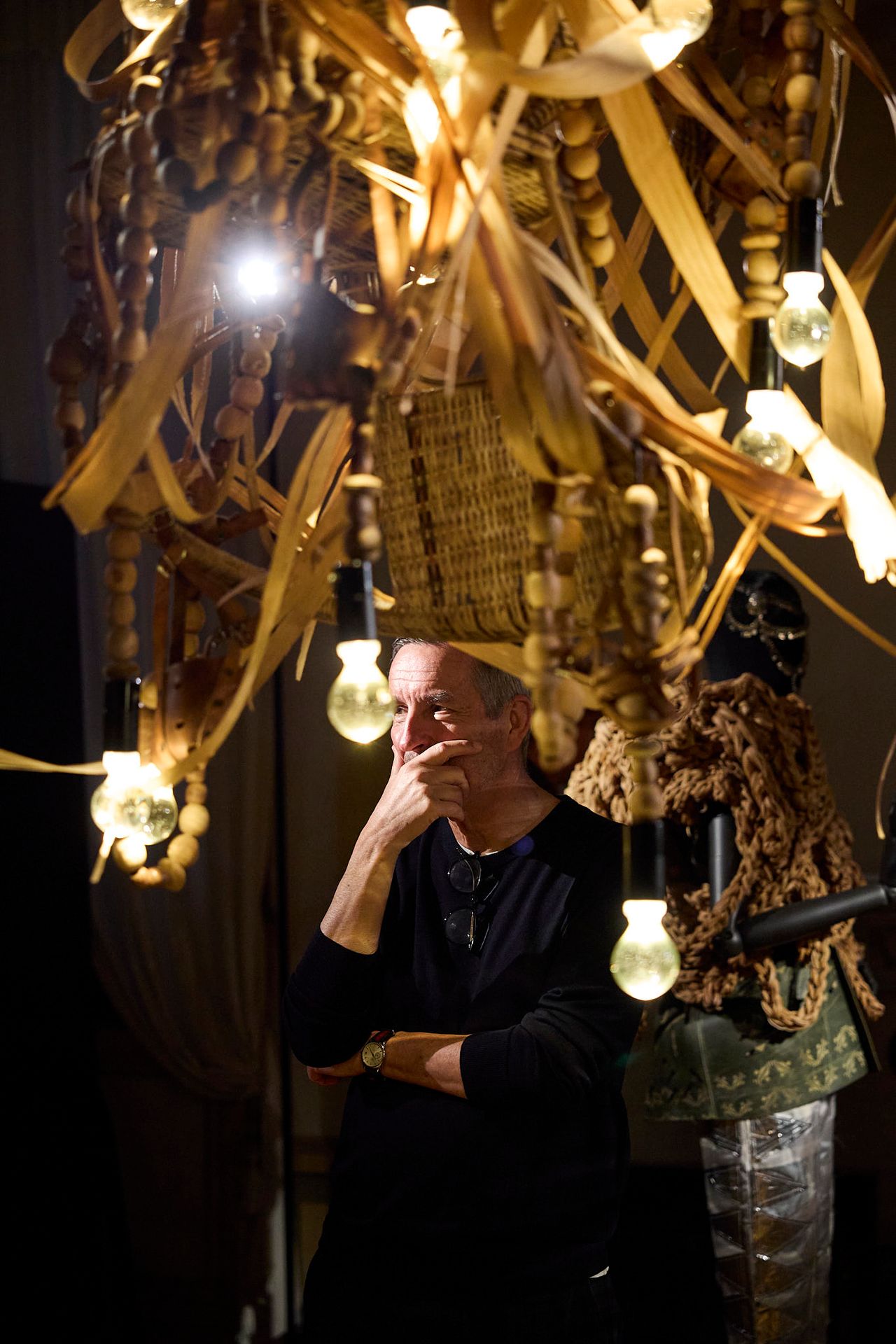
Van Noten at his foundation. (Photo: Antonio Campanella for The Slowdown)
DVN: Mm-hmm. Of course, gardening, of course, being creative doesn’t stop when you come home. Paul yesterday had to go through a lot of experiments in the kitchen, and in the garden also. So, of course you do things, like when I planted the rose garden, which is now twelve years old, I think, twelve, thirteen years ago, years ago fast, okay, there are the rules of how you have to put a rose garden and what’s best for the plants, but I said, “I don’t have time. If I plant the garden, in two years, I want to see already what I have in my mind and not wait five years.” I planted far too much, with far too much underplanting, with a lot of peonies and things like that. Some kinds of gardeners come to my garden and say it’s impossible. But the effect is really, it feels like plants tumbling over each other and things like that. Very difficult to keep it tidy, very difficult to keep it in a good shape, but the effect is glorious.
SB: Do you view this foundation as a garden?
DVN: A garden can be kind of symbolic of a life, so yes.
SB: To finish, as I was researching, I came across this newspaper clipping from 1987.
DVN: Ooh, la. A while ago.
SB: A while ago. You said, “To design clothing forever would not be interesting. I want to do more, maybe fabrics and furnishings.” Could you ever have imagined this foundation back then? Did you ever think that something like this would be possible, this large palazzo in Venice?
DVN: No, I think for us it was really okay. We were dreaming big, but stayed always with our two feet on the ground. I think that’s also kind of a Belgian attitude. Of course, even three years ago, I couldn’t have imagined it. A while ago we were sitting here with a few friends at Porta d’Acqua in front of the palazzo, with a good glass of wine, seeing the gondolas passing by. We said, “Could you even imagine two years ago that we would sit here looking at this? No. Incredible.” We are really lucky guys, and we have to appreciate it every day, that what we can do is really exceptional.
SB: Elsewhere in my research, there was this quote where you said, “At any particular moment, I can see that I am a child of the time I am living in.” I love this idea of looking at the world with a childlike curiosity, just being totally in awe at the wonderment of what is. Venice is certainly a place that it’s hard not to feel that.
DVN: In awe, yes, but also realizing, in fact, that the world is not such a nice place, hence the title, and maybe you make now the full circle.
SB: Dries, thank you for having this conversation and inviting us in.
DVN: Thank you. Very nice to talk to you.
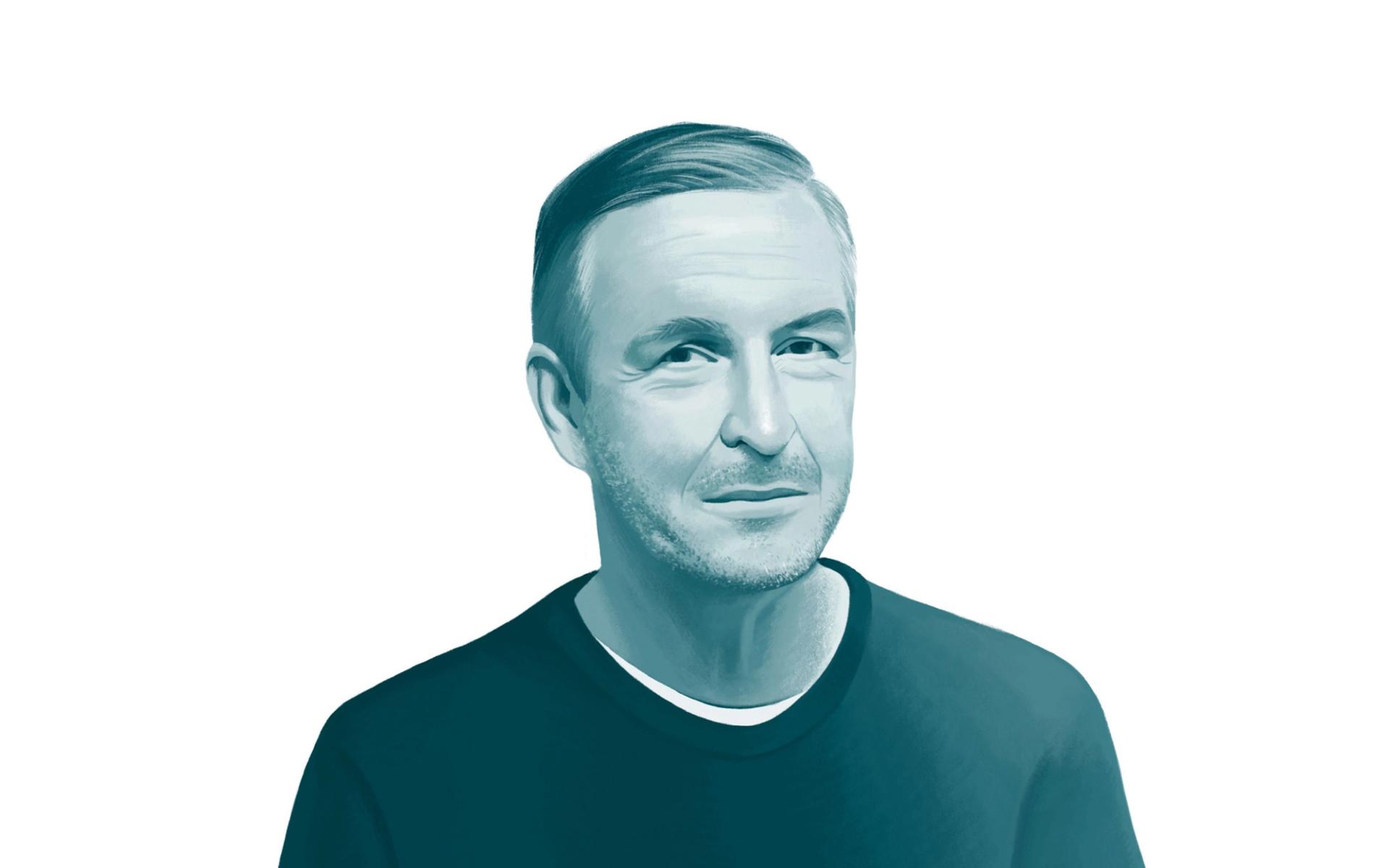
This interview was recorded in Venice, Italy, at the Fondazione Dries Van Noten on Friday, May 22, 2026. The transcript has been slightly condensed and edited for clarity. The episode was produced by Olivia Aylmer, Ramon Broza, Mimi Hannon, and Johnny Simon. Illustration by Paola Wiciak based on a photograph by Antonio Campanella.