Follow us on Instagram (@slowdown.media) and subscribe to our weekly newsletter to receive behind-the-scenes updates and carefully curated musings.
TRANSCRIPT

Mona Chalabi in the Time Sensitive studio during the recording of Ep. 161. (Photo: Matthew Harrington for The Slowdown)
SPENCER BAILEY: Hi, Mona. Welcome to Time Sensitive.
MONA CHALABI: Hi, thank you so much for having me!
SB: Let’s just cut straight to the subject.
MC: Okay.
SB: Let’s talk money—
MC: I’m ready.
SB: … and your new book, Ten Lives: How What We Have Shapes Who We Are. You write that “we’ve been so discreet about our money that we barely have a vocabulary for talking about it.” Yet you also note elsewhere that we all seem obsessed with getting to some kind of truth about money. There seems to be a disjunction between those two things. Throughout the book, you’re remarkably open about your own finances.
MC: Yeah, in a way that I’m obviously very uncomfortable with now, but anyway, this is going to be an interesting interview.
SB: So, I was thinking we could start our conversation by trying to get to some of that vocabulary, and maybe the best way to do that is just getting personal. What did money mean to you growing up in East London? How has your relationship to it and what you thought it could give you changed over time?
MC: I think that… you know there’s this fantasy that kids aren’t aware of race, and kids aren’t aware of money? I think, actually, that very often is a fantasy. I think kids are aware of those things from a very, very young age. So, I remember the primary school that I went to was a very... Most of the kids that went to this primary school were poor. It’s so funny, even still, my instinct is to be like, it was a very disadvantaged school. What does that mean, “disadvantaged”? What are you talking about? The vocabulary is still lacking. But anyway. A lot of the kids that when they were poor— I was quite aware of the fact that I had more money than those kids.
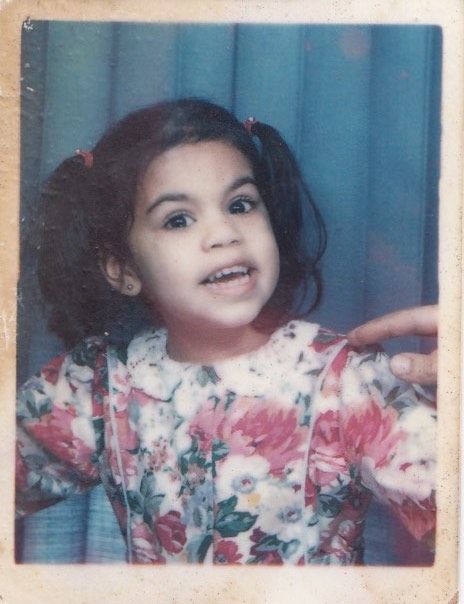
Chalabi as a child in 1990. (Courtesy Mona Chalabi)
But then, when I was maybe 9 or 10, my mom put me in a private school for about a year, and then I was the poorest kid in the class, and I was hyper-aware of money, again, in a very, very different way. Basically we grew up... It’s so funny, I’m still using all of this trashy vocabulary. I want to say comfortable. What does “comfortable” mean? So, in the book, I think it’s just much better to use numbers wherever possible. Growing up, my parents’ combined household income would’ve been about a hundred thousand dollars in today’s money. But my dad became sick, so we went down to one income. Again, as a child, I was hyper-aware that something had shifted.
I think that was the beginning of me also worrying a lot about money. I will also say that some of this is about your environment and your circumstances, and some of this is just character. When I speak to my sister and I talk about how there were times when money was difficult or whatever, she’s like, “What are you talking about?” Even though we both lived under that house, she has a totally different set of experiences. Part of the reason that she has a different understanding of our economic circumstances and our class, basically, is that I have moved over here. I spent a lot of time with a lot of wealthy people.
So, I spent a lot of time looking up and looking at people who came from wealth, who had parents who earned a lot of money. My sister, her life has taken a very different path. She spends a lot of time working with charities, working with people who have just arrived to the U.K. with nothing. I would actually say she’s more grounded in reality than I am. She’s like, “We were fine. What are you talking about? There was never a question of us being homeless. There was never a question of us not being able to eat. We were fine.”
SB: I think what you’re basically saying is context, right?
MC: Yes.
SB: Context shapes how we understand money and, therefore, how we see the world and also, in turn, who we are.
MC: Yeah. That’s so important. I realize I’m being so garbled in some points, because I’m getting my head around how to talk about this.
When you say “who we are,” I think part of the thing that the book is trying to get at is that money is also part of our very identity. It’s not just a fact of life and how we move through the world. It shapes how we understand ourselves. When it comes down to intersectionality, when you are doing all of these hyphens about your sexuality, your race, your gender—money very rarely is articulated within that.
What’s interesting is that if it is, I would say it tends to be people who are working class who might say, “I came from a white suburban working-class background,” for example. But what’s really telling to me is people who have more rarely will integrate that into their intersectional identity. And if they do, they might say “middle class.” They might, at a push, say “upper middle class.” For me, if somebody says upper middle class, that means you’ve grown up filthy rich. Filthy rich. Seriously, because who says upper class? When was the last time you heard someone say, “I grew up in an upper-class environment?”
SB: I have an anecdote that I have to share here.
MC: Yeah, tell me.
SB: Well, one, I knew that I would have to share a little bit about—
MC: Well, you don’t have to.
SB: Money in my life... Well, I feel like it’s a cop-out not to in a way—
MC: I agree. [Laughs]
SB: There was a freshman class I had in college [at Dickinson College, a private liberal-arts college in Carlisle, Pennsylvania] where the teacher went up to the board and he drew a line across the board. This was a class that had to do about wealth and money and inequality in America. He asked all the students to go to the board and mark where you fall on the line—
MC: That is incredible.
SB: With the left side being poor and the right side being rich.
MC: Okay, but there weren’t numbers on that line...
SB: There were not numbers on the line.
MC: Okay, interesting.
SB: Obviously, it was an exercise I think most of the class did not really feel comfortable or want to participate in, but I have always felt that it’s important to articulate and be open about your privilege. I went up to the board and I put myself on the far right side. I was the only student in the class who did that. There was one student who said she had a full-ride scholarship to the college and she marked herself closer to the far left side. Most people put their little markers toward the middle or maybe slightly to the right of middle.
The teacher asked me, “Spencer, I see you put yourself…” I said, “Well, I don’t think I should be alone on that side, actually? I’m curious, how many people in this room went to private school? How many people in this room have parents who make more than two hundred thousand dollars a year?” I don’t think many people really wanted to participate, but for me, it was very jarring that a lot of the class wanted to classify themselves as “middle class” or “upper middle class.” This word rich almost was like, “We can’t say it.”
“We do live in a society where money is so aspirational, and yet, you don’t want to say that you’ve arrived. There’s some shame in just being like, ‘I’m here.’”
MC: Yeah. That’s such a powerful anecdote. It reveals so much. We do live in a society where money is so aspirational, and yet, you don’t want to say that you’ve arrived. There’s some shame in just being like, “I’m here.” I’m also just thinking about how different that whole exercise would’ve been if there were numbers on the board. Again, that’s part of what the book is trying to do is to really, really get specific, because once there are numbers on the board, the act of lying becomes much more explicit, actually.
The truth is, many of us, as you’re already saying, many of the people who are noting where they are on the line are ultimately lying, but they get to kind of obfuscate because they’re not being specific. The other part of it is that I would also say there are many people who feel a disconnect between what their bank balance is and their perceived class. I’ve written in the past, and I think I mentioned this in the book, this concept of money dysmorphia, I think it’s actually in the introduction, sometimes there’s a disconnect between your bank balance and how you feel.
So, for example, for me, when I started to accrue wealth and I actually became rich, that feels so strange for me to say, because it’s not part of my identity, right? Those are other people who are rich, that’s not me. So, it can go that way. Similarly, you hear loads of stories of people who grew up with wealth and then lose it and still want to go shopping in Ralph Lauren, or whatever, because they just can’t get their heads around the fact that they don’t have that money anymore. I think there is, for some people, a very real disconnect, but it’s also people playing with the truth. Like you said, some of the other students in that class just were lying. They were just straight-up lying.
SB: One thing your book does, which we’ll definitely get to, is the nuance that underlies all of these stories and how personal money is. I own my privilege, but I also would say that part of owning it is understanding where it comes from or how you came into it. In my case, it was a combination of a horrible accident that my family suffered when I was young, a plane crash, and there was a legal and financial settlement that followed this, and my mother passed in this crash.
MC: Oh, my God.
SB: I’ve talked about this on the podcast. My mother came from some wealth—significant wealth, actually—that I then inherited after she died.
MC: Wow.
SB: So, for me, money’s always been imbued with—
MC: Grief.
SB: Grief, loss. I mean, to call it “blood money” is actually quite accurate, in a way. It’s always been a very complex thing for me. It’s never felt straightforward. That’s one thing I love that your book does, is show how you can make assumptions about somebody, whether they’re rich or poor based on what their lot in life is, and almost always those assumptions are wrong.
MC: Unless you’re really going to spend five years following them and understanding exactly where that money came from and exactly how it has fluctuated over the course of their life.
Can I ask to go back to this idea of assumptions and also that class exercise that, again, I think we’re going to be talking about the whole way through? [Laughter] It’s fascinating.
SB: I had to bring it up because of what you do for a living, too. It’s like the idea of just a line across the board and how people mark it, right?
MC: But also, I love that professor. It’s such a spicy first exercise.
SB: [Laughs]
MC: I’m curious, because it was the first day, how do you feel like it changed the way that the students perceived you and it changed the relationships between you?
SB: I actually felt a level of respect, which was interesting that—
MC: Wow.
SB: ... and partially—
MC: For your honesty or for your wealth?
SB: Oh, man. I think for the honesty [Laughs], but I don’t know. I mean, that’s a very good question. I think more so for the honesty, because I put it forward to the class like, “Hey, have you actually thought about this? Are you saying you’re upper middle class because your parents told you that that’s what you are? Or have you actually looked at U.S. census data? Have you actually looked at where you fall in not just America, but in the world?” Because I think in that exercise, the professor was probably talking about America, but if we were talking in the world, almost everybody on that board would be far right.
MC: I mean, I would say that everyone on that board might even be in the top one percent worldwide. Worldwide, we are hyper, hyper privileged. But then that goes to something that you said earlier, which is about context. If you are living in New York and you are making forty thousand dollars a year, who gives a shit that you’re very, very privileged on a global level? This is your life, this is where you live, this is the cost of groceries and rent here. Someone kind of patting you on the shoulder and being like, “You are rich, relatively speaking.” Fuck you!
SB: [Laughs]
MC: And that is real.
And at the same time, what’s kind of fucked up is that some of the students in that class, like me, have spent time with people who are hyper, hyper rich, that has distorted their notion of their own privilege. So, they spend time with kids whose parents earned millions, rather than simply hundreds of thousands of dollars, and they don’t see how lucky they are.
SB: Yeah. I mean, very often, too, the wealthiest families cash-wise are sometimes the poorest emotionally, which is also another dichotomy in this.
MC: Yeah, because again, you might have been raised, then, by nannies rather than by a primary caregiver who is constantly there. Again, that is so far removed from my experience that I can’t really imagine it, but yeah.
SB: I want to talk about definitions of wealth at some point in this conversation too, but I think just to go back to your journey, I loved learning that one of your first jobs was a place called Bling, which—
MC: [Laughs] Yeah, East London. Gotta love East London.
SB: For a book about money is just fantastic. Early in your career when you were working at The Guardian in London, you were earning thirty-two thousand pounds a year. You write that you felt successful and content, but you also worried you were too young to feel that way. Why did contentment feel like something to be suspicious of? Or where was that kind of feeling coming from?
MC: I mean, some of it is my character. My friends will just tell you that I just love misery.
SB: Misery?
“Being comfortable is uncomfortable to me, in some ways.”
MC: I love misery. Yeah. It’s funny, I’m a really jovial person or whatever, but I’m quite comfortable with difficulty and misery. Honestly, being comfortable is uncomfortable to me, in some ways. So, I just felt like I wanted to stretch myself. For so many people in the U.K., if you have ambitions of being a journalist, if you get to The Guardian, then you’ve arrived. That’s it, right? There’s so few other really reputable places to work. So, what am I going to do? Just coast from 26 until retirement at The Guardian? No way.
But also, I want to say my notions of ambition were about professional… wanting to get better at what I do, wanting to hone my craft, and I did want to earn more money, one hundred percent.
SB: Your story of coming to America is kind of jarring, honestly.
MC: Really?
SB: Well, because it was an opportunity and it felt like so much hope, and then the reality when you get here was anything but. Maybe you could just share a little bit about that experience.
MC: So, I was looking around at who is good in this field of data journalism, and there was this guy called Nate Silver who had gotten very, very successful predicting U.S. election outcomes. I was reading as much as I could about him, and I saw that he had left The New York Times and was setting up a new website at ESPN. It’s so interesting, looking back. FiveThirtyEight launched—I want to say it was either the same week or the same month as Vox? So, it was Ezra Klein’s Vox and Nate Silver’s FiveThirtyEight. It was these two guys who were widely held up as geeks and savants and numbers guys setting up their own respective websites.
Anyway, I wrote to Nate Silver; asked if I could have an interview. He brought me over for an interview. I was here for a day for that, and then got the job and came back. I was one of their very first hires, and it was just terrible. I just realized really, really early on, “Oh God, this is not good.” But I didn’t realize that I had locked myself in—I learned this expression afterwards, called the “golden handcuffs.” Normally, that’s used for a well-paid job, but this was actually a different kind of golden handcuffs because it was related to debt.
Basically, the company said that they had paid so much for my 01 visa to bring me over for... They put me up in corporate accommodation for maybe six weeks or two months in Midtown. They’d shipped my things over from the U.K. They said that if you want to leave, you have to pay us about a hundred thousand dollars. I did not have a hundred thousand dollars lying around, so I just had to... Sorry, if I wanted to leave before eighteen months, I think it was. There’s a possibility it was twelve months, but I think it was eighteen. So, I just had to wait it out. That’s actually when I started drawing. I wasn’t illustrating before that, but I was so—

Chalabi at work on a painted illustration. (Photo: Poupay Jutharat)
SB: Oh, wow.
MC: ... fucking bored at my desk, and I was so depressed that I doodled. I was never a doodler. I remember looking at the kids in class when I was in high school and I would be like, “What are you doing? Focus.”
SB: [Laughs]
MC: And then I became that person. It was a godsend.
SB: So, that moment of tension, boredom, frustration led to you merging this data journalism with illustration.
MC: Yeah. And it was also me looking around at these people who were... It changed my whole relationship with data journalism. I saw them building these really intellectually domineering interactives that were very, very complicated that showed you state-by-state outcomes of who was going to win the election. I was just like, “Okay, if you guys are going to do that and I don’t see a way into that, I’m going to do something else.” So, I started to post them on Instagram and I literally had a hundred followers.
What happened was, quite early on, I would say maybe after six, seven months of doing it, I created a hand-drawn data visualization that was about circumcision rates in the Midwest, the South of the U.S., the East Coast and West coast, maybe something like that. And Jerry Saltz, I still have no idea how he found it, but The New York Magazine’s art critic, Jerry Saltz, found it and posted on his account. Overnight, I went from a hundred followers to a thousand, and then it was just constantly like that. I would do one weird illustration that would get this big bump.
SB: Okay, but it started with circumcision?
MC: It started with circumcision rates.
SB: That’s hilarious. [Laughs]
MC: I should say the way that I illustrated it was to show the different rates. I drew these little penises as bar charts. It was just so nice because within that building, I felt like I wasn’t respected and it was all going to shit.
SB: So, you were working with a bunch of dicks and then drew a bunch of dicks.
[Laughter]
MC: That’s a pretty good summary. Yeah.
SB: I love that. How fascinating to think about this importance in a way of taking something that is often viewed as kind of hard-and-fast data and then doing something slow with it, which is drawing.
“I became really, really critical of this idea of perfect computer-generated graphics that make the world seem really, really precise when that’s not how epistemology works. That’s not how we know things.”
MC: Yeah. It was also because I was becoming disillusioned with data journalism itself, I was watching Nate and I was like, “Oh, do you know what? I don’t believe it anymore. I don’t believe that you can predict elections. I don’t believe that you can sit there and, with your massive Excel spreadsheet, say there’s a forty-two point three chance of this candidate winning.” I don’t buy it. How do you know one month in advance? I became really, really critical of this idea of perfect computer-generated graphics that make the world seem really, really precise when that’s not how epistemology works. That’s not how we know things.
SB: It’s gambling with reality.
MC: Yeah. I’m sorry. The analogy that I always, always give is you would’ve opened your phone up, I’m guessing this morning, one of the first things you did was to check the weather forecast, right? It might have said a ten percent chance of rain. And you understand from that, oh, it means there could be somewhere between a zero and a twenty percent chance of rain. And that’s meteorologists, this is the physical sciences, predicting the chance of precipitation today. There is no way in which that is less precise than predicting the behavior of millions of people one month from now. It’s just not true. It’s not true.
But what happens, though, is that I really, really also became hyper-focused with... I became interested in the way that journalism is also shaping the world itself. I remember taking a ride in a cab and the cab driver was saying to me, “Oh, I want to vote for this candidate.” It was the midterms or something. He was like, “I want to vote for this candidate, but they don’t have a chance of winning. I’ve seen the numbers.” And I’m like, “What? You should vote for the guy that you believe in and the guy whose policies you back. You shouldn’t be voting for the guy who the journalism is telling you has only got a thirty-five percent chance of winning.”
Look at Mamdani. I remember being in a room with him. He was giving some kind of talk, and it was maybe eight months before the election, and he was polling at one percent. And by the way, anybody else on the polls was polling at two percent, and he was polling at one percent. Can you imagine if people were just like, “I like that guy, but I’m not going to vote for him because he doesn’t have a chance.” Anyway. Yeah, I’m going to run if I don’t want to buy it, don’t worry.
[Laughter]
MC: Keep moving, keep moving.
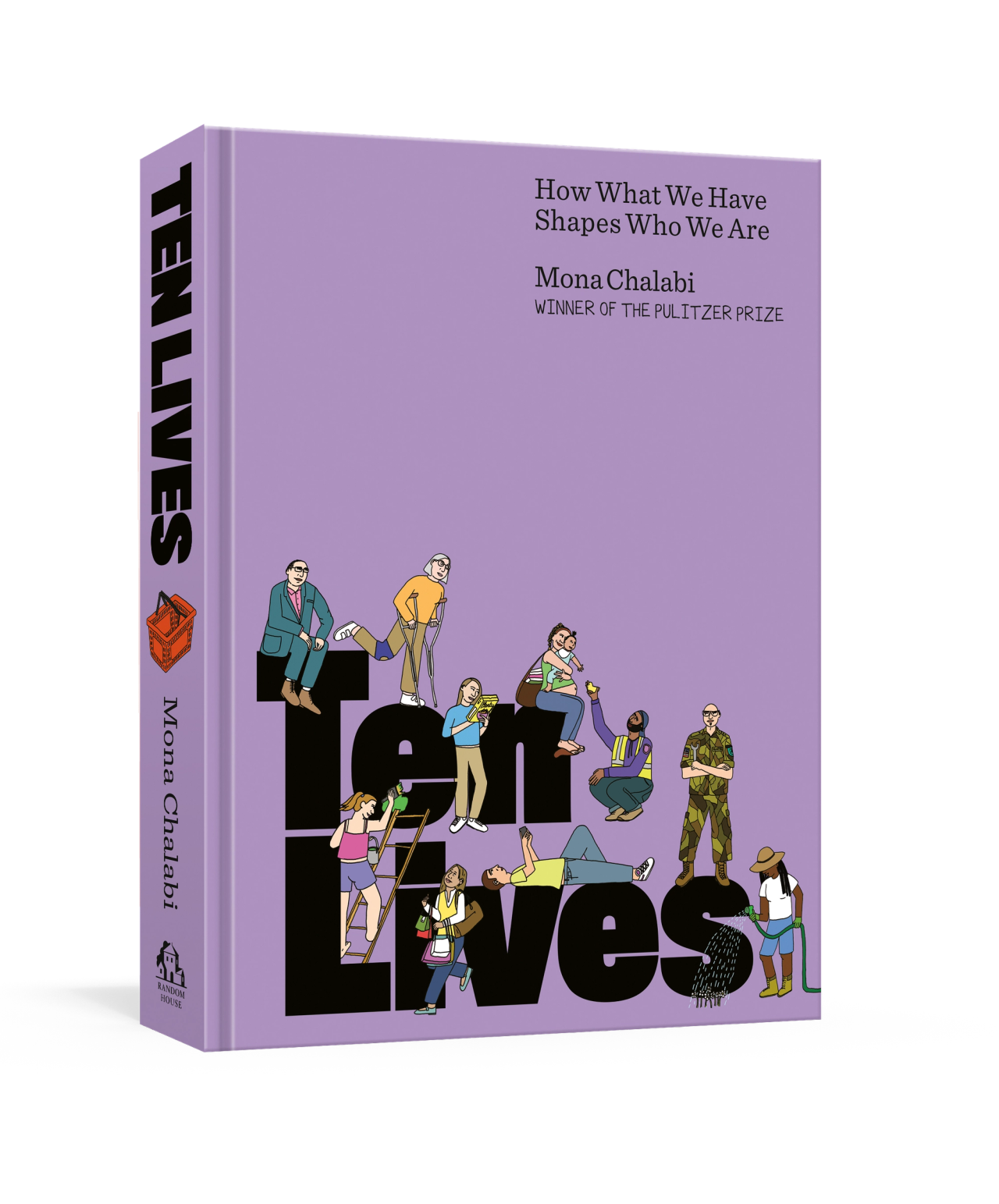
Cover of Ten Lives: How What We Have Shapes Who We Are (2026). (Courtesy Random House)
SB: Let’s go back to your book. How did you choose the ten lives that it centered? What were you looking for in choosing those specific ten?
MC: Such a good question. I sold the book in early 2020, and I said to the publisher, which was Penguin Ransom House, “Okay, I think it’s going to take me eighteen months to write this. It’ll take me about two months maybe tops to find these ten people, and I’ll just interview them and write it.” Oh my God, delusional, delusional.
I think finding the ten people in itself probably took me two years actually to fill in all of those slots. That was really, really challenging because I knew... Look, I didn’t need everyone to be a perfect class representative. I was actually really open to the idea that the person in the richest ten percent might be a person of color, might be a Native American. Then you get to just speak to that person and they don’t have to be this perfect symbol because actually the charts can do that contextualizing work. You can say in the charts, look how rare it is for somebody who’s Native American to be in the richest ten percent, but this is this person’s story. I knew that I didn’t want them to just be based on the East Coast and West Coast. I knew that I didn’t just want them to come from my age bracket. I knew that I wanted to speak to some people who were immigrants. I wanted to speak to some people who had an experience of disability. I had all of these things that I kind of wanted to cover, and it was really, really tough.
The first few were kind of okay when you’re filling in the slots, but then you get to a place where you’re like, “Okay, I want to meet someone who’s earning roughly fifty-five thousand dollars, who’s living in the Midwest and is doing surrogacy.” It’s like, “Yeah, good luck finding that person.”
So, the recruitment was interesting. I did some call-outs from Instagram that were like, “Do you want to talk to me about money?” For some of the other more specific things, I knew that I wanted to find somebody who was working in an Amazon warehouse. That was going to local press reporting to try and find that person.
SB: I wanted to ask you about him because he’s a case where this one life changed dramatically—
MC: Totally.
SB: ... in the writing of your book. I can name him. His name’s Christian Smalls. When you first met Christian Smalls, he was not yet a public figure.
MC: Not at all.
SB: But he became so through his efforts to unionize Amazon workers. What was it like to watch that journey? And what did you learn about your time with him through that?
MC: Yeah, it was incredible. So, Christian Smalls is the only person in the book who you will find out their true, real name. Everyone else, their first names are pseudonyms. It was really interesting, literally even just... We were doing Zoom calls, and I could see the environment behind Christian on these calls, and he was living in the basement of a friend’s apartment. Was it a basement? He was living in a friend’s apartment in a really, really rough part of town with his kids living with him part time. Yeah, it was really, really rough. It’s interesting to think about the ways in which he’s changed and the ways in which he hasn’t, actually. A lot of his character traits have remained the same, partly because I think he has found wealth at a time when he is very much a fully formed adult. I think he’s basically the same age as I am. It’s also fascinating that both of us got to a totally different place of wealth through book deals. The book deal was really, really instrumental for him. I don’t know, what else can I say about watching him change?
SB: I mean, there’s this scene where he rolls up in a BMW.
MC: Yeah, a white pearlescent BMW and lowers the window. I was like, “Oh, hi, Chris.” I mean, we’ve had really, really frank conversations actually because... Okay, so actually, it’s still unclear to me how much wealth exactly Christian has now, but let’s say it’s plausible that we have similar levels of wealth. But the fact that we grew up with very, very different household incomes, very different household levels of wealth, changes our identities and the way that we interact with money.
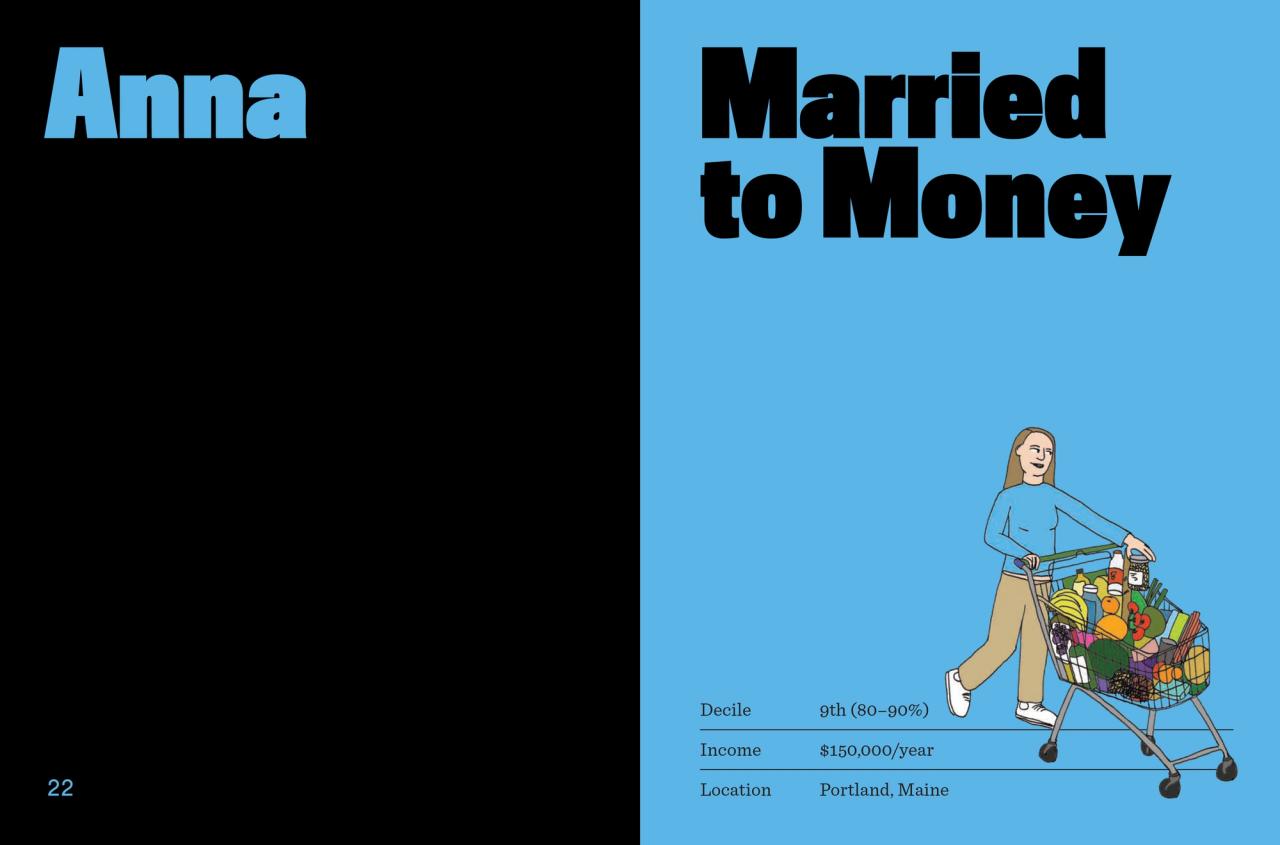
An interior spread from Ten Lives. (Courtesy Random House)
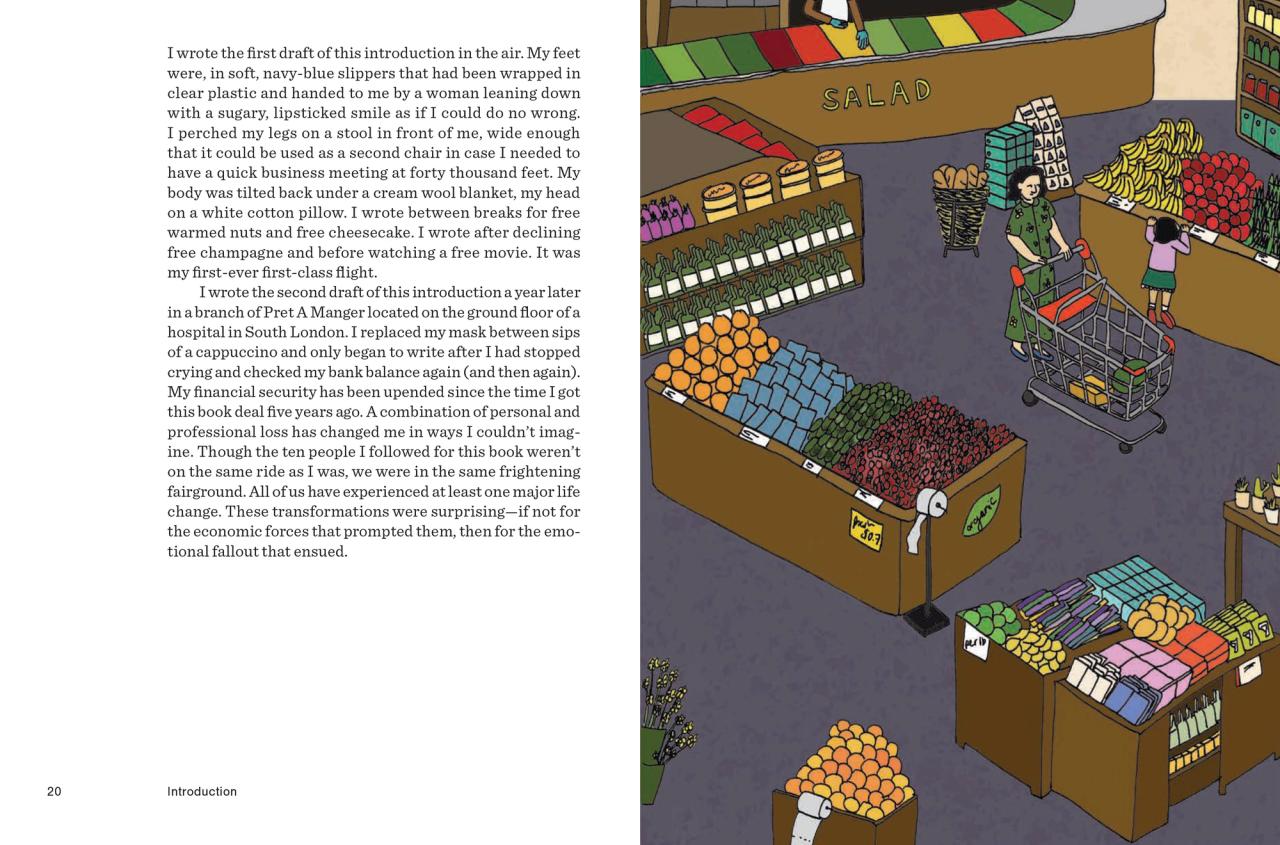
An interior spread from the introduction to Ten Lives. (Courtesy Random House)
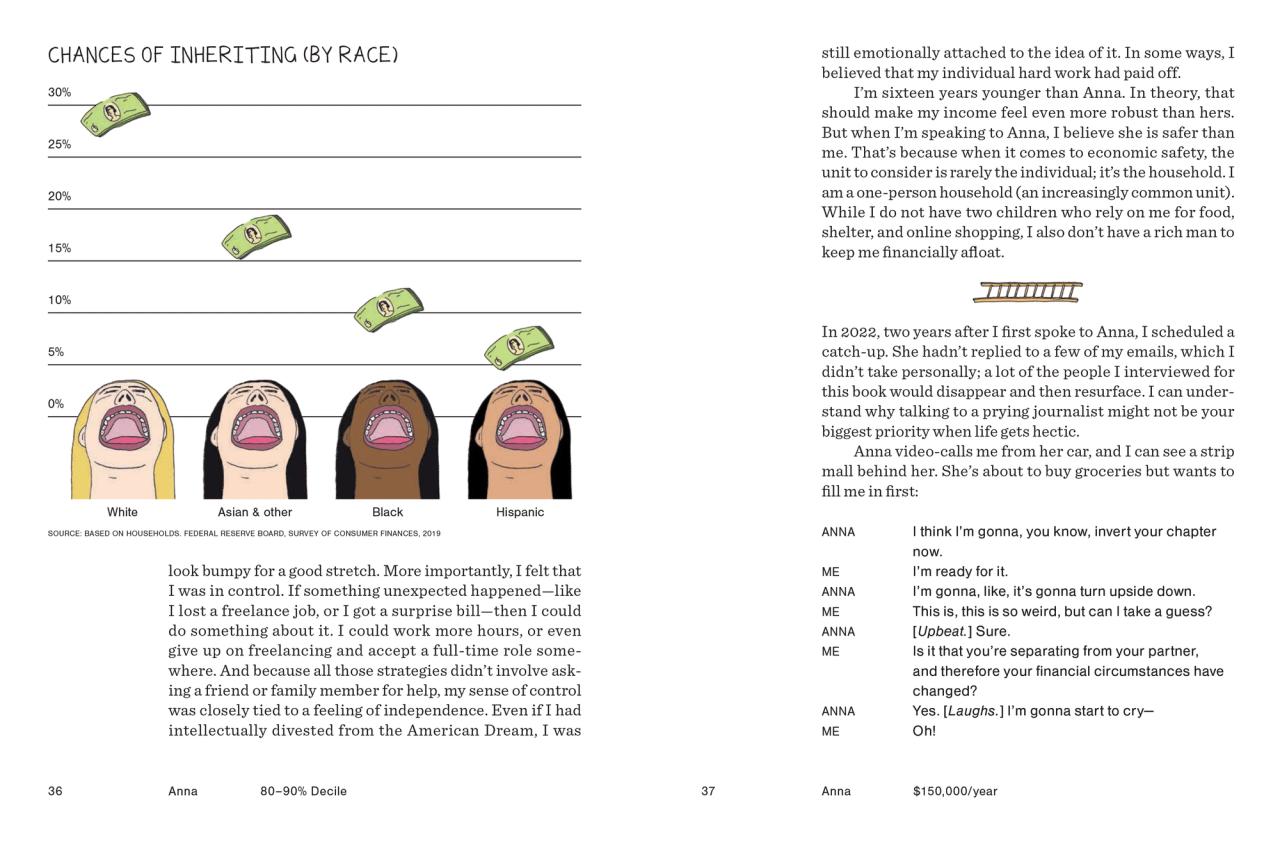
An interior spread from Ten Lives. (Courtesy Random House)
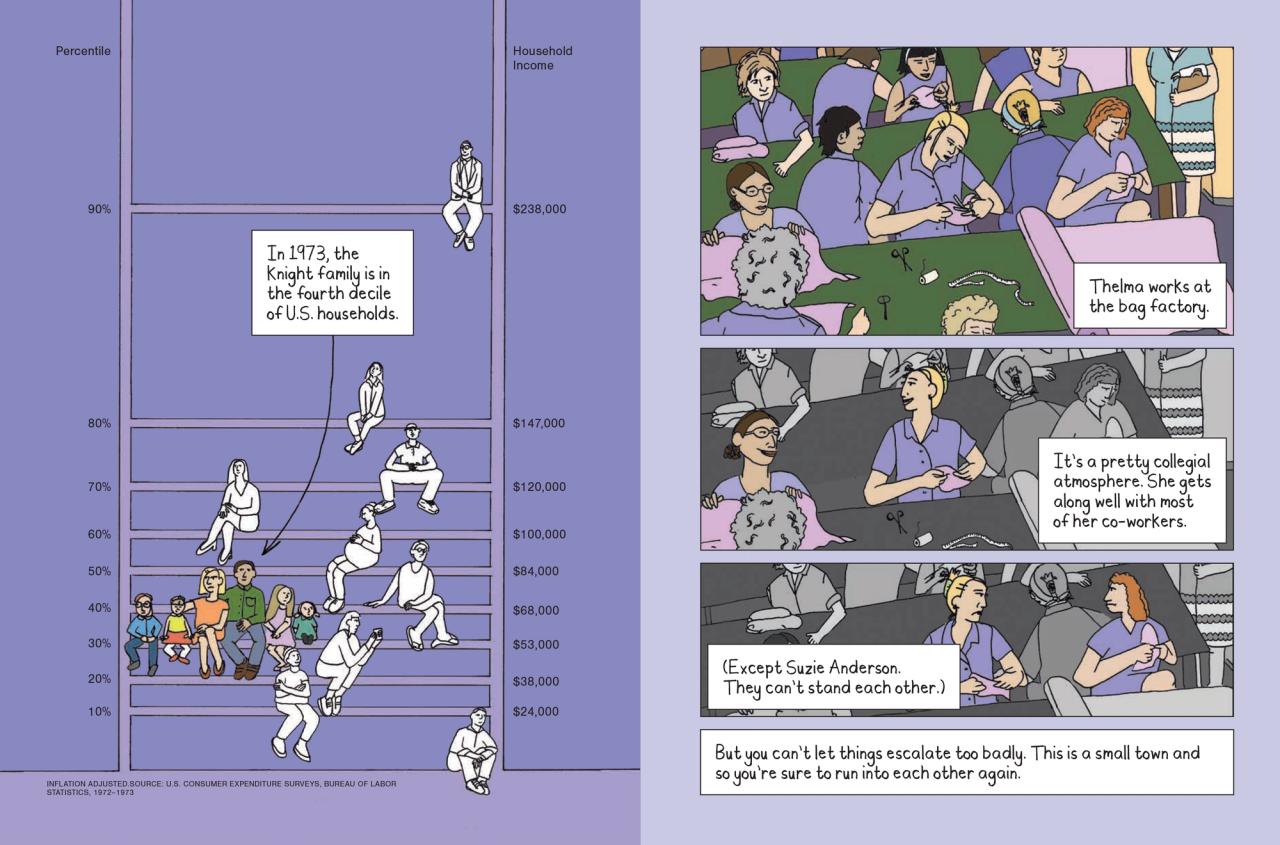
An interior spread from Ten Lives. (Courtesy Random House)
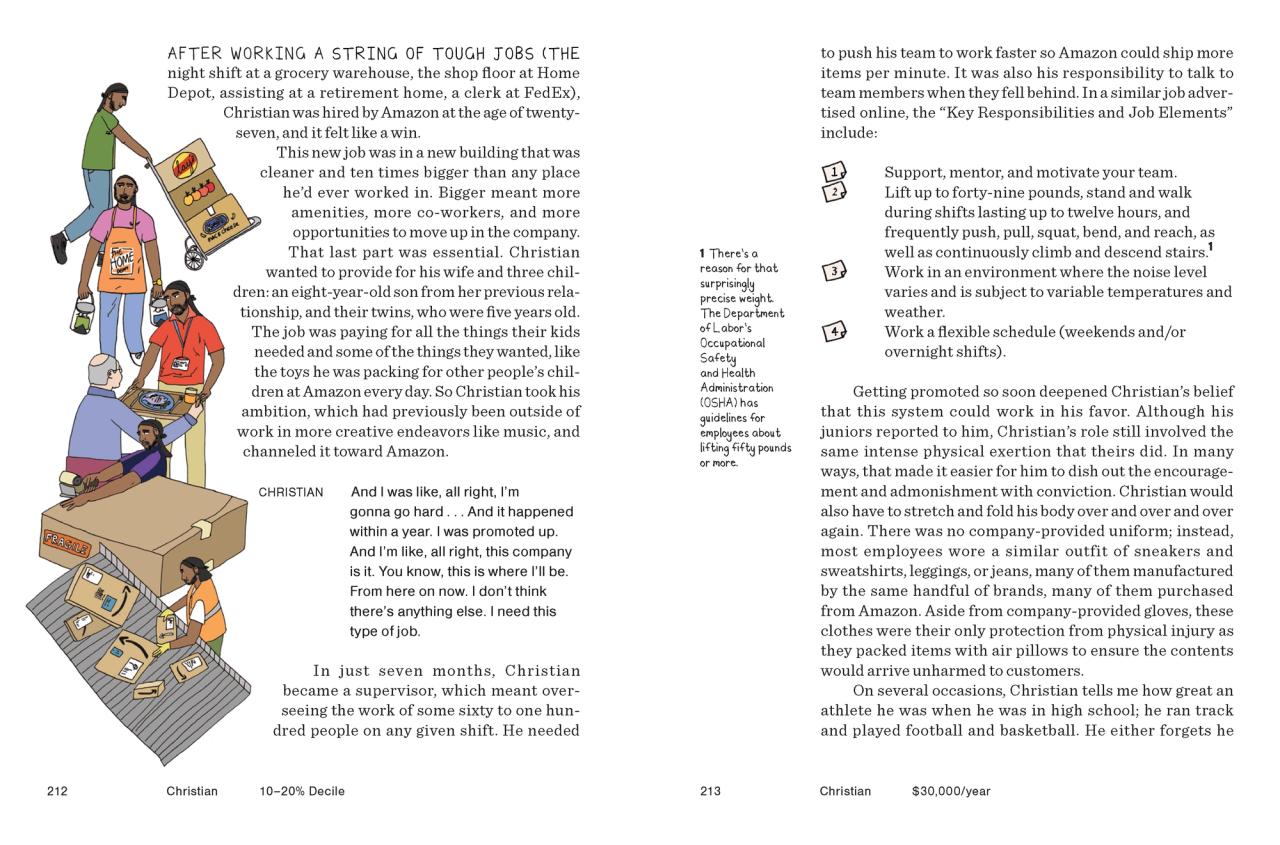
An interior spread from Ten Lives. (Courtesy Random House)
An interior spread from Ten Lives. (Courtesy Random House)
An interior spread from the introduction to Ten Lives. (Courtesy Random House)
An interior spread from Ten Lives. (Courtesy Random House)
An interior spread from Ten Lives. (Courtesy Random House)
An interior spread from Ten Lives. (Courtesy Random House)
An interior spread from Ten Lives. (Courtesy Random House)
An interior spread from the introduction to Ten Lives. (Courtesy Random House)
An interior spread from Ten Lives. (Courtesy Random House)
An interior spread from Ten Lives. (Courtesy Random House)
An interior spread from Ten Lives. (Courtesy Random House)
“The things that we choose to spend our money on, it’s so revealing of your character. It says, ‘What do you value in life? What matters to you? Who are you as a person?’”
So, me and Chris had a conversation where I was like, “You shouldn’t be spending this money on a car. What are you doing? This is crazy! I’ve never bought a new car in my life. I always buy a secondhand car because the second that you drive it off the lot, you’re losing loads of money.” He’s like, “No, no, no, you’re spending way too much on rent. That’s crazy how much money you’re spending on rent.” It felt like actually it was super vulnerable to be having that conversation. That’s not normally how most people talk about money, but it was really telling. The things that we choose to spend our money on, it’s so revealing of your character. It says, “What do you value in life? What matters to you? Who are you as a person?” I’m just as ashamed, actually, of the things that I’m kind of extravagant on as I am about the things that I’m stingy on. I think that says a lot about myself.
SB: What are you extravagant and stingy on?
MC: Yeah, great question.
SB: [Laughs]
MC: Okay. Again, some of this stuff has changed as I’ve gotten older and as I’ve accrued more savings and you have more financial security. I’ve always been stingy about any form of self-care. So, for example... God, it’s going to make me sound like a psycho.
SB: [Laughs]
MC: This is also because I don’t like these environments, but I have cut my hair myself since I was 16. I don’t like going to the hairdresser. Again, I don’t like sitting in the chair and having to look at my face for an hour. I find that quite upsetting, actually. I don’t like the small talk of, like, “Where are you going on holiday?” I hate all of it.
But also I’m like, “Why am I going to spend a hundred dollars on this when I can do it myself?” I’ve gotten quite good at cutting my own hair.
I have just recently started to do things like... I’ve had two massages in my life. I’ve been to maybe four facials. These are all new things for me, but that felt like... I don’t know. It’s crazy. It’s crazy. I don’t really spend money on clothes. I don’t have expensive taste when it comes to clothes or makeup or any of those things.
What am I extravagant with? I mean, I bought a massive house. There was no need for me to buy a house that size. Other people would’ve been far more pragmatic and been like, “I’m going to buy a smaller apartment and then go on holiday more or buy nice clothes or any of those things.” But I was like, “No, I want a really big, nice house.”
SB: Well, homeownership is a big part of your book.
MC: Yeah. Whole chapter on it.
SB: Yeah. It’s so connected to, I think, what we think about when we think about wealth.
MC: Yeah. And security, right? For me, I don’t know if I shared this in the book. I really, really, really worked like a maniac, which I know sounds like a brag, and I don’t think it should be a brag. I actually have regrets about how hard I have worked and how much I’ve focused on my career. But basically, my period stopped for a number of years, partly because I was using an IUD, which very often stops people’s periods, but it was also stress. For about, I think over a period of five years I went on one vacation. I don’t take holidays, either. Basically over those five years, I got my period twice. Once was when I went away on vacation and I walked down to the beach, I saw the sea and I got my period. It was my first time actually resting and I literally looked at the sea and got my period.
And the second time was [when] I finally bought this house. I put literally all of my savings into the house and I slept in that house and I woke up the next morning in a home that I owned and I got my period. It was so profound to me. It was a totally different feeling of security than I had ever known before. I think it’s actually allowed me to spend more money now, because that feeling of safety, of having this asset that it feels like someone can’t take away from you, is profound.
SB: I found it interesting how seamlessly you were able to weave your own story.
MC: Was it seamless? I don’t know…
SB: I think so.
MC: Thank you.
SB: I mean, let the listeners read your book and figure out for themselves if they agree. But I think what was interesting is that you’re coming from such a different place than these ten Americans and yet your story does find its way into each of them through these intimate portals.
MC: I hope so.
SB: You write that “so much of journalism involves invisibilizing yourself in order to insist on your objectivity.”
MC: Yeah, I do.
SB: When did you stop believing that removing yourself from the story made it more truthful? What led you to that belief? Because I think it’s the opposite of what they try to teach you at journalism school, right?
MC: It’s a good question. I don’t know if I ever fully bought into it or I very quickly realized it wasn’t true. When I first started doing journalism, like many people, it was kind of like this... Honestly, I don’t want to be too disrespectful of it, but it felt like it was slop. It’s just these short pieces that you’re turning around, lots of young journalists do. So, I was writing two, three pieces a day that were short summaries of government statistics. The government spits out data. I actually think it is also important public service stuff, because otherwise nobody’s covering any of those government statistics, but I’m just writing the short summary.
I remember this was at The Guardian in London. The government had published these statistics showing that teen pregnancy rates had dropped to their lowest level for twenty years. I just wrote this short piece. There were all of these comments in it being like, “This is so stupid” or “This is so off the mark. You’re writing about this as if it’s great. I became a parent as a teenager and it’s one of the best things that ever happened to me, and that’s so presumptuous to view this as a terrible thing.” I was like, “Well, yeah.”
My understanding that teen pregnancy is bad is completely imbibed from teachers and the culture. It’s this disastrous thing, and I have no lived experience of this thing that I’m writing about—none whatsoever. That’s really, really important. It’s so interesting. Anytime I’m reading an article about racism, I’m just going... Or even if it’s not explicitly about racism, if I’m reading something where race comes up, I click on that byline and I want to see the race of the person or I’ll Google them to find out what is their race or ethnicity, because I want to understand which perspective are you coming from?
Similarly, if someone’s writing about money or class in America, tell me, what is your perspective on this? You get to hide and be like, “I’m just a person.” But no, it affects your understanding of affordability, of wealth. I’m sure it affected... The way that you come to this book is different to the way that somebody else is going to come to this book because of your lived experience.
SB: Exactly. I think that what you bring up about race is so spot-on, too. In prepping for today, I was like, “Oh, wow, this sort of reminds me of when I prepared to interview Claudia Rankine”—who I would argue is the foremost Black scholar on whiteness.
MC: Yeah, I would agree.
SB: I’m not saying you’re the foremost scholar on money, but— [Laughs]
MC: No way near.
SB: I mean, to talk about these subjects, very often, we almost intentionally avoid them somehow. But to me, it feels like race and money are among the most important—
MC: I agree.
SB: ... things in culture and society, but they’re also both fictions, which is kind of interesting to think about, too.
MC: Yeah.
SB: Money is this thing that’s just been... One day someone was like, “This coin is worth something.” Our whole system of capitalism has been built on a farce, in a way.
MC: Yeah, a collective delusion. Absolutely. That feels necessary in order for us to—
SB: Have structure.
MC: Yeah, buy a coffee, whatever, sure. But A, there’s lots of cultures and societies that question whether or not that collective delusion is necessary and think about other ways of being. But yeah, I think there’s times when we lose sight of that. We lose sight of the fact that what is Asian? What is Black? What are we really, really talking about when we say that? It’s this line that has been shakily drawn around a group of people that sometimes is useful for organizing, for resisting and sometimes, it’s used as a tool of oppression.
SB: Same with class.
MC: Exactly. Yeah.
SB: So, you tell us exactly what you were paid to write the book. Can I say?
MC: Yeah, of course you can.
SB: Eight hundred and fifty thousand U.S. dollars.
MC: Huge amount.
SB: Which you describe as “a shitload” of money.
MC: Yeah, I would still say that. I should say, by the way, the first line of the manuscript initially was, “I was paid a shitload of money to write this book,” and the editor was like, “Babe. No, no, no, no, no.”
SB: Yeah, I was going to ask how’d the publisher feel about you just kind of—
MC: Listen, they honestly didn’t love it and I understand why. I really, really liked my editor... I understood why she said this shouldn’t be the first sentence, because she said, “If you write that, people are just going to think you’re only writing the book because you was paid money and you have no real emotional intellectual investment in the ideas that you’re grappling with,” Which is not true. Would I have written the book if I wasn’t paid lots of money to write it? I don’t know. And I think that’s also uncomfortable for people to talk about.
People have this idea that artists are motivated by these higher ideals, and actually, we’re supposed to be post-materialists somehow. We’re supposed to want to wake up and write or paint or make music, even if there’s no money on the table.
SB: I had someone ask me if I got paid to make a book, and I was like, “Yeah. This isn’t a charity.”
MC: Totally. There’s work. There’s absolute work that’s involved. Yeah. Anyway, there was some hesitation, but I think they understood why... There’s no way for me to be honest about money without disclosing all of those figures. But it is astonishing to me. It was such a learning curve. I saw that book contract that my phenomenal agent, Emma Patterson, put together, and I was like, “I’m rich. I am filthy, filthy, filthy, rich.” And I would still say that I’m rich, but I would probably ditch some of those “filthies.” It didn’t work out quite as I expected.
SB: You do this beautiful thing, too, where unlike typical...
You do this thing, too, where unlike how journalism normally works, you pay the subjects. So, you paid everyone you interviewed for the book, traditionally an atypical practice in journalism, I would say.
MC: Definitely, yeah.
SB: Why was that important to you?
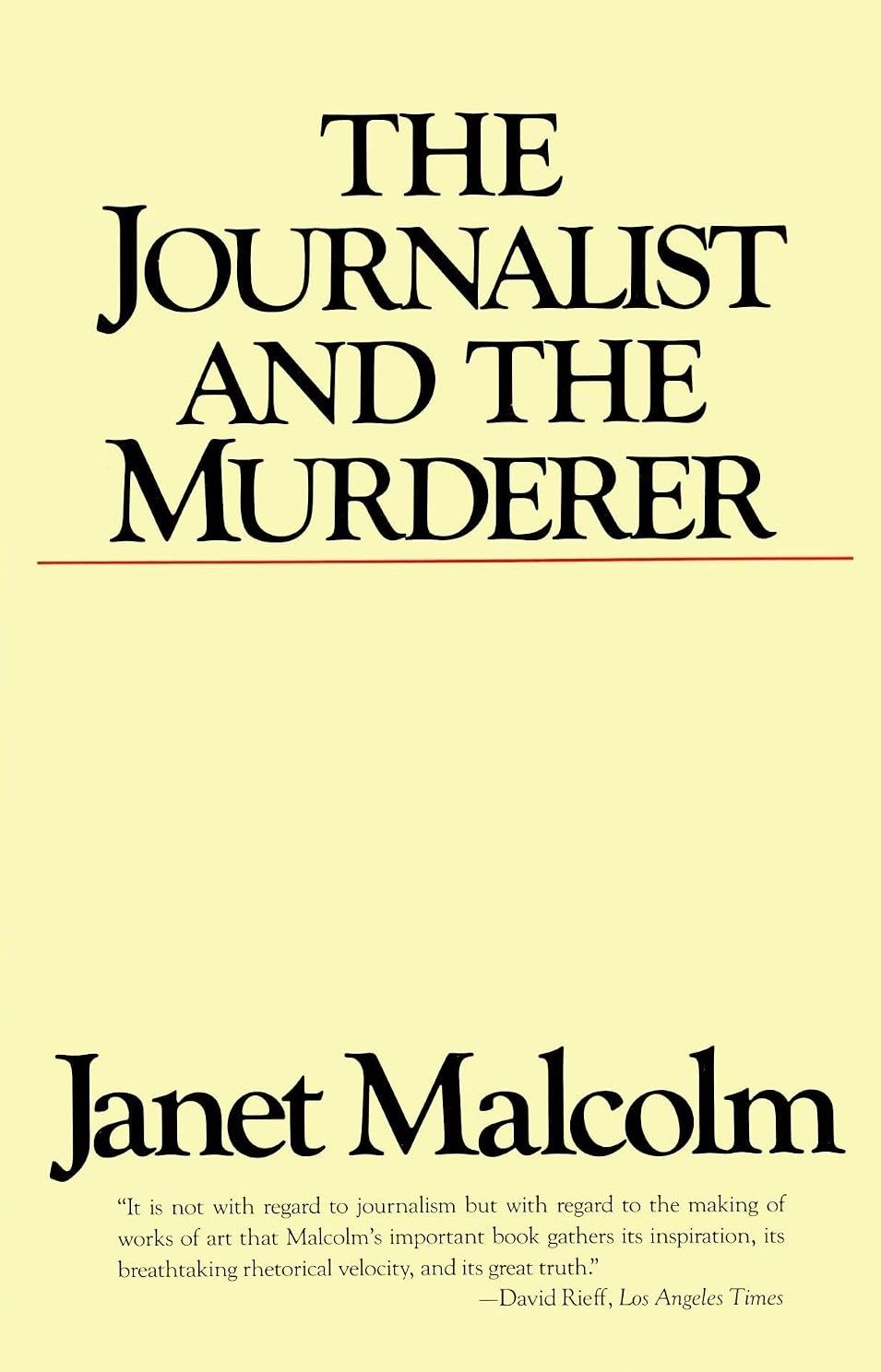
Cover of The Journalist and the Murderer (1990). (Courtesy Knopf)
MC: Honestly, especially when I was interviewing people who had less money than me, it felt straight-up exploitative to be like, “You give me your story, you tell me about your life, and I’m literally going to profit from that. I’m going to make money off of it and leave you with nothing.” And we know as journalists, there’s this really, really complicated dance. Have you ever read Janet Malcolm, The Journalist and the Murderer?
SB: One of my favorite books.
MC: Mine too. And by the way, I only read it the past year. I had no idea.
SB: I have a whole stack of Janet Malcolm books that I’m slowly working my way through.
MC: But that book is sublime. I think the first line of it says something like any... I’m going to really paraphrase, this is so not her language, but she says something like, any journalist who is not a total fraud or piece of shit knows that, ultimately, they’re a liar. [Editor’s note: Malcolm writes, “Every journalist who is not too stupid or too full of himself to notice what is going on knows that what he does is morally indefensible.”] Because we know that so often when we’re sitting down with someone, they think they’re going to get something out of the exchange.
I know, for example, Tiffany, who I spoke to, if I’m honest, she never said this to me, but I felt like she was talking to me because she hopes that by being published in the book somehow she’s going to capture somebody’s imagination or some policymaker is going to read her story and want to help her out. And that’s why most—
SB: I was moved by her story.
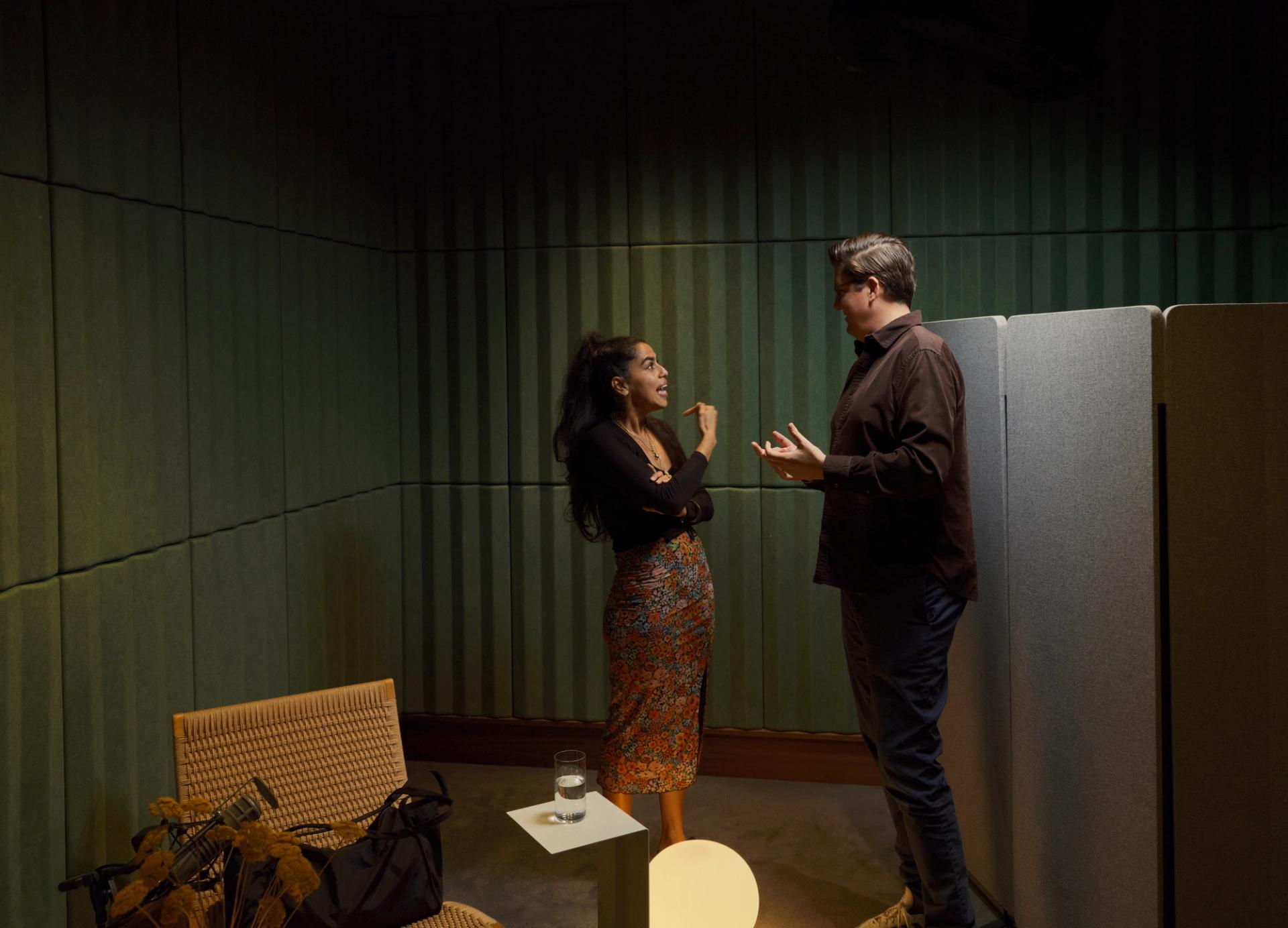
Bailey in conversation with Chalabi after the recording of Ep. 161 of Time Sensitive. (Photo: Matthew Harrington for The Slowdown)
“Journalism is about exposing systems so that policies can change, so you can have more systematic changes in our societies.”
MC: I know, but are you going to try and get in touch with her and send her a thousand dollars to help her out? No. Realistically. Sometimes journalism does change individual people’s lives, but I’m not in this job actually to be helping people with their GoFundMes. That’s not my understanding of journalism. To me, journalism is about exposing systems so that policies can change, so you can have more systematic changes in our societies.
So, if that’s the case, that the person who’s speaking to you is kind of hoping for this outcome that we know isn’t really going to be the case, how can you be more fair so that they’re getting something out of it no matter what?
Look, I understand that this practice of paying someone doesn’t necessarily work across all of journalism, but certainly for the book, it just felt so, so fucked up not to pay people. It really, really did. And again, I don’t think I could have done some sliding-scale thing. I thought about it, some sliding-scale thing where I only pay the poorest people in the book, but it gets really complicated. Part of the thing that I uncovered in the book is that even if someone’s earning a hundred thousand dollars, if they’re going through something, they might actually still need more money. How am I going to figure out those exact calculations of how much each person should get?
SB: Here I want to talk about the American Dream.
MC: Tell me.
SB: Because I feel like there’s a whole part of your book that’s really trying to unpack this notion or idea or concept or philosophy that is the American Dream. You write that “the American Dream is rooted in a temporal idea,” so, time. And you note that “it’s never about the here and now,” but about what could be. So, a sort of distant future we’re looking toward. In what ways did coming to America change your relationship to that American Dream idea and, ultimately, to money and to time?
“If you were to ask me, do you believe in the American Dream? I would say no today, and I would have said no when I first moved to the U.S.”
MC: Yeah. If you were to ask me, do you believe in the American Dream? I would say no today, and I would have said no when I first moved to the U.S. I didn’t have this... See, it’s funny. Intellectually, I knew that it was bullshit, but there’s always this little voice inside of you. In Arabic, we say waswasa, which is this little demon whispering in your ears, onomatopoeia waswasa, that’s like, “Yeah, but maybe.”
I think that many of us, even if intellectually, we know that all of the odds are stacked against us. I mean, it’s the same reason: Why does anyone play the lottery? It is completely, completely delusional, but there’s some kind of comfort in hope. I think hope is a very, very American thing, that one day X.
It’s interesting to me that I’ve created work about lots and lots of different subjects that people might find controversial: the genocide in Gaza, trans rights, all of these different things. I have never—
SB: Circumcisions.
MC: Circumcisions. [Laughter] There you go. Spicy.
I have never ever received more abuse for a single post that I did than one that I created at the start of Covid, where I was creating a video that was demonstrating that yes, Zuckerberg had donated, I think something like a million dollars for Covid relief efforts or whatever, but as a fraction of his fortune, it was nothing. It was like nought point nought, whatever. I posted this thing. I’ve never gotten more abuse, never. It was fascinating to me. It was all of these people who, I’m sorry, judging by the sheer scale of it, this is not fellow billionaires that are coming out to protect Zuckerberg. It was people being like, “How dare you? He’s given so much more than you have.”
What that revealed to me is that so many of these people believe in the American Dream, so they identify more with Zuckerberg than with me, even though I’m going to be so much closer to them in terms of my material circumstances, that they’re already not only imagining a world in which they could have millions, but they’re imagining a world in which they have millions and they have a right to decide how they spend their millions. What are you talking—? Why are you coming out to defend this guy? I don’t get it! Anyway, is that what’s going on? Maybe there’s some other explanation. What is going on there?
SB: I couldn’t tell you, but yeah, it’s—
MC: It was mostly men. I do think that, actually, men have probably bought more into the American Dream than women have, I would say.
SB: Oh, for sure. I feel like there’s a whole segment of male-hosted podcasts, this one not included, where I think that’s the culture, right?
MC: Totally. Buy these vitamins and anything is... All of the drop-shipping stuff, this idea of you being a mini CEO, I think it is actually really tied to what’s happening in... I don’t know. It’s interesting. All of these Trump voters that were working class, I think there was a choice between socialism or a president who might help you to individually get rich. I think that informed some of their voting decisions. They’re listening to podcasts about becoming a CEO, about how to invest. Well, they have, I don’t know, six hundred dollars in the bank. What are you talking about? It’s never going to happen.
SB: Well, in your mind, is the bargain of the American Dream essentially just give us your time now and maybe you’ll be rewarded later? What is it? I mean, what is it that this ongoing promise seems to be?
MC: Give us your time, work hard, and anything is possible. And “work hard” is basically work more hours per week. Again, it’s a fantasy. There is no number of hours that you could work as, for example, an Uber driver in this country that will result in you becoming significantly wealthy. It’s just not going to happen.
SB: Do you think money on some level is an attempt to control the future?
“I still think if I can get to a certain level in my savings account, I will be safe. And my idea of safe is about control, is about being able to even have this vision that if I get to a certain level of wealth, I will be healthier. I won’t get sick. I’ll be able to control outcomes.”
MC: That’s an excellent way of putting it. I think that is one of the ideas that I personally haven’t totally divested from. I still think if I can get to a certain level in my savings account, I will be safe. And my idea of safe is about control, is about being able to even have this vision that if I get to a certain level of wealth, I will be healthier. I won’t get sick, right? I won’t get sick. I’ll be able to control outcomes.
SB: You have this great phrase in the book, “displace temporality,” which is this idea that survival, our well-being, our survival requires us to be constantly preoccupied with what our lives will be—
MC: In the future.
SB: Years from now. What does that do to how we live in the present?
MC: It’s exhausting. It’s absolutely exhausting. One of the biggest surprises for me was that pretty much everyone I spoke to was deeply afraid. They all felt insecure, even though they had loads of—not all of them obviously—but some of them had plenty of wealth, plenty of income. But because of this displaced temporality, because of this idea that security is just up ahead, what that means is that you’re insecure now. You feel like you don’t have enough. To constantly live with this idea that you don’t quite have enough is a real psychological load. Again, that’s what capitalism does. Capitalism tells you, you need this new shirt, even though you’ve got ten in your closet.
That feeling of need and desire is so intrinsically tied to this idea that yeah, what you have isn’t enough, that your body is actually not in great shape. You just need to lose a bit more. It doesn’t matter if you are in good health—your body doesn’t look good. I don’t know. It’s a real psychological toll. It’s miserable, actually.
SB: Are you good at being in the present?
MC: Not at all. I’m a deeply, deeply anxious person, and I think anxiety is just about living in the future. So, no, I’m never here. I’m never here.
SB: You write that when you went dancing during your University of Edinburgh years, that you would find yourself watching the clock and calculating how many hours of studying you were losing.
MC: Yeah. Sad… It’s actually really sad.
SB: Has that always been your experience of time?
MC: It’s really sad. I went back to Edinburgh, because I dropped out of my undergraduate degree. I don’t know if I said that in the book.
SB: You didn’t.
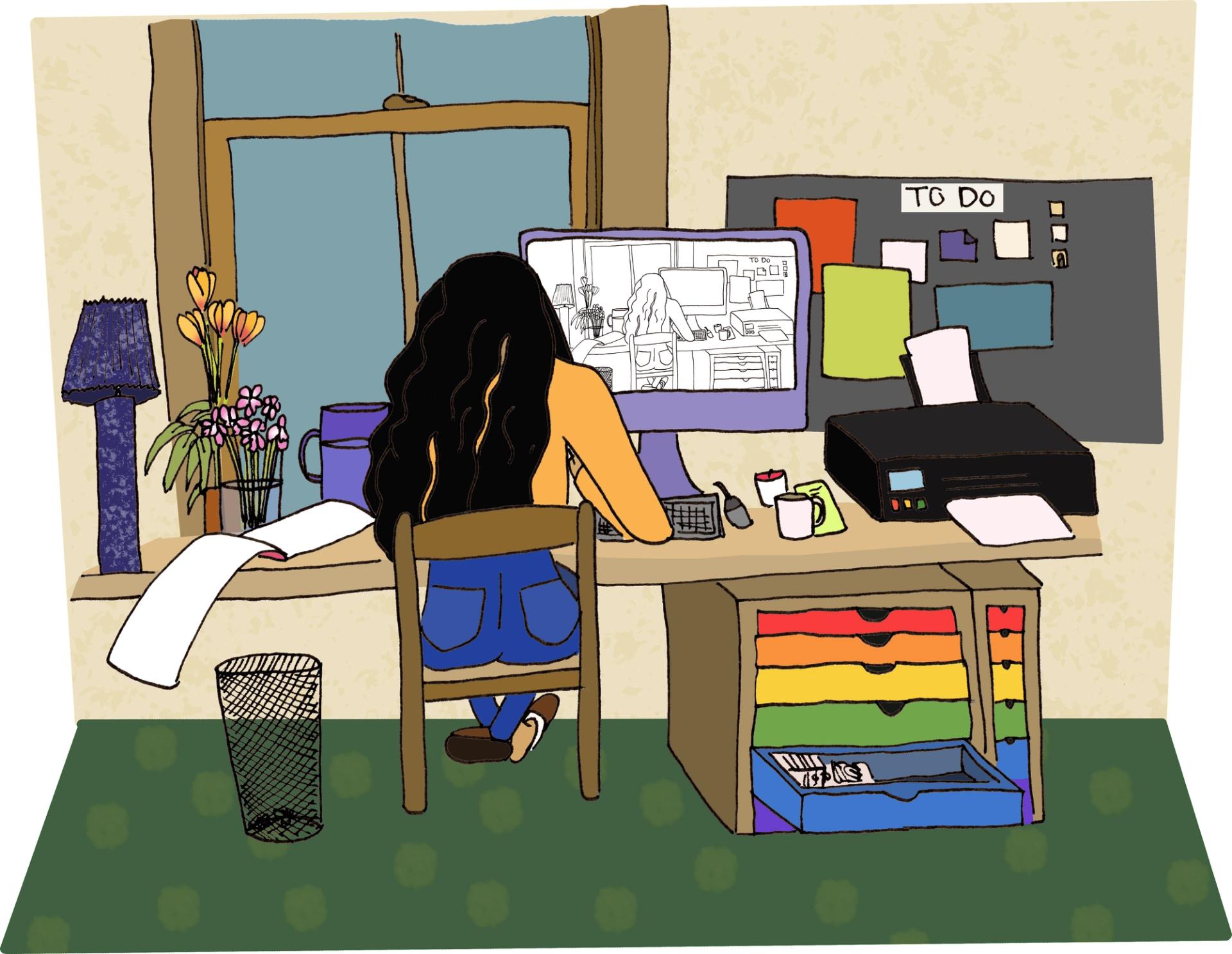
An illustrated self-portrait of Chalabi at her desk. (Courtesy Mona Chalabi)
“I really missed out on a lot by just being so obsessed with my future.”
MC: Didn’t I? Anyway, it’s not me lying. It’s just, I guess it didn’t come up. But I dropped out of my undergraduate degree because actually I was working myself to the point of sickness and it ended up working out okay, long circuitous path, I ended up getting a master’s instead of an undergrad. But I went back to Edinburgh a couple months ago for the very first time, I think, since I left. And I was just like, “God, I really missed out on a lot by just being so obsessed with my future.” Every summer, for example, my friends would go away on holidays somewhere. They would work a summer job and then they would all go away to these clubbing holidays in... British people are really notorious for this.
They go to Europe and they just get really fucked up and trash things, but whatever. They would go away on these holidays and they would come back. It was quite a big group of us. I was in this friendship group where there were seven or eight of us, and they would come back with these amazing stories. I was just like, “I don’t have time for that. I have to work.” I would work every summer and not go away. Their friendships, I still wonder if, even to this day, they have different bonds of friendship because they spent all of that additional time together that I just wasn’t present for. For what?
Because I wanted to get another line on my resume so that I could get a good job so that I could live in a good house. I was just obsessed.
SB: When did you realize you wanted to be a data journalist? When did that come into the equation for you?
MC: I did a one-day workshop in data journalism in London, and I did really, really enjoy it.
SB: When was that?
MC: Before I started working at The Guardian, maybe 2010 or something like that?
SB: More to that, I’d be curious to hear you also just talk about journalism and storytelling.
MC: It’s so funny. Weirdly, when I describe myself as a journalist, that still feels like a destination rather than where I am at right now, which is so strange.
SB: You won a Pulitzer. Let’s be real. [Laughs]
MC: Yeah. I don’t know. I really, really love journalism, and I think that I have always had a difficult relationship with a lot of journalists. There’s not that many journalists, if I’m really honest, where I’m like, “Yeah, I want to do exactly what you do.” I think part of that is that my family’s Iraqi, and I watched all of those lies unfold to invade that country and kill so many people. Now I think my relationship to journalism is also under a huge amount of strain, as I watch many colleagues in this field refuse point-blank to use the word genocide.
It’s just this totally ludicrous intellectual dance that is so damaging. Having said that, I’ve also watched incredible, incredible journalists in Palestine reveal the truth over and over again. Yeah, I don’t know. I don’t know. I have a complicated relationship to the industry.
SB: Of course. I mean, there’s the institution of it, right?
MC: Yes. And then there’s the individuals. I think actually it’s probably a bit of an exaggeration to say there’s so few journalists that I respect, but as an institution, I think it’s so deeply flawed and problematic and so unwilling to do any introspection.
I keep on thinking about... I don’t know how big of a story it was here, but there was a professor called Professor [Jason] Arday in the—
SB: Oh, yeah.
MC: Yeah, yeah.
SB: Heartbreaking story. The way he was bullied and—
MC: Hounded.
SB: ... targeted.
MC: Absolutely hounded. I really thought that there was going to be a moment of really profound introspection within the industry of like, “Okay, which stories do we tell and how do we decide what is considered newsworthy?” And there just wasn’t. There just wasn’t. They were just like... They put out a statement saying, “We stand by our reporting,” and that was that.
SB: Mm-hmm. I think one of the things you do that I’ve always appreciated and always found, I was going to use the word illustrative, but I mean, is the way you take illustration, the way you draw something that seems inherently so simple because of how you present it, but is actually a deeply complex subject. So, you’re taking something that’s incredibly dynamic and complex and presenting it in a way that becomes understandable, almost instantly understandable.
So, from a time perspective, I also find that really interesting, the amount of time it must take to sift through the data, understand the story, translate that to a drawing and to some sort of form of visual or illustration that someone can grasp in almost an instant.
“That is what I’m trying to do, is to almost be a translator.”
MC: Yeah. Thank you. I mean, that is what I’m trying to do, is to almost be a translator, but it’s troubling because I really feel like such a weight of responsibility. I really felt it during Covid as well. I remember when Covid started, do you remember how much uncertainty there was about, like, what the fuck this is? I remember all of the stuff... I actually posted an illustration that was based on data about how long the virus lived on different surfaces. That was based on a scientifically researched paper. Then I took it down because all of the understanding shifted and it was like, no, it doesn’t live on paper for twenty-four hours.
You don’t need to leave your mail quarantined for twenty-four hours, but that was the thinking at the time. I really felt like, God, if I get this stuff wrong— For example, if I publish the wrong information about masks, people could literally die because of my reporting. They could make badly informed decisions and die as a result.
SB: Or come after you afterwards.
MC: I’m fine with them coming after me. I just don’t want people to die. You can come after me. It’s alright. [Laughter]
SB: I mean, I can only imagine what it was like to be Fauci.
MC: Yeah
SB: Crazy.
Well, the question of what numbers can and can’t communicate seems particularly to be what you do. I think often you choose things where there’s a real urgency. So, let’s take the work around genocide in Palestine. How do you think about the responsibility of turning statistics about death or human suffering, these things that are so weighted with getting it right? How do you consider the responsibility of that?
“I think that so much of my work is both communicating the data and at the exact same time, trying to communicate the limitations of the data.”
MC: Yeah, it’s a huge responsibility, not just to get it right factually, but I think to get it right emotionally, because so much of my work often uses humor or levity or something, this playfulness that draws you in. Again, with the genocide, there’s no space for any kind of levity. So, you’re also trying to tonally communicate the gravity of some of these subjects while getting it factually right at the same time. I think that so much of my work is both communicating the data and at the exact same time, trying to communicate the limitations of the data.
So, in the case of the genocide, for example, I spent so much work, I spent months reporting on this and also creating these different illustrations that showed how deeply flawed our understanding of the death toll is. That when you have a society that has been systematically obliterated, including the mechanisms of government in that society, how is it plausible to even count the dead when the morgues themselves have been bombed? We understand that those numbers are so flawed, that so many bodies are lying underneath the rubble while also leaving people without just a shrug of being like, “There’s no way of knowing.”
I hate that kind of journalism. We’ve all read it where there’s a headline that’s like, “How many X?” And then the answer is it’s just too complicated to tell. No, you have to leave someone with something. So, I do think it’s really, really challenging and it keeps me up at night, the idea of getting it wrong, truly.
SB: I also was thinking about a few years before Ten Lives, you did the project that would go on to win the Pulitzer, this “9 Ways to Imagine Jeff Bezos’ Wealth” for The New York Times magazine. That whole project was essentially an attempt to take this almost, again, incomprehensible number, this insane amount of wealth and make it comprehensible. I’ll never forget flipping through that magazine and seeing it and just being like, “Oh, my God.” Because I think you realize through that work how much those numbers actually represent.
It’s one thing to see a number on paper. It’s another thing to see it drawn out in comparison to using real data. What did working on that piece teach you about the difficulty of understanding numbers, but particularly wealth at that scale?
MC: Yeah, it was a really, really great commission because I think we often think of journalism as being about informing people of something, but actually informing people was a relatively small part of that task. Everyone already knows that he’s rich. Sometimes the thing that you’re trying to do is actually re-sensitize people to something that they’ve kind of come to be desensitized to, right? If you thought, Oh, my God, when you opened up that magazine, then it succeeded because you’re supposed to not just be like, “Yeah, he’s really, really fucking rich. What are you going to do?” But if I can take those numbers and show you how that wealth could be used in different ways to benefit society, how that wealth—
SB: Could fund an entire country.
MC: Exactly. Then that “Oh, my God” reaction, hopefully, in an ideal world, what it actually also does is it doesn’t leave you shrugging or despairing, but you are left actually potentially with more specific demands of government, of your community. Yeah, I don’t know, It’s to re-sensitize people.
Again, that’s part of the work when it comes to Palestine right now is I think people are kind of desensitized to this scale of killing. That’s really, really dangerous actually for us as humanity. What does that do to our humanity if you’re just like, “Yeah, these things happen. People are slaughtered en masse.”
SB: I think we’re so desensitized to images, pictures—
MC: Totally.
SB: ... and graphs. In a way, I think that’s where your work comes in, this hand-drawn, I took the time to really think about how this should be shown or presented.
MC: I hope so. I would also say there’s a role for all of those things in our intellectual orbit. I want to be clear that all of that other work is how I do my job. So, I was creating a post actually about beheaded babies in Gaza. I had to look through journalism and photographs of beheaded babies to fact-check that and be able to do it.
There was another post that I did, which was about settler attacks on the West Bank. I really wanted people to still be paying attention to what’s happening elsewhere in Palestine. And to do that, I’d drawn these illustrations of Israeli settlers, fundamentalist, Jewish Zionists with an ax and somebody else who was holding a gun. I created these illustrations. And then the very last slide is me showing the photographs that the illustrations are based on. So, you don’t get to just be like, “Oh, it’s a bit of an exaggeration.” No, no, no. These are real, real people.
SB: It’s kind of crazy we’re in a time in which you have to illustrate a photograph to make it real.
MC: But I get it, though. I get it. I don’t know if that’s even necessarily of our time. Maybe that’s always been true. Maybe people also became—
SB: It’s worse with A.I. content, though.
MC: Yes. I would agree with that.
SB: It definitely is.
I want to get back to this word wealth. You spent ten lives complicating this word. And I guess what counts as wealth, where it comes from, how it grows, what it protects us from? And after spending all this time thinking about it, I wanted to ask, how do you define wealth now? What is wealth to you?
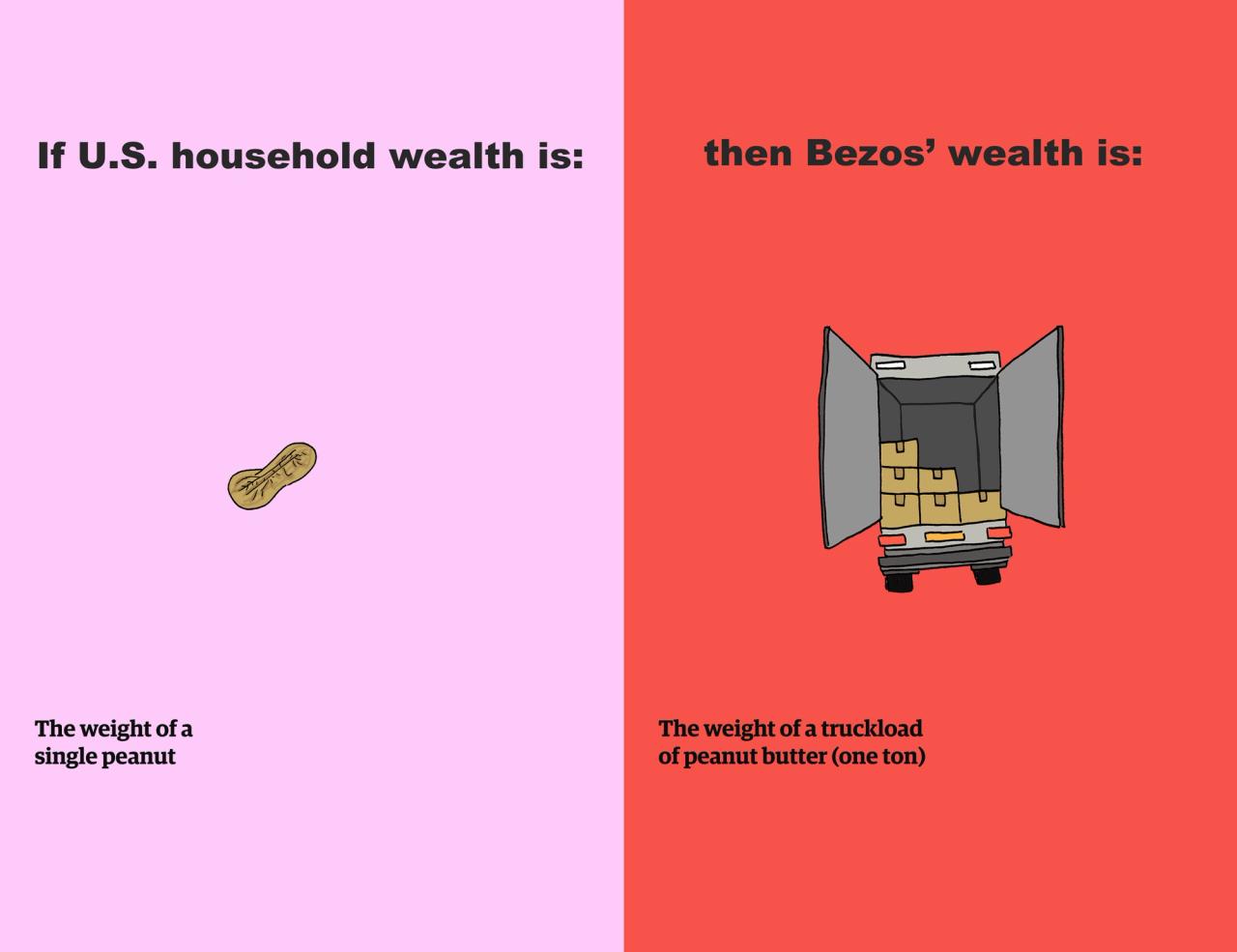
Chalabi’s illustrations from her Pulitzer Prize-winning project, “Nine Ways to Imagine Jeff Bezos’ Wealth,” created for The New York Times magazine in 2022. (Courtesy Mona Chalabi)
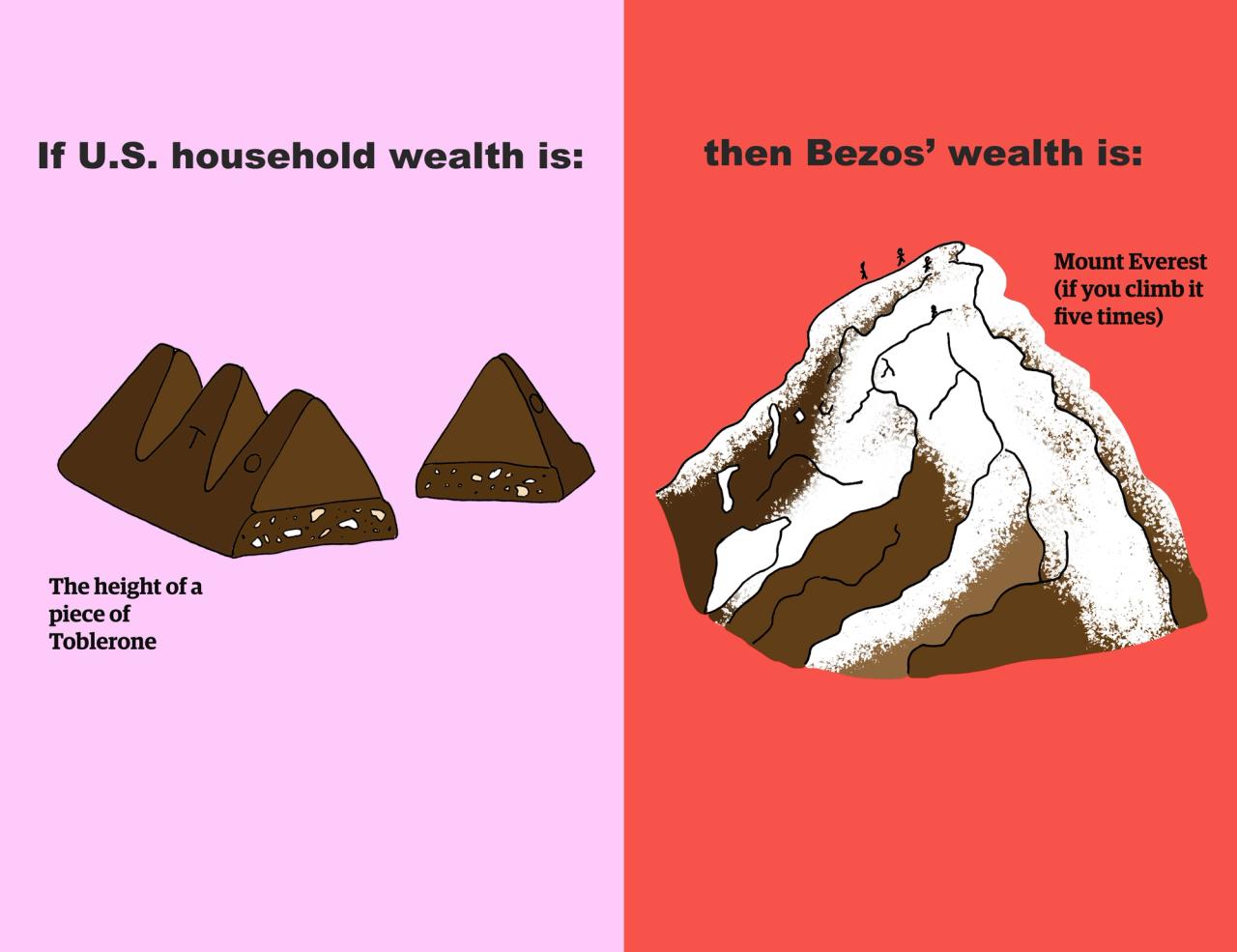
Chalabi’s illustrations from her Pulitzer Prize-winning project, “Nine Ways to Imagine Jeff Bezos’ Wealth,” created for The New York Times magazine in 2022. (Courtesy Mona Chalabi)
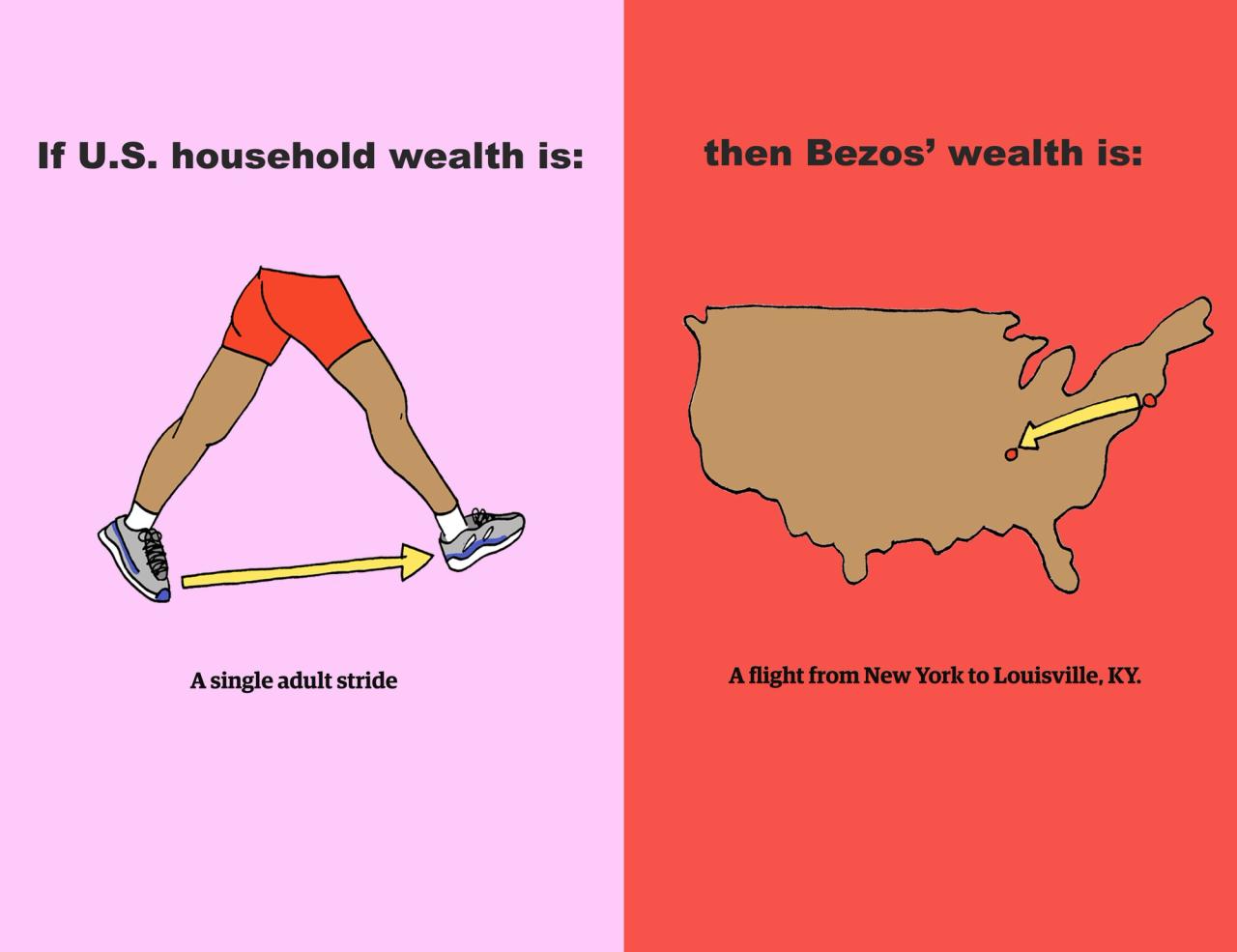
Chalabi’s illustrations from her Pulitzer Prize-winning project, “Nine Ways to Imagine Jeff Bezos’ Wealth,” created for The New York Times magazine in 2022. (Courtesy Mona Chalabi)
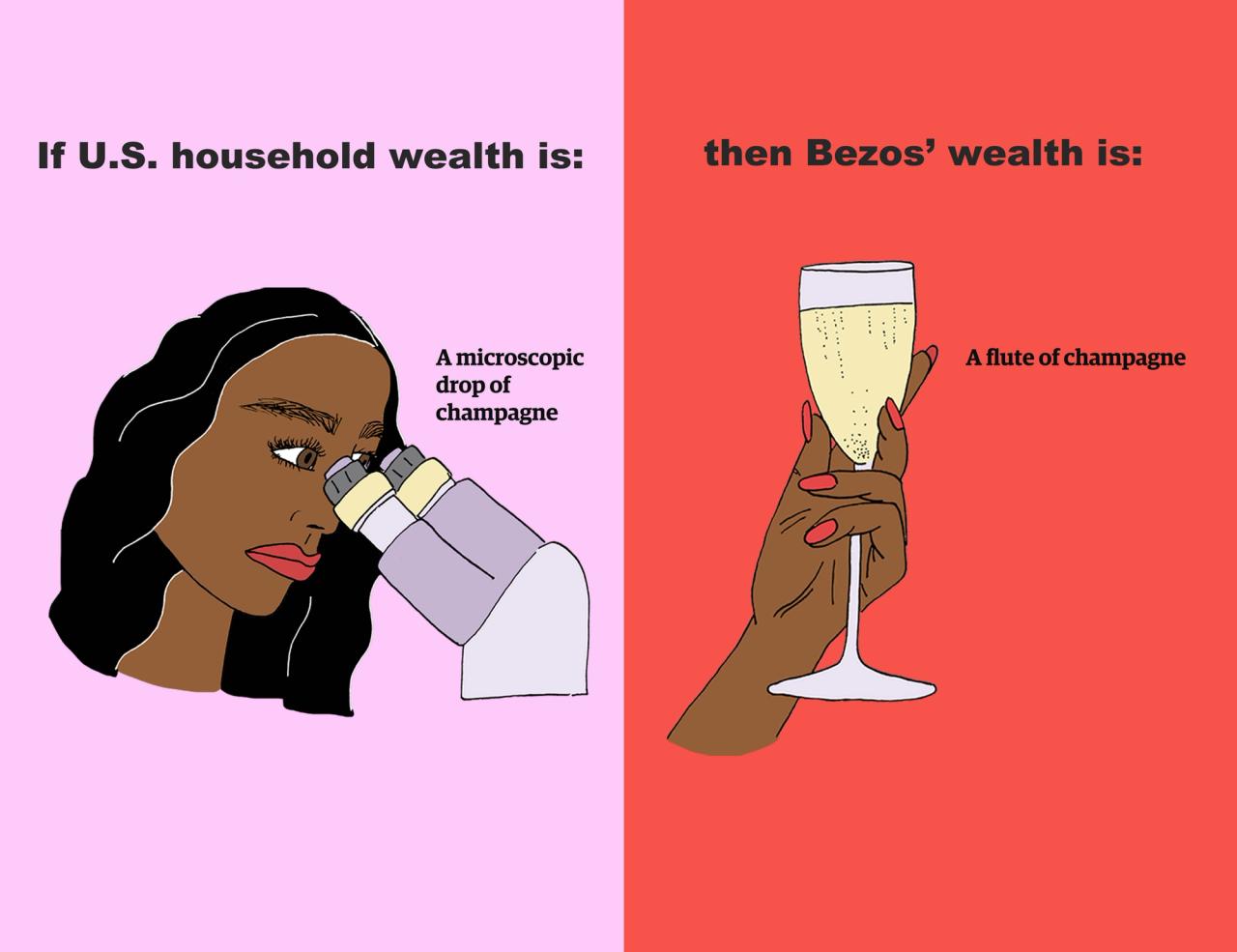
Chalabi’s illustrations from her Pulitzer Prize-winning project, “Nine Ways to Imagine Jeff Bezos’ Wealth,” created for The New York Times magazine in 2022. (Courtesy Mona Chalabi)
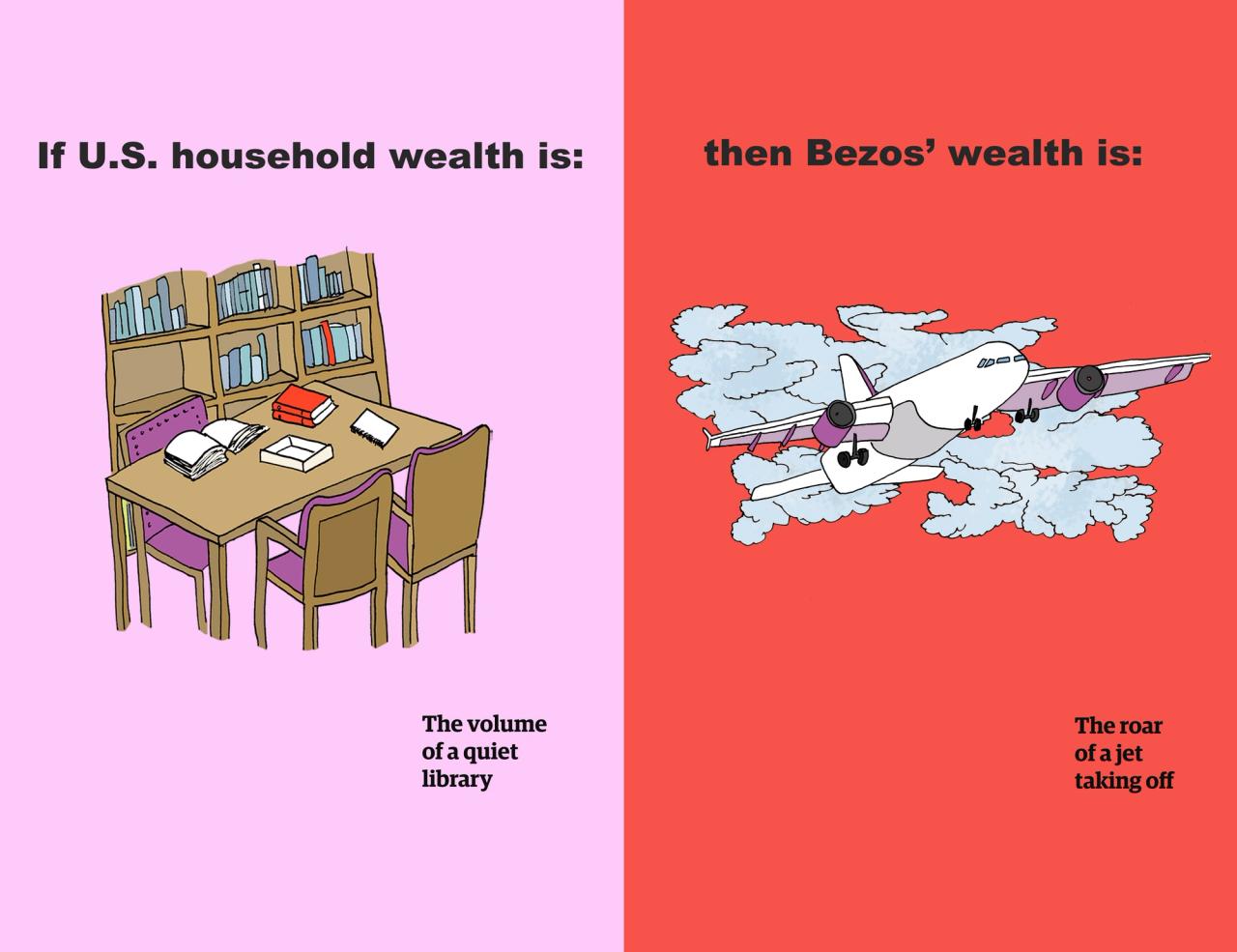
Chalabi’s illustrations from her Pulitzer Prize-winning project, “Nine Ways to Imagine Jeff Bezos’ Wealth,” created for The New York Times magazine in 2022. (Courtesy Mona Chalabi)
Chalabi’s illustrations from her Pulitzer Prize-winning project, “Nine Ways to Imagine Jeff Bezos’ Wealth,” created for The New York Times magazine in 2022. (Courtesy Mona Chalabi)
Chalabi’s illustrations from her Pulitzer Prize-winning project, “Nine Ways to Imagine Jeff Bezos’ Wealth,” created for The New York Times magazine in 2022. (Courtesy Mona Chalabi)
Chalabi’s illustrations from her Pulitzer Prize-winning project, “Nine Ways to Imagine Jeff Bezos’ Wealth,” created for The New York Times magazine in 2022. (Courtesy Mona Chalabi)
Chalabi’s illustrations from her Pulitzer Prize-winning project, “Nine Ways to Imagine Jeff Bezos’ Wealth,” created for The New York Times magazine in 2022. (Courtesy Mona Chalabi)
Chalabi’s illustrations from her Pulitzer Prize-winning project, “Nine Ways to Imagine Jeff Bezos’ Wealth,” created for The New York Times magazine in 2022. (Courtesy Mona Chalabi)
Chalabi’s illustrations from her Pulitzer Prize-winning project, “Nine Ways to Imagine Jeff Bezos’ Wealth,” created for The New York Times magazine in 2022. (Courtesy Mona Chalabi)
Chalabi’s illustrations from her Pulitzer Prize-winning project, “Nine Ways to Imagine Jeff Bezos’ Wealth,” created for The New York Times magazine in 2022. (Courtesy Mona Chalabi)
Chalabi’s illustrations from her Pulitzer Prize-winning project, “Nine Ways to Imagine Jeff Bezos’ Wealth,” created for The New York Times magazine in 2022. (Courtesy Mona Chalabi)
Chalabi’s illustrations from her Pulitzer Prize-winning project, “Nine Ways to Imagine Jeff Bezos’ Wealth,” created for The New York Times magazine in 2022. (Courtesy Mona Chalabi)
Chalabi’s illustrations from her Pulitzer Prize-winning project, “Nine Ways to Imagine Jeff Bezos’ Wealth,” created for The New York Times magazine in 2022. (Courtesy Mona Chalabi)
“Wealth is all of the physical assets that I own. So, money in the bank, car, home, all of those things. But more importantly—and this is again where people can play and distort reality—it’s also the wealth of everyone that I could reliably lean on to support me if I encountered hardship.”
MC: Wealth is all of the physical assets that I own. So, money in the bank, car, home, all of those things. But more importantly—and this is again where people can play and distort reality—it’s also the wealth of everyone that I could reliably lean on to support me if I encountered hardship. So, if I had a romantic partner, it would be all of their assets, if we share a household together. I think what has been so fascinating... I already knew this before I started writing the book, but it’s people who know that their parents have wealth. Yes, okay, technically on your census form, whatever, it doesn’t get counted up as yours. That has a profound effect on your psychological sense of economic safety. It also has real material consequences as you get older and you one day inherit that wealth.
SB: Do you think wealth can also be something nonmonetary as in a safe home, a parent who loves you unconditionally, delicious food on the table?
MC: I think those are really important, but I think those are very often consequences of wealth. Obviously, there are lots of parents who are very, very loving, who don’t have money at all. And I feel like a lot of people who grow up in poverty, their parents are more likely to be out of the home, working. They are more likely to experience things like drug addiction. They are more likely to experience a lot of mental-health issues. Money influences so, so, so much. And that’s still uncomfortable for us to talk about. We have this, again, one of the things that all of us subscribe to is this idea that love is something that money can’t buy. And of course that’s true.
SB: And yet…
MC: And yet I really, really think that I spent less time with my mom than I would have done if we had more money. That’s just a fact, both in terms of—
SB: Yeah. The money and time is a—
MC: It’s huge.
SB: It’s a real thing. I mean, you point out that the word wealth comes from the old English weal—W-E-A-L—meaning the state of being well. Do you think we’ve lost touch with that definition of the word?
MC: Yeah, I think we have. Well, again, no, because you look around yourself and you go to L.A. and there’s people walking around with their juices and they’ve just come from an exercise class or whatever. It’s so transparent that money has afforded them that kind of physical well-being. At the same time, no, I think when we casually use the word wealth, we’re not necessarily thinking about health, but those two things are so intimately tied up.
SB: I mean, it’s one letter. Just one letter.
MC: Crazy.
SB: You write that imagining wealth is relaxing. I think it is. But also that fear is pervasive among the voices in your book. So, why doesn’t acquiring wealth necessarily relieve financial fear?
MC: Because I think capitalism is designed to make you not sit still. I mean, I even think about even on a national level, a country is deemed as being in recession, not if there’s a sudden rise in poverty or whatever. If you stop growing, then you’re in trouble.
SB: Literally. I mean, it’s ironic because I have a company called The Slowdown, but the notion of a slowdown is a negative thing in financial terms.
MC: Exactly.
SB: But when we talk about it in our personal lives, it’s like, who doesn’t like to slow down and relax?
MC: Yeah. But on that national level, this idea that you must constantly be growing also feeds down on the individual level where if I experience any drop in income from the previous year, it feels disastrous. Even if it’s actually not, it feels like, okay, then that means to me, the line is about to turn around and the line is about to go on this downward trajectory and then I’m fucked. I think what happens is this idea of maintaining and staying on the same level. Yeah.
SB: You make this point in the book that I love. You write that the fear of not having enough is itself expensive. You say, “It cost me dearly, and it costs others too.” So, I wanted to ask, what has that fear cost you? What do you think is the ultimate cost of that fear?
MC: I guess it goes back to what I was saying about... spending less time with friends and family as I’ve been working my ass off. I think it’s too simplistic to say that part of the reason why I’m single is because I work so hard. I think there’s a lot more to that. And I definitely think it affected my romantic relationships in a big way, and how much I was working. I don’t know. I just spent less time with people that I cared about. The number of times that I would skip a dinner, skip drinks, or immediately after dinner or drinks, instead of spending time with the person that was laying on the couch opening up my laptop. I don’t know.
“I could have left opportunities on the table for other people to pick up. You don’t really think of it in those terms, that you’re hoarding up all of the jobs and that by you saying yes to everything, you’re taking opportunities away from other people, but you are.”
Again, there’s more to that than simply economic fears, but they really, really played a huge role. And again, I think at one point I mentioned this idea of I could have left opportunities on the table for other people to pick up. You don’t really think of it in those terms, that you’re hoarding up all of the jobs and that by you saying yes to everything, you’re taking opportunities away from other people, but you are. If I would’ve said no to some of the stuff, okay, someone else would’ve done it, great.
SB: I remember interviewing Roxane Gay for this show, and she talked about how for so long it was so hard to say no.
MC: Yeah. I still feel that, if I’m really honest, I have gotten better at it, but yeah.
SB: Toward the end of the book, you write that once you had achieved some financial stability: “It was time to reprioritize, to spend less time working and more time organizing with people I love.” When did you realize that money had given you the ability to not just buy things, but to reclaim some of your time?
MC: Again, I think homeownership really, really changed things because it was just like, what am I going to do? Just keep on working like a maniac to what, buy a second home?
SB: In your big house. [Laughs]
MC: Yeah. No, you can see that, okay, no, no, no, it’s time to really recalibrate. I think that was profound. I think some of it is us holding ourselves accountable, right? Yes, the book explains that there’s so many different variables. It depends on how many people you’re supporting, where you live in the country, how much debt you have, all of these things. But I think individually we can come up with a definition of security for ourselves and then hold ourselves to it. So, I had always said, if I come to be a homeowner, I am going to work less. And then it’s a case of holding myself accountable to that or am I just going to redefine it and say, no, it’s the next thing that’s just up ahead.
I don’t want to own two homes. I mean, I kind of do, but I don’t like that instinct, that desire in myself. I would love to own two homes.
SB: So, now that the book is published and coming out, what are your thoughts in terms of what you thought you knew before you did the book and what you know now? I guess ultimately, too, what do you hope those listening to us talking about and eventually reading your book, what do you hope people come away with understanding about money?
MC: I hope that they have a much clearer sense of where they fit exactly in the system. I think a lot of books about money just make you kind of come away thinking, “Okay, I’m not rich like that guy or I’m not poor like that guy,” but not really understanding exactly where you sit. I hope that once you do see where you sit, you can have more frank conversations with the people around you. I don’t know. When I go out to dinner with friends, I am the person who pays quite often, because I’m aware of the fact that I have more money than other people. Sometimes, that’s uncomfortable and it’s its own dance because sometimes people don’t want you to pay for them. We also have conversations about that, but I also have friends who are very, very happy for me to be the person who always gets the cab and always gets the meal.
I’m okay with that, too, because it’s about acknowledging my privilege just in the same way. I mean, again, the analogies with race are difficult and complicated, but I think that as we have had more frank and honest conversations about race, white people have acknowledged their privilege, and it has—some…
SB: Definitely not all. [Laughs]
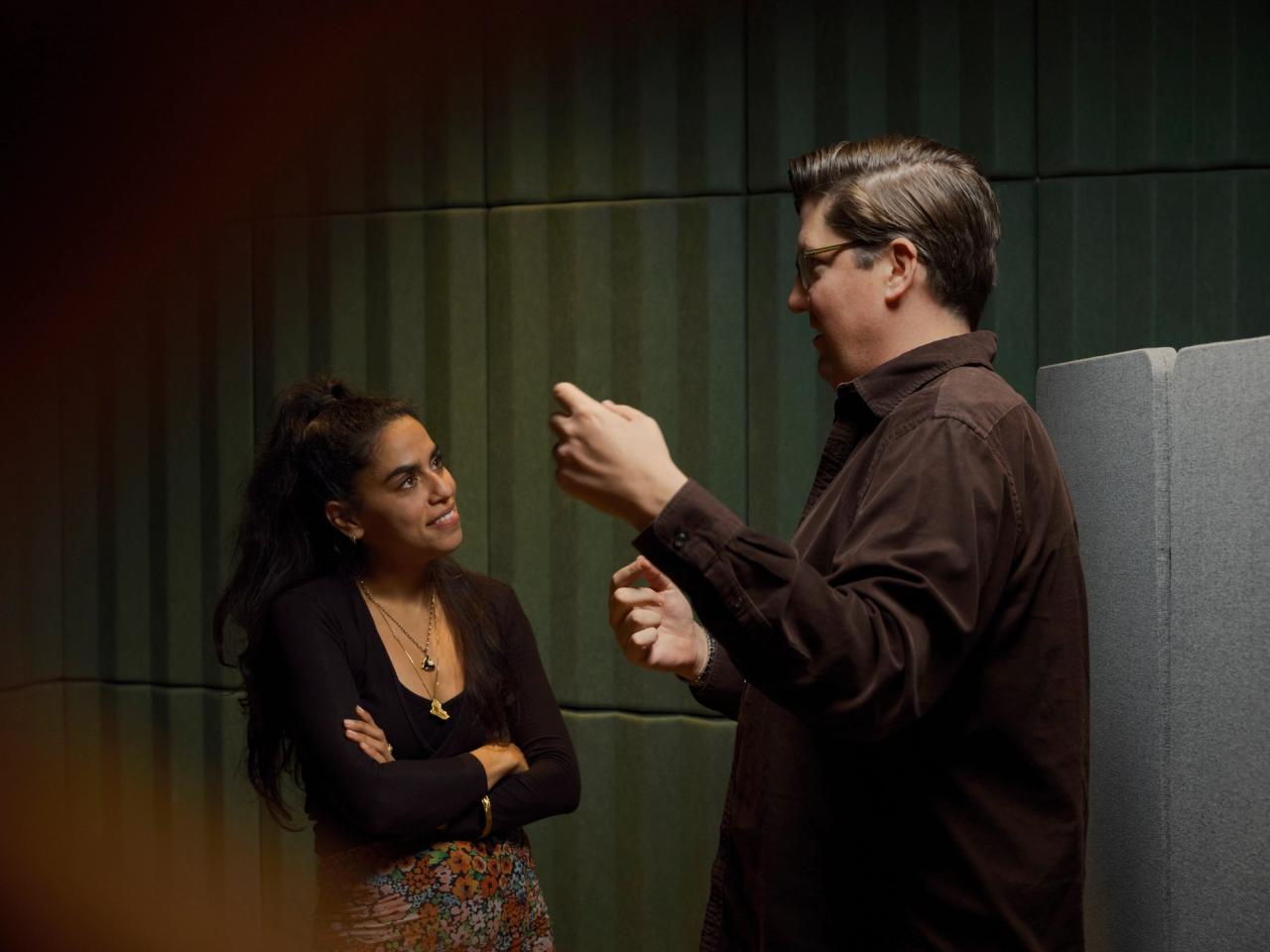
Chalabi (left) with Bailey in the Time Sensitive studio. (Photo: Matthew Harrington for The Slowdown)
MC: Very, very not all. In some cases, it has changed people’s behavior by... I mean, it’s one of the reasons why I moved here from the U.K.. In the U.K., I feel like our conversations about race are still very much about solely focused on people who aren’t white and about the struggles of people who aren’t white. In the U.S., one of the things that has happened because of thankfully writers like Claudia is that there has been a conversation about what is whiteness? In the same way, I think there has to be a conversation about not just poverty, but what is my privilege in this system relative to other people around me? The book begins with these ten deciles.
Deciles are like this very... I hope it’s not too complicated, this economic concept of dividing up the U.S. population into ten percent brackets. So, rather than just talking about the richest ten percent or the poorest ten percent, we have the richest ten percent and the ten percent below that, all the way down. If you can find where you sit, and that becomes part of your intersectional identity to not just say, “I’m an Arab cis hetero woman, but I’m an Arab cis hetero woman who is in the seventh decile,” that’s really, really powerful, actually. That’s really nuanced and complicated. Again, even in this room, there are four of us here. If we were to all share our numbers, it really helps us understand who has power in this room right now.
SB: Mona, thank you so much.
MC: Oh, my God, thank you. That went by so fast. I can still feel that I’m kind of like [makes an explosion sound] as I’m talking about it, but you really spent time with the book. I can really tell, and with my work in general, those were really, really great questions. Thank you.
SB: It was great having you in the studio.
MC: Thank you.
SB: At last.
MC: At last. It took a while.
This interview was recorded in The Slowdown’s New York City studio on October 8, 2026. The transcript has been slightly condensed and edited for clarity. The episode was produced by Olivia Aylmer, Ramon Broza, Mimi Hannon, Chelsea Debrot, Drew Arndt, and Johnny Simon. Illustration by Paola Wiciak based on a photograph by Eva Vermandel.