Follow us on Instagram (@slowdown.media) and subscribe to our weekly newsletter to receive behind-the-scenes updates and carefully curated musings.
TRANSCRIPT
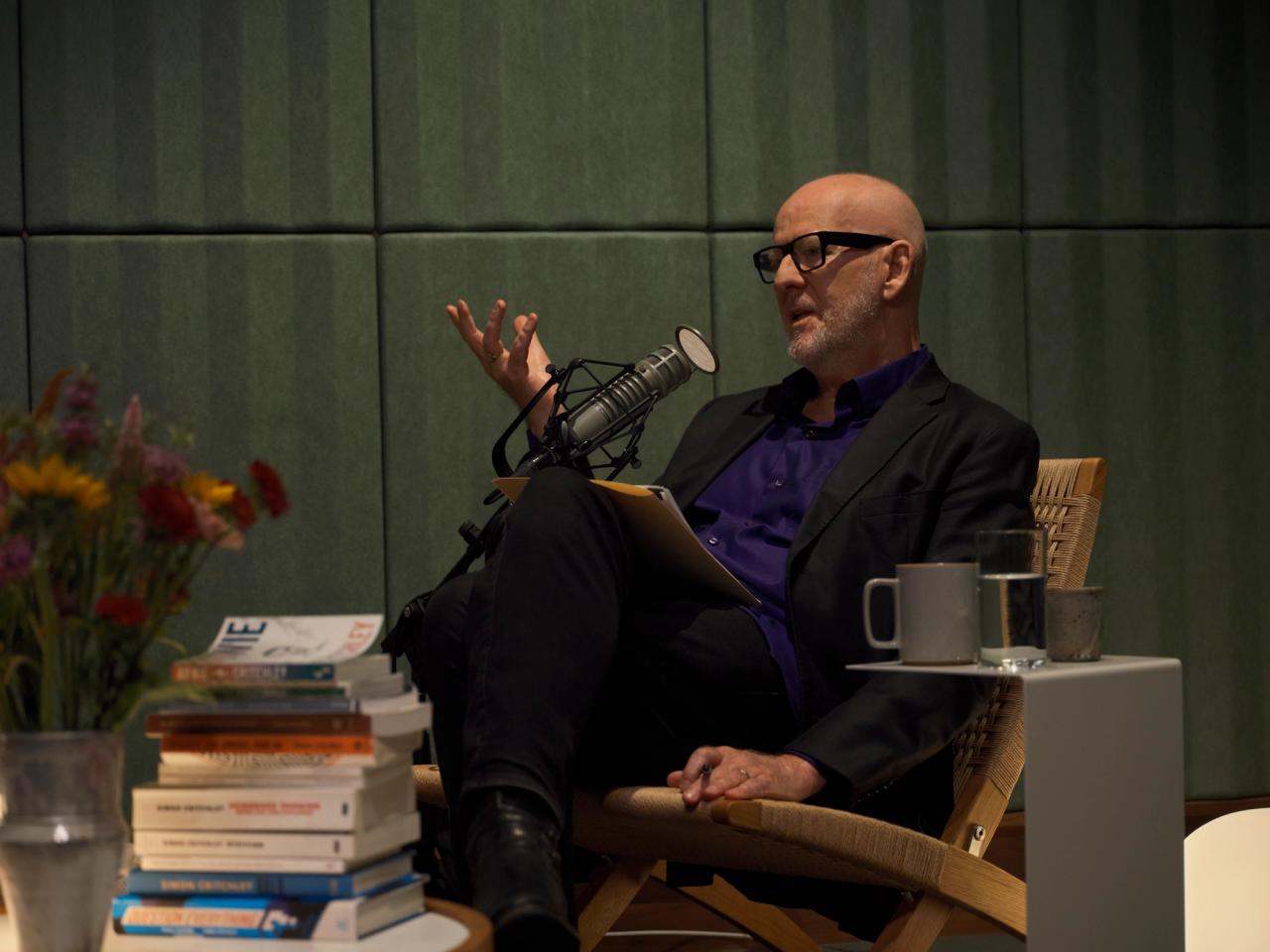
Simon Critchley. (Photo: Matthew Harrington for The Slowdown)
SPENCER BAILEY: Hi, Simon. Welcome back to Time Sensitive.
SIMON CRITCHLEY: Thank you very much, Spencer. It’s great to be back.
SB: This makes you the show’s first repeat return guest.
SC: Good.
SB: Very happy to have you back in the studio.
SC: I’m flattered.
SB: I thought we could get meta up front here and in light of your new book, Heidegger Thinking, ask if you could unpack this very podcast from a Heideggerian perspective. What do you think Heidegger would have made of this recording, which will soon be disseminated in the year 2026 on Apple Podcasts, Spotify, YouTube, and our timesensitive.fm website, and ultimately listened to by thousands of people around the world?
SC: Well, oddly, Heidegger has what you’d call a theory of social media, meaning in his time, the 1920s, when he was writing Being and Time, radio—he has some interesting remarks about radio and telephones. He says that he’s interested in what these media do to space. The idea roughly is that space is something we draw close to us. So, when I’m attending to you, I’m looking at you, I’m bringing you in close. Then at that point, I’m not looking at the camera or whatever. You’re closer to me than the microphone is experientially, right? I’m focused on you there, but I draw things in. He’s thinking about that in relationship to the environment of a room, a house, or a landscape.
But he also says that there’s this wonderful thing called radio. In radio, we could be anywhere. We could be in Moscow or London or Berlin or anywhere in the world and we draw that in close. So there’s a sense in which the media, for Heidegger, are a collapsing of distance, a collapsing of distance where things are pulled in to us and feel closer than maybe our bodies even feel. You could see I’ve got my phone in my pocket—it’s turned off—but that can feel closer to me when it pings than my heart or my nose. I can’t see my nose, thank God.
There’s a sense in which there’s a constant engagement with space in Heidegger. The book is called Being and Time, but it might have been called “Being and Space.” And space collapses, we draw things into nearness, into proximity. When I’m using this pen, this is proximal to me. I draw that in and simultaneously I can let that go. Now I’m talking to you. So, space has this elasticity, this malleability, and the media would just be another way of thinking about that. At least in the early work, he doesn’t think that’s anything particularly bad. In the later work, that changed a little bit.
Now, Time Sensitive is completely Heideggerian because Heidegger was time sensitive. To let the cat out of the bag, for Heidegger, time is not a series of nows. It’s not the now of the present, the not-yet-now of the future, and the no-longer-now of the past. So what Heidegger’s trying to get away from is the idea of time as a line, which we usually, we often invert and we think of time as an arrow pointed toward the future. Time is not like that. It’s not a line of nows. Time is something which we are sensitive to, experientially.
In the time, in lived time, what we call lived time, often what comes first will be the future. Out of that future comes my sense of the past, not as something bygone, but as something which I carry with me. This is what Heidegger calls my “having been.” He has this strange idea, beautiful idea, that the basic structure of time is one where I am coming toward a future that which I had been, the past. You can think about that in relationship to one’s own past, that what you’re coming toward in time is what you have been and what you carry with you. You could then unleash that into the present. These aspects of time are what he calls the ecstasies of time.
Basically Heidegger, like other philosophers in this period, someone like [Henri] Bergson, is trying to get away from this linear idea of time as a series of countable units. Time is this flow, this movement, which we know and we live within, but somehow we don’t theorize time that way. We think about time as this series of lines.
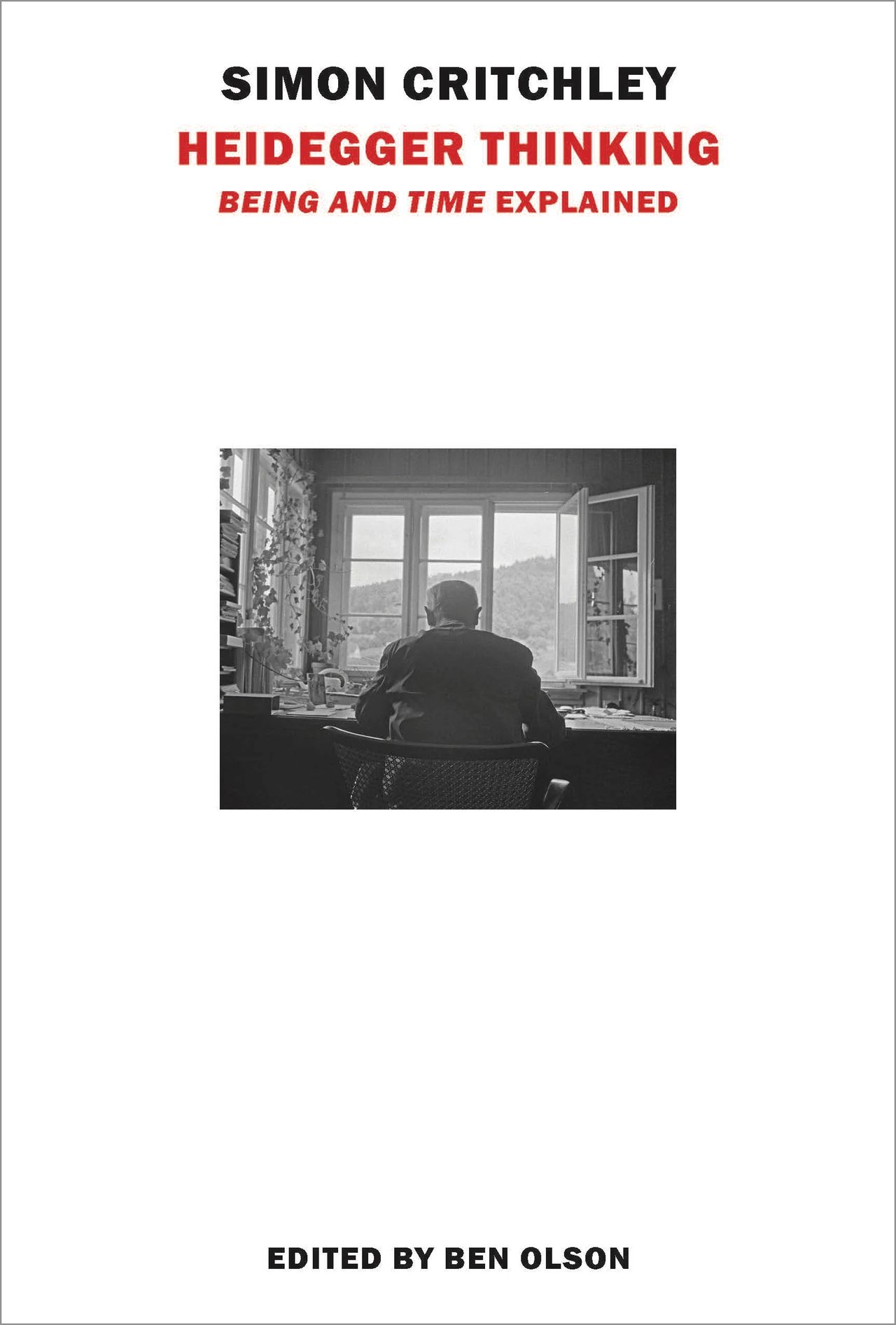
Cover of Heidegger Thinking: ‘Being and Time’ Explained (2026). (Courtesy New York Review Books)
SB: There’s this great diagram in your book that shows this. I was laughing to myself as I looked at it, because I realized that that diagram is literally how I structure these Time Sensitive interviews. It’s always starting very much in the present, but rooted in the past, looking toward the future. Then it all circles back on itself. To look at that diagram was almost to look at how I structure the Time Sensitive interview itself.
SC: Right. So, it’s an orientation toward the future, toward what is to come, which opens up what has been, and which is unleashed into the present.
SB: Exactly.
SC: That time is not a circle, but it’s a time where I’m... It’s a lived time that we know all too well, that we carry with us in our bodies and in our heads. But I think almost more profoundly in our bodies—a sense of what we had been. That could be an injury; that could be a memento.
I talk somewhere in the book about this ring, and this ring was my grandfather’s ring from Liverpool. When my grandfather died, in 1968, my grandmother kept it for twenty-five years, thirty years. And then the year before she died, she gave it to me and she said, “This is yours now.” So I inherit a ring. And that ring is the having-been of my grandmother. I think of it as, this sounds a bit twee, but I think of it as her holding onto me in some way. It’s an actual physical connection to that past. That’s mine.
But then we can think about that in more general terms. There could be symbols, structures, sports teams, music, which can be collective and shared. And there can be things which are intimate, like a childhood memory, which you have been. Maybe when you don’t even remember it.
SB: We’ll get to sports, for sure.
SC: Okay.
SB: Going very top-line here, this book Being and Time, it came out in 1927, almost a century ago. What is the fundamental question Heidegger is asking?
SC: The question Heidegger’s asking is what is the meaning of being? The answer to the question is that being is time. So the book is called Being and Time. The thesis is: Being is time.
SB: So you are time.
SC: Yep. We are time. We are all time. Which means for Heidegger, we’re finite. So being in time can be reduced to two semi-sentences. Being is time, and time is finite. And if time is finite, it means that all ideas of infinite time or eternity are out the window. It means that if time is finite, it means that my time comes to an end. And it comes to an end with my death. My time is my time. And there was a time before my time and a time after my time. So, to live is to live in accordance with your time.
SB: Between birth and death.
SC: You live in a stretch between birth and death. Perfectly obvious. But people could think about ideas of... Usually in the history of philosophy and theology, someone like Augustine, when he’s thinking about time, he says something like, “What is time? When nobody asks me what time is, I know. But if somebody asks me, I can’t define it.” AHe says, “But maybe we can get to the idea of time by contrasting it with eternity.” So, he builds this whole structure, eternity, which is timelessness and then time which is happening.
Heidegger drops the eternity part out. Or the idea of time as a flow of nows I talked about before, you could think about that as an infinite flow of nows. For Heidegger, no, it’s a finite set of units through which your existence is going to pass and the existence of those that preceded you and those that will come after you might pass.
It’s important to hang on to that. That changes that experience of time. It’s a very simple thought in Heidegger. The problem with Heidegger and the problem I’m trying to set myself in the book is, in a sense, how to retrieve these very simple intuitions in his work. But they’re intuitions which are clouded by the language that he uses.
SB: Super baroque language.
SC: Baroque language. The baroque quality of it is interesting because it was also written at a time when the Baroque was in discussions. So, around this, roughly contemporary with Heidegger’s Being and Time, is Walter Benjamin’s book on the origin of German tragic drama, which is all about Baroque. So something about the Baroque going on in the 1920s. But the baroque quality of Heidegger’s text is really, really ugly.
SB: Hard to parse.
SC: Yeah. He’s doing it for a reason. The reason is how can he think about the fundamental questions that philosophy has tried to deal with, but in a way that shakes up the tradition? And for him, the tradition has a deadening quality. His answer to that is to try and develop his own language, his own vocabulary. Of course in German, to do that in German is one thing. It’s already strange enough in German, but then you’ve got to translate that into English and it gets particularly weird and complex.
The way we’d normally think about things, consciousness, doesn’t want anything to do with that. Objects, no. Subjects, no. He tries to get rid of all of the mind, things like that. To get rid of all of these standard ways of thinking about us and our life, because he thinks that they settle too easily into something traditional that we think we understand. Actually, he’s trying to shake that up in order to produce a novel experience.
SB: Yeah. He comes up with this term dasein.
SC: Dasein.
SB: Which roughly translates to “being there.” Why does he choose that as opposed to just human being or person or self?
SC: Yeah. He thinks that person, human being, which in German is mensch, which is neutral, but he thinks that’s too familiar. These have been used before. There’s lots of discussions of personhood in philosophy. So, he thinks that dasein is good. IAlso, he likes homophonic structures. SThe German for consciousness is bewusstsein, which is “being conscious.”
Heidegger’s book is called Being and Time. Being is sein, right? The way we normally think about human being is bewusstsein, consciousness, and he wants to think about in a different way. So, he comes up with this term, dasein, which is us right here, right now, as we experience a world. The key thing that he wants to do is to show that who I am is not distinguishable from the world that I experience.
SB: Right. The being in the world is that we’re looking out at this external reality, but always entangled in it.
SC: Yeah. So we could begin thinking, and this is the way many people still think about things, There’s this thing called consciousness, which people think is a mystery. It’s a mystery why people think it’s a mystery. It’s just awareness. What’s so mysterious about that? The mystery is actually matter, but that’s a separate question.
We usually begin from this idea of consciousness and then a world that’s out there. And then the standard philosophical question is, how do we connect consciousness in here, in my head, with a world that’s out there? And can we guarantee knowledge of an external world? Philosophy becomes this discipline of theories of knowledge, what’s called epistemology. Heidegger says no.
I remember this really hit me when I was an undergraduate and I was just beginning to... I’d heard the name Heidegger and I was beginning to...I thought Heidegger was cool and interesting. There was this graduate student, this woman called Fiona, who was a master’s student at the university I was at. I was very impressed with her and she was working on Heidegger. So I said, “What is it about Heidegger that appeals to you?” She said, “What appeals to me is there’s this sentence he has where he says, ‘I’m always already out there alongside the world that I experience. I’m not in here. I’m out there.’”
So, dasein means that I am out there ecstatically with things.
Now, how do we think about that? We think about that for Heidegger in very practical terms. So, when I’m engaged in a task that I’m familiar with—making coffee or doing the washing or something—I’m not in my head. I’m engaged in a series of practical actions where I’m doing things with my hands and I’m pressing buttons or whatever, but I’m out there with things.
Another way of thinking about it would be in terms of what happens when you play. In play, you’re not stuck inside your head, you are playing. If you’re doing, say, a physical game like soccer or whatever it might be, you’re out there alongside the world. A good example would be you ask—and this always happens—you ask a professional soccer player the interview after the game…
SB: It’s always horrible.
SC: “What was going through your mind when the ball came to you on the edge of the eighteen-yard box?” Of course, nothing was going through that person’s mind. They just know what to do and they’re trained to have this background set of abilities which they can train and develop these skills and they are on the pitch with the other players in movement with them. So, when they’re playing, they’re not in their heads, they’re on the pitch. Nothing’s going through their head—unless something goes wrong. If they screw up, then maybe something’s going through their head. “God, I messed that up.” But if things are going well, or when a child is playing, the child isn’t thinking, necessarily. The child’s engaged with stuff. So, to try and get back to that lived, everyday experience of the world is what Heidegger’s trying to get us toward.
SB: It sounds pretty simple and it is, as you describe it, it’s “extremely simple,” but there’s so much complexity embedded in this. You wrote five hundred pages about his book. [Laughter] Why is his proposition so radical or why do you see it as so radical? Is it radical? Maybe backing up for a moment, too, I’m curious how you came into Heidegger in the first place, your first encounters with this book Being and Time, which you’ve now been teaching for decades. Clearly, there is a radicality in it that keeps you coming back.
Why is it radical and what keeps you coming back to it?
SC: It’s radical in the sense of radical comes from radics or from the word we get radish. It’s thinking about the roots of things, the roots of experience and not the overgrowth. So Heidegger, in a way, is a very completely old-fashioned thinker. He thinks that there was a radicality to what the ancient Greeks were up to at the time of Being and Time, that’s Plato and Aristotle.
In the later work, he develops more interests in the people that we call the pre-Socratic thinkers, Heraclitus, Parmenides, and others. There’s something radical in the sense in which here are the roots of thinking, the roots of our tradition, which have been covered over by tradition. They’ve become covered over by the accrual of various habits of thought. All that Heidegger is trying to do in his work is to get back to where this whole adventure of thinking—in particular what we might call Western thinking—began, with the ancient Greeks. They were onto something.
SB: So, time is his vehicle.
SC: Time is his vehicle. The thing about the ancient Greeks is that they… Being and Time begins with this untitled first page, which begins with a quotation in Greek from a dialogue by Plato called “The Sophist.” The quote says something like, "And we do not understand what being means. Furthermore, we’ve forgotten to be perplexed by this."
“You assume that today is going to be like yesterday and you know how everything works, you know what the score is, you know what’s going to happen when you turn the news on or whatever. Heidegger wants us to reawaken our deep perplexity, our aporia, about that which is.”
The word perplexity is this interesting word in Greek. It’s called aporia. And an aporia is a place without an exit. It’s a place where you are just allowed to be perplexed. And for Heidegger, the fundamental Greek experience was an experience of perplexity about that which is. And they were perplexed. Because they were perplexed, they were asking questions. He wants us to move back into that experience of perplexed questioning. As opposed to a view in philosophy or in life, indeed, where you assume that you know everything from the get-go. You assume that today is going to be like yesterday and you know how everything works, you know what the score is, you know what’s going to happen when you turn the news on or whatever. Heidegger wants us to reawaken our deep perplexity, our aporia, about that which is. That experience of aporia in the face of that which is, is what he calls wonder, the open experience of wonder. And that is the, aAccording to Aristotle, that is the mood that the first thinkers, the first philosophers experienced—wonder.
In many ways, all that Heidegger wants to do is to recover that experience of perplexity and wonder about that which is. On the basis of that, you can then begin to investigate and explore. That means though, that the whole intervening tradition of thought, in particular for Heidegger, the modern tradition of thought, and in particular what’s happened since the time of Descartes has to be, it’s the word he uses, destroyed. We have to engage in a destruction of that tradition in order to reawaken a perplexity about that which is. So that’s what’s radical about this project is that we have to basically learn to—
SB: It’s a whole new architecture.
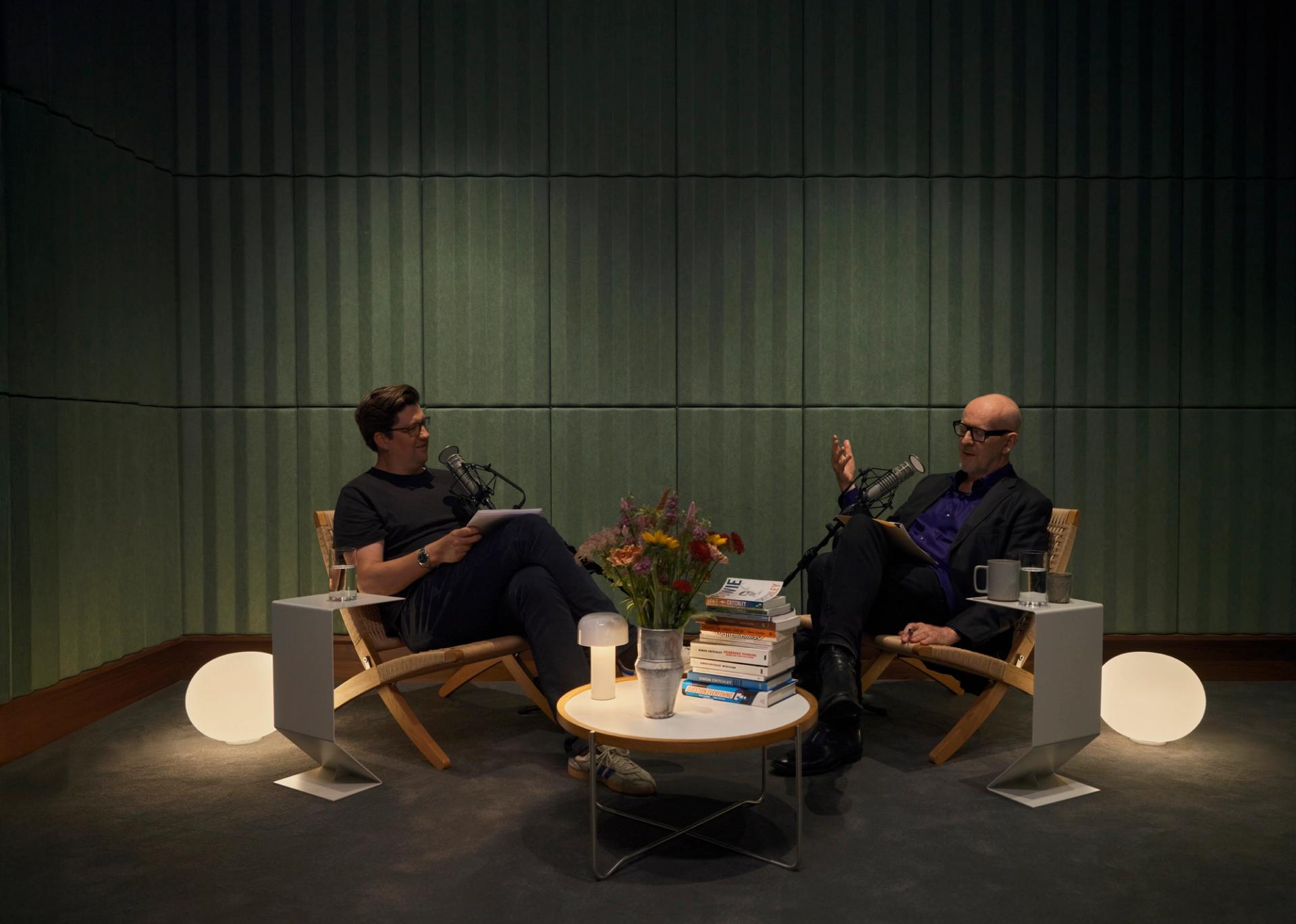
Critchley and Spencer Bailey during the recording of Ep. 159 of Time Sensitive. (Photo: Matthew Harrington for The Slowdown)
“Philosophy is a kind of unlearning, making what is familiar unfamiliar, what is obvious, strange and uncanny, in order to open these deep questions.”
SC: Yeah, we have to learn to unlearn. [Maurice] Merleau-Ponty has this lovely remark when he’s asked at some point what philosophy is. Philosophy, in his view, is relearning to see the world. We know what the world is. We’re familiar with it and we’re familiar with how to orientate ourselves in the world. That goes stale and rusty. So philosophy, on that view, is a kind of unlearning, making what is familiar unfamiliar, what is obvious, strange and uncanny, in order to open these deep questions.
And philosophy is that. Philosophy is… What is philosophy? Philosophy is the inverted world. It’s the world upside down. And you see the world through the spectacles of a great philosopher like Spinoza, whoever it might be, and suddenly you’re shaken by that. You think, “Wow, I could be the same as nature, which is the same as God?” And the whole thing is vibrating together?” So, the idea is that habit and custom and the traditional ways of thinking about things deaden us. What Heidegger is trying to do in his thinking, and philosophy is trying to do more in general, is to make us feel alive.
SB: What about Heidegger brought you in? What shook you when you engaged with his work, and how has it kept you rapt for decades? You are, as you’ve put it, “a rather worried Heideggerian.”
SC: A worried Heideggerian.
SB: But you’re a Heideggerian nonetheless.
SC: Yeah. The basic, if you like, the paradigm shift that happens with Heidegger is not reversible. There’s thinking before Heidegger, and thinking after Heidegger. It doesn’t mean you have to agree with him.
But for me, the experience is quite specific. Let me try and recount it. I went to university late. I was 22. I had a misspent youth, rock and roll, drugs and sex. In that order, there wasn’t much sex. There weren’t enough drugs, but there’s lots of rock and roll. That all came to an end. And I got a second chance. I went to a community college. I did some remedial exams.
Someone mentioned to me, almost casually, in the library, “You should apply to university.” It never crossed my mind, because no one in my family had been to university. So, I got there, and I was going to do literature because that was what I knew I cared about. But then my fourth topic in my first year was a philosophy class, which I thought would just be an option. I was totally blown away by philosophy, because I had great teachers, and it was just more astonishing. There was also less to read, as well. I found that helped me. I couldn’t really keep up with the pace of reading a five-hundred-page George Elliot novel every week. Can’t read that fast. Still can’t, really.
So things were going okay. In my second term at university, I began to experience what became a nervous breakdown—what you would call a nervous breakdown. I wasn’t sleeping, I was a mess, and it was awful. I was given some drugs by the doctor, and they made things worse. I was just terrified of exams, terrified of what I got myself into.
So, I was experiencing anxiety, profound anxiety—which I still experience, but I’ve learned to manage. Then I read in this Existentialist Reader, this little text by Heidegger called “What Is Metaphysics?” And I understood very little of it. But he says in this, it’s about fifteen pages long, he talks about anxiety. And he has this line where he says, “Anxiety reveals the nothing.” Anxiety reveals the nothing. And I thought, Yeah, I know exactly what that means. Anxiety reveals the nothing. And it spoke to me.
“Anxiety is not a disorder. Anxiety is what human beings do. You can experience it as fear, but you can also experience it as a kind of calm.”
Then he says another thing which was fundamentally transformative for me. He said that anxiety isn’t anything to be scared of. It isn’t something to be... He doesn’t talk about this. It’s not something to be medicated away. It’s not a disorder. Anxiety is not a disorder. Anxiety is what human beings do. You can experience it as fear, but you can also experience it as a kind of calm. Now, this really got me going.
He makes a distinction there between anxiety and fear. He’s drawing on Aristotle, but the details are unimportant. Fear is fear of something. So, if I’m scared of spiders—I’m not, but people are—and a spider comes into the studio, I feel fear. “Oh, there’s a spider. Spencer, get rid of that spider. Violence is the only language they understand. Kill it.” [Laughter] And the spider is shooed out and then the fear is gone and we can resume our conversation.
So, fear has an object. Anxiety doesn’t have an object. Anxiety is an objectless mood, a fundamental mood whereby... I do find the world profoundly strange, uncanny, and I’m not at home at all. If I can inhabit that with a kind of calm, a kind of poise and I can take my time with that, then perhaps something can happen.
One of the reasons I’ve kept teaching Heidegger for so long is because of that experience, and because of that experience in relationship to people that I’ve taught over the years, who will often be experiencing something like that anxiety. And to try and get them to see it as something revelatory, something profoundly human, which can open things up, open up possibilities.
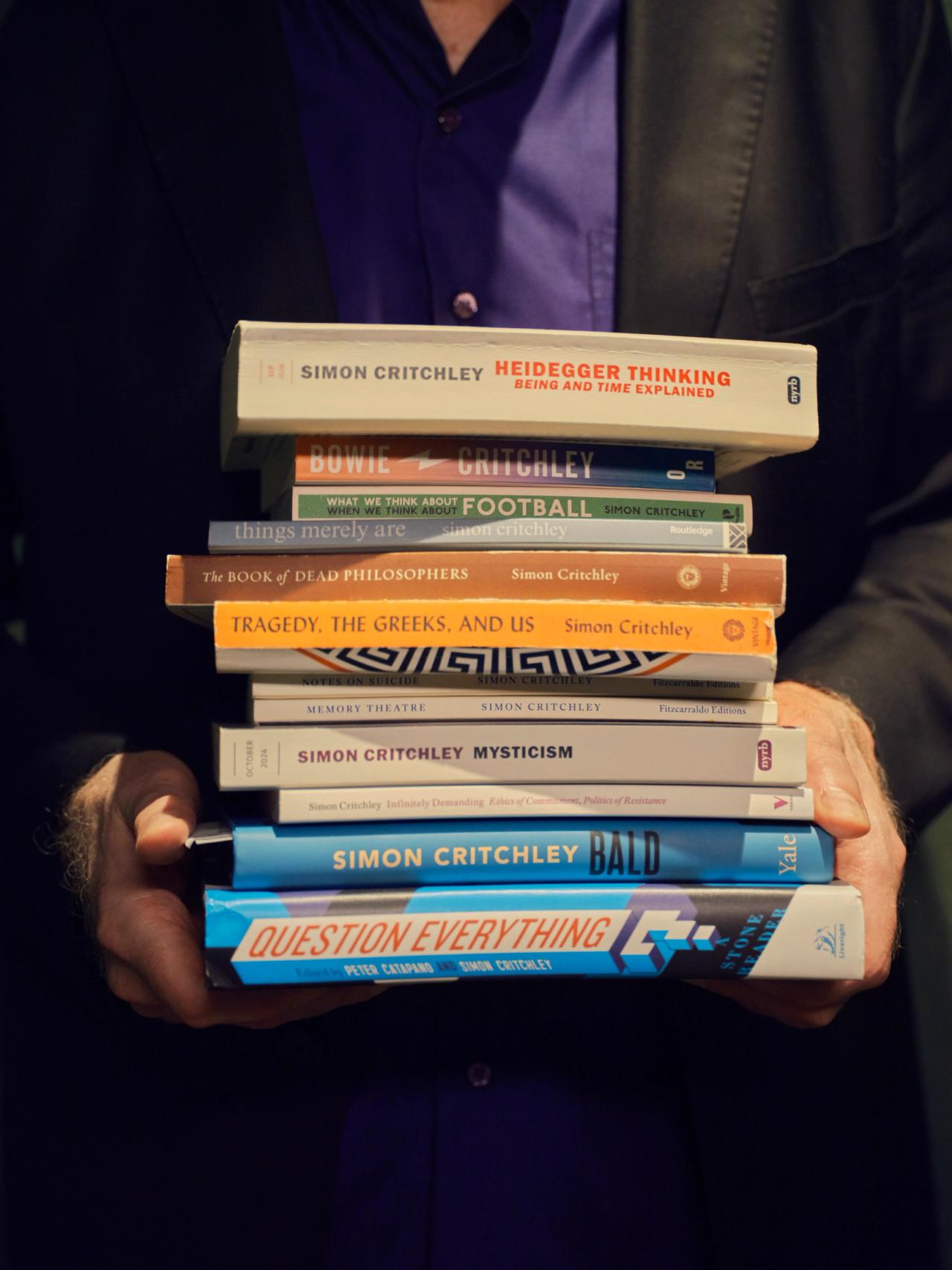
Critchley holding a stack of his books, with his latest title, Heidegger Thinking, on top. (Photo: Matthew Harrington for The Slowdown)
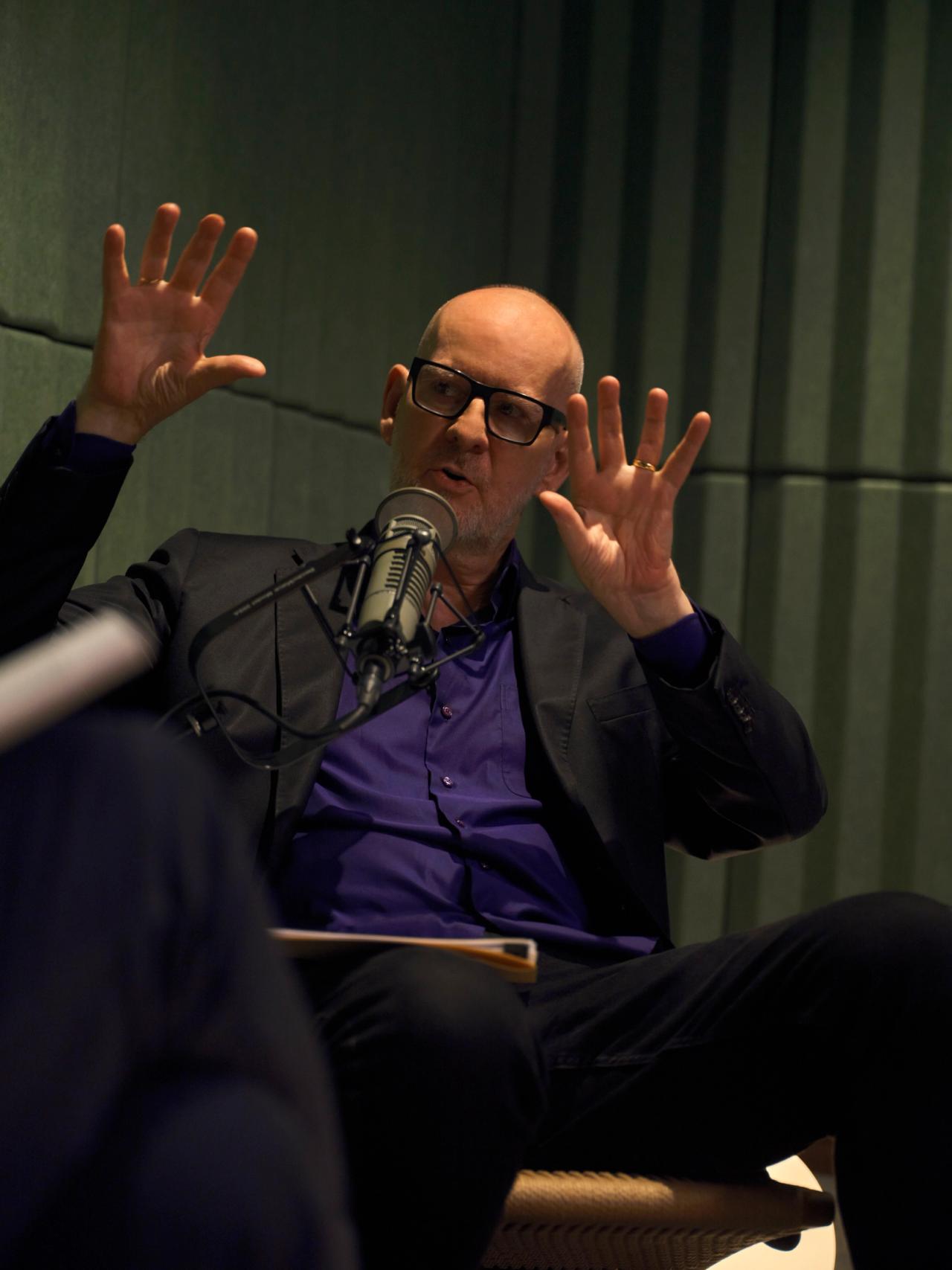
Critchley during the recording of Ep. 159 of Time Sensitive. (Photo: Matthew Harrington for The Slowdown)
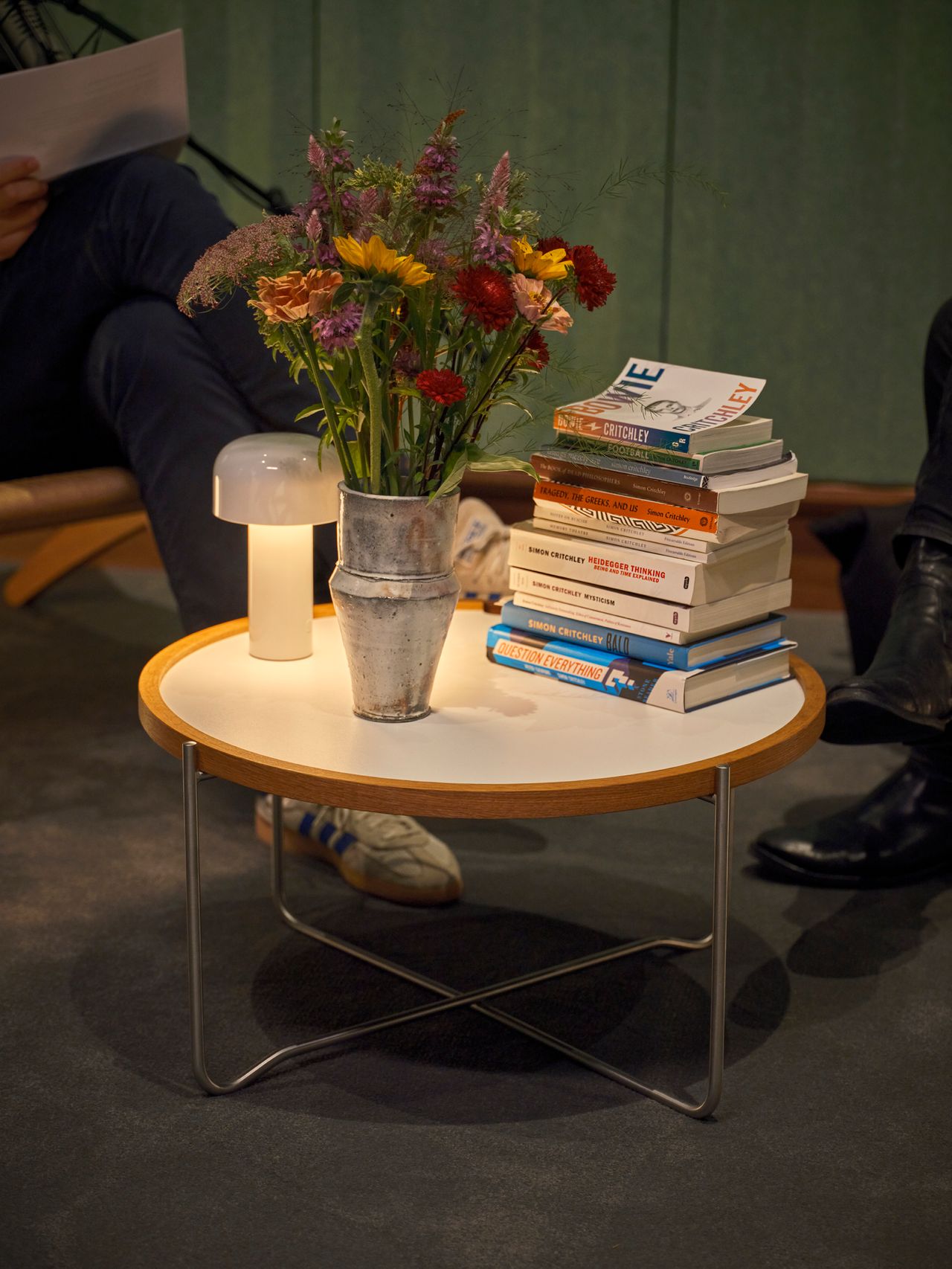
A stack of Critchley’s books on the table in the Time Sensitive recording studio. (Photo: Matthew Harrington for The Slowdown)
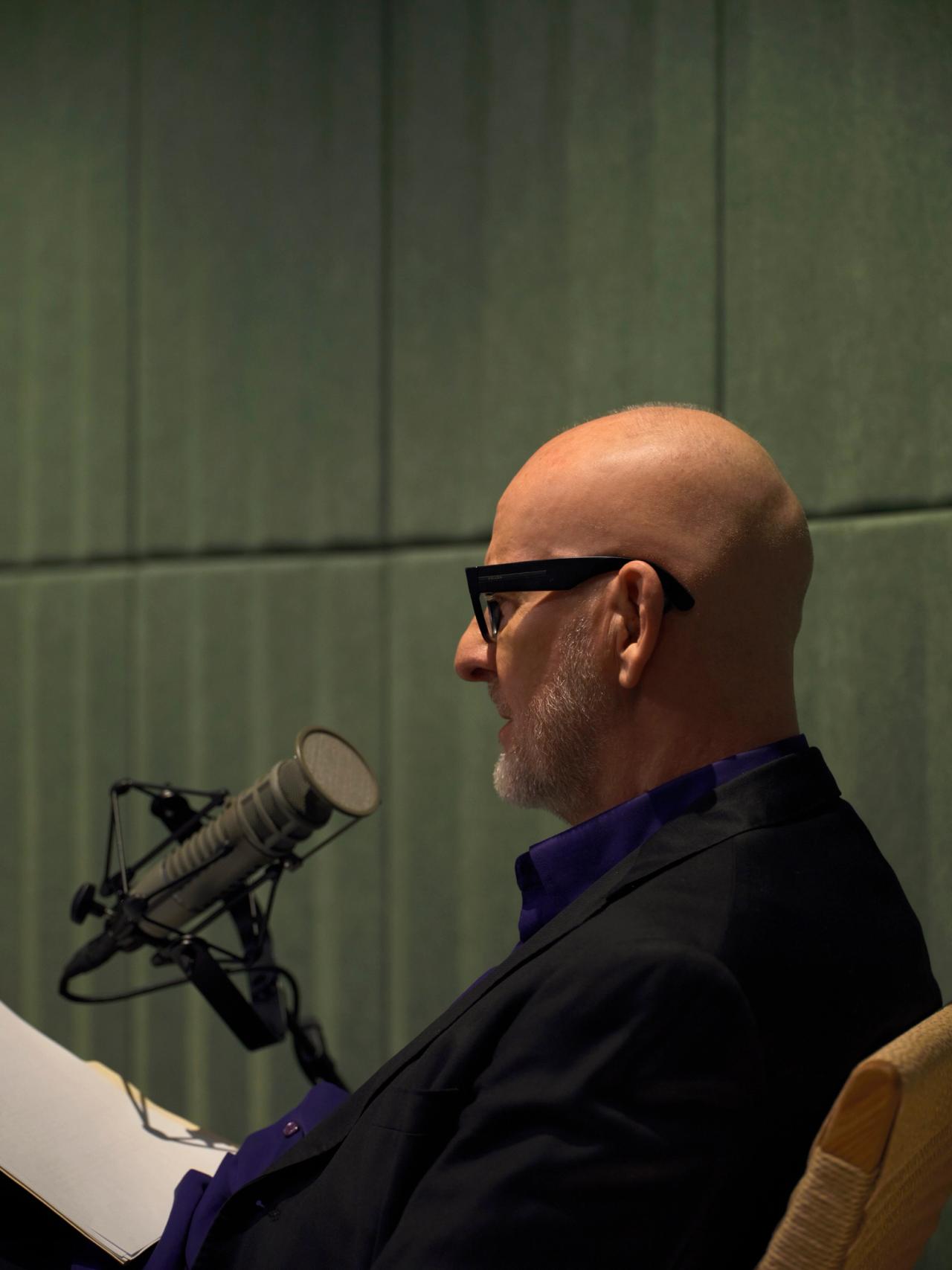
Critchley during the recording of Ep. 159 of Time Sensitive. (Photo: Matthew Harrington for The Slowdown)
Critchley holding a stack of his books, with his latest title, Heidegger Thinking, on top. (Photo: Matthew Harrington for The Slowdown)
Critchley during the recording of Ep. 159 of Time Sensitive. (Photo: Matthew Harrington for The Slowdown)
A stack of Critchley’s books on the table in the Time Sensitive recording studio. (Photo: Matthew Harrington for The Slowdown)
Critchley during the recording of Ep. 159 of Time Sensitive. (Photo: Matthew Harrington for The Slowdown)
“There’s an almost therapeutic aspect to my interest in Heidegger.”
To that extent, there’s an almost therapeutic aspect to my interest in Heidegger for myself and for others. So yeah, I’ve got more to say, but I’m talking too much.
SB: [Laughs] Well, I think I mentioned we’d get to sports.
SC: Yeah.
SB: You have touched on football, or soccer. I’d like to tie this here to your book, What We Think About When We Think About Soccer. In it, you effectively argue, if one wants to know what the ecstatic temporality that Heidegger’s talking about feels like, then they should watch a football match.
SC: Right.
SB: Do you view football, then, as among the most Heideggerian experiences one can have?
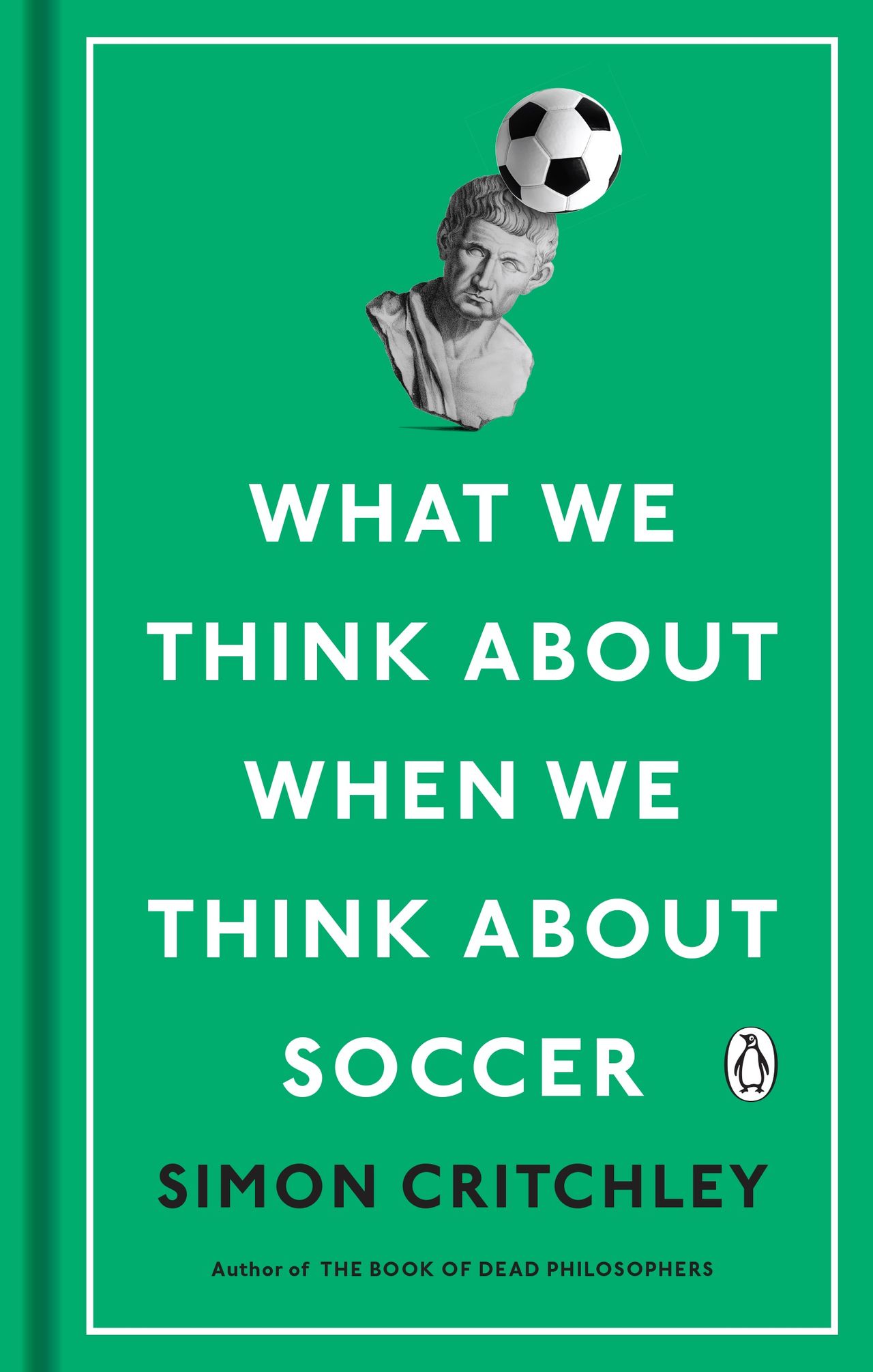
Cover of What We Think About When We Think About Soccer (2017). (Courtesy Penguin Books)
SC: Yeah. In the book I talk about—the hero of the book is Jürgen Klopp, who was the coach of Liverpool Football Club, my team for about eight, nine years. Glorious years that ended a couple of years ago. And Klopp was indeed from that corner of southwest Germany where Heidegger was from, Swabia. There are all sorts of echoes back and forth. The way Klopp wanted to play football was in a very Heideggerian way. He wanted moments of intensity. He wanted what he called, or what was called in relation to it, heavy metal football. Football that would be about just a sheer joy and life and energy and power and the delight of the competitive situation.
In relation to time, if what Heidegger is describing might sound abstract, here’s a very concrete way of making it simple.
SB: Right. Ninety minutes of clock time, but seen through another lens, it’s totally different.
SC: Right. So, a football match, a soccer match, the two things are the same. The game is called association football for which we get the abbreviation soccer. So the idea that “soccer” is an Americanism and “football” is the proper English expression is ridiculous. When I grew up, it was called soccer, as well as football, so whatever.
A soccer game or a football game is measured by clock time. Two units of forty-five minutes with a fifteen-minute break, extra time for injuries. It’s linear time. And yet within that experience of time, I see time in totally different ways. If my team are a goal up and we’re getting toward the ninetieth minute, time drags. I want the game to end, I start whistling or whatever. Contrarily, if my team are a goal down, we’re getting toward ninety minutes, time seems to speed up and there isn’t enough time for my team to score a goal and get back in the game.
Time has this elasticity, this malleability, and it’s something we actually see. During the World Cup, which was to everyone’s surprise, quite good fun, despite Gianni Infantino and everything else. You could see in certain games a concentration of time.
When England lost, as they always do, to Argentina in the semifinal of the World Cup... And we were a goal up, sixty-five minutes to go. For about three, four minutes, I was almost hopeful. What was really shocking about that game was playing Argentina, long history, complicated history with Argentina, we scored a goal, a lovely goal, goal up. There was this amazing recovery tackle by one of our defenders, Djed Spence. And he thought, “Okay, we’re in with a chance here.” Then we put on three defenders; Argentina could smell blood. The coach said that. They just went after us, and we left the best player in the world, the best interpreter of space, the best hermeneutician in the world, Lionel Messi, to just occupy space and work his magic.
They scored two goals and we lost. And that last ten minutes of that game was like a concentrated hell ride for us—or if you’re Argentinian, it was a joy. So time is therefore relative to one’s relationship to one’s affiliations and so on and so forth. And that’s kind of cool.
SB: You call this time that we’re suddenly lifted out of the normal kind of clock time. You call it Klopp time, K-L-O-P-P.
SC: Yeah, that’s after Jürgen Klopp. Yeah, because Klopp just wanted to give fans just that thrill, that excitement of being lifted up out of yourself. In sports, we saw this, for example, in the N.B.A. finals, the Knicks game, was it Game Four? I forget which game it was. That was just so exciting. Now, what was happening with time there? The time at the end of a basketball game is a whole different experience, but the acceleration and the joy and the sense of transformation, and you felt that. I’m not a huge basketball fan. I’ve seen some basketball, but it’s not my sport. But the joy that that unleashed in people—
SB: Yeah, the felt time throughout New York City and the minutes, hours and days after that.
SC: Yeah. Obviously, as we all know, it’s been so depressing. I mean, every day is just so depressing and sad. And I’ve stopped... I’m a news junkie and a radio-head and I listen to the news and I read the news and I just can’t. I can’t.
That Knicks’ victory was actually one of the few moments in the last year where there’s been a lived collective sense of, “Oh, yeah, this is something and this is ours.”
SB: That’s good.
“Sport can change things collectively in a way that is intensely tribal and attached to place, and an experience of ritual. It revives something incredibly deep about what it means to be human.”
SC: So, sport can do that. Sport can change things collectively in a way that is intensely tribal and attached to place, and an experience of ritual. It revives something incredibly deep about what it means to be human, which I think it was...
Actually, yesterday I took some time off and I was watching on the Criterion Channel, because I’m a bourgeois individualist, that Brian Eno movie, which comes out in different iterations every time; it’s a generative documentary. So I thought I’d watch the August version of that. Eno says this remarkably simple thing. Eno’s a very simple thinker who enjoys complexity arising out of simplicity. But he says that, “I thought for many years that language was the key thing. We’re linguistic beings, language is what it’s all about, language, reason, truth and so on and so forth. But the older I get, the more I think it’s feeling. It’s just feeling. It’s feeling that is what is transformative and that’s what’s at the core of things.” I think that’s right.
I think that’s why music matters to us in the way in which it does, that music— We can talk about music and we have talked about music at length, but you feel it and you can’t describe it. And that sense in which... Here’s another thing, another great innovation of Heidegger’s work, the primacy of feeling or what he calls mood. The word in German is Stimmung, which is also linked to... It’s kind of attunement.
I’m looking across the studio at musical instruments, and let’s imagine that guitar is appropriately tuned. When that was being played, that guitar would be in tune with the room and it would create a feeling in the room. Moods are like that; feelings are like that. I think what we crave—and I think Covid was the negative proof of this—is some kind of collective experience of feeling.
We were deprived of that for however long we were deprived of that. And I think it’s a desperate sense in which... And there’s something just really deep about that human collective wish for a feeling which can be shared.
SB: I mean, I’d almost use the word ecstasy here, which is a word you use a lot in your books, even looking at this Simon stack we have in front of us.
SC: Yeah.
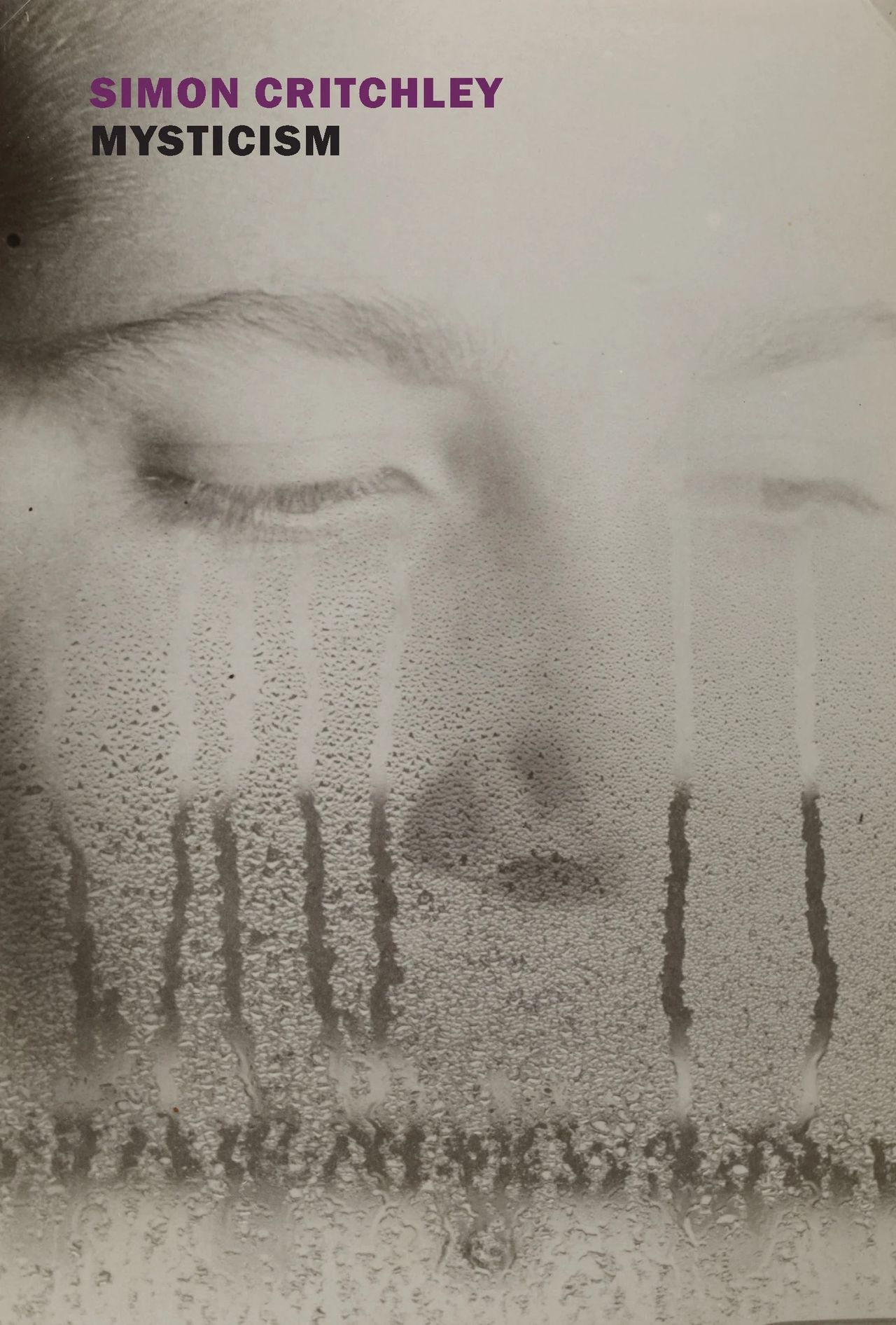
Cover of Mysticism (2022). (Courtesy New York Review Books)
SB: These are my books which I’ve been reading over the years, and I absolutely love your work. And I would say there’s quite a few different central conceits I would argue, but ecstasy certainly seems to be one. You can see it in your Bowie book, your mysticism book—maybe not your suicide book so much, but perhaps we could make that argument.
SC: Maybe.
SB: In Heidegger, there’s this notion where we’re ecstatic temporal beings. In football, you described sensate ecstasy.
SC: Yeah.
SB: Are you talking fundamentally about this same thing? Is ecstasy sort of the manifestation of those feelings you were just describing, where we all kind of come alive?
SC: Yeah. For me, I experience it most obviously and most readily when I’m listening to music. It’s not me in this box in my head listening to the music. I’m there with the music, even when it’s on some crummy streaming service on my not-brilliant speakers, but I’m there with it. If you can listen to that with someone that you love, who you really like, then there are little things that are better than that. You add a martini into that mix. [Laughter] It’s just that sense in which to share something like that, to share that experience of joy, and to be outside yourself.
Heidegger has different understandings of ecstasy. There could be that kind of heightened collective joy, which is really, really important to me. I’ve also thought about that in relationship to mysticism, on which there’s a book which is about these types of things. But it can also be in a very everyday sense of ecstasy that I’m not locked in a box in my head, that when I am...
I think about this when I wake up or, when I’m thinking about this... When people think about— The listeners or people can think about this, when you wake up and you’re not fully conscious, you’re not fully awake, you’re kind of half awake. Maybe you get up, maybe you got to use the bathroom or something, you’ve got to do something, but you’re not awake. At that point, you’re not really in here. You’re just in the room. You know where things are in the room, if you’re at home. You know where the little table is by the bed, where the door is, where the objects are.
This reveals two things. It reveals that, in everyday life, we are outside ourselves in a very matter-of-fact way, using implements, doing things, making coffee, whatever, hammering, guitar playing. And secondly, that the world hangs together. This is another important point in what Heidegger’s up to, is that people think of meaning as a big deal. There’s no meaning in my life. For Heidegger, meaning is a fact. And what he means by that is that things hang together, the world makes sense, and I can orientate myself in that world that makes sense in really complicated ways.
When I’m teaching students—and I’ll be doing this in, say, Greenwich Village, and I recount with them their path from wherever they’re living to the seminar room. We go through the levels of sheer complexity which are required to get up, get dressed, get showered, get out the door, get to the subway, get on the train, go to Union Square, all those... It’s thousands of tasks, which a robot couldn’t do, right? Couldn’t even do five of them. We have that background know-how, deep know-how, and it’s something really, really important. And we do that in relation to a world which is significant and there for us. We are experts in orientating ourselves in the world.
There’s another great little discussion in Heidegger, which is where he talks about the distinction between things being ready to hand and things being present at hand. This takes us to a really, really important point in Heidegger’s work. This is where it’s really radical, I think. That he’ll say, for example, when I am using my laptop—he wouldn’t talk about laptops in 1927. When I’m using my laptop, it’s ready to hand. It’s handy. It’s just handy and available. It works and things are going well. Then, the screen goes black and the thing won’t work. At that point, there’s an aspect change in my relationship to that thing. The thing which had worked and in whose world I was moving, doing my email, checking things, becomes a world that doesn’t function. At that point, the ready to hand becomes the present at hand. The practical becomes the theoretical. Heidegger’s point is that our relationship to the world is fundamentally practical. That’s why his work has been picked up by pragmatist philosophers, American pragmatists like Hubert Dreyfus. But, there’s an overwhelming tendency to view things theoretically.
This is a really deep point that Heidegger—and the tradition that he represents, phenomenology, and I’m a phenomenologist—makes. That we miss the phenomenon of the world and our time in the world and our life in the world, because we come to it with the wrong orientation, this theoretical orientation. We imagine that, for example, the way natural science approaches things is primary, right? We ask ourselves of any thing that we experience, what is the causal nexus which allows that to be produced? Instead of just trying to describe our life in the world, we ask ourselves these secondary—and often quite fruitless—questions about brains, and the connections between brains and this mysterious thing, allegedly mysterious thing, called consciousness. Whereas what we should be focused on is the common, shared, everyday practical world, because that’s where we live. That’s the first layer of experience, the first layer that needs to be described, and everything else has to be built upon that.
“For Heidegger, it’s not that the scientific conception of the world is wrong—he doesn’t believe that. It’s just secondary to this practical lived sense of the world.”
So, for Heidegger, it’s not that the scientific conception of the world is wrong—he doesn’t believe that. It’s just secondary to this practical lived sense of the world.
SB: What you’re describing, I feel like, is really why Heidegger matters, is why the work is so essential and life-transforming. That point of view completely reorients and repositions how one looks at the world.
SC: You see it in terms of an engagement, a lived commitment, of things being meaningful, of things hanging together, of things having a structure that you can intuit.
SB: Most importantly, probably time being finite, right?
SC: Time being finite. So, time is something... It’s not the abstraction of the time of the cosmos, or it’s not a question of thinking about the Big Bang and me. The Big Bang and Me.
SB: That’d be a good book title.
SC: Closing the Explanatory Gap. It’s just how do we describe where we are right now, and what is happening with time and space right here, right now? It’s what good social science does. It’s what I think music evokes. It’s what I think literature and poetry do better. They give us back a world with a different point of view on it, but we see our own world differently through the eyes of the novelist or the poet.
SB: Let’s talk about poetry.
SC: Okay.
SB: You stopped writing poetry.
SC: I did, thank God.
SB: Just after your 25th birthday. You’d been writing what you call “delicately crafted little observations of architecture, landscape, and other usually inert things.” You wrote this poem—your last poem, I believe—about how good W.H. Auden was.
SC: Yes.
SB: What happened? When or why were you like, “Okay, that’s it. I can’t do the poetry thing.” Was that an admission that philosophy was your form or…?
SC: Yeah. I wasn’t a good poet. It was the admission that I just wasn’t any good. But, to back up a tiny bit, I was playing in bands. I was playing in punk bands and all sorts of bands, none of whom made it, although—
SB: Give us some of the band names. I want the band names.
SC: The Furkoffs, The Good Blokes, Social Class Five, Panik—with a K. I think that about completes the cycle. We played with, supported, bands like Siouxsie and the Banshees, The Police, all sorts of bands, because London was a small scene. So, I knew people that made it, but we never made it. And I was a songwriter, so I wrote the songs. And we kept trying and kept failing.
And we had, of course, a manager who was a drug dealer and who shafted us. I didn’t like playing live. It made me anxious. I thought it was just boring. And there was one night we were playing this club, and it was horrible. And I was working with a great singer, but he kept forgetting the lyrics that I’d written.We were halfway through this gig just thinking, “I just don’t want to do this.” So I left the band the next day and I took all my songs with me, so they didn’t have any songs to play. That was my act of vengeance.
Then I started to write poetry. Did that for about five years and got better and better at it. Technically, formally, I taught myself prosody. If there’s any advice to young persons or even not-so-young persons out there, if they’re interested in writing, how do you write? Two things. You make notes, and you study the rules of verse. You study how iambic pentameter works, what a trochaic foot is, what a villanelle is, a sestina, a Petrarchan and a Shakespearean sonnet. You learn to master language by mastering form.
I really spent years trying out different forms and I got better and better at the forms. The better I got at the forms, the less I had to say. I would then go around on my bicycle looking for something to write about and find some ruin and try and write something about it and could manage, say, ten lines.
Anyway, it just clearly wasn’t going to work. I actually sent my poems to John Betjeman, who was the poet laureate in... That was how stupid and arrogant I was. I was about 19. Betjeman replied, which was amazing, on a headed letter paper saying, poet laureate. A handwritten letter saying, “Thank you for sending me your poems. I would urge you to read [Thomas] Gray’s “Elegy Written in a Country Churchyard.” That was about it. I read
Gray’s “Elegy Written in a Country Churchyard.” Of course, it’s a pre-Romantic poem, which is very beautiful and which uses form really well. So Betjeman was very gently saying, “You need to sharpen up your form and your content.”
But then I was 25, I’d finished my degree, and that had gone quite well. And I just realized that, for me, the poet was T.S. Eliot. I was obsessed with Eliot. I’d not really read W.H. Auden. I read Auden, of course, lived in Brooklyn Heights at a later point. I realized that Auden could do everything with form that I wanted to do, and it seemed to cause him little effort. He could just produce these things relatively easily. So I thought, “Well, I’ll just stop.” And so I stopped. But I took what I learned from the study of prosody into the writing of these books that you see in front of me. I still, I think about sentence structure in very poetic terms. I try—
SB: Yeah, there’s a poetry to your books, for sure—and a rhythm and a cadence.
SC: Yeah, I hope there is. That’s really all I’ve tried to do with this commitment to this … this dying form.
SB: It makes it more approachable too. I mean, there’s a rhythm to Heidegger, but Heidegger is coming at it with a very—
SC: Big German hammer.
SB: Yes.
SC: A big German hammer. It’s about short sentences, long sentences. It’s about forms of illusion, which again, is something you can take from poetry, how to refer to something by not really referring to it. Also compression of thought and then elongation of thought. Then having some content to that, and that’s where the notes come in. So I think, really, this is something which I think one of the many crises we’re going through now is a crisis of, who’s going to take notes from now on in, right? Given I’ve got Claude or whatever.
SB: Yeah. Where do those notes live and how are they used?
“Everything I’ve written has come out of note-taking. And the note-taking takes hours and hours and hours, and you are just trying to transcribe the thought, the argument, in an article or a book. But once you’ve got that, once you’ve got that into note form, it’s yours and you can mobilize it.”
SC: Yeah. Whereas I have thirty-five years of notes, which, everything I’ve written has come out of note-taking. And the note-taking takes hours and hours and hours, and you are just trying to transcribe the thought, the argument, in an article or a book. But once you’ve got that, once you’ve got that into note form, it’s yours and you can mobilize it.
SB: I wanted to bring up this enormous claim you make in a 2005 book, Things Merely Are.
SC: Ah.
SB: You write, “A life without poetry is a life diminished, needlessly stunted.” What can poetry give us that these other forms can’t?
SC: I think it gives us things as they are, but turned around on the blue guitar, as Wallace Stevens would say. Things as they are, but in some way that is new and fresh... Poetry doesn’t make discoveries. It’s not like science. Poetry reacquaints us with what we’re familiar with, but in some new language, some new vocabulary that suddenly cracks the whole thing open.
For me, well, music is very, very important. But poetry, I think the possession of poetry, the experience of reading poetry and making it mine, trying to understand it, was the most important thing. And to think of a life without that, a life condemned to a kind of dull literality, would be awful, it seems to me. [Laughs]
SB: There’s also this link between poetry and reality. You’ve noted that poetry is “the imagination touching reality” and basically that the poet makes reality more visible.
SC: Yes.
SB: Which ties us back to this Being and Time conversation.
Cover art for Critchley’s Heidegger-focused podcast, Apply-Degger, which encourages listeners to “slow down, take your time, open your ears and think deeply.” (Courtesy Onassis Foundation)
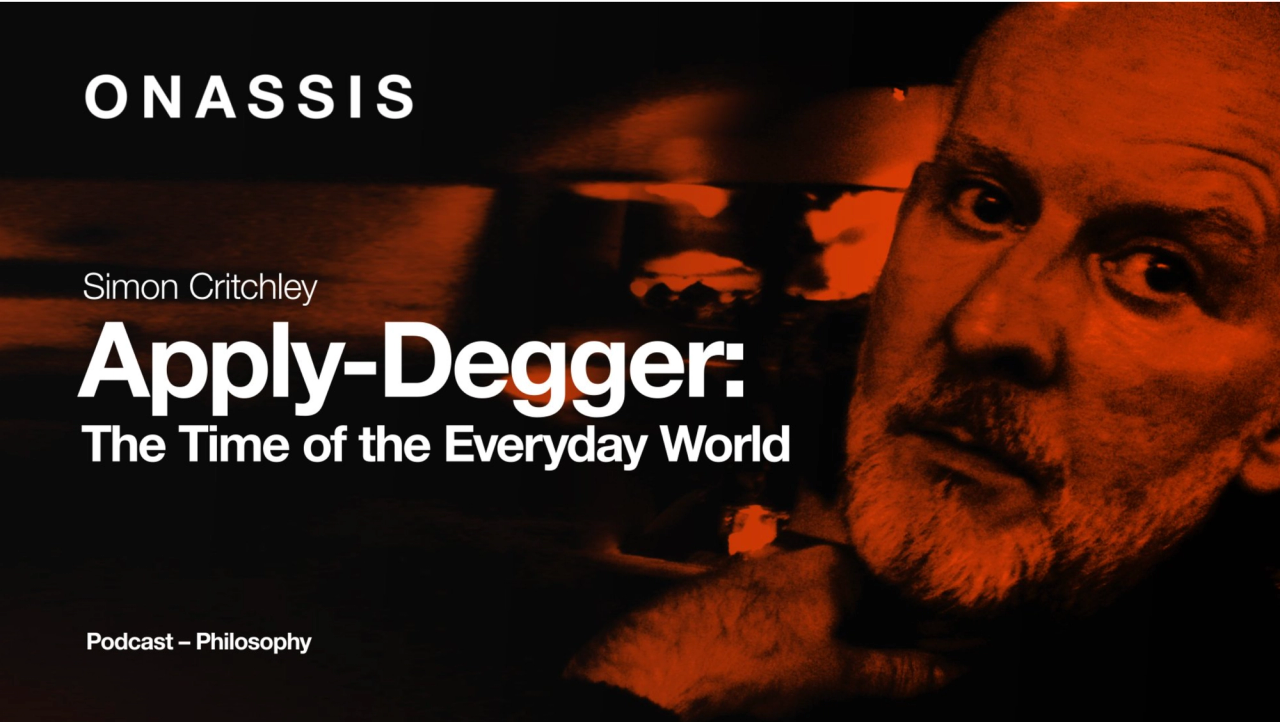
Cover art for Critchley’s podcast, Apply-Degger. (Courtesy Onassis Foundation)
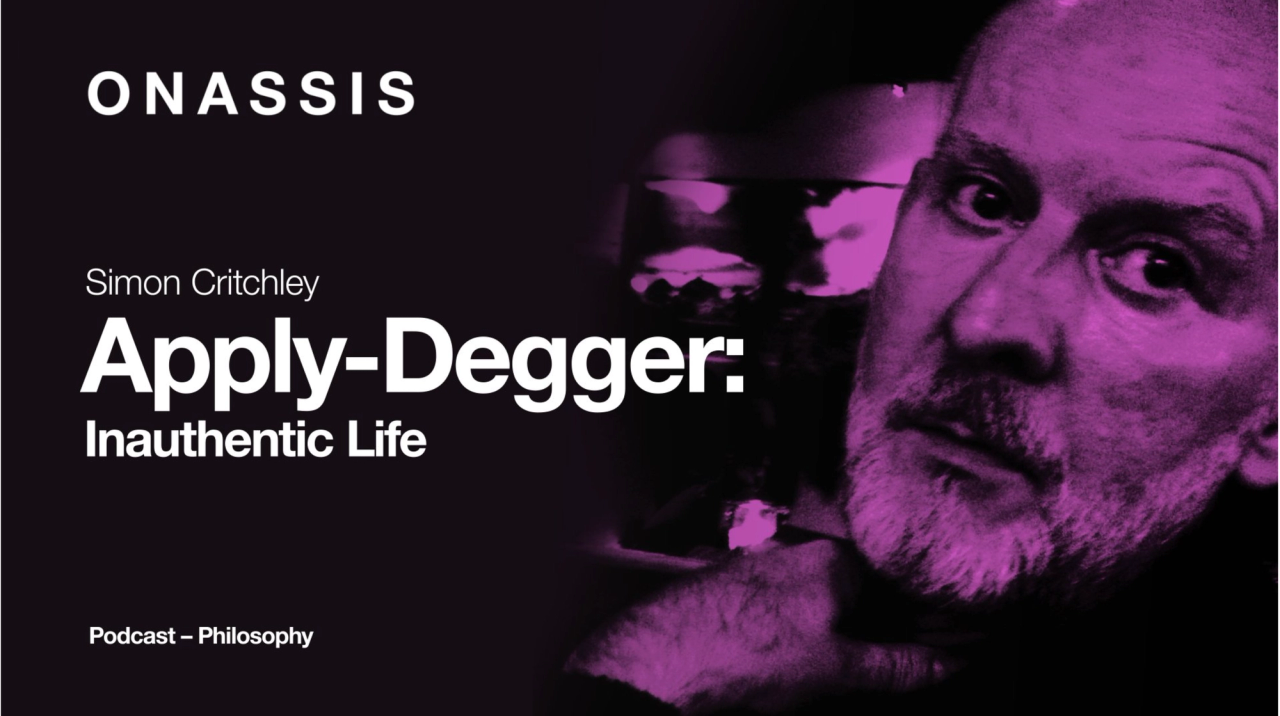
Cover art for Critchley’s podcast, Apply-Degger. (Courtesy Onassis Foundation)
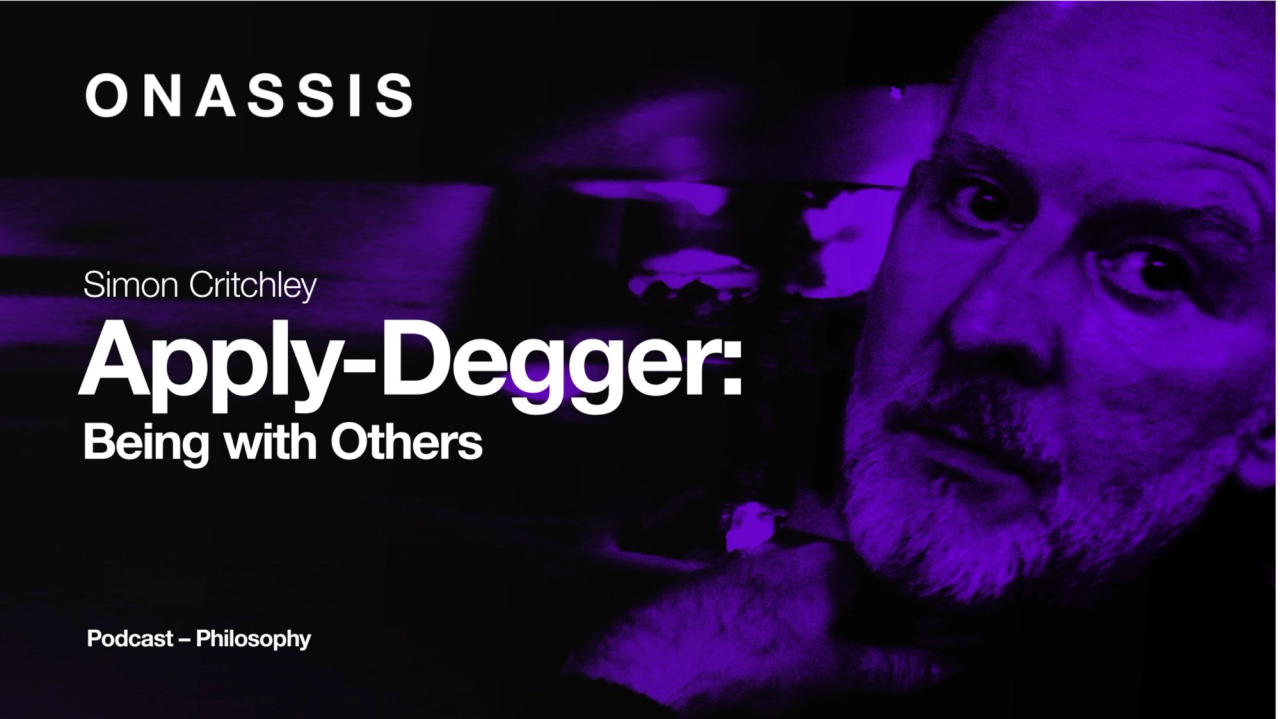
Cover art for Critchley’s podcast, Apply-Degger. (Courtesy Onassis Foundation)
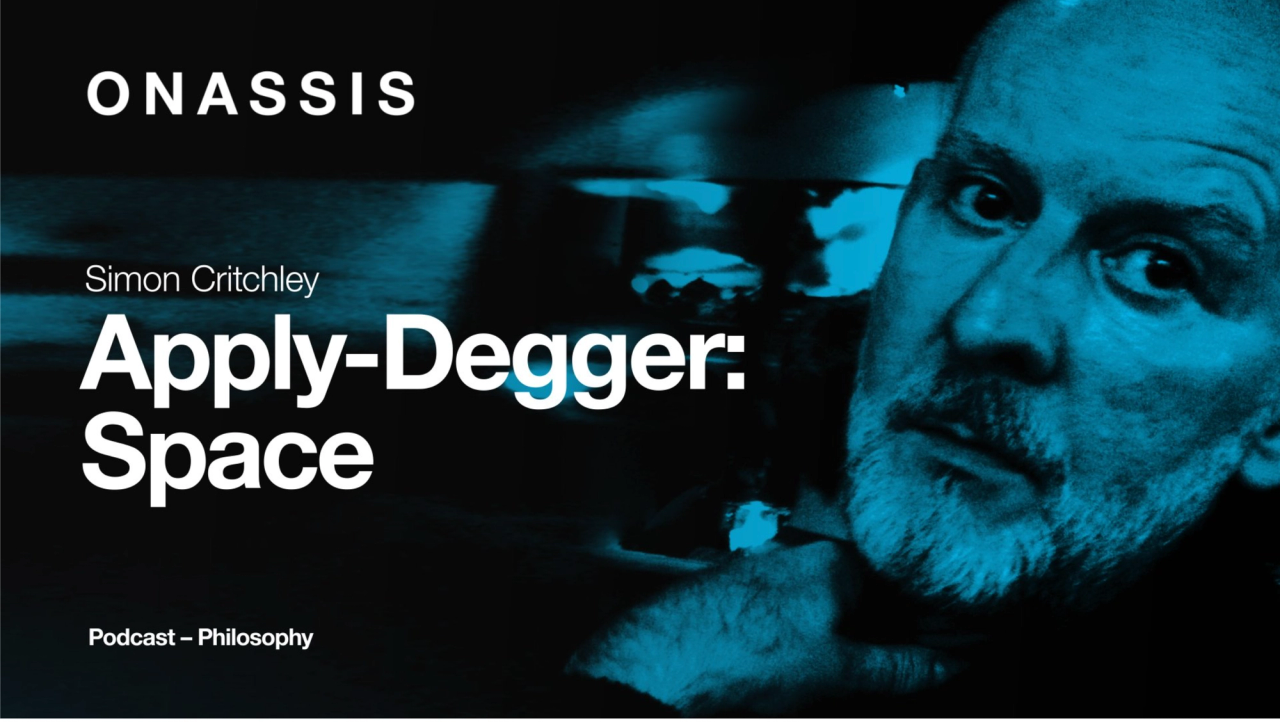
Cover art for Critchley’s podcast, Apply-Degger. (Courtesy Onassis Foundation)
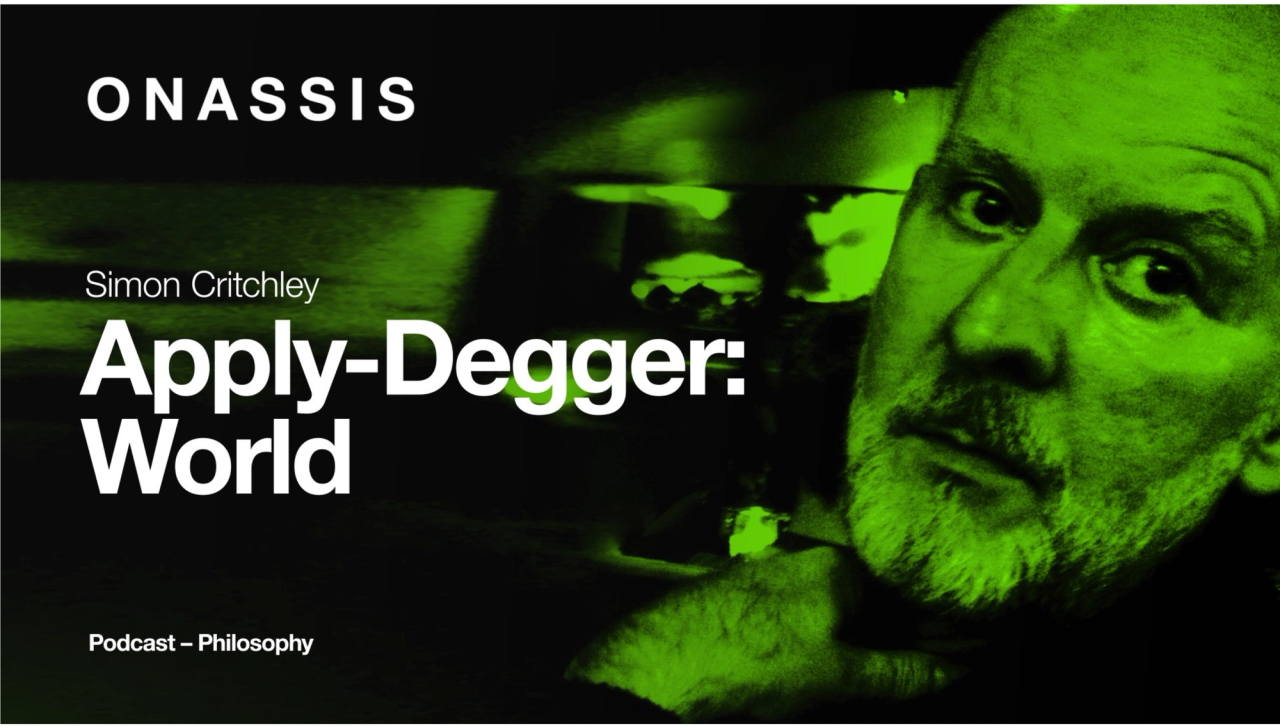
Cover art for Critchley’s podcast, Apply-Degger. (Courtesy Onassis Foundation)
Cover art for Critchley’s Heidegger-focused podcast, Apply-Degger, which encourages listeners to “slow down, take your time, open your ears and think deeply.” (Courtesy Onassis Foundation)
Cover art for Critchley’s podcast, Apply-Degger. (Courtesy Onassis Foundation)
Cover art for Critchley’s podcast, Apply-Degger. (Courtesy Onassis Foundation)
Cover art for Critchley’s podcast, Apply-Degger. (Courtesy Onassis Foundation)
Cover art for Critchley’s podcast, Apply-Degger. (Courtesy Onassis Foundation)
Cover art for Critchley’s podcast, Apply-Degger. (Courtesy Onassis Foundation)
“There has to be a realism to poetry. There has to be things, actual things in an actual world, but imagination allows those things to be transformed.”
SC: Yes. Poetry is, I’m using here Wallace Stevens—who, for me, is the finest philosophical poet in the English language in the twentieth century—he gave some lectures during the Second World War, a couple of lectures, one or two, where he talks about poetry as the imagination pushing back against the pressure of reality. It seems to me that’s what it can do. There has to be a realism to poetry. There has to be things, actual things in an actual world, but imagination allows those things to be transformed. A lot of Stevens’s greatest poems are the most ordinary things.
“An Ordinary Evening in New Haven,” or “The River of Rivers in Connecticut,” whatever it might be. A lot of the things that were local to him, which he’ll try to not turn into mythic structures, but recreate as imagined worlds. A poet, for Stevens, or poetry for Stevens is—he says this in a very late poem—it’s ideas about the thing, not the thing itself. The thing itself, the sun, let’s say, and the stars, I can produce ideas about the thing. In those imaginative ideas, I can push back against the pressure of a hostile reality. Stevens was thinking about that in relationship to what we might think of as the whimsical mid-twentieth-century media space. And we experienced that pressure of reality in a much more intense doubled up way.
SB: And it gets me thinking, too, about mysticism and what you’ve written about mysticism. Maybe there’s an argument that poetry is mysticism or a form of it. There’s a paragraph in your mysticism book that I wanted to quote here, that also shares a lot of language with a paragraph in your book that I referenced on poetry. Which one was it here? Things Merely Are.
SC: Right.
SB: You write, “Reality presses in on us from all sides with a relentless force, a violence, which drains our energy and dissipates our capacity for belief and for joy. The world deafens us with its noise; our eyes sting from the ever-enlarging incoherence of information and disinformation and the constant presence of war. We all feel, we all live, within the poverty of contemporary experience. This is a leaden time, a heavy time, a time of dearth. As a result, we feel miserable, anxious, wretched, bored.” In a way, poetry is the opposite of that, or it’s the counterreaction to that.
SC: Yes, the countermovement to it. It is that. It’s that, we begin with that and how can we think in the face of that? And this goes back to a famous line of the great German poet, [Friedrich] Hölderlin. And the line is, “What are poets for in a time of dearth?” “Wozu Dichter in dürftiger Zeit?” So poets are, in a sense, whenever poetry is written—I take this all the way back to Homer—it’s always a time of dearth. It’s always a time when the gods have fled, the songs are silent, the great time of the Trojan War and whatever it might be is gone, but we can recall it in song and reimagine it. But in that imagination, we can press back against the pressure of reality and find a kind of relief in that. At this point in history, that is perhaps even more important.
SB: Yeah. Vital.
SC: Because that pressure is, which is the premise of Time Sensitive and The Slowdown, is that, given the pressure of reality, given the way in which that is allowed to order time, and time is that pressure of the line. That pressure of the growth model or the number of likes or whatever it might be, one way of responding to that is through slowness, through a different order of time. And that can be radical—revolutionary.
That doesn’t mean going off the grid and living in an ashram for months. It can mean a shift in the way you relate to the world that you inhabit in an everyday manner. And I think that is available. I think there’s a poetry in that and a poetry which is—this is, I think, utterly democratic. This is available to everyone. This is what Whitman’s about. This is [“Crossing] Brooklyn Ferry.” This is the low, the near, the common. This is something we can, if we want to, we can find, and which does afford us some relief from that relentless drumbeat of time.
The idea of time as an arrow…The arrow of time that’s always about progress and growth and the future. Not the future two hundred years from now, but the future in terms of a growth model ten years, maybe fifteen years from now. So, give us the funding, we’ll do the work. We’ll have cancer cured by 2035. It’s that idea of time as that arrow. That makes us very strange beings, modern creatures, with regard to how most of human beings have been. I’m going to put this a different way. If we think about, say, really ancient societies, neolithic societies, time was experienced as some kind of cosmic time, and a cosmic time which had some kind of shape, which usually followed the year and the seasons.
SB: And the sun.
SC: And the sun, right? That could be a daily cycle, a seasonal cycle, and an annual cycle. Ritual becomes really important as a way of punctuating that cosmic time in order to … what? In order to allow for growth to appear, for there to be a harvest, in order for people not to starve through the following winter, and then the whole thing repeats. There’s a sense of time as a circle and a cycle, and a recycling of time, where there’s no radical separation between us and the cosmos, and the built environment, which is not the modern conception of things. I think there are ways of recovering that.
This is where I think the experience of Covid still is relevant. Not just in terms of not allowing a million people to die of disease and all of that, but just in a sense in which, I think—
SB: It shook us up.
SC: It shook us up. It also showed us there’s something very ancient about us. There’s an antiquity to what it means to be human. We are very similar to creatures that lived fifteen thousand years ago in social groups without cell phones and electric guitars, but they lived. [Laughs] And they’re not alien to us. I think there was a tendency, certainly that I grew up with, of feeling that we’re now moving, we’ve left all that behind and here we go into some other future. I’m much more skeptical about all that now.
SB: Yeah. We talk about the need for different kinds of literacies: media literacy, this, that kind of literacy. I think temporal literacy is something we all lack. We don’t spend enough time with... I guess the listeners of this podcast do. It’s something I think about and yet still I wake up some days and I’m like, “I don’t understand time.”
SC: Right. I mean, Heidegger makes the distinction between what he calls vulgar time, the time of the line, the time of now, no longer now, and not yet now. The time of the clock, the time of capitalism, really, the time of the factory and the company. And then we have lived time. The time that we experience day to day, where, I’ll see you later on. All the time that happens when you’re sleeping, all these types of things. And then there could be ecstatic time, where you’re lifted up out of that for a moment and you can see the whole picture. You’re going to fall back into lived time.
So, we’re not temporarily literate because we are just spending too much time on this vulgar experience of time, and ignoring these two other levels that we actually do inhabit.
SB: We got to level up our time.
SC: We got to level up time.
“Philosophy’s been in business for about three thousand years, and we’ve not solved any of the basic questions. Nothing has been sorted out. There’s no agreement about justice, truth, beauty. There are different views, let’s just put it that way. And that’s its great virtue.”
Again, it’s nothing that we don’t know. The great problem with Heidegger—and with philosophy as I see it—is that, philosophy’s been in business for about three thousand years, and we’ve not solved any of the basic questions. Nothing has been sorted out. There’s no agreement about justice, truth, beauty. There are different views, let’s just put it that way. And that’s its great virtue, right? It’s not that we’ve finally sorted matters out. These are open questions. What it means to be a human being is to encounter those open questions.
There’s a sense in which philosophy is radical, in the sense in which education is meant to proceed in accordance with metrics, and measurables, and data points, and things that can be indexically organized with outcomes and objectives. And philosophy is, well, no. I mean, read these books and you discover that we’re none the wiser than these people that lived two and a half thousand years ago.
Furthermore, another great thing is… it always made me laugh when the school that I teach at, The New School, some of the stuff that had been happening in student movements in 2008, 2009, and Occupy Wall Street and around then, then became used as branding for the institution. You’d see, “Come to The New School, Social Justice, World Transformation,” in huge letters. You look at this, “Really? That’s what we’re doing?” And then we were told by administrators that these were our core values and that we’d all signed up to this. I think, was there a vote? Was there a discussion that I missed? Justice? Did somebody clear up what that means? Because we’ve been thinking about this for two and a half thousand years, and there are six or seven theories which are pretty good, but we’ve not made our minds up.
SB: As one of your books is titled, Question Everything.
Another area of your work to just totally... I don’t know. It’s not a one-eighty here, but I do want to bring in, because we’re talking about poetry—
SC: Yes.
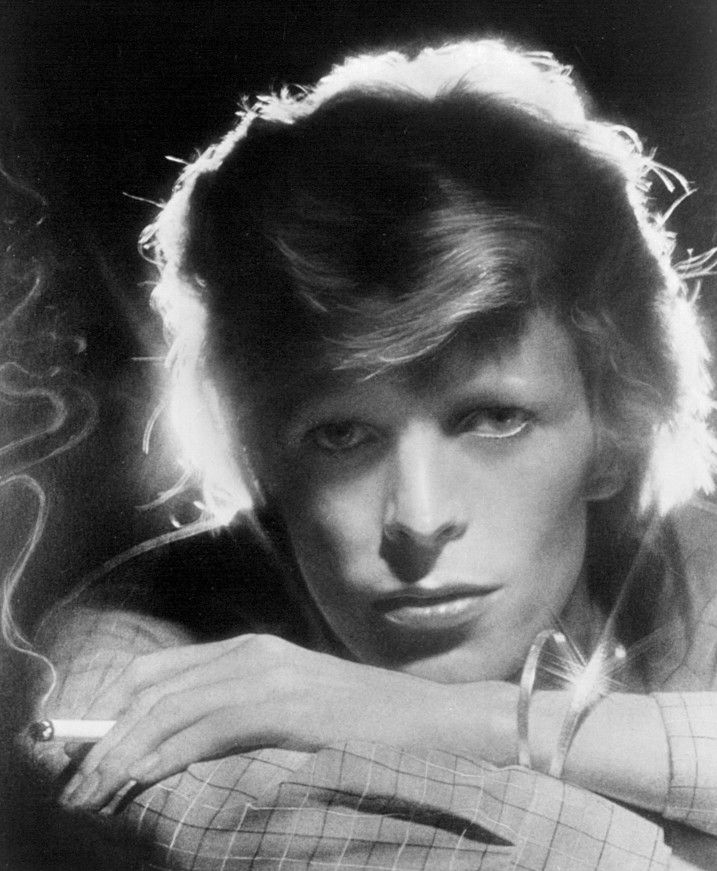
David Bowie in 1975. (Courtesy RCA Records/Public domain via Wikimedia Commons)
SB: ... and we’re talking about Heidegger. And we’re thinking about ekstasis or the ecstatic. I feel like a conversation with Simon about all these things isn’t a conversation until you bring up David Bowie.
SC: Okay.
SB: Who’s another artist you’ve written about with extraordinary passion on the level of—
SC: Sexual frenzy.
SB: On the level of Wallace Stevens or, I would say, your deep love of football. But you’ve said that “no person has given me greater pleasure throughout my life than David Bowie.”
SC: Yeah.
SB: It’s a very strong statement. Do you view Bowie as a poet, too, and in this sort of… maybe even in the Wallace Stevens sense?
SC: Yeah.
SB: How do you view Bowie in this continuum of philosophical energy that you put out into the ether?
SC: I decided to write books at a certain point on things that I really liked, my fundamental passions like football and poetry and music like Bowie. And this was a great relief. The books are also short, which can work really well. Having said that, the book on Heidegger’s really long.
SB: [Laughs]
SC: But Bowie, for me, it was... this is good. In a sense, the job’s been done and mission accomplished. But when I started to write the Bowie book... What became the Bowie book began as a bunch of ideas. My friend Colin helped me turn it into something else. It was sort of unseemly to speak about Bowie in such lofty terms, years before he died.
Bowie was just another kind of important rock star who’d been away for a long time and then come back with a relatively successful album the next day. And I just didn’t think that there was a space in writing at that point, 2012, ’13, that really gave music its due. There was really good music journalism, good biographies of musicians and good sociology of music, history of music.
But nothing that really gave a sense of... For me, Bowie’s the most important artist of the last fifty years. He did pop music. Why can’t both those things be true? Well, they are. I With his death, which happened after the book came out, and then I rewrote some bits of it after he died, but after his death, and then speaking to people after Bowie died, was really beautiful, because I realized that this was going to carry on, that Bowie was going to be an important artist long, long, long into the future.
I was talking to people my age who’d seen Bowie on Top of the Pops in 1972. We think of ourselves like proper Bowie fans, but to someone who’s 25 or someone that’s 15 or 40, it’s a different experience. I became clear after his death, talking to people, this will survive and this will continue. Pop music, in that sense, has perhaps found its language—perhaps found its visual language as well. The movie that was made, Moonage Daydream, about Bowie, which is not perfect, but it kind of evokes... And I think the exhibition of his... He’s now approached the appropriate status, so that’s good. But for me, there’s nothing more important than the songs that changed everything and the songs that you can put on and feel that rush of joy and delight.
SB: How would you define “Bowie time” for you? What does listening to David Bowie do for you?
SC: Well, it’s nostalgic. It’s nostalgic and it’s also futural. It’s both at once. I think that Bowie often through his... Because he was very good at finding people to work with, like Brian Eno for the so-called Berlin trilogy—Low, Heroes, and Lodger—was able to see the future of music. Bowie was one of the people very early on, very, very early on, [who] had a sense of what the internet was going to do. In the nineties, there was an interview with him on the tonight program, Newsnight in the U.K., with a very grumpy, but very influential host called Jeremy Paxman. And Jeremy Paxman was saying, “Oh look, this is just... David, you’re a pop star, but you really can’t be serious about this internet thing. It’s just a tool. It’s just a tool, David.”
He said, “No, no, no, man. It’s not at all. This is the tip of the biggest iceberg you’ve ever imagined in your life. It’s going to change absolutely everything.” So, Bowie understood that early on. There’s a sense of the future happening with Bowie, in Bowie’s music, and the way in which his music made possible the work of all the artists that have come subsequently, the St. Vincent’s and all the rest. There’s so many people, in many ways, particularly female artists that Bowie’s enabled. At the same time, there’s something intensely nostalgic about Bowie. This is an evocation of a time and a place and an experience of often lost love or half-remembered love, which is being evoked. I think that’s also what music does. Music gives you that powerful sense of joy mixed with a kind of melancholic yearning.
SB: As you’re talking about Bowie, I’m just thinking with this nostalgia or looking to the past, let’s say, but then a sort of futurology that’s very present. It kind of reminds me of what you were describing about Heidegger’s take on time. Do you see a line from Heidegger to Bowie, maybe with Wallace Stevens thrown in the middle?
SC: Yeah. And then it was Bowie’s son did a Ph.D. in philosophy—didn’t finish it. He was doing it at Vanderbilt in Nashville in the nineties. I gave a talk at Vanderbilt in the nineties and I was with my friend Keith Ansell-Pearson, who’s a very good philosopher and also a Bowie fanatic. After the whole thing had happened, we found out that David Bowie’s son was in the audience. [Laughter] We made the connections there.
There is a sense in which Bowie’s work in the late nineties is quite full of philosophical references that perhaps he’s just getting from his son. That’s a nice thought. Bowie doesn’t need that. There’s a kind of intuitive ability, an ability to... How would I describe that? There’s something that when... It’s like the question of how people write songs. People think that people write songs, that ideas come to them and they write them down and then they play them on the piano. It’s a point that Eno makes very well, that writing a song is about the evocation of a mood and the inhabitation of a personality. And the personality and the mood come first. Once that’s kind of established, then you can begin to imagine the idea of a song.
Eno tells this story about Bowie doing a take on a song and does the take, sounds really good. He comes back into the booth and says, “That was a bit lumberjack.” Right? “Yeah, it was a bit lumberjack. Maybe this guy should have a nine-to-five job.” So, he goes back, does another take. Doesn’t sound that different, but it’s a different mood inhabiting in the room. I think there’s something about that. It’s about the inhabitation of mood and attunement and then the music comes out of that. Without that, you’re just left with the technical capacity. So, is Bowie Heideggerian? Yeah, why not?
Before we get lost in all that, one thing I wanted to bring up was you and The Slowdown, and to make a point which you can respond to or not respond to. When we first really got to know each other, in 2020, during the pandemic, we were spending a lot of time in each other’s company, having the time that one could have back then.
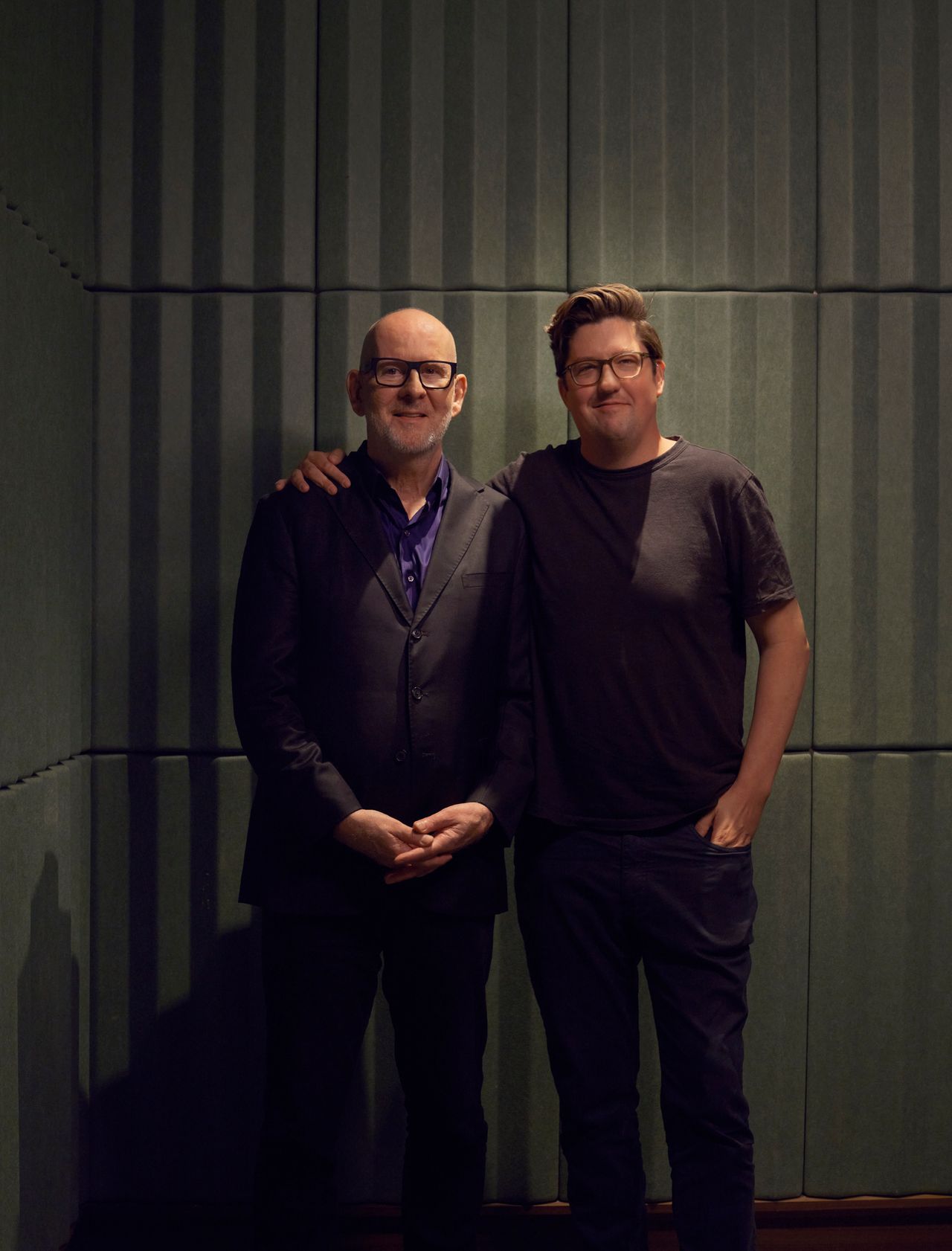
Critchley and Bailey during the recording of Ep. 159 of Time Sensitive. (Photo: Matthew Harrington for The Slowdown)
SB: This is true. I should disclose to the listeners that Simon was one of my closest friends during the pandemic—the ultimate pandemic friend, in a way. We had met in the fall of 2019, shortly before the arrival of Covid. And in the midst of the maelstrom of early mid 2020, I got to become closer friends with you, during which [time] we would meet up at our favorite local establishments [Henry Public and The Long Island Bar, in Brooklyn].
SC: We lived fifteen minutes away from each other.
SB: Yeah, walk down the same street in Brooklyn—
SC: Walk down the street.
SB: ... and have drinks together, sometimes dinner. I got to experience in real time one of the most challenging, perplexing moments of probably most of our lives in real time with a philosopher. So thank you for that, Simon.
SC: You were working on memorials.
SB: Yes, I did. I had a project about memorials and memory and time and architecture [the book In Memory Of: Designing Contemporary Memorials].
SC: Memorials, memory, and architecture. That’s what I was thinking of in relationship to time, and in relation to what Heidegger thinks about time, namely that Heidegger makes a distinction between the bygone, which is over, and what he calls the “having been.” The having-been is something which we can possess in the future. So I come toward that which I have been. I was thinking about that in relationship to the stories you were telling me in 2020 about [United Airlines] Flight 232.
SB: Which I’ve told on this podcast—
SC: The whole question of... I mean, it seems to me that that experience of time, it’s intensely, ferociously personal. But there’s also… It’s very close to the kind of thing we’re talking about, that you can come towards the future having been, that you have been since you were 3 years old, which you may have no memory of, but it’s still there. It’s still structuring things. Then how you lead a life is in terms of how you orientate yourself futurely to that having been. That’s kind of the idea of time that Heidegger’s talking about.
SB: I have to admit here that I realized I was a Heideggerian when I was reading your book. I have tried to get through Being and Time and failed miserably. It is dense and, as we’ve said, baroque. It’s not easy to get through. It’s a difficult text, but your new book makes it so much easier. In reading your new book, I was totally shook by the fact that I’m a Heideggerian and I didn’t even know it.
SC: Right. [Laughter]
SB: I was a reborn Heideggerian at age 3 or almost 4. It’s so strange to understand how deeply this notion of what Heidegger calls “thrown-ness.” I was literally thrown and that post-thrown, let’s say, post-thrown-ness kind of led me in this direction of always understanding my finitude.
SC: Yeah, yeah. Then how would you understand the memorial in relationship to that whole structure? Because that’s obviously… I’m interviewing you now.
SB: Oh, man.
SC: Switched it around.
SB: Okay.
SC: Because you were memorialized in relationship to, in a sense—it’s not a false memory, it’s a memory taken from a photograph, but it’s a memory that you lived, but you don’t recall.
SB: It’s a version of history that’s... I’ve described it as almost biblical. It’s based on an account of what happened, but it’s a version of what happened, not the full story. It’s an idea of what happened. But yeah, I find the memory conversation... I mean, that would lead us into a whole other podcast, but I do think memory in this time conversation is really interesting. And the notion of memorial is to try to freeze some sort of memory or moment in time, and hold it for eternity. I mean, this goes back to the ancient Greeks, for sure. And you’re looking at the architecture and the statues from that time when you go to Athens to a museum or look at a Cypriot pot or... Yeah.
SC: But memorial also opens the future, right? A good memorial.
SB: Mm-hmm.
SC: And that might be the difference between a bad memorial and a good memorial.
SB: I argue in the book that it’s more about embracing abstraction or creating room for interpretation, multiple readings of the same event, such that each person who goes to said memorial can walk away with their own version of that experience, their own idea about what it’s trying to represent. I guess we need more abstraction in our life, which is a Heideggerian thought, right?
SC: Yeah. Heidegger is very interested in memorials and he gives a memorial address in his hometown of Meßkirch in the late fifties. I’m not quite sure if I can remember the date. I think it’s the late fifties, maybe the early fifties. He was very interested in the idea of memory, Gedächtnis, and the idea of memorial or what’s called in German Denkmal. And in that Denkmal in German, you have the idea of thought. So, memorial isn’t just a thing, an object, it’s something which is thinking and—you can think with. So a good memorial should be not just thoughtful, but should provoke thinking. And I guess that takes us to all the debates around memorials that have happened over the last decade, in particular the memorialization of the Holocaust.
SB: This brings us back to poetry, too. I think the best memorials are kind of built poems. They are a form of language, of rhythm, of material. They are built stanzas and they punctuate the landscape in a way that gives us pause the same way a poem might. Now I sound sort of pretentious, but I think that’s true. [Laughs]
Well, I want to close on something I kept noticing across your work, that philosophy begins in disappointment.
SC: Yeah.
SB: Poetry is an experience of failure.
SC: Right. [Laughs]
SB: Football asks ourselves to submit to fate. Anxiety exposes the groundlessness of the self. Death confronts us with something over which we have no power. So, are you ultimately trying to teach us how to give up the fantasy of mastery?
SC: Yes, yes, yes. To give up the fantasy of mastery and to embrace weakness. Weakness as strength and failure as success, and all of that, which is why if I’d written other books, they would’ve sold more. [Laughter] You’ve got to do what’s true.
But I think the idea of an impotence as a kind of... There’s always this emphasis on possibility, potency, potentiality, ability, projection. You see this in various technological fantasies that are driving the contemporary world or people that are critical of the contemporary world because it’s lost those technological fantasies of the future.
SB: Yeah, the Bryan Johnsons who want to live forever.
SC: And you don’t live forever. You die. And that’s really, really important because— This is also where I part company with Heidegger, because Heidegger, there’s a way of reading Heidegger around the question of weakness, and that’s kind of what I do in the more critical part of the book. But there’s one point I want to make here, which is that when Heidegger talks about death, he talks about death as non-relational. He says that death is my death. It’s my own-most death coming from me, and I have to have power over that or to assume power over that. And that’s where I think he’s wrong, one of the various places I think he’s wrong.
I think that death is relational, that finitude is relational. So if he’s right about finitude, you can’t take finitude and reduce it to just me and my death. This would take us back to your experience as a child, my experience in different things I’ve had over the years, that your fundamental experience is defined by your relationship to another that you love, over whom you mourn and grieve.
That’s what shapes the self. If you think about finitude in relationship to grief, we all know that we’re all going to die. And it kind of breaks our hearts to know that the people that we love are going to die. But the important thing is learning to accept that, to accept that lack of power. That lack of mastery is what defines us. That’s the limit that defines us as human. I think there’s a tendency in the modern world to define human life in terms of limitlessness and infinite capacities and all of that. I think it’s a lie, and it’s a pernicious lie.
The first thing we have to accept is that human existence has limits. The important thing is to internalize those limits and then to live. And this turns very directly to the question of death, and this would maybe take us to the longevity of people and all those characters. Montaigne has this line from his essay, “To philosophize is to learn how to die.” So there we are. “To philosophize is to learn how to die.” Simple definition. And Montaigne says, “He who has learned how to die has unlearned how to be a slave." It’s a line that I particularly like because, for Montaigne, what human beings are fearful of is death. It’s that fear of death that keeps us enslaved. This goes all the way back to Epicurus and the ancient Greeks, that we are captives to the fear of death. So these longevity people are defined by this overwhelming fear of death, which is why they want to live forever.
“The point is to accept your limitation. You’re not going to live forever. And if you could accept that, to learn how to die, then you could become free.”
The point is to accept your limitation. You’re not going to live forever. And if you could accept that, to learn how to die, then you could become free. Now this is the kind of subtle but very simple operation that’s required here, that to accept your finitude and the relational character of your finitude, and not to be scared of that, is to set the conditions for your own freedom. Freedom—
SB: To accept death is to live a well-lived life.
SC: Yeah. Therefore the worst imaginable life is a life which is unable to accept the fact of one’s dying. And as human beings and as we grow older, that’s what you have to learn to accept. As kids, you inhabit a kind of... There’s death when you’re kids, obviously, but the sense in which this will pass, and you will pass, and that is good. That’s what allows you the space for actual lived freedom.
SB: I, too, shall pass.
SC: Yeah.
SB: Simon, thank you. This was really special. I’m so glad we could finally sit down.
SC: Finally sit down. Thank you very much, Spencer. Thank you for your questions and all of your thoughts. That was great.
SB: All right. Heidegger Thinking, go buy the book.
SC: Heidegger Thinking, go buy the book. Are we out? [Laughter]
This interview was recorded in The Slowdown’s New York City studio on August 31, 2026. The transcript has been slightly condensed and edited for clarity. The episode was produced by Ramon Broza, Olivia Aylmer, Mimi Hannon, Chelsea Debrot, Drew Arndt, and Johnny Simon.