Follow us on Instagram (@slowdown.media) and subscribe to our weekly newsletter to receive behind-the-scenes updates and carefully curated musings.
TRANSCRIPT
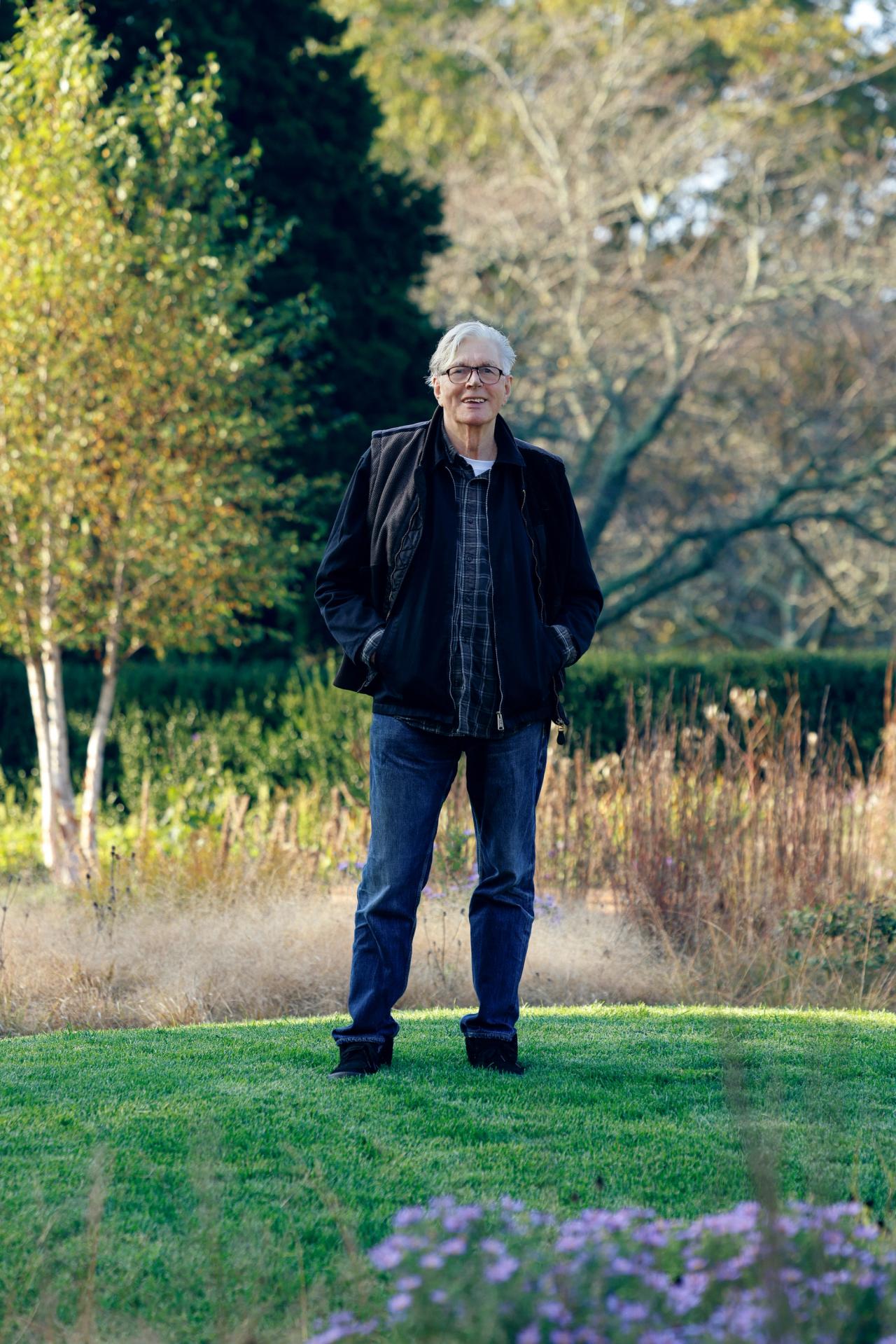
Piet Oudolf in his Planting Fields Foundation garden. (Photo: Ogata for The Slowdown)
SPENCER BAILEY: Hi, Piet. Welcome to Time Sensitive. How incredible to be here in your garden.
PIET OUDOLF: Yeah, good you made it here.
SB: [Laughs]
PO: It’s a good ambiance.
SB: I thought we’d begin right here at Planting Fields. We’re sitting in a garden you only recently brought into being, but one that will definitely change a lot in the weeks and months and years ahead. Tell me about this commission. How did it come about, and what do you hope to see happen here?
PO: What I hope to see happen here—of course, what it already is, more or less. Gina [Wouters], the CEO of the garden, came to me in Holland to ask if I could do a garden at Planting Fields. But at that time I had no time. I was busy. My wife had an operation, so I was really saying no to everything that had to do with more work. Then [Gina] came back the year after and I thought, “Okay, we’re going to do it. She’s so nice.” Now she really wanted to [make] things happen. So, that’s the start.
SB: This garden sits in a landscape that was shaped over many centuries, but more than a century ago, it was the Olmsted Brothers.
PO: Yeah.
SB: What was your understanding of what was here and how did you think about this being in the greater context of…?
PO: We’ve done the arboretum and everything around the house and the woodlands, to see what a good place would be. But I think the kind of gardens I make, especially these kinds of perennials or meadow type of gardens, should be close to the house. People don’t need to drive a mile to see it. This was the only place open. There was a collection of peonies. I think a collection you can always move. A garden you can’t move, because then you would destroy something, but a collection you could. There were some trees that we had to take out; otherwise there was no space, and they would be too dominant in the overall design, too. Let’s say it was possible. So, they moved them to another place and then we had this sort of blank, clear space to do a design.
SB: What was your vision when you showed up here? Did you already have it in your mind what you wanted to do when you first walked to the site?
PO: No, no, no. I know what I do, but you’ve seen Calder [Gardens] and you’ve seen what I did there, and if you look at the Calder and here, it’s different. Every place I come, we first make a basic plan: the circulation, the logistics, how do people enter the garden, how will they experience the garden? That’s the first, and we call that the master plan. That can be simple. We don’t have to build walls to make it interesting. That’s the first step. Then you try to find a way that when you walk here, that the garden has moments that you are surprised by or you see a plant that’s different than what you saw on the other side. We try to find a few concepts, a few ideas to put together to make the garden more interesting than just having something that is—how would I say?—similar everywhere you go.
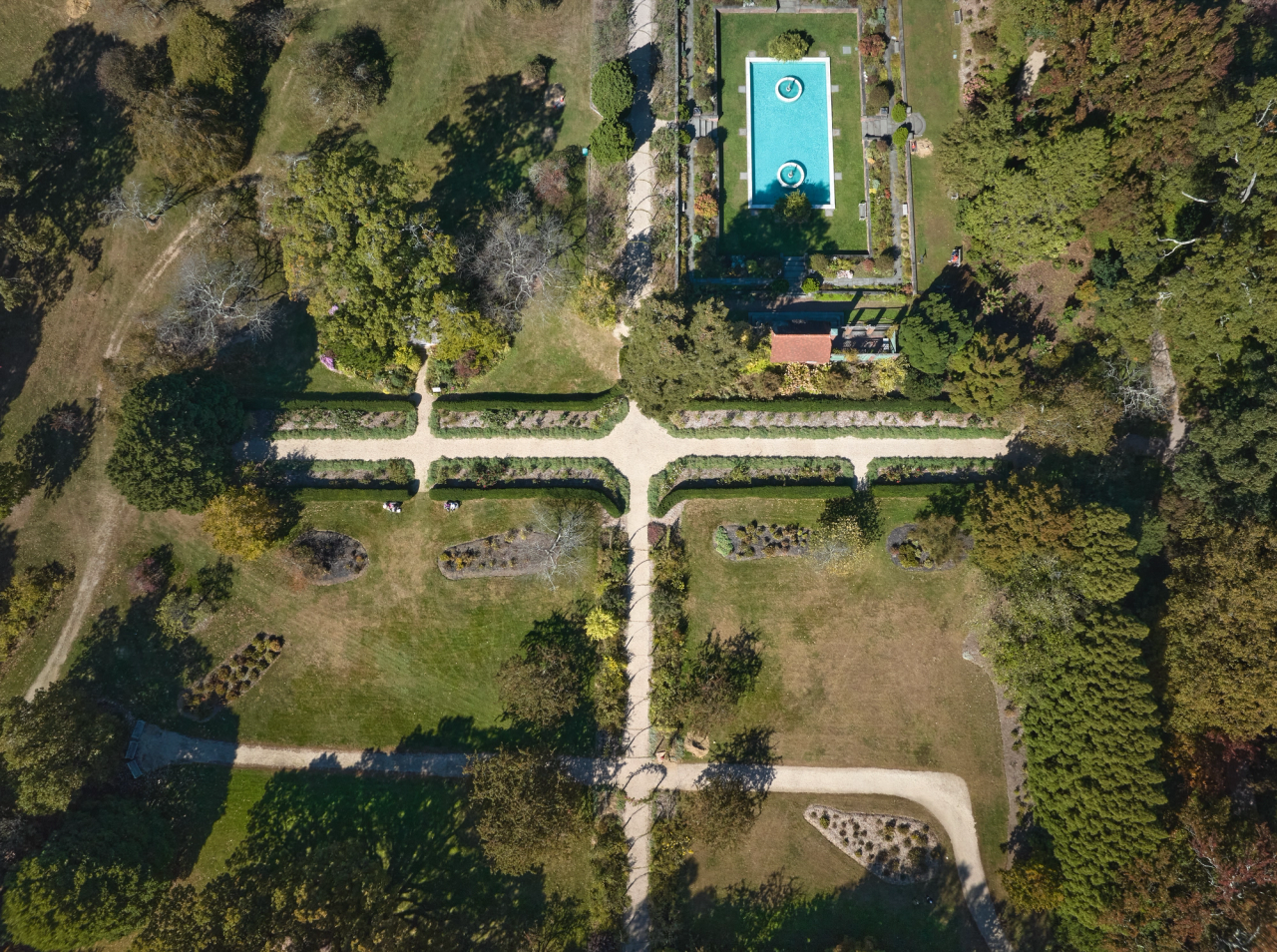
An aerial shot of the Planting Fields estate from 2024, before Oudolf began planting his eponymous garden there. (Photo: David Almedia)
SB: You’ve described garden design as a four-dimensional practice, because you’re working not only with space, but time.
PO: Yeah.
SB: How far into the future, when you’re doing a garden, can you actually see? How far out can you imagine this garden?
PO: This is a very dynamic garden. If you plant an oak tree, you know that in two hundred years’ time, it will be like that, or three hundred years’ time. If it stays alive ... So in that sense, this is more ephemeral. You can say it will disappear over time. If we talk about twenty, thirty years, you should at least have changed ...
[A plane soars overhead]
SB: We’re in the flight path of LaGuardia ... and J.F.K, I think ... [Laughs]
PO: It doesn’t matter. But you know that there’s a lifespan of the garden and you know that after fifteen years you have to redo pieces and not ... But it’s very dynamic and I think it changes, not only over time, but through the year, it changes so quickly that if you come now and you come in a month’s time, it’s completely different. So also the experience is very high.
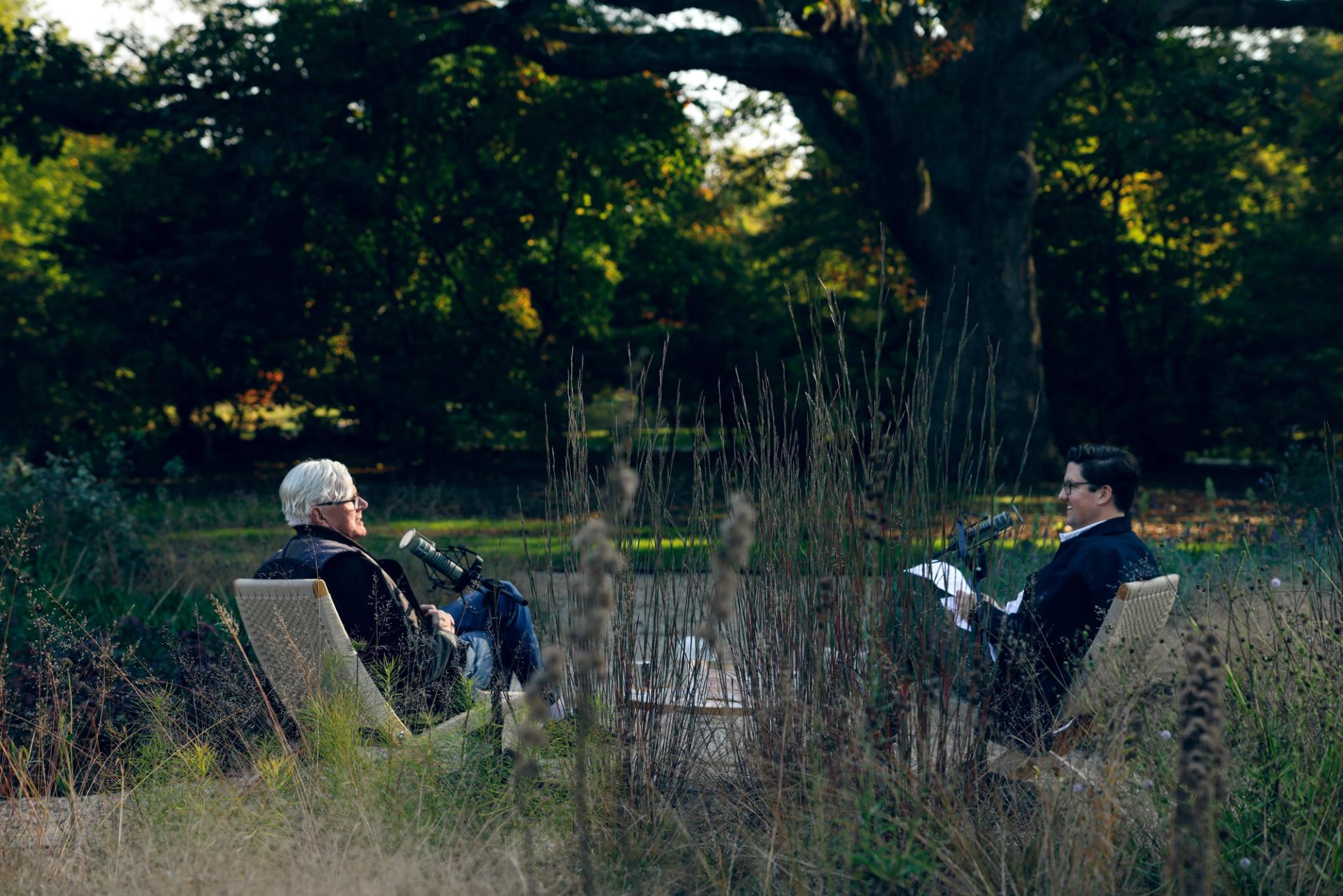
Oudolf in conversation with Spencer in his Planting Fields Foundation garden in Oyster Bar, New York, during the recording of Ep. 162 of Time Sensitive. (Photo: Ogata for The Slowdown)
“If you know gardens and you know what you see now, you won’t see it in a month’s time. What you see now, you didn’t see two weeks ago. That is how it goes.”
If you know gardens and you know what you see now, you won’t see it in a month’s time. What you see now, you didn’t see two weeks ago. That is how it goes.
SB: One of the things I wanted to ask you is when you look around this garden, what can you personally see that the rest of us can’t?
PO: Yeah. I can see what it will be next year, or I can see what I’ve done wrong.
SB: [Laughs]
PO: Because I make mistakes. I design at home, so everything is seen from a perspective, from a bird’s-eye perspective. When you walk here, it’s a linear perspective, which is completely different when you turn, here, walk around, with some moving and turning paths. So, it’s completely different. I see things that I can adjust and that’s what I do with Peter [Slothower] [Planting Fields Foundation’s landscape curator] tomorrow and say, “Okay…” Yeah, we have to make more space between so-and-so plants. I think we make little, little changes, not many. I’ve done it so many times that the changes we make don’t take much time. We don’t have to redo the garden.
SB: How much of the garden would you say is in your control, and how much of it is out of your control?
PO: The plants we use are controllable. They’re not invasive. They grow one a little bit faster than the other, but in general they are good companions. So they keep themselves, each other, in place—with some exceptions. If you look over a few years, there’s always one that leans over the other and at the end takes over. But, having good gardeners or good people that know their plants, they probably will see that and take action. They cut it back. Of course, you have to reduce the size of the clump sometimes between the two different species. If you have the right people, it will work. They can call me, also. We can have a video call nowadays and say, “Okay, Piet, what do you think about this?”
I was here in spring when they started to plant and I was away and we communicated in between when there were some questions. But if I come back now, I think, “Okay.” No need to be here for a month to see if it’s all happening.
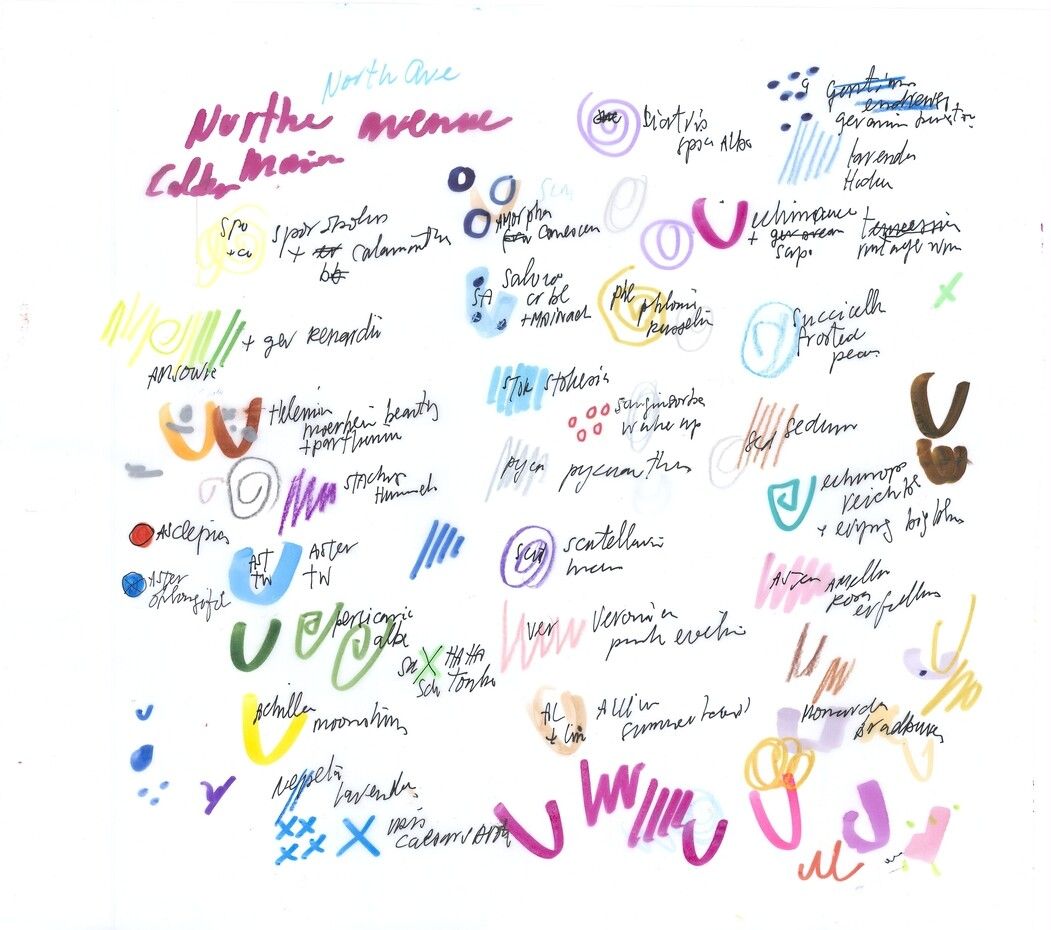
One of Oudolf’s color-coded sketches, created as a reference for plant selections while designing Calder Gardens. (Courtesy Calder Gardens/Piet Oudolf)
SB: Last year, you completed Calder Gardens, where I was lucky to meet you and write that profile for Elle Decor. You did that working alongside Herzog & de Meuron. That garden was still very much taking shape when we were together. Have you been back since then? How have you seen it in the past year?
PO: I’ve seen it in June and it looked good. It was very promising. I was there last year, as well, so I had to make a few corrections in some... I think there were some places where plants were a little bit too close together. That’s what sometimes happens. We made that movement. We made that move, and they changed a little bit. Then I came back in June; it looked all good.
There’s always some problems. Some plants don’t grow fast enough, or the first year there’s some plants that are suffering from the heat because they are planted as shade plants, but the tree is not big enough to provide that shade. All those kinds of things keep on happening.
SB: Calder sculptures and your gardens are really both about movement, in a way.
PO: Yeah.
SB: How did you see the relationship between those sculptures and the plants at Calder Gardens?
PO: I think good art always fits. I don’t mind good building. For me, it’s also context. It’s not the art, it’s just how it feels. You know my gardens at Hauser & Wirth?
SB: Yeah.
PO: Whatever they do, the yard is good, the space is good, whatever. So I feel happy. I see myself more as a part of it. Of course, I’m the last one that will tell them not to put a Calder in the garden or a different Calder. It’s a mutual project.
SB: You recently returned to Hauser & Wirth, in Somerset, where you had done the Oudolf Field more than a decade ago, and now you have this new courtyard garden there?
PO: I did that, yeah. Looks good.
SB: I’m curious what it’s like to return to a place like that and expand your conversation with a site. Has your understanding of landscape—that landscape—changed in that time?
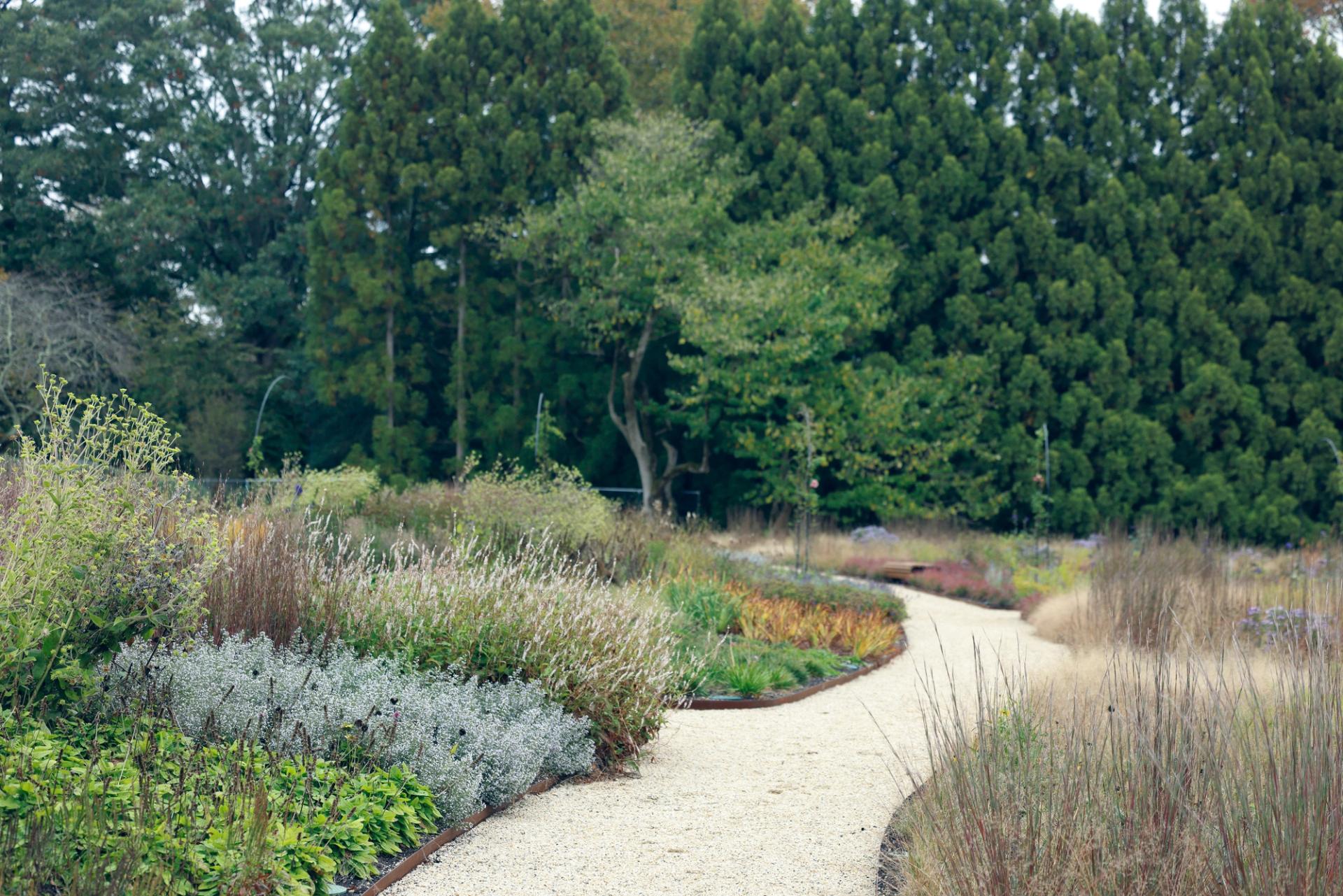
A path winding through Oudolf’s Planting Fields Foundation garden. (Photo: Ogata for The Slowdown)
“You need, as a gardener, an aesthetic eye so that some plants don’t overrule other plants.”
PO: It’s very well kept by a gardener, Mark Dumbleton. He keeps it as it was on the plan, and that makes it, in a way, very good. When he keeps the plants where they were meant to be at the beginning, and I noticed that at another garden in the Netherlands, it stays good. I think other gardens where you allow plants to evolve, to seed a little bit, to do their thing, and you think it looks good, so let it... That’s more complicated. Then you need, as a gardener, an aesthetic eye so that some plants don’t overrule other plants. I think, if I may talk about The High Line, that’s where it evolves. We let trees grow, plants disappear, we have to replace them with other plants that we’ll do and so on. That’s another process, but then you need a really great gardener, good gardeners, really… craftspeople, craftsmen.
SB: I wanted to ask about this relationship with Hauser & Wirth, because it extends beyond Somerset to Menorca, as well…
PO: Oh, yeah.
SB: …a landscape that is a little more unusual than what you’re used to working in—or climate, certainly.
PO: Yeah.
SB: You’ve known and collaborated with Iwan and Manuela Wirth for many years now. Tell me about that relationship and that ongoing dialogue you’ve had with them.
PO: Yeah. When we met for the first time, the gallery was big, but I think they only had two or three galleries. So, we met often and I think they were fond of my work, but they’re not really “plants people,” in the sense that they love gardens from a distance. It looks good. It was more... And I can imagine that their life became more busy and…
[A goose honks nearby in the garden]
SB: Oh, hey. [Laughs]
PO: They didn’t drop anything.
SB: [Laughs]
PO: So, we met in the beginning. Recently we did Menorca. After that, more galleries, more… so I didn’t see them for a few years.
SB: How has that relationship shaped your thinking about this art-and-garden-and-landscape relationship?
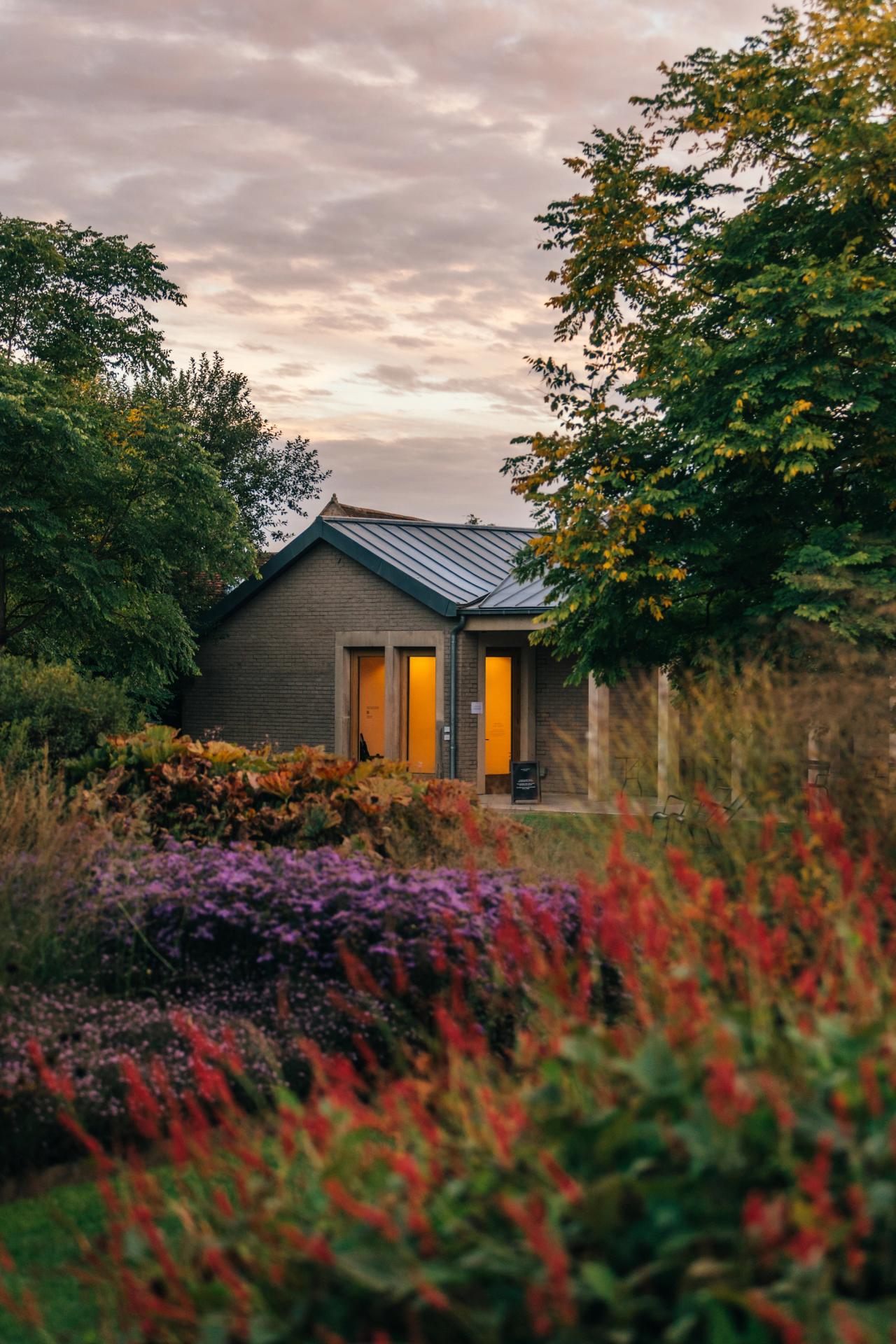
A view of Oudolf Field at Hauser & Wirth in Somerset, England, in 2026. (Photo: Benjamin Pryo/Courtesy Hauser & Wirth)
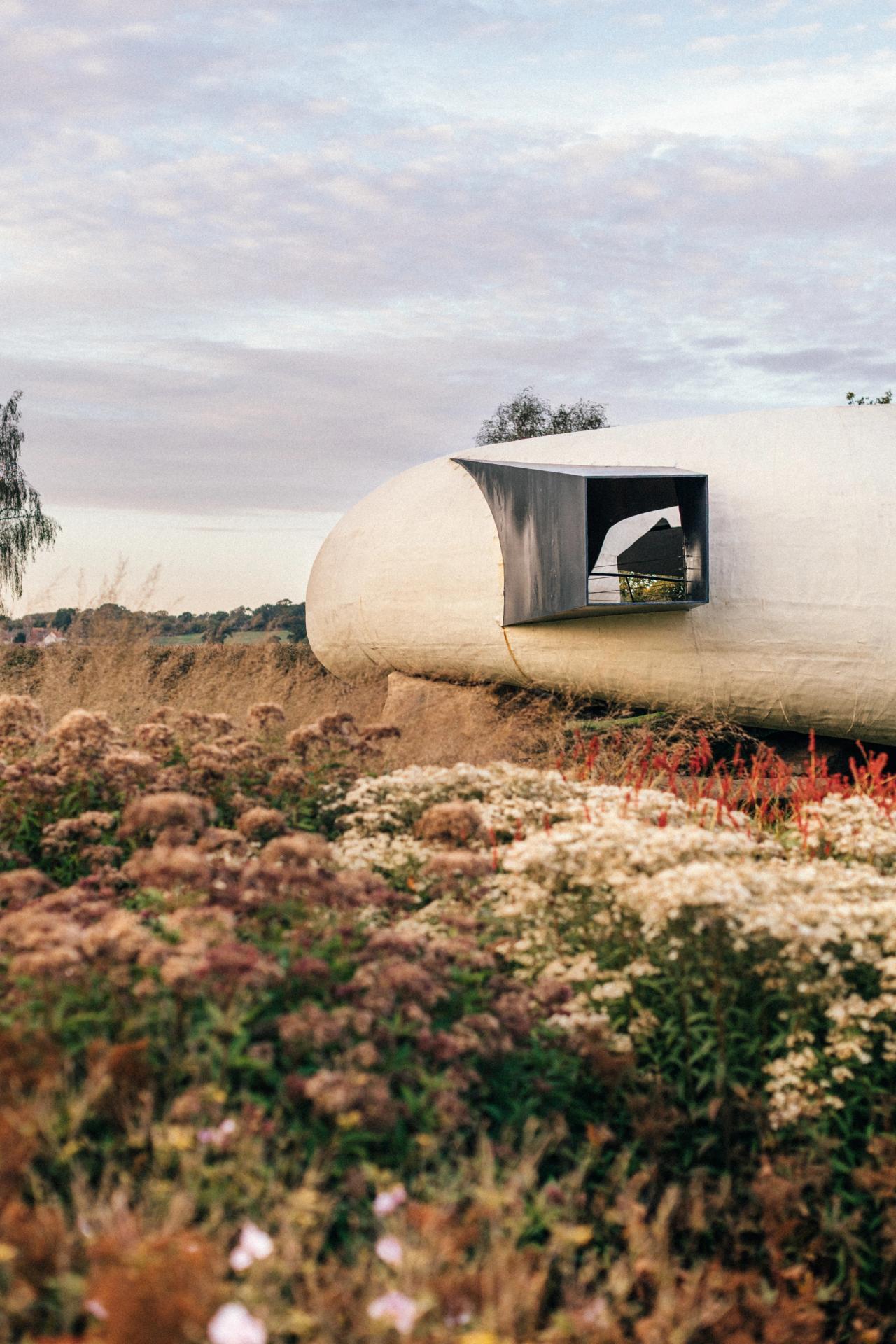
A view of Oudolf Field at Hauser & Wirth in Somerset, England, in 2026, featuring the Radic Pavilion, designed by Smiljan Radic in 2014. (Photo: Benjamin Pryo/Courtesy Hauser & Wirth)
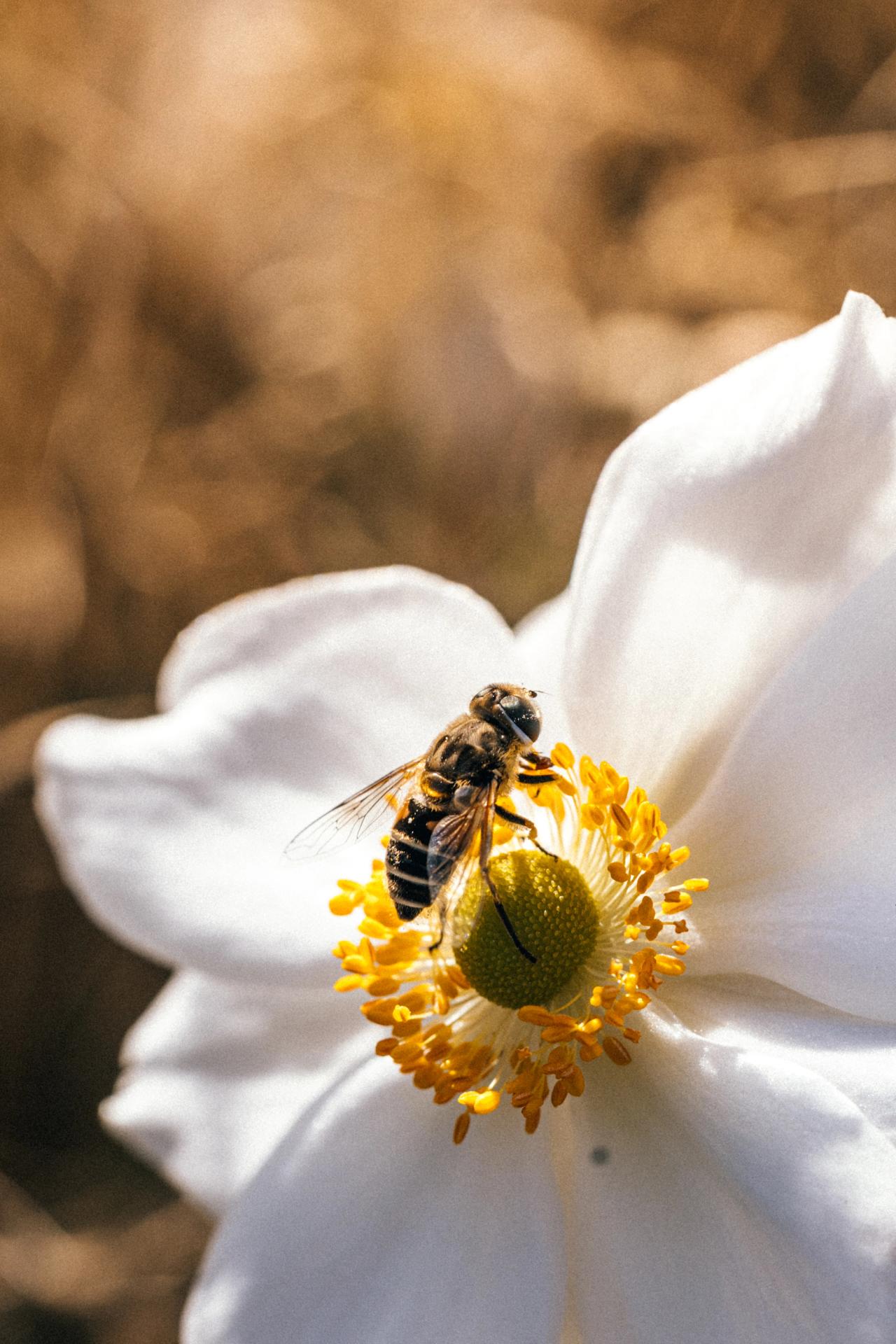
An Anemone Hybrida (“Honorine Jobert”) visited by a bee. (Photo: Benjamin Pryo/Courtesy Hauser & Wirth)
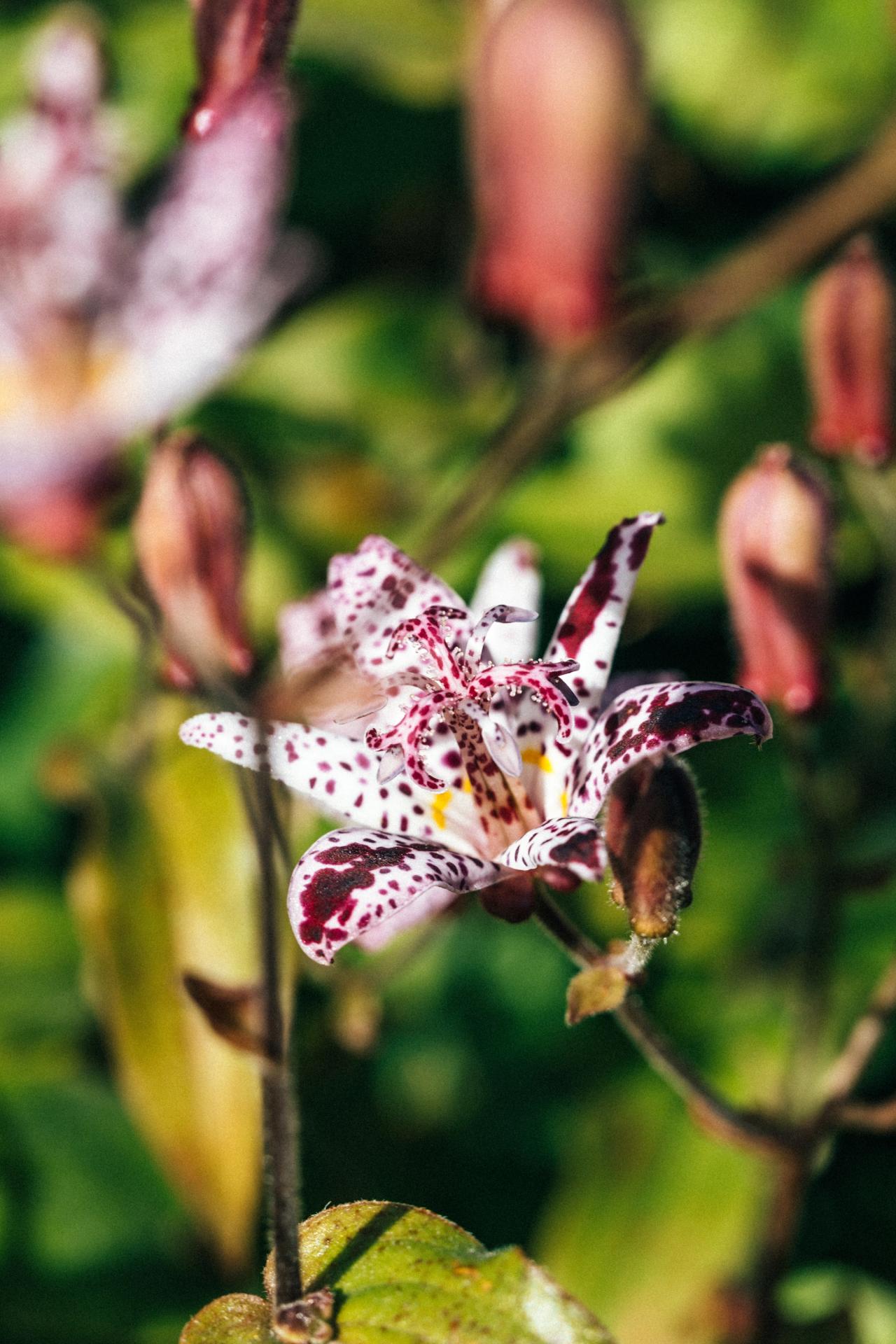
A Tricyrtis Formosana (“Toad Lily”). (Photo: Benjamin Pryo/Courtesy Hauser & Wirth)
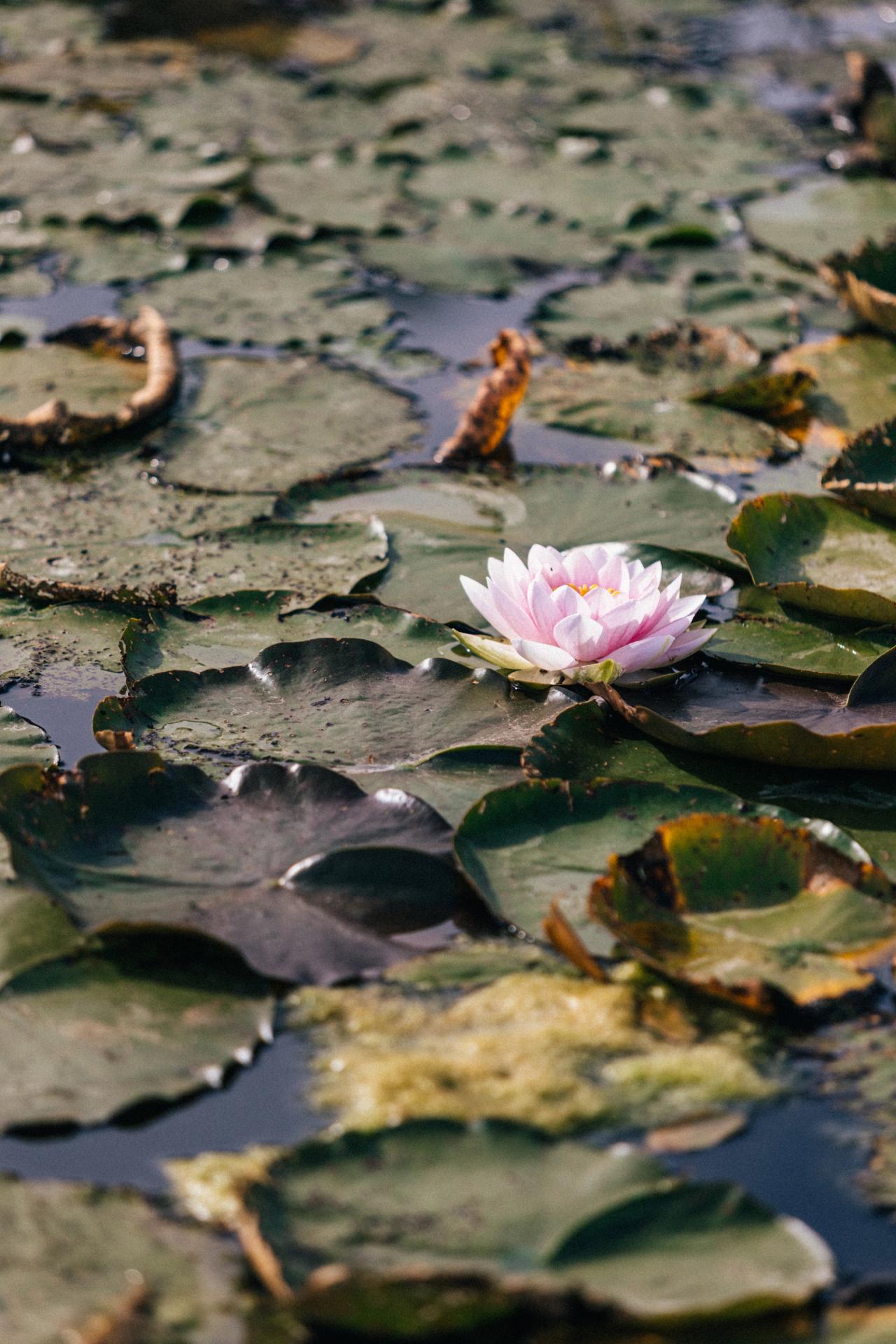
A water lily in the pond at Hauser & Wirth in Somerset, England, in 2026. (Photo: Benjamin Pryo/Courtesy Hauser & Wirth)
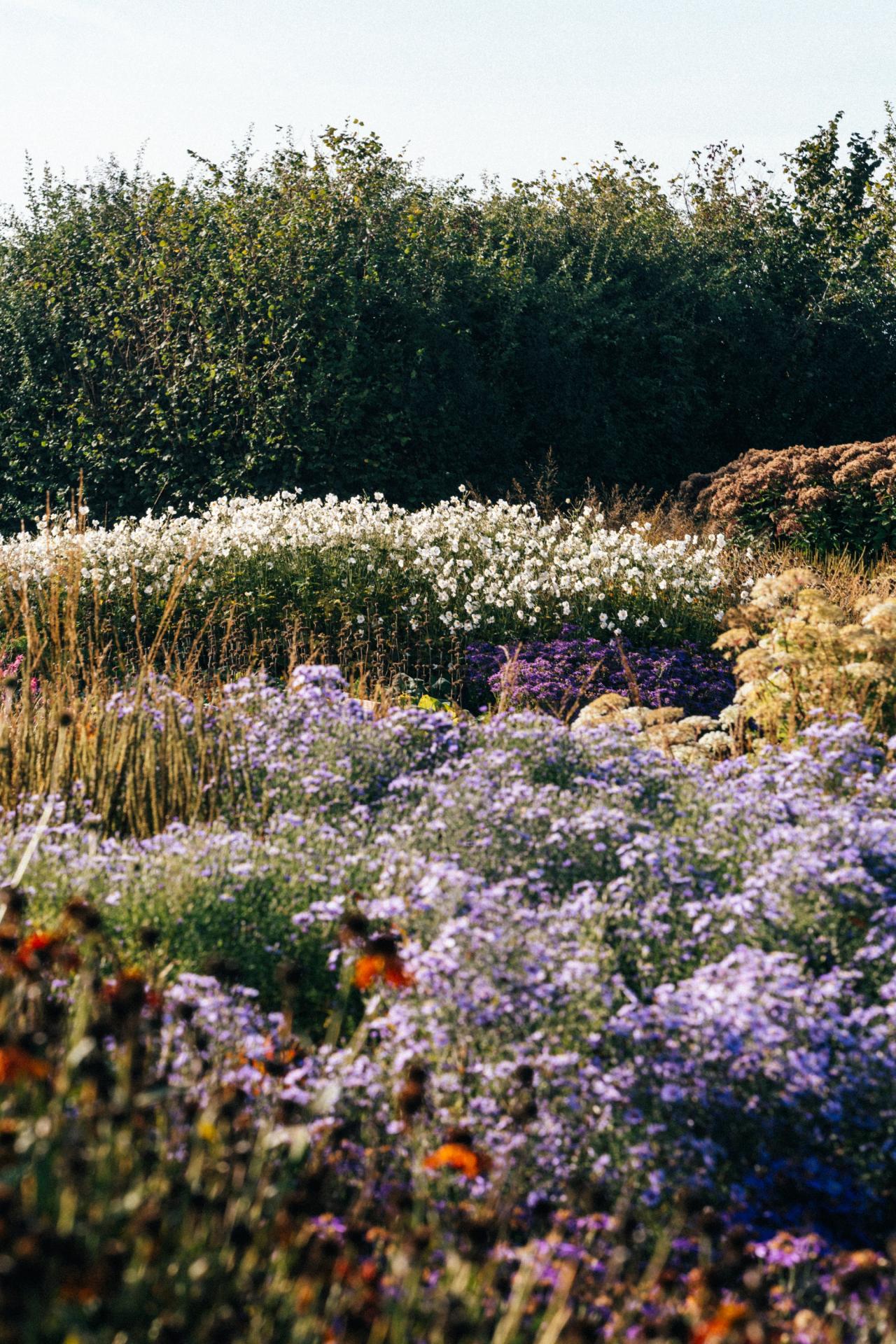
A view of Oudolf Field at Hauser & Wirth in Somerset, England, in 2026. (Photo: Benjamin Pryo/Courtesy Hauser & Wirth)
A view of Oudolf Field at Hauser & Wirth in Somerset, England, in 2026. (Photo: Benjamin Pryo/Courtesy Hauser & Wirth)
A view of Oudolf Field at Hauser & Wirth in Somerset, England, in 2026, featuring the Radic Pavilion, designed by Smiljan Radic in 2014. (Photo: Benjamin Pryo/Courtesy Hauser & Wirth)
An Anemone Hybrida (“Honorine Jobert”) visited by a bee. (Photo: Benjamin Pryo/Courtesy Hauser & Wirth)
A Tricyrtis Formosana (“Toad Lily”). (Photo: Benjamin Pryo/Courtesy Hauser & Wirth)
A water lily in the pond at Hauser & Wirth in Somerset, England, in 2026. (Photo: Benjamin Pryo/Courtesy Hauser & Wirth)
A view of Oudolf Field at Hauser & Wirth in Somerset, England, in 2026. (Photo: Benjamin Pryo/Courtesy Hauser & Wirth)
A view of Oudolf Field at Hauser & Wirth in Somerset, England, in 2026. (Photo: Benjamin Pryo/Courtesy Hauser & Wirth)
A view of Oudolf Field at Hauser & Wirth in Somerset, England, in 2026, featuring the Radic Pavilion, designed by Smiljan Radic in 2014. (Photo: Benjamin Pryo/Courtesy Hauser & Wirth)
An Anemone Hybrida (“Honorine Jobert”) visited by a bee. (Photo: Benjamin Pryo/Courtesy Hauser & Wirth)
A Tricyrtis Formosana (“Toad Lily”). (Photo: Benjamin Pryo/Courtesy Hauser & Wirth)
A water lily in the pond at Hauser & Wirth in Somerset, England, in 2026. (Photo: Benjamin Pryo/Courtesy Hauser & Wirth)
A view of Oudolf Field at Hauser & Wirth in Somerset, England, in 2026. (Photo: Benjamin Pryo/Courtesy Hauser & Wirth)
“I feel happy to work in an artistic environment.”
PO: I feel happy to work in an artistic environment.
SB: The Chillida [Leku] as well, right, in Spain?
PO: Yeah. I think most of it comes because I did a garden at the [Venice] Biennale in 2010. I think that was the first garden for the Biennale and I think that’s where I met Hans Ulrich Obrist.
SB: Obrist, yeah.
PO: Yeah. Anyway, he talked about Iwan and Manuela. “They need a garden,” he said, “I’m going to call them,” so...
SB: Yeah, it’s urgent. [Laughs]
PO: Yeah, it’s urgent. So that is how it happened. Then I went to London to see them in the gallery over there, and I think we talked and they were really nice and wanted me to do the garden. But as I said, I’ve always been busy because I have a one-person—
SB: Person team.
PO: I’m the only one that designs in the office.
SB: And answers emails.
PO: Yeah. And books his own flights and makes his own appointments.
Nothing happened for half a year. And then we were... I think it had to do with the Serpentine that we were, in November—that was the moment that the pavilion had to close and the planting had to move out. So there was a dinner, and Hans Ulrich was there. He said, “How is it going with the garden of Iwan and Manuela?” I said, “Yeah, nothing happened. I think I’d still like to do it.” Then he took the phone, and then we really made an appointment and that’s how it all started.
SB: Oh, good. Yeah. I mean, he’s a master of making things occur.
PO: Happen, yeah. Really.
SB: I wanted to turn to your childhood. We spoke a little bit about this in our previous conversation, but you grew up on the Dutch coast where your parents had this restaurant and bar. I’m curious what that world was like. What sort of people came through the doors? Looking back, do you see any connection between that world—that early experience in hospitality—and making gardens?
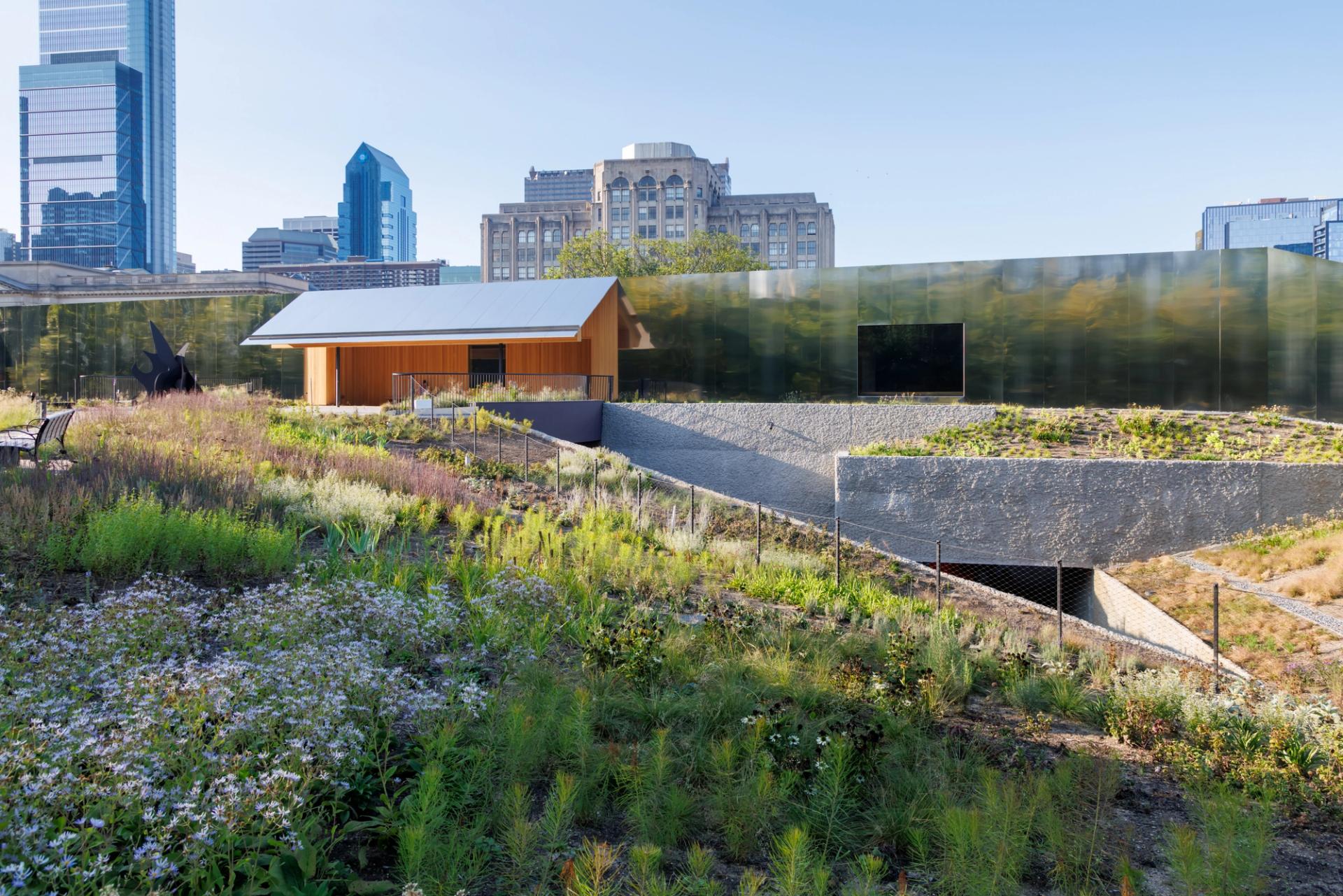
A view of Calder Gardens in 2025. (Photo: Iwan Baan. Artwork by Alexander Calder/Copyright: Calder Foundation and Artists Rights Society, New York)
“We lived right [next] to a nature preserve. So, the fence, our property, the fence, nature preserve. That’s where I always played when I was young, but I never realized that that would become my passion and hobby later in my life.”
PO: I grew up as a child where my parents were working and we had a bar, a nice bar, a lot of people, young people coming there in the evening. During the daytime, it was a restaurant for people that were traveling and visiting a national park close by. So, it was quite normal, a mainstream thing, but outside the city. It had a beautiful location and we lived right [next] to a nature preserve. So, the fence, our property, the fence, nature preserve. That’s where I always played when I was young, but I never realized that that would become my passion and hobby later in my life.
So, I worked hard. We had to help. The weekend, we were serving on the terrace; at night we were, when I got older, behind the bar. And the intention was that I would take over the business with my brother, but I was in my twenties, then I suddenly thought, “Okay, is this my life?” A lot of fun, a lot of friends, a lot of, whatever, happening. But yeah, I felt I became a little bit down and tried to find another way to—
SB: Another outlet.
PO: Yeah, outlet.
SB: What were you like as a teenager?
PO: Uh… Sort of quiet, observing. Also, abundant with my friends. But always observing. A lot of nightlife, but always in the corner looking at what was happening. You can imagine when you close the bar at twelve o’clock that you go out into the city with some people and you meet people from other bars that go out at night and you go to, whatever, dancings or—how they call it at that time, discos?—later. A lot of fun, but when you’re in your twenties, you start to realize, “Is that my life?”
SB: Yeah. Did you imagine spending your whole life in the Netherlands?
PO: No, I never had the intention to go away. I never had the intention to work abroad, because my career went very slowly. It went from that I found a job in the garden center and they wanted to keep me after the winter so that I could work on the nursery a little bit, cleaning up and maintaining the plants. I think that is when I started to become interested. First it was just a job and then I started to look at the plants in the nursery and I started to become interested about what is this and what is that? I asked the people that were working—nobody was really interested in the plants. They were just working.
Then I bought a book first about trees and I started to buy one, order a tree, in my mother’s garden. I think my father [had] passed away at the time, but I planted them in the garden around the restaurant and started to create a garden there, and that is more or less how it slowly helped. I had no paper and I think I started to work later after nursery for a contractor. It was a very good one. I learned a lot and I went back to school in the evening for two years because, at a certain point, working your whole life is sort of independent with no people telling you what to do... I wanted to start for myself. I went to school to become legally a contractor and then I started for myself. So that’s a very short—what I say now. A lot happened in between. Then I started my own little company with my wife, Anja.
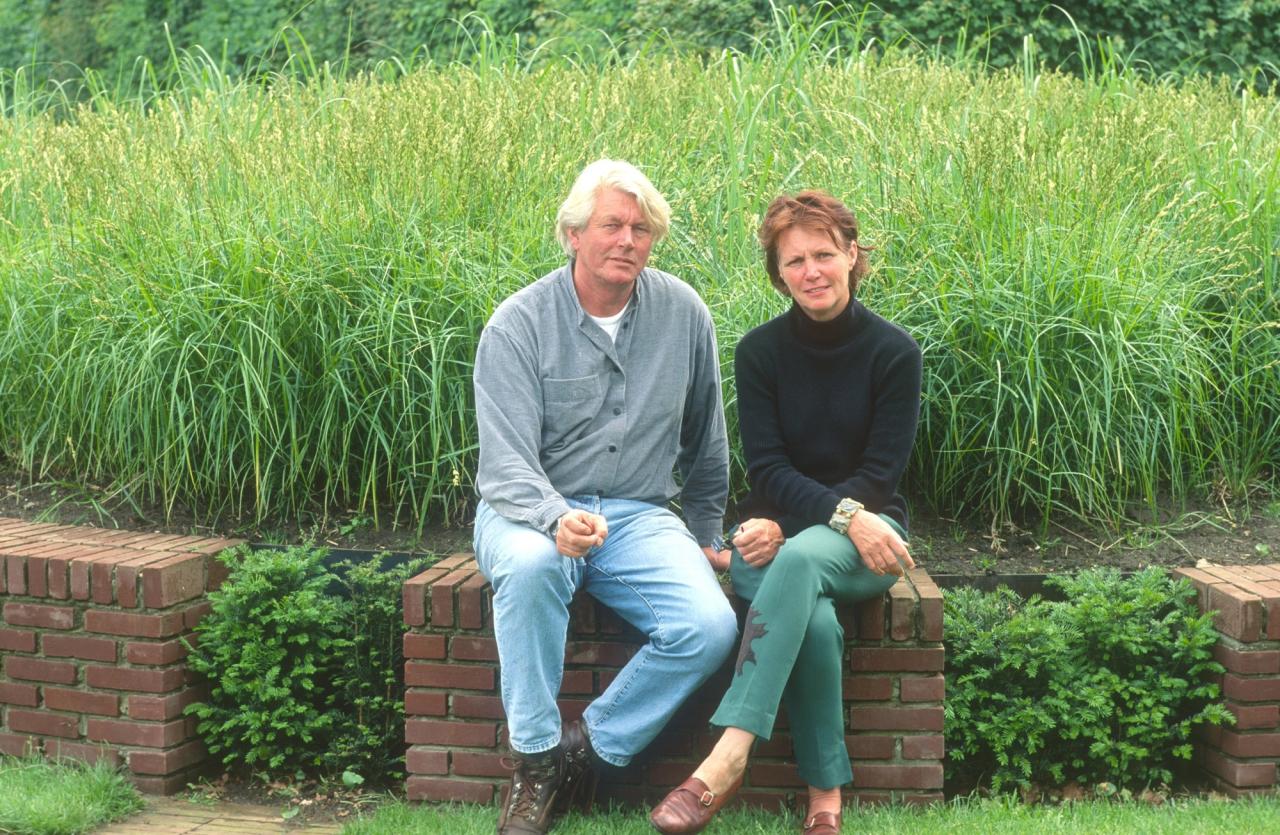
Oudolf sitting beside his wife, Anja, in 1988. (Courtesy Piet Oudolf)
SB: I wanted to ask you: How did you and Anja meet?
PO: We met at the restaurant at night.
SB: Oh really?
PO: Yeah, because it was a nature preserve. There were a lot of playing fields, hockey, football, and so on. She was doing athletics, and she came to drink in the afternoon when she was ready and I talked to her and I... So they came every week after training. And then I started to, how do you say, meet her? And then we married, and we’ve been married for fifty-six years.
SB: Wow. What do you think initially drew you to Anja?
PO: She was very attractive and also had a personality, very nice and sweet and her own little way of doing. She was supporting me, not for the first phase, that’s just, you fall in love and you don’t know why because, yeah, she looks good and everything outside the personality, what she really was. But when we started our business, she really... Everything I wanted, she said yes. I never had to push her, even when I stopped my business in the west part of the Netherlands and said “I want to start a nursery.” Because we had good clients, but I felt so tight, [such a] small area. I wanted to do more and I was in between. I was becoming heavily passionate about plants and plantings and design with plants.
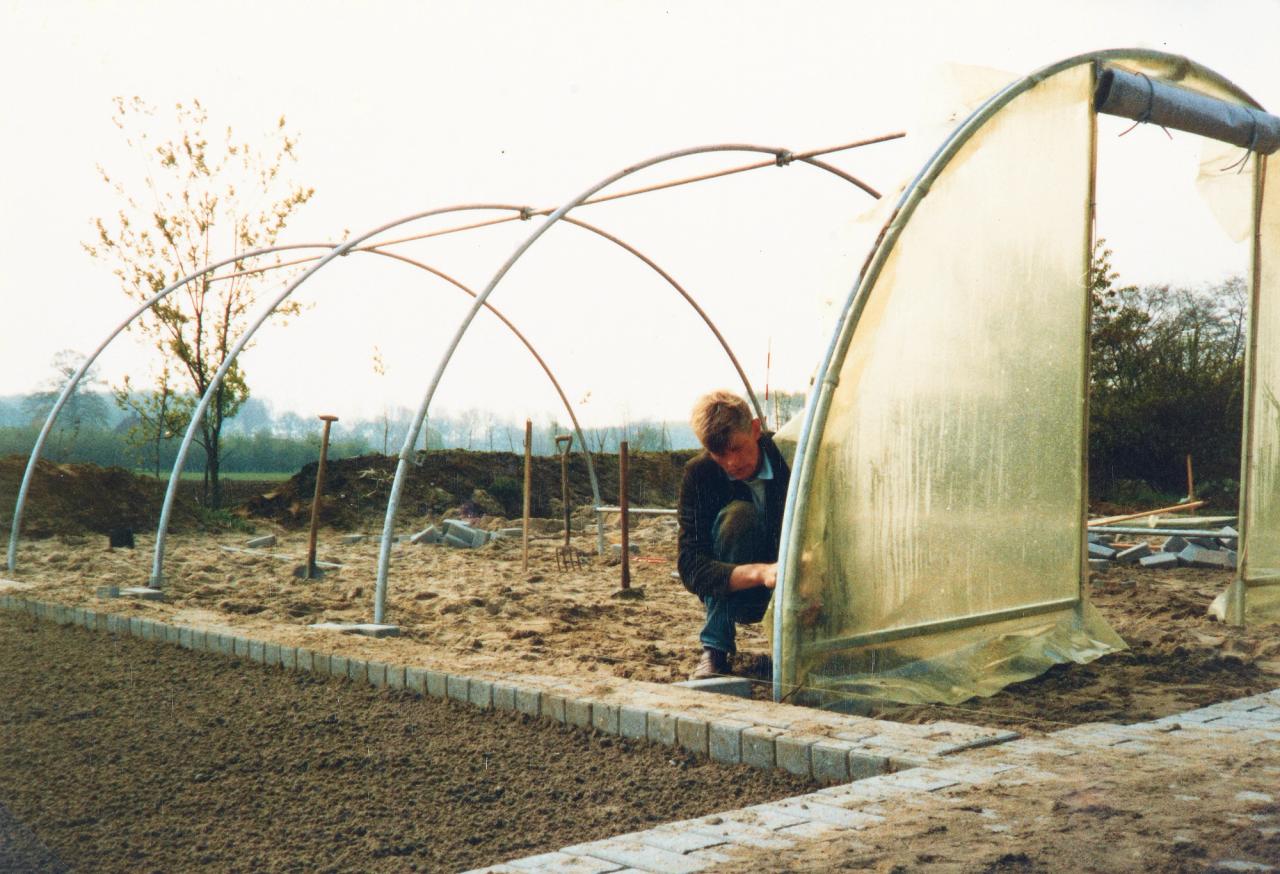
Oudolf at work on establishing his first nursery in Hummelo, the Netherlands, in the early 1980s. (Courtesy Piet Oudolf)
So, I wanted to start a nursery and that was a big…I would just say that this is something you do without thinking. You have a business that you run, a small business, but you have your income and then suddenly you say, “Stop. I’m going to move a hundred miles from here, start a nursery.”
The only thing I had was a house, so I could sell that. I could pay off my mortgage and had maybe, if I say in dollars, sixty thousand dollars to live. Then, from that, we bought a derelict farmhouse, and I forgot that we had to work on the house first and then on the field and grow the plants. So, it’s very complicated. I think, in life, you meet more people that do things without... They think they’re thinking while they’re doing it, but they never... It’s sort of—
SB: The reality comes crashing down.
PO: “Oh, are you doing that? Why are you doing that? Do you think you can make a living?” You think, “Yeah, I think, because the plants and so on.” Long story short, so the nursery, I stopped making gardens and the nursery became, because we were so plant-interested that we collected plants from over Europe. We got, I think mostly over Europe plants that were not well-known in nurseries, not sold. So, our collection of plants became very big. We traveled to England. We had a big connection with English growers, so we introduced plants from England, because we had a lot of varieties of plants that real gardeners loved and traveled to England for, but we had them. So we became a hub between Germany, England, and other countries. We became busier and busier. At that time, I started to... The nursery was in order, how would you say?
SB: Running.
PO: Running. We started to create a garden around the nursery with borders and just a show garden. That also became attractive for people to travel to us. We organized from the second year on open days, that was not common. We invited other nurseries from the Netherlands, specialists, to come to our nursery to sell plants. But by doing that, people said, “Yeah, but they’re competitors, because they also…” We said, “No, they are colleagues.” We bring them to our place, people will come to us and that makes more income for us, because they will come back, because they bring their own clients also. So, in that sense, it grew slowly. It was ten years, I think it took ten years to get to a level financially.
SB: I want to backtrack just a little bit, because when you and I last spoke, you mentioned that you and Anja had traveled through England by bicycle. I think it was—
PO: Oh, yeah.
SB: ... in the seventies. You were visiting gardens along the way.
PO: Yeah.
SB: I was struck by this image of the two of you on bicycles going to visit these gardens. I wanted to hear more about that trip or those trips. Where did you go? What do you remember from that?
PO: Yeah, mainly Kent and of course East Anglia. So we went on the boat from Calais to Dover and then we started cycling. Then we traveled along youth hostels and visited gardens, because there was little money. I think that was the best thing to do and we could see gardens. We could travel. We were active. I think we even did that when we had two children, and we traveled with our pickup. We had the children in the back and the bicycles and then we stepped out, and then I had a little car that I made behind the bicycle. That was in the late seventies. I put the children in that.
SB: [Laughs] Amazing.
“There were moments that we really had no money at all. I had to find some money. I had a collection of tin toys. I had to sell that to survive.”
PO: But we saw a lot and we made a lot of friends in the garden world, and I learned a lot. When I look back, I think, “I’ve done so much.” It’s such a… little more, a little different, a little more, a little different, a big step. Then I realized, “Okay, how could I do that?” But still we survived. There were moments that we really had no money at all. I had to find some money. I had a collection of tin toys. I had to sell that to survive. Then, luckily, there was a contractor that helped that was working for us, bringing the sand in for how to create a nursery. We were lucky that he didn’t send us the invoice—only after two years. But it was just moments that you think, “Okay.” But in my head, it still happened. I couldn’t believe that we would stop.
SB: Was there ever a moment where you thought, “I’m not sure I should be doing this”? Or...
PO: No, I couldn’t believe it. I couldn’t think about it. Every day was hardworking, and as long as there was one dollar in the house, I kept on going.
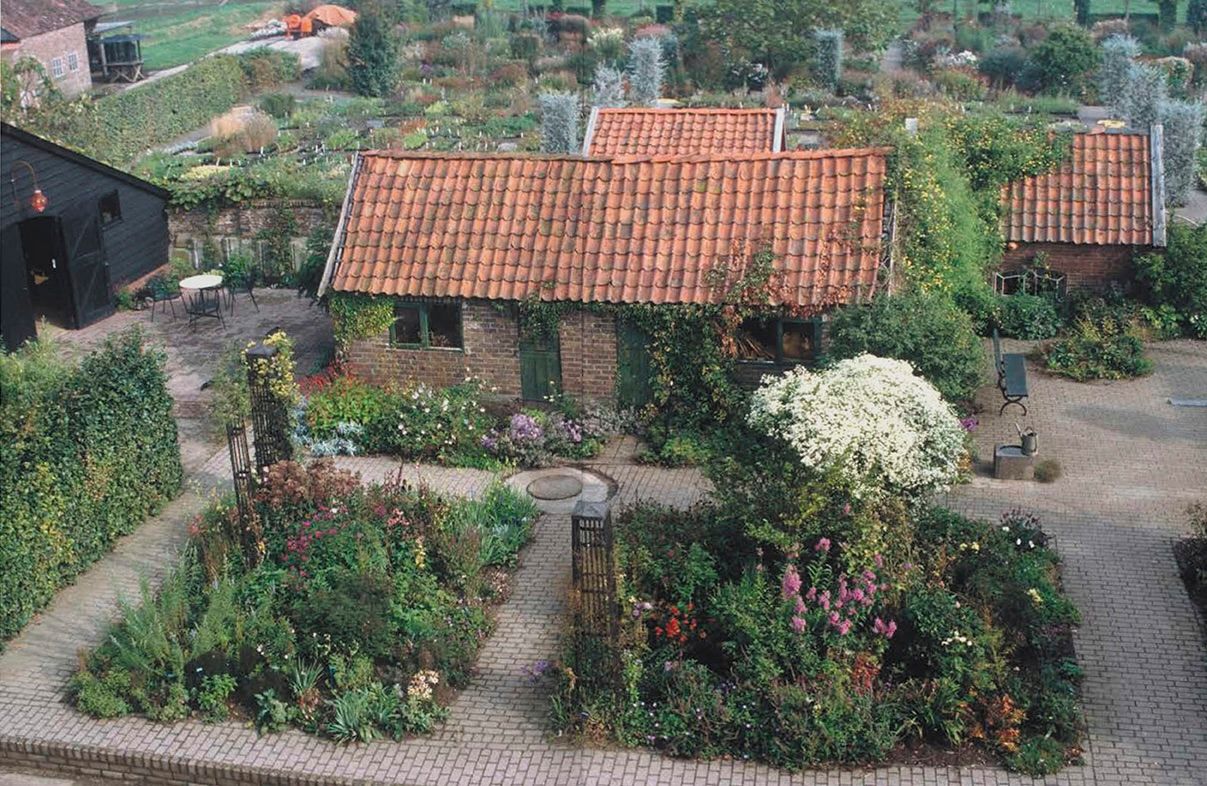
An interior spread from Oudolf and Noel Kingsbury’s 2015 book Hummelo: A Journey Through a Plantsman's Life. (Courtesy Phaidon)
SB: [Laughter] I wanted to ask about your kids, because I imagine how incredible to grow up in Hummelo, in that environment.
PO: Yeah.
SB: What was it like for you to watch them as their parent?
PO: I had no time to watch them, to be honest.
SB: [Laughs]
PO: I think they played around, and Anja, she’s a super mother. She ran the nursery, the sales, and the plants on the nursery. She took care of the children. But the good thing is that the children could... We had room. They had a car, they had an automobile in ’04 when they were 9, 10 years old, they had a Piaggio, so they had all kinds of things that they could ... A motorcycle. When they were 12, they had everything they could wish [for] at that age.
SB: When I was researching for this, though, it wasn’t lost on me that you were starting this family with young children, pretty much still in a nursery, making another nursery for your plants.
PO: Yeah.
SB: You had two nurseries. [Laughs]
PO: Let’s say I was just aiming on what I had in mind. Anja, of course, she did everything on the telephone and communication, calling magazines, “We have a nursery, can you come?” We made a catalog, one of the first nurseries that had a written catalog with subscriptions of the plants. And people combined over the post, so we would be let’s say two hundred and fifty guilders at the time and people ordered them and we were able to get magazines to put in our catalog, because we called them and if that was possible, they said, “We don’t do that.”
SB: Wow.
PO: “That is too commercial. We don’t…” But we got it done. So, very slowly with all these little tricks, tricks you can call it, but it’s more... It’s not a trick. It’s just—
SB: Pushing it.
PO: ... pushing yourself in a good way. You think, “Yeah, why not? We have the best collection. Why shouldn’t they put that in the magazine that we have a good collection and say that there’s a catalog for very little money?”
SB: It’s marketing.
PO: Yeah.
SB: Hummelo also became so much more than a nursery. It was your home, of course, but it was also this place of experimentation and it became a gathering point, as well, for a lot of people who were rethinking gardens.
PO: Yeah.
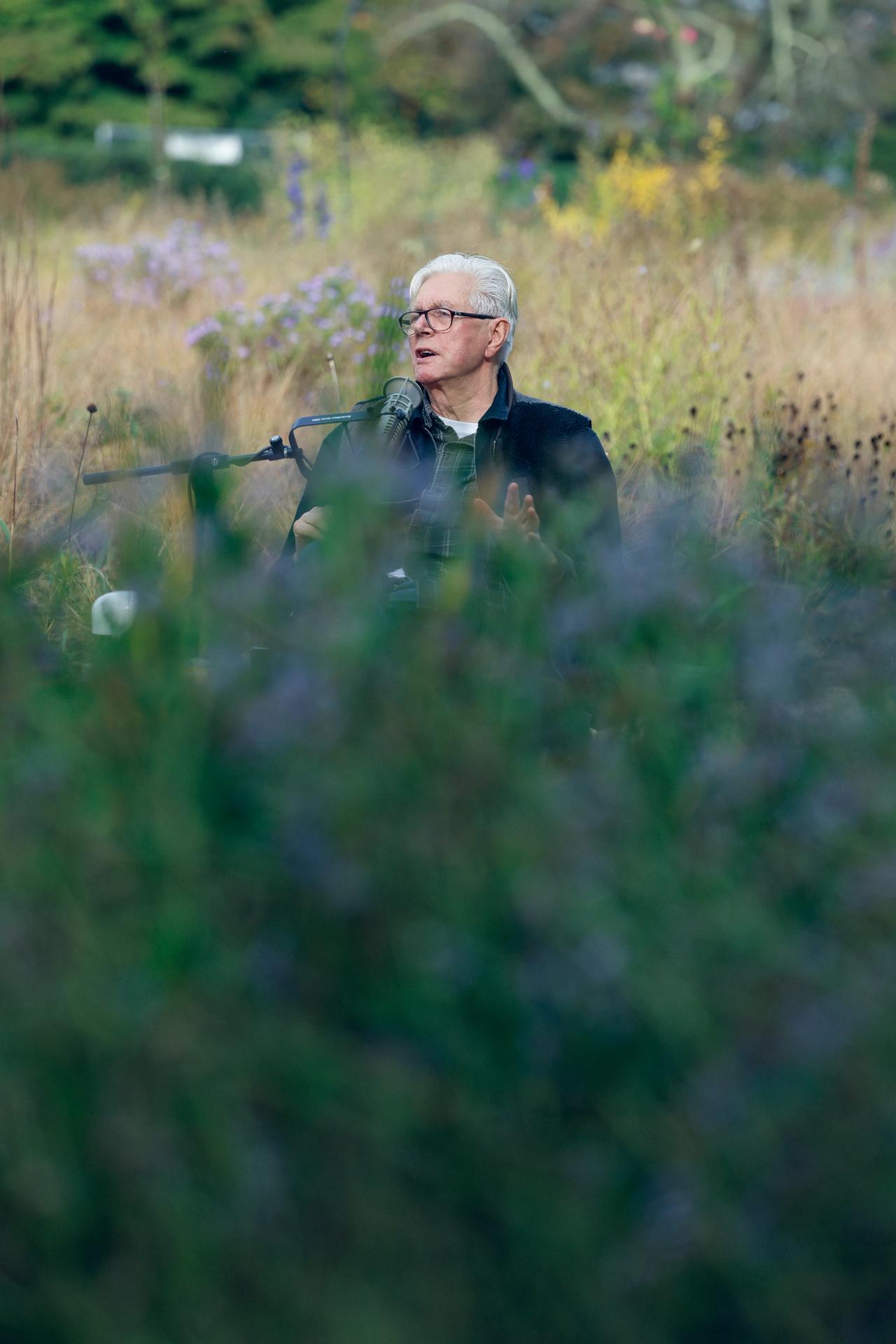
Oudolf sitting in his Planting Fields Foundation garden in Oyster Bay, New York, during the recording of Ep. 162 of Time Sensitive. (Photo: Ogata for The Slowdown)
SB: What was the atmosphere like in those early years? Who were some of the people coming through? What sorts of conversations were you having?
PO: I think through these open days and the people that came in and who we invited to speak, we met people from the wild plants and wild— from more native plant societies, but good people. They were also gardening next to their interest in wild plants. The conversations went on after our events still at night.
Also in that crew, we met people, and I think at a certain moment there were conferences based on public space and the quality of public space. We were invited to speak about our experience with plants, the beauty of the plants, and especially in the time that we wrote the book with Henk Gerritsen about dream plants and a new generation of garden plants. That was discovered by Swedish professors from the University in Lund in a bookshop in Amsterdam. They wanted it to be translated into Swedish and that happened. The first book we made was translated into Swedish as the first language it was translated into. In that sense…
Then we were invited and we met other people and there were conferences in Freising [in Germany], in Kew in England. It all comes together in a way that you’re part of it, but also the other people become part of it, and you become part of a new idea about gardening. It’s not what you would say gardening is. If you talk about classical gardening, it’s more about flowers, it’s about showing off with the plants you have. Also, it could be beautiful; if you look at the arboretum here, it’s great. But I think this dynamic gardening or gardening with plants that are probably wild or native—that didn’t happen at that time.
So, by writing the books and with Henk Gerritsen and showing the plants in winter and telling people that brown is also a color.
SB: [Laughs] Yeah.
PO: You don’t have to be in summer to enjoy your garden. We took people’s attention. The group became bigger and bigger. We had the nursery, and I started to design gardens again. They became [published] in magazines, because it was new for journalists to show something different than just a teahouse with a water can and a bench and some flowers in the background. So, it became totally new.
SB: Right.
PO: Yeah.
SB: Wild, wispy. [Laughs]
PO: Yeah. The Dutch Wave, the Swedish called it. Then it was called the New Perennial Movement.
SB: Did you realize you were in a movement? Or was that something that you were conscious of or—
PO: Yeah. I was just doing... I met friends. It was called a movement, I think, but when it was called the Dutch Wave, I said something: “No, it’s not the Dutch Wave, because there are more people involved.” Then it was called, I think, the German movement, but it is a New Perennial Movement, we call it.
SB: You said, “My relationship to plants is through people.” I was curious what you mean by that. Are there plants that carry a particular memory of a person, or do you think about plants more as sort of—
PO: Characters.
SB: Yeah, like, the people in the bar that you were talking about.
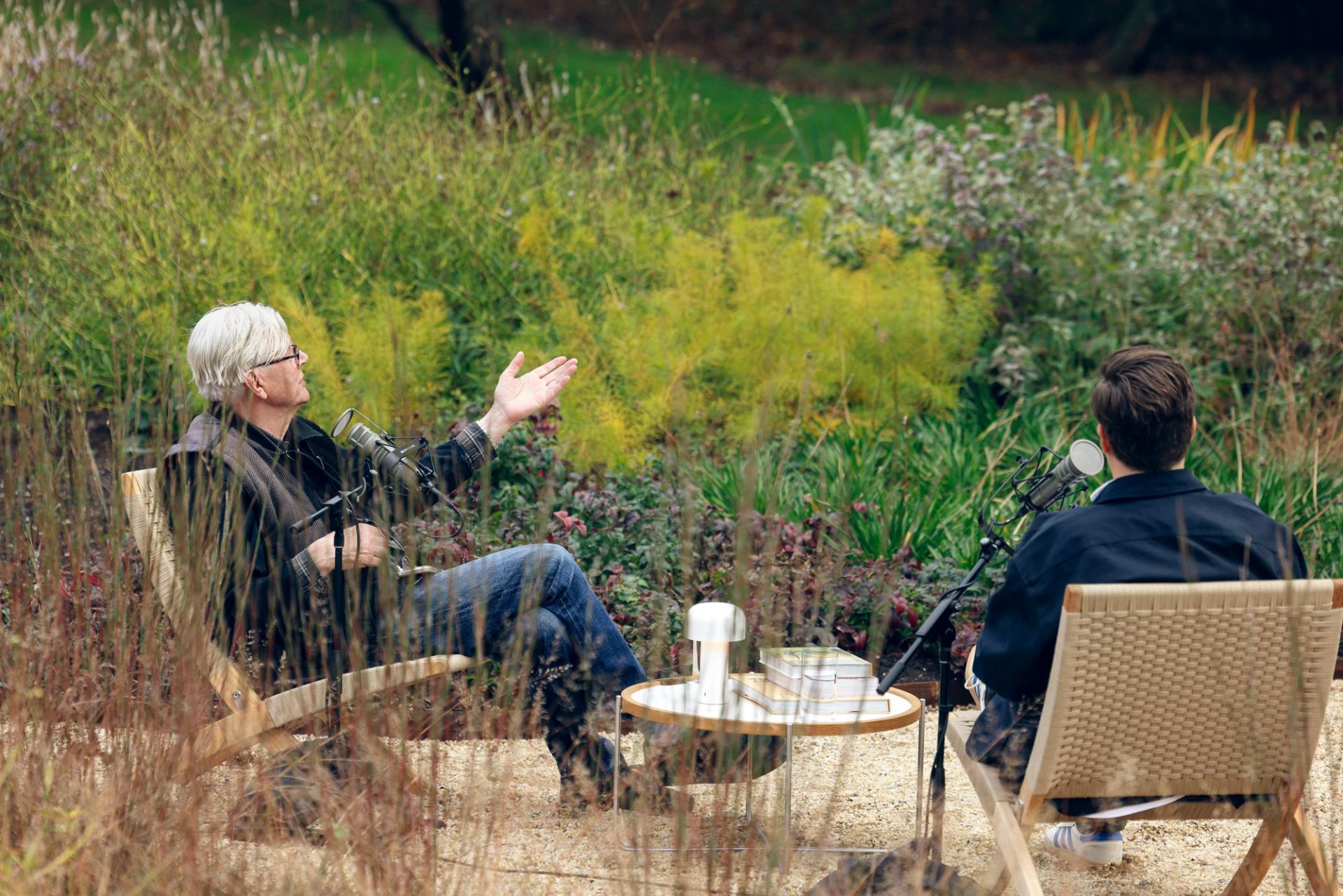
Oudolf showing Spencer his new eponymous garden at Planting Fields during the recording of Ep. 162. (Photo: Ogata for The Slowdown)
“I often have said gardening is like a stage play. You put them in a position with other plants. It looks like something completely like people, personalities together that create something visually very beautiful. With the same plants and other combinations, sometimes a plant plays a major role, sometimes just a minor role. The same plant can be a servant or a leader.”
PO: Yeah. If I look at a plant, I see something that is... I see a character. I see something straight up and that has a position, and I can see that in the context of other plants or plants next to it. It’s composition-making... I often have said it’s like a stage play. You put them in a position with other plants. It looks like something completely like people, personalities together that create something visually very beautiful. With the same plants and other combinations, sometimes a plant plays a major role, sometimes just a minor role. The same plant can be a servant or a leader.
SB: It’s all about who it’s next to, the context it’s in, yeah.
PO: Yeah.
SB: At Hummelo, you and Anja didn’t just grow and collect plants; you also developed new varieties. One of them you made was called “Dear Anja.” So I wanted to ask about that in particular. What was the story behind that one, and why did you decide to name it after—
PO: Yeah. I thought of my wife first and I’m looking for an occasion to give a plant a name. That’s also very simple. I think that we found— Because it was a nursery, we had plants that you wouldn’t find at other nurseries, but also having a nursery, you find seedlings. Because you know your plants, you see that when seedlings start to flower, they occur in your other plants, in your planting beds, and they’re different than the variety you grow and it’s more beautiful, you think. You’re the only one that knows that, because you know your plants. Other people would say, “Okay, nice, it’s a little bit darker,” but they don’t see the quality. I’ve looked for other qualities in some plants and we found, I think, at least eighty plants we gave a name. Many of them disappeared, but there’s still plants that go around. Salvia “Purple Rain” is one, Or “Evergreen,” “Whirling Butterfly.” But I think the Salvia “Dear Anja” was so beautiful, I think. Yeah. I had a good picture of it and it occurred in a book.
SB: What does it take to develop a new plant? How do you recognize you’ve discovered something new when cultivating?
PO: I’m not a breeder. I’m not a pollinator. So it’s more that I found plants as seedlings and I grew them up and I saw the quality, and many of them are still in the trade as great garden plants. But it’s more the eye, you must have—part of it. You must know your plants, you must have the eye, and you must see that plant really has to stand out next to another plant, that it’s not just that it has a little bit of a grayer leaf or variegation that is hardly visible. It really should be different.
SB: It’s about contrast, but also conversation.
PO: No, it could be a color, as well. It could be a plant that normally flops and suddenly, you find one that stands up. So, it’s a better-quality plant.
SB: You’ve said you think more about structure than color and a plant can be beautiful long after its flowers have disappeared. Do you think you’ve helped change how people understand gardens through that perspective? How they actually see plants?
PO: I don’t know. Most people still see plants by color. It’s true. But they see my gardens more as something they like, but probably try to do themselves. But I think if I look at my work, you must have a certain kind of talent or vision that is different than other people have. Otherwise, you can’t make it. Otherwise, it would be something that other people do and already have done and never have been noticed.
SB: The thing that strikes me about all your gardens—the ones I’ve been to, anyway—whether it’s walking along the High Line, or being at the Chillida Leku in Spain, or here at Planting Fields, it’s like the texture overtakes you in a way, the layering. We’re sitting in the middle of this stone path, but I feel sort of… surrounded.
PO: Yeah, surrounded. I can see it because it feels... I will say it feels sort of normal, but it is not normal.
SB: [Laughs] It’s not.
“A colleague of mine, James Hitchmough, he called my work ‘nature on steroids.’”
PO: Now I know that a colleague of mine, James Hitchmough, he called my work “nature on steroids.”
SB: It does feel like there’s something very dreamlike about it. We have the birds and the bees and...
PO: I think what we brought in with this kind of garden is, of course, by leaving things into the winter, it’s for the birds and the spiders and the insects and whatever. Also for creatures you don’t want.
SB: Well, we’ve been talking about plants, but it does strike me that another way of thinking about your gardens is actually the sort of creatures that inhabit them.
PO: Yeah, it’s a habitat for creatures, as well.
SB: I love seeing when a spider makes the perfect web on your plants and the light hits it just right.
PO: Yeah. Now we have mice in the garden—many. There’s a certain plant when first it’s flowers and then… There’s this seed head. The moment it’s becoming a seed, and you go in the garden and then at night you see a mouse coming in, nibble it off, let it drop. Other plants have that, too. In the first years, I was really annoyed to think, okay, the seed heads are so nice and now this mouse is taking it off. Yeah, but it’s part of life.
SB: Yeah.
PO: But I think that, through all this work, people see nowadays what they want with our climate—or, not want with our climate, what they do with our climate—seeing this is a relief for them, I think. They see something that they probably have in mind of nature and have a mind of how they would like to see nature and at least that is a resonance....
SB: It’s almost the opposite of the flatness we’re faced with our screens all day long, right?
PO: Yeah. It’s alive, and I think it has dimension and it changes all the time, not only in time, but also with the weather.
SB: A quote of yours I love that I had to mention, because this podcast is partly about time anyway, is, “Everything I do is a playful intermezzo with time.” And last night I went to—this is a little side tangent—Music for 18 Musicians: Staged Variations, Steve Reich, at the Park Avenue Armory. It’s this sort of landmark composition of his, and I couldn’t help but think about your work in that context of these gardens as these sort of... I mean, I like your analogy of characters and actors, but I was also thinking about it as like a musical composition.
PO: That’s also how, but I think I see it as both. I see it also as a composition in time.
SB: There’s so much rhythm to this place.
PO: I noticed over time people that come to our garden, that really like my gardens, often are musicians.
SB: Interesting.
PO: Yeah. They see that sort of... And other people, of course. I don’t ask what they do, but I noticed that when we had the nursery and people came in, oh, they loved it so much, because they saw the rhythm and what happened.
SB: The meditative nature of the music I was hearing last night—this layering upon layering upon layering—I was like, “I think it’s going to feel like that in the garden tomorrow,” and we’re sitting here now and I feel that.
PO: And the weather couldn’t be better now.
SB: We lucked out. [Laughter]
PO: Yeah.
SB: There’s an interesting tension in your work I wanted to bring up, too, which is that your gardens can appear spontaneous, and I guess we could say almost wild, but they’re rigorously composed also.
PO: I have to, yeah.
SB: You’ve said, “I’ve always seen gardening as control.” How do you reconcile this control feeling with the unpredictability of nature?
PO: I think a lot of things happen and you have to control that to keep your garden going in the way you like it. So, if we look into the garden, we come and see when something is too big, too small and think, or there’s a weed, you have to control otherwise the weeds take over.
“Gardening is about control and maybe the kind of garden we make is less control and more ‘let go.’ But as long as we let go, we need people with more knowledge, because they know what goes—what we have let go.”
So gardening is about control and maybe the kind of garden we make is less control and more ‘let go.’ But as long as we let go, we need people with more knowledge, because they know what goes—what we have let go.
SB: Do you find pleasure in weeding? Is weeding a pleasurable...
PO: No, I have not done it.
SB: [Laughs]
PO: I always say I have done weeding enough. I’ve dug enough in the garden. I’ve done heavy work in the garden. I’ve dug out bamboo and everything. And weeding is, you are so concentrated to a little spot that you don’t see the garden anymore. I say weeding is... I like weeding, but by other people. I love to look in the garden. Looking is more interesting for me. Look what happens. See what happens in the garden
SB: Is that a big part of your work as a gardener, you would say, looking?
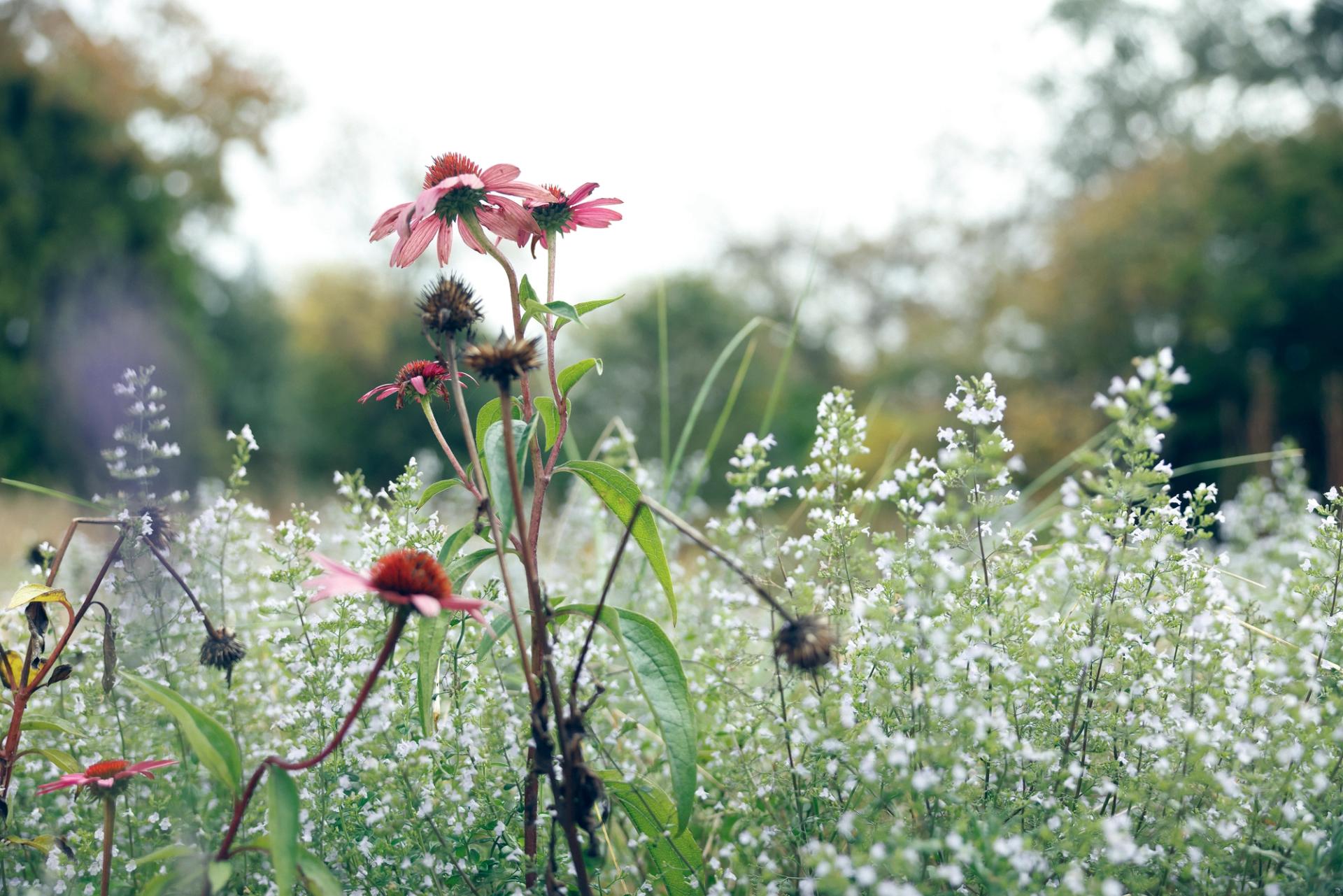
A view of Echinacea purpurea (“Vintage Wine”) and calamint in the Oudolf Garden at Planting Fields. (Photo: Ogata for The Slowdown)
“It’s always looking for a little bit more perfection. On the other hand, less perfection. So, it’s a sort of yin-yang.”
PO: Observing, looking, seeing what goes wrong in your mind, or not just in my mind, in the garden that you think that could be better, or just it’s always looking for a little bit more perfection and, on the other hand, less perfection. So, it’s a sort of yin-yang.
SB: I mean, I think a little bit about John Berger’s Ways of Seeing, but in the garden.
PO: Yeah, but it’s complicated, because my work depends on people that take it over and work with it. Like you say, you have to be a good musician to play the Garden, huh?
SB: [Laughs] I love that. I mean, tell me a bit about that because I think the gardeners are unsung, in a way. I think we forget about how much work it takes to maintain the High Line, for example. What’s your relationship like with these people who keep your gardens alive?
PO: Normally very good, because they’re really people that do gardens for many years, have the experience. Not everyone has the experience, but at least they want to learn and they want to listen to what I say and I can teach them. So, when I come in the High Line or other gardens, the best thing is to do and to go around with the people—like here, Peter [Slothower]. The first thing I did was to start talking with Peter about what I wanted to be sort of more spread or something like that. My relationship with gardens should be good, otherwise you’ll lose your garden. I’ve lost many gardens by bad gardeners.
SB: It’s such a living, active thing.
PO: Yeah. It’s hard to say, but if I talk about my... If I see my work in perspective, it’s what I say, ephemeral. You can lose it within two, three years. You can lose it in fifteen years, but it will go. As long as you can keep it going in a way that you think it is interesting or you can see how things evolve and people can learn from it, it’s also a teaching tool for gardeners, for people… teaching tool for human beings.
SB: Go on with that. I’m curious about that—a teaching tool for human beings.
PO: Being in a garden gives you a certain sense of a mood or can teach you about… processes. Things that come and go. If you come and go in through the years, you’ll see things different. So, it teaches you something about life, something also about nature, about... Yeah. My English is not so good that I can find all the words I have for it, but...
SB: [Laughs] Has being so... I mean, basically living and breathing gardens for most of your life, has that changed how you view your own life, your own mortality, your own sense of—
PO: I will be 82 in two weeks time, but I never thought about age till two years ago. Never thought about it.
SB: Oh, really?
“Suddenly you become 80, and then 80 is the sort of threshold into another life, thinking about not being there anymore.”
PO: Never. Suddenly you become 80, and then 80 is the sort of threshold into another life, thinking about not being there anymore. But the thing that happens with getting older is that you cannot do all the jobs you get offered, because people ask you to do the garden that, you know, the building still has to be done or built and permitted. So you see yourself seven years after your first conversation with the client doing a garden, so—
SB: You want to take on projects you know you’ll see happen in your—
PO: One more year.
SB: Yeah.
PO: You have one year to get it done, otherwise I can’t do it anymore—or maybe two years.
SB: That’s sort of a beautiful limitation though, in a way.
PO: Yeah, a good excuse to say no.
SB: [Laughs] So, beyond gardening, in my research, I learned that Anja and you also have been avid collectors of ceramics. I wanted to ask about this.
PO: Yeah, the Bloomsbury Group, that is from Arts and Crafts. She loves that. I collected Finn Juhl, the core things, and other designers, things you couldn’t buy in a shop.
SB: Do you see a link with that sort of obsession with clay or with pottery, with ceramics, and the garden?
PO: Oh yeah. As long as it’s what you do with... If I talk about what I was able to afford myself, not much for a long time, maybe it’s better now. So, we collected small things that we could pay for. There was never a big artwork, but I think we were happy to find it and just to have it at home like other people have little collections. But everything we did was quality. Also, it was maybe not the most expensive collection, but it was very beautiful, very individual. So, that’s our life. Simple things.
SB: There’s also a fragility to pottery that—
PO: I love pottery. You’ve never been at our house, but we have beautiful little things... Also contemporary pottery.
SB: I wanted to ask also about architecture because you’ve collaborated with these extraordinary architects: Peter Zumthor, Jacques Herzog, James Corner [Field Operations], Diller Scofidio + Renfro. What have those taught you about your own practice? Have they shifted at all how you think about your work?
PO: No, not at all.
SB: [Laughs]
PO: I always say, architects, they are sometimes very sort of big egos. They know exactly what they want and you have to fight for your place. It doesn’t matter what you do, who you work with, from Zumthor to Herzog, they all want you to do what they think, have in mind. The only thing you have to do is say, “No, I can’t do that.” And then they let you go, more or less, huh?
SB: Yeah. Well, you’ve earned your spot at the table, too.
PO: Yeah. I say, “I can’t do that. That is impossible.” I think there’s such an easy way of thinking about gardens that is ridiculous sometimes. People say, “Why is the plant still so small?” I say, “Because it’s April,” something like that. “And when will it be flowering?” I say, “In August.” “And how tall will it be?” So, those people want to tell me what to do. It’s impossible. It’s not negative about the people, but about an understanding of my work.
SB: It’s almost like quietly manifesting it forward, just insisting, “This is what we’re doing.”
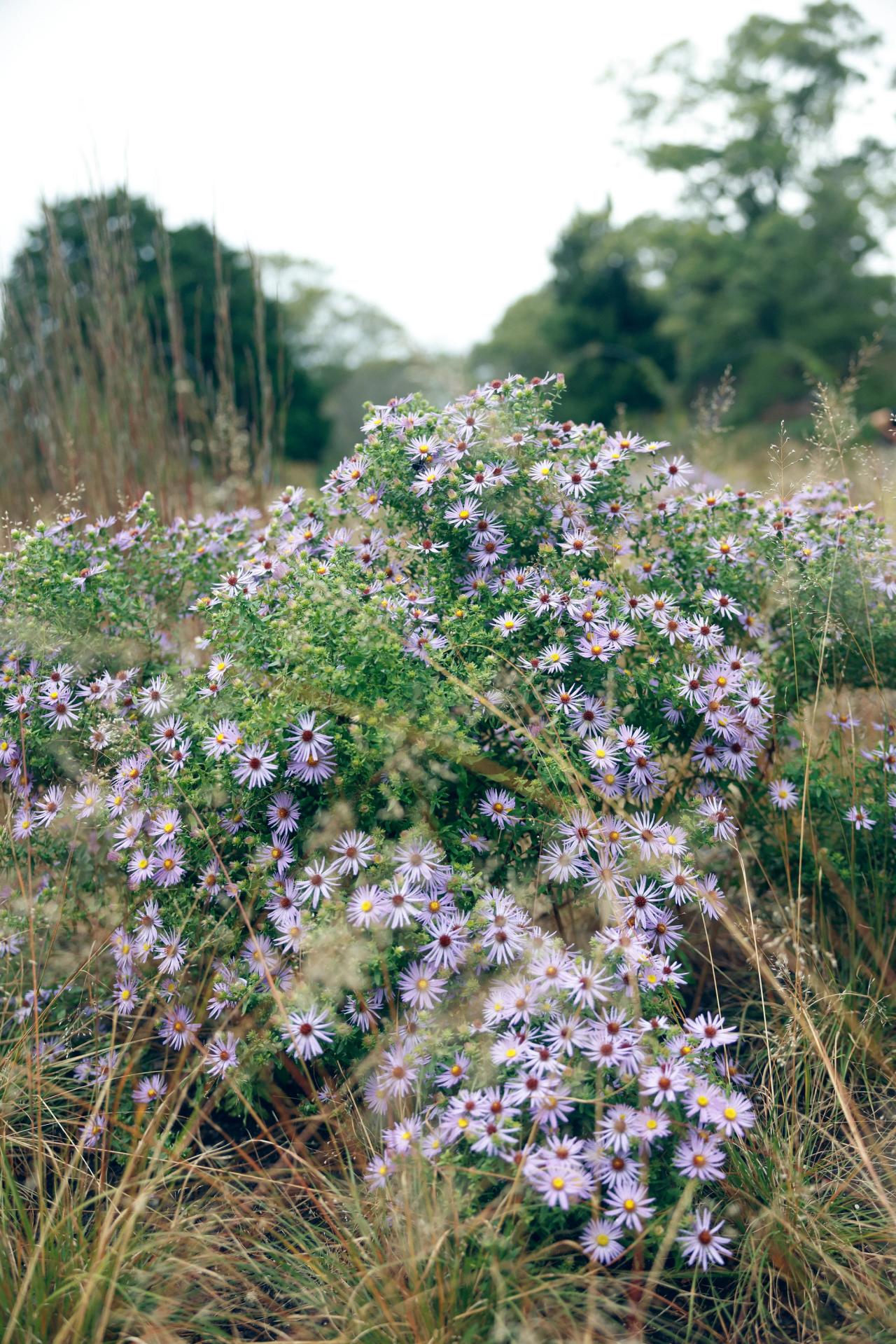
Aromatic aster (“Raydon's Favorite“) and prairie dropseed at Planting Fields. (Photo: Ogata for The Slowdown)
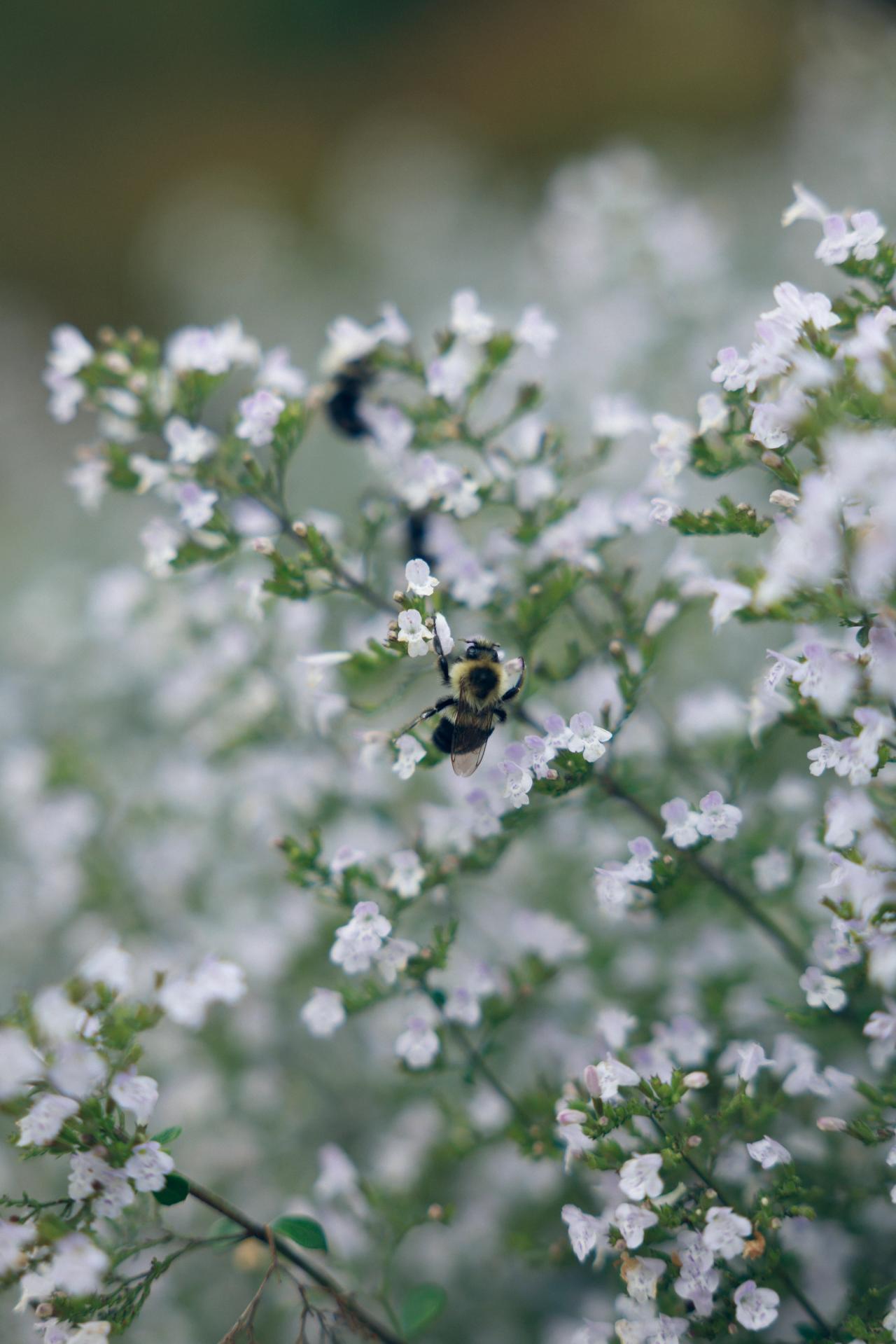
Calamint at Planting Fields. (Photo: Ogata for The Slowdown)
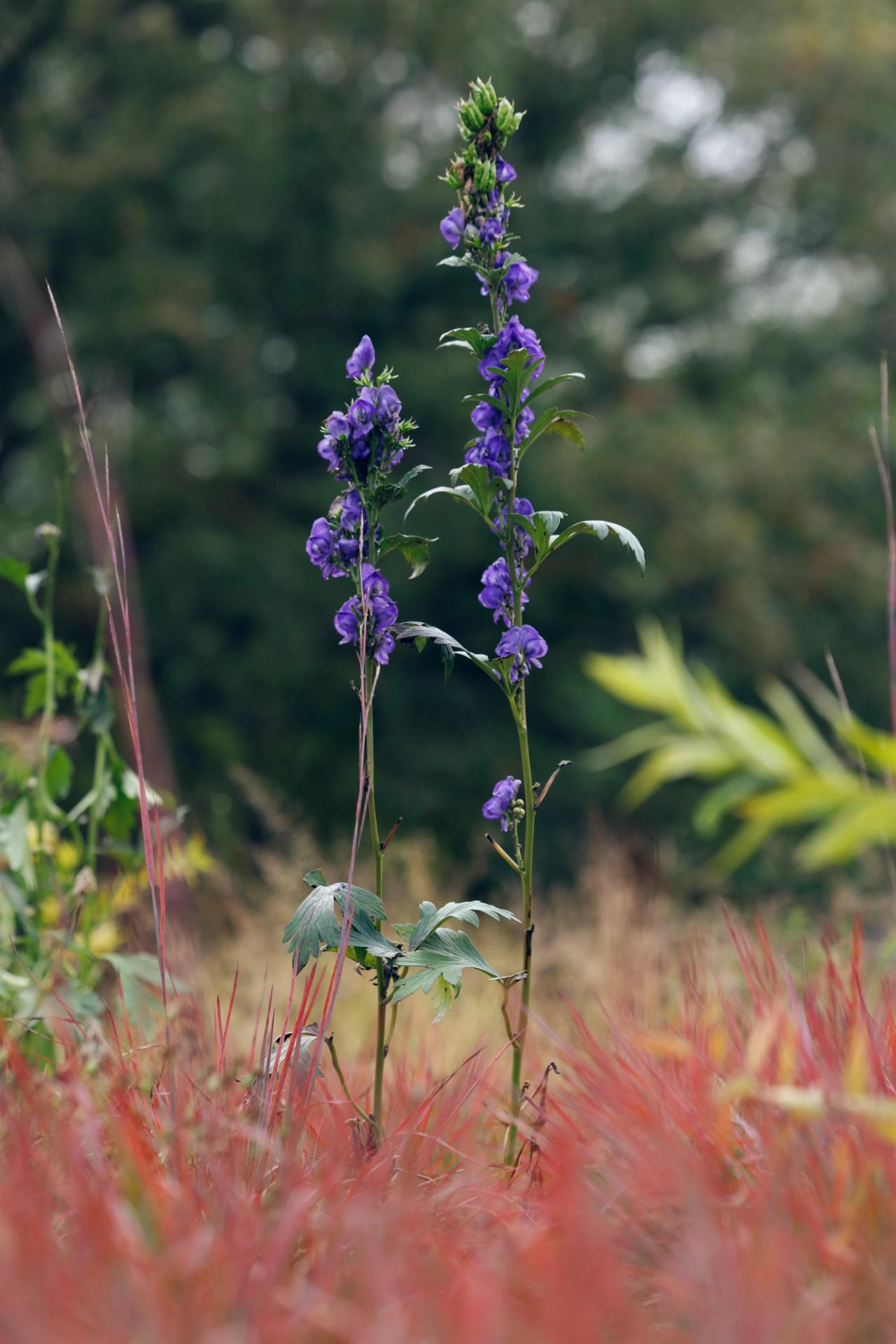
Azure monkshood (“Arendsii“) surrounded by little bluestem (“Standing Ovation“) at Planting Fields. (Photo: Ogata for The Slowdown)
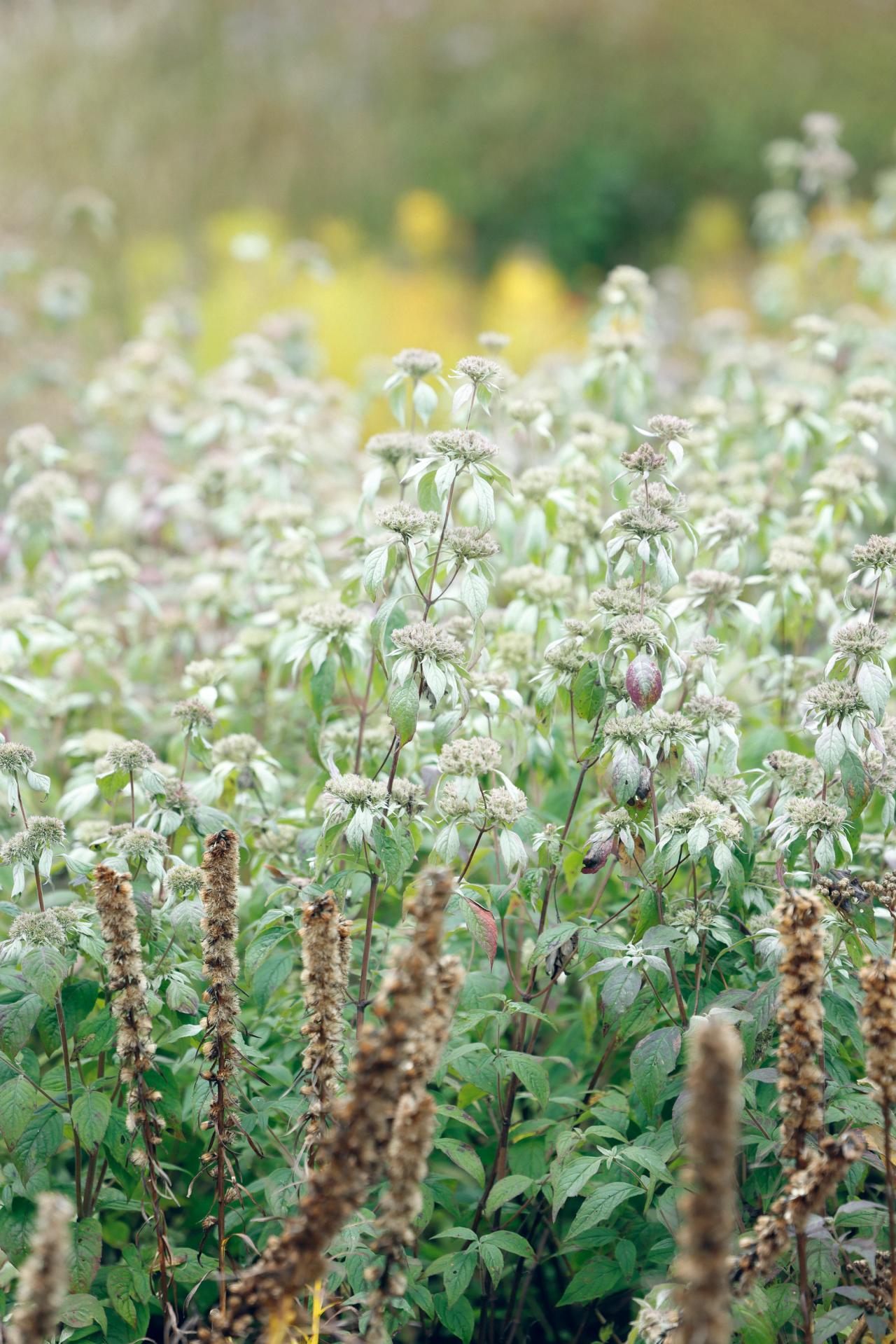
Hoary mountain mint with dense blazing star (“Alba“) in the foreground at Planting Fields. (Photo: Ogata for The Slowdown)
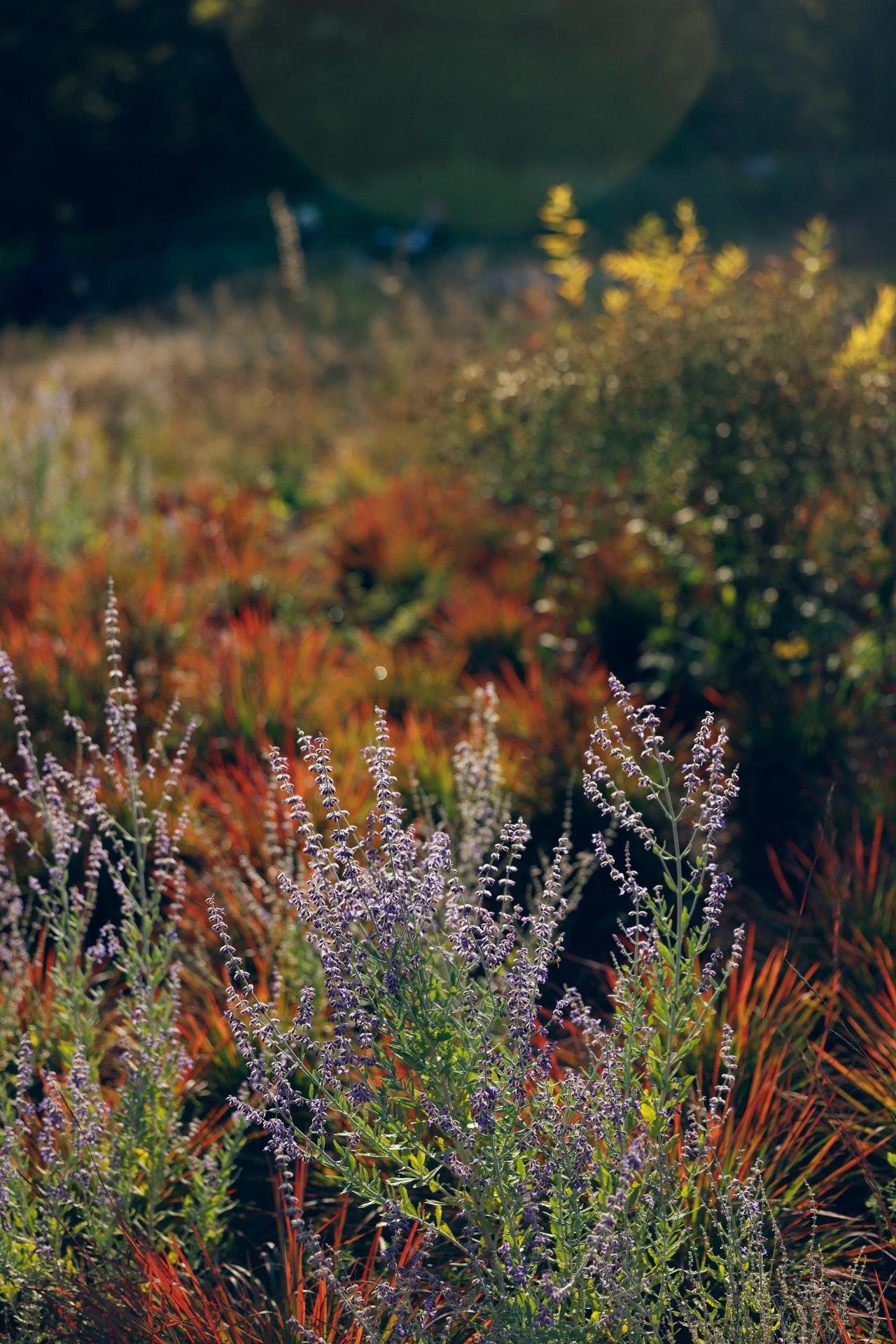
Russian sage (“Little Spire“) surrounded by little bluestem (“Standing Ovation“) at Planting Fields. (Photo: Ogata for The Slowdown)
Aromatic aster (“Raydon's Favorite“) and prairie dropseed at Planting Fields. (Photo: Ogata for The Slowdown)
Calamint at Planting Fields. (Photo: Ogata for The Slowdown)
Azure monkshood (“Arendsii“) surrounded by little bluestem (“Standing Ovation“) at Planting Fields. (Photo: Ogata for The Slowdown)
Hoary mountain mint with dense blazing star (“Alba“) in the foreground at Planting Fields. (Photo: Ogata for The Slowdown)
Russian sage (“Little Spire“) surrounded by little bluestem (“Standing Ovation“) at Planting Fields. (Photo: Ogata for The Slowdown)
“[Architects] have a very clear, clear, clear idea about the world and what they are doing, and they do great jobs. I love architecture, but working together is not always easy.”
PO: Yeah. You can imagine that or not. You know architects, of course; you’ve interviewed them. They have a very clear, clear, clear idea about the world and what they are doing, and they do great jobs. I love architecture, but working together is not always easy. Easier now than in the last ten years, maybe.
SB: [Laughs] I wanted to ask about a few of your key projects. In the mid 1990s, you had the commission from the Swedish town of Enköping?
PO: Enköping, yeah.
SB: Drömparken or Dream Park.
PO: Yeah. Dream Park.
SB: This was your first public garden, I think?
PO: Yeah, it was my first public garden. That brings me back to this conference that we had all over Europe, you know, Kew. I met the director of the city gardens, and we were in the bus and he loved my plants, of course. He ordered sometimes some plants from Holland to use in his park. It was really a little town where planting was his thing, so beautiful trees, selections, and also plantings. But we were on the bus and he showed me a place near a library, a small place. He said, “Piet, what plants do you think we could use there?”
I said, “No, I think most of the plants we do.” I don’t think that he asked me to do the garden, but I think I thought he asked me to do the garden. So that conversation, at the end, he told me, “Can you do it? Okay, you can do it.” It was very small, maybe ten thousand square feet or so. I think altogether that was my first public garden. But that garden became an example for most Swedish cities for public space with perennials.
SB: Then, a few years later, you were invited to do the Lurie Garden in Chicago.
PO: Yeah. First, The Battery.
SB: The Battery, of course, too, in New York. These both brought about a much larger scale and visibility. What do you remember from that time and those commissions? What were your ambitions for those gardens?
PO: I had no ambition. I had a drive. That’s different. Or not?
SB: It’s definitely different. Yeah.
PO: I had only one drive: working with plants. But I think the Lurie Garden, when I look back, I think how... It was a competition, and I can tell you about what it was. I was called by someone from Chicago, from [the Park District]. They said, “We have a competition.” He said, “We sent you a fax if you wanted to be part…” How would you say? “You were invited to a competition, and this is about Millennium Park, and we want to create a garden that is about plants, mainly.” I said, “Okay.” It’s not maybe in the following order, but I said, “Send me the information, and I will have a look.” So they sent me this package with people that were invited to do that. And then the next thing was that he asked me, “Do you think you want to do it?” I say, “No, I’m not going to compete with these people because I think there’s a few I can’t win from, so I don’t do that.”
That’s what I said. And then he said, “Why don’t you team up with one of the persons that you can’t win from?” I said, “Oh, that’s a good idea.” So then I called Kathryn Gustafson, and she found it a great idea to work together. That is how I came in this competition, and we won that competition. Then I had to do the job, and I’ve never done a job that big, complicated, but I thought I could do it, and I just did it, but...
SB: But then soon came the High Line.
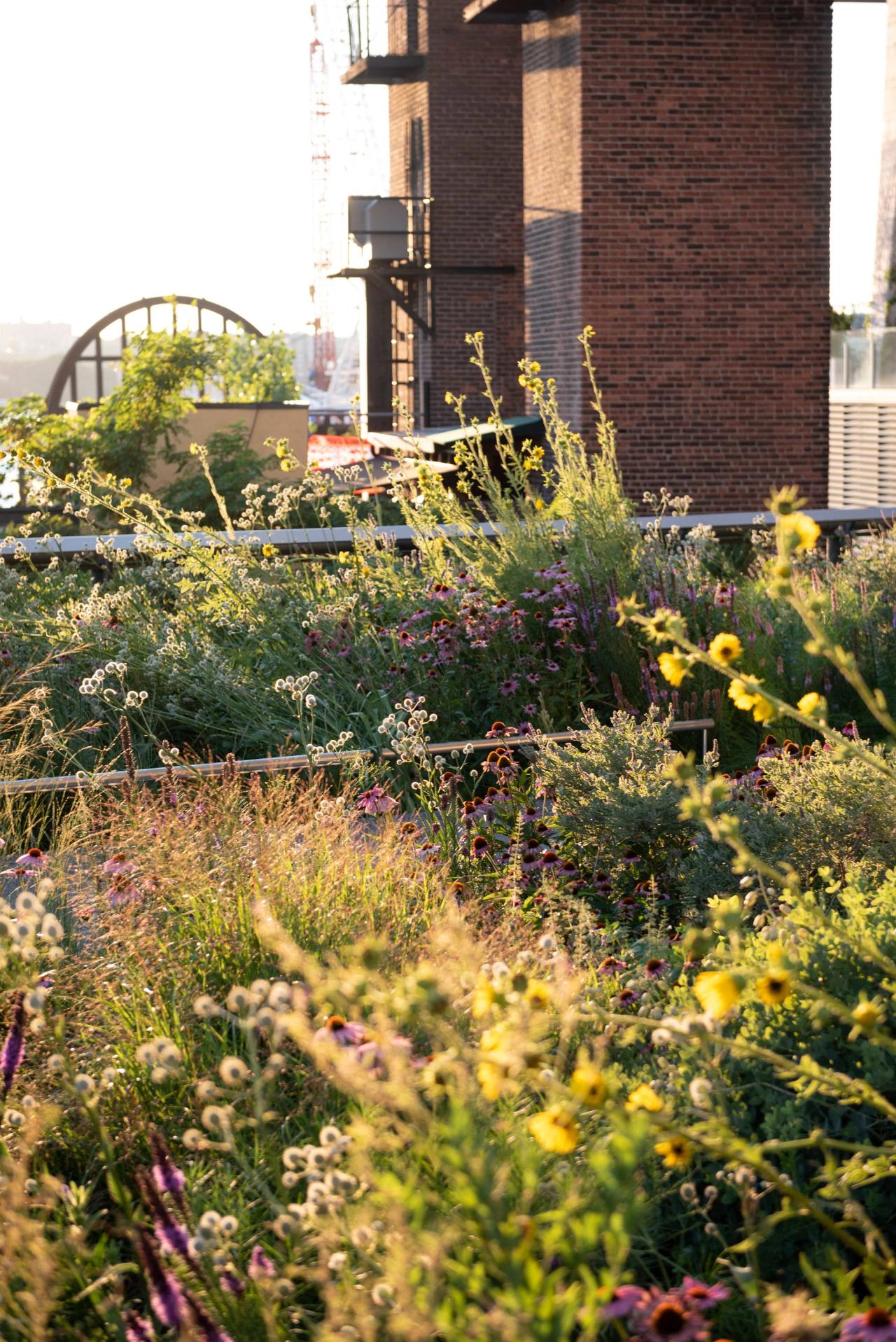
A view of the High Line gardens at sunset. (Photo: Timothy Schenck/Courtesy the High Line)
PO: Yeah, the High Line came. That was also a competition. I was called by [James Corner [Field Operations], they were looking for a horticulturalist. They don’t talk about designers. Every designer in planting is a horticulturalist, has nothing to do with design. But they needed someone... It sounded good, but I think I needed to think about it, because it was one and a half miles long. Then I looked on the internet. There were enough people that were talking about the High Line and it was so unique, and so and so wanted to save it. Then I thought, “Okay, yeah, so sympathetic. Why shouldn’t I say yes?” So, I said yes, and it was one and a half miles long. But the reason that I said yes is because I thought, “If I can do a hundred yards, I can do ten times a hundred yards.” Why not? Because I do it all my life.
SB: Did its success surprise you? I think it surprised everyone, right?
PO: Yeah. It was due to the whole story of the High Line. It’s a narrative. It starts with half-open woodland, meadow, nature preserve. So, ten different stories, divided over the whole length of the High Line. And I can translate a narrative into a planting.
SB: Yeah, it’s a play.
PO: So, it is woodland, half-open woodland, less trees, more plants. Meadow, no, meadow, block planting. So, I could move myself from the beginning till the end, but I was on my own. It was so much work, unbelievable. I was working in black and white. I never used color at that time, so it was even more complicated too.
SB: It was like your Wizard of Oz moment, right?
PO: [Laughter] Yeah. It was complicated. You can imagine when I think about it, looking back, saying yes to all these moments that you had to say yes to be what you are now, that is, I think, crucial.
SB: Saying yes, but knowing when to say yes.
PO: Yeah. Saying yes at the moment that... You don’t think about it, you just say yes. When they asked me to come to Sweden for the first lecture, I said, “My English is not so good.” So, they said, “We don’t mind. We like the Dutch accent.” Then I said, “I have to think about it.” So I thought, “I’ve never done a lecture,” at that moment, having a nursery. I was a bit shy, I think, “Yeah, how do you do that for a public…?” Then I was inside and it got stuck in my head. I think, “If I don’t do it now, I will never do it.” So, I said, “Yes, I’m going to do it.” I forced myself, and I’ve had that several times in my life. I’ve forced myself to do things, otherwise I knew, like going to America for a garden. I thought if I don’t do it, I will never go outside of the Netherlands.
SB: Right. And now you’ve completed the 63 Oudolf Garden in Seoul.
PO: Yeah.
SB: You’ve done work in Korea, much of it or all of it with the landscape architect Bart Hoes.
PO: Bart Hoes, yeah. I know how to work there, but it’s complicated. Gardens are not so the thing they [in Korea] know about. But there’s a lot of people that love gardens, and I think the way we garden is taken over by students in Japan and in Korea. Most of the books—and this book is translated into Korean.
SB: Planting the Natural Garden?
PO: I think most books in Japan, as well. It’s not a secret, but I’ve never written one word.
SB: Of your books?
PO: No.
SB: Yeah. Noel [Kingsbury], right?
PO: Noel writes, and I have the ideas, sometimes a mutual idea, but I think that’s the only way that I could express myself, not to pretend that you can write, just say you can’t write and then it will happen.
SB: [Laughs] You can write with plants.
“I write with plants. That’s my signature.”
PO: Yeah, I write with plants. That’s my signature.
SB: Your name’s become kind of its own identity, I would say, to the gardens themselves. I mean, we’re sitting in a garden named after you. There’s Oudolf Field at Hauser & Wirth Somerset. There’s Oudolf Garden Detroit.
PO: Wisley. It’s Oudolf Garden at Wisley, the RHS in England.
SB: I mean, in a sense, your name has this imprimatur. It’s almost like a promise of a particular kind of experience.
PO: Yeah, but also a sort of quality of what, let’s say, a draw to get people to the place.
SB: Is it strange to you to have your name attached, or is it a point of pride almost that your name is synonymous with these kinds of—
PO: It’s very double. One way, you don’t want to be recognized or whatever, and the other way, I want to be recognized. So, it’s a double thinking. Let’s say, calling it “Oudolf Field” or “Oudolf Garden,” yeah, it becomes normal, as well. Like a name of a band, The Beatles or The Rolling Stones. They don’t call it Four Musicians, huh? [Laughter] You need to know where you go to.
SB: Exactly.
PO: Let’s say it’s like a concert you go to. You know who’s playing.
SB: Actually, when I was at the Chillida Leku, they had a whole concert venue set up right next to your garden.
PO: Yeah.
SB: They seem in harmony, music and plants.
PO: I think so, yeah.
SB: One of the radical aspects of your work that you touched on talking about the fall/winter aspect is that there is this beauty in decay. Your gardens look great in the middle of winter.
PO: Yeah.
SB: There’s the seed heads, the dried stems, the skeletal structures. What has that time of year taught you about plants?
PO: Now, as I said, looking at plants, what they do in the winter, that’s how you used to mean you design already. So, when I start designing, I know that plant becomes black in the winter and has the brown, or I know exactly what color it has in the winter. That’s why you also in the winter have this sort of nice balance in textures, in color. I know amsonia will be yellow. A veronicastrum becomes black, a yarrow becomes dark brown, and then the seed head. So, that’s how I compose, without thinking, when I compose.
SB: Are there things about plants that still elude you? Are there things you feel you still need to learn about plants at this age?
PO: Yeah, of course. They don’t do what I want them to do sometimes, and I can’t teach them. So that is the point. [Laughter] You learn every day. Every place, gardens are made by man. Most problems we have with gardens are just with drainage or with over-watering. So, the problems come after we leave, if things are done not well. We’ve seen that at Calder, lots of compaction, had to do real sections to replant themselves. That is what I think, there’s a lack of good preparation of gardens before you start planting.
SB: When you look back at your younger self, this sort of young man who discovered that planting was what you wanted to do, do you feel like you’ve become the person you imagined you might be? Or have plants taken you somewhere totally unexpected, somewhere far beyond…?
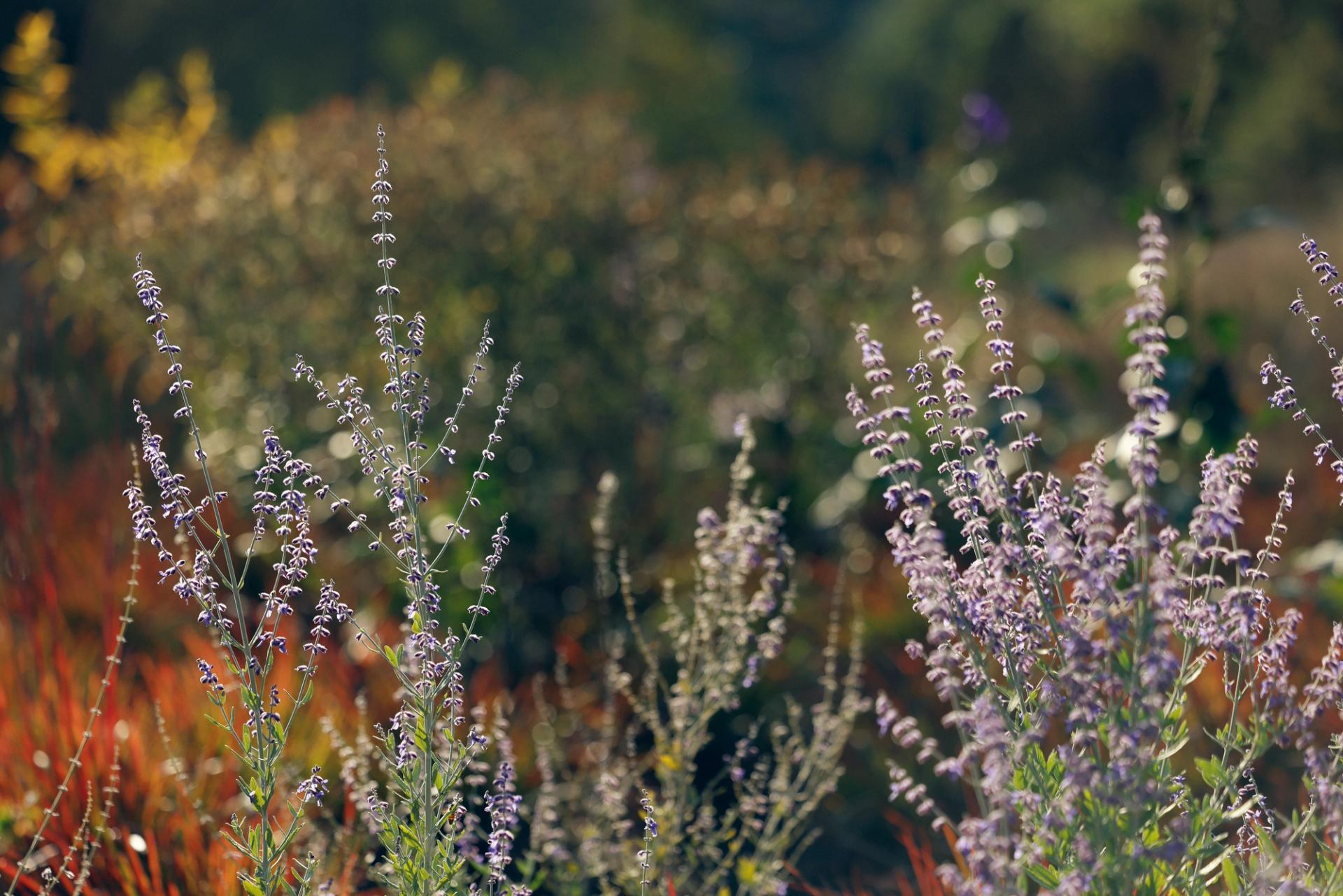
A view of Perovskia atriplicifolia (“Little Spire”) in the Oudolf Garden at Planting Fields. (Photo: Ogata for The Slowdown)
“My passion brought me to places that I would never have thought about, like being here now in this beautiful afternoon.”
PO: Yeah. They’ve taken me, from my passion into... My passion brought me to places that I would never have thought about, like being here now in this beautiful afternoon—or the High Line. When you walk there, you think, “Okay, I was the person that did the planting.” I always say, “What do people see? Do they see the architecture? Or do they see where they walk and where they walk through in the planting?” So, I know that architects, of course, are very important for cities, and so good architecture, I couldn’t do without. But planting has another meaning to people. It more goes into your heart.
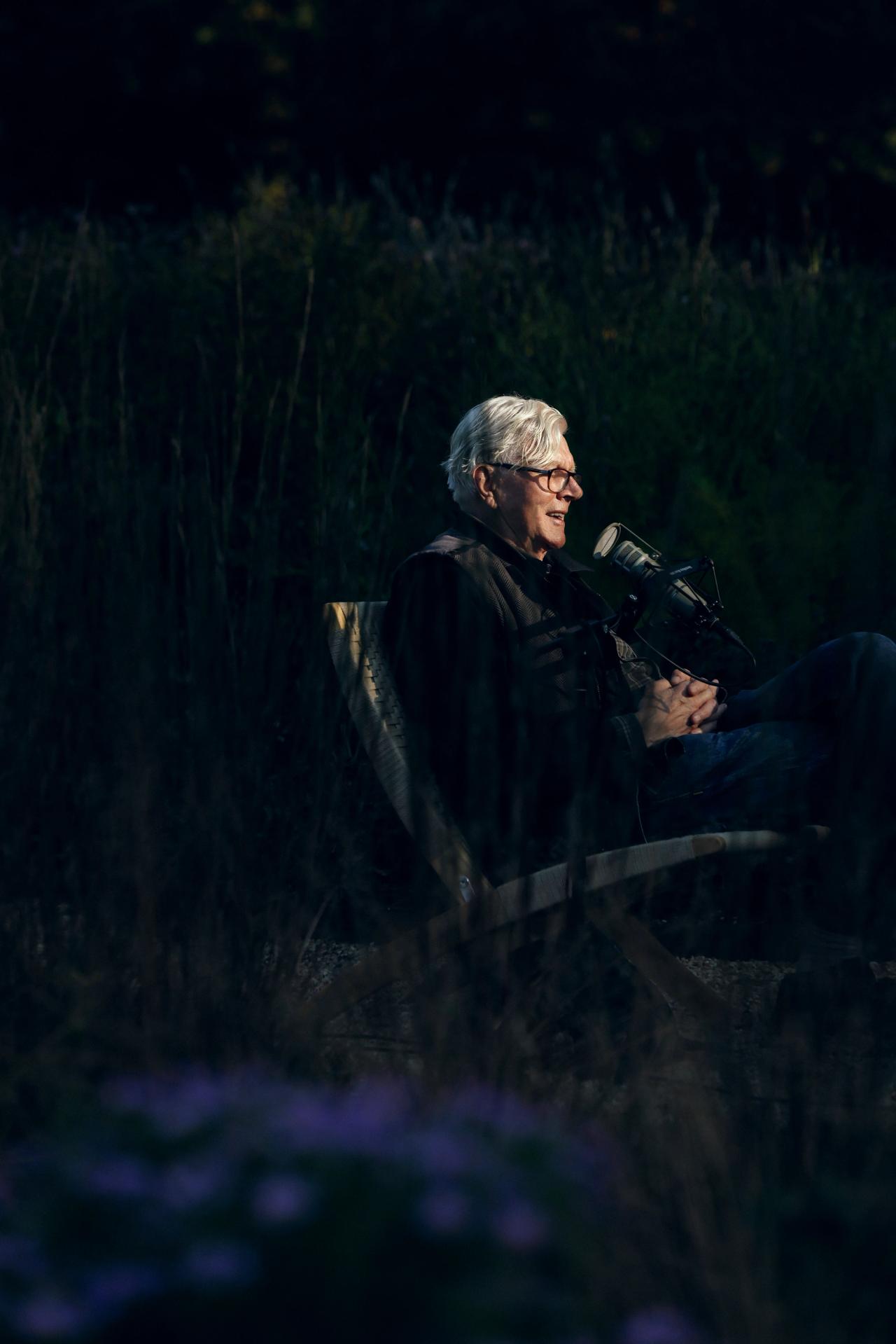
Oudolf sitting in his Planting Fields Foundation garden in Oyster Bay, New York, during the recording of Ep. 162 of Time Sensitive. (Photo: Ogata for The Slowdown)
SB: I wanted to ask, actually, as a closing question: You’ve spent more than fifty years doing this now and you’re still taking on new projects, discovering new landscapes like the one we’re sitting in, imagining places… that really won’t— Maybe it’ll be realized in a year or two, but they’ll still be alive twenty, thirty, forty years from now. What keeps you excited about this work? Are there certain ideas right now that get you out of bed in the morning?
PO: No, I think I love my work. I start working, even if I don’t have the commission, I’m always busy with gardens and designing, planting. So, I sometimes start already before the client has said yes to me. I want to start. I think that keeps me fit and alive in my mind. It’s very complex, thinking about planting and putting it together in time. It needs a lot of concentration, and I need that. Otherwise, I got a person that sits in a chair and does nothing. It’s the only thing I can. Like you, if you’re a good journalist, the only thing you can do well is what you do, because you learn from yourself, you learn over the years to do it better and you ask the right questions and you know what... I think that is what we all try to find, the real soul of life, and that’s probably sometimes your passion. Can you say that?
SB: Yeah, and finding the right—
PO: You find it in your passion.
SB: And structure.
PO: The meaning of life, that is what you do.
SB: Yeah, I would say there’s few jobs better for finding deep soul and meaning than probably being a garden designer.
PO: Yeah. I think that I’m happy with what I do. I couldn’t do without... I think I would disappear, if I don’t do this work, disappear, for myself, I would get somewhere. Can you imagine that or not, really? That if you don’t do the work you love for so many years and you’re sort of handicapped, or you think you can stop now because you’re 82, almost, then you think, “Okay, I have to stop. Why... People, look at me. Why am I still working?” That doesn’t work. But there are many more people, let’s say an artist, a painter, he keeps on painting. That is what it is. That’s what I try to do. If you stop, you’re dead.
“People, look at me. Why am I still working?” That doesn’t work. But there are many more people, let’s say an artist, a painter, he keeps on painting. That is what it is. That’s what I try to do. If you stop, you’re dead.”
But there are many more people, let’s say an artist, a painter, he keeps on painting. That is what it is. That’s what I try to do. If you stop, you’re dead.
SB: Orwell was writing till the end of his life—planting roses too, actually.
PO: Yeah, but that’s what it is. If you stop, that’s the end of the world, your world or my own world.
SB: Piet, thank you for sitting down with me and your beautiful garden next to a J.F.K. flight path. [Laughs]
PO: Thank you for the interview. I think it was very... well done.
SB: Meditative, hopefully. A little bit.
PO: Oh, yeah. Good questions. I think that’s important. I think trying to get things out of me that I haven’t thought before.
SB: That’s the aim.
PO: That’s the aim.
SB: Thanks, Piet.
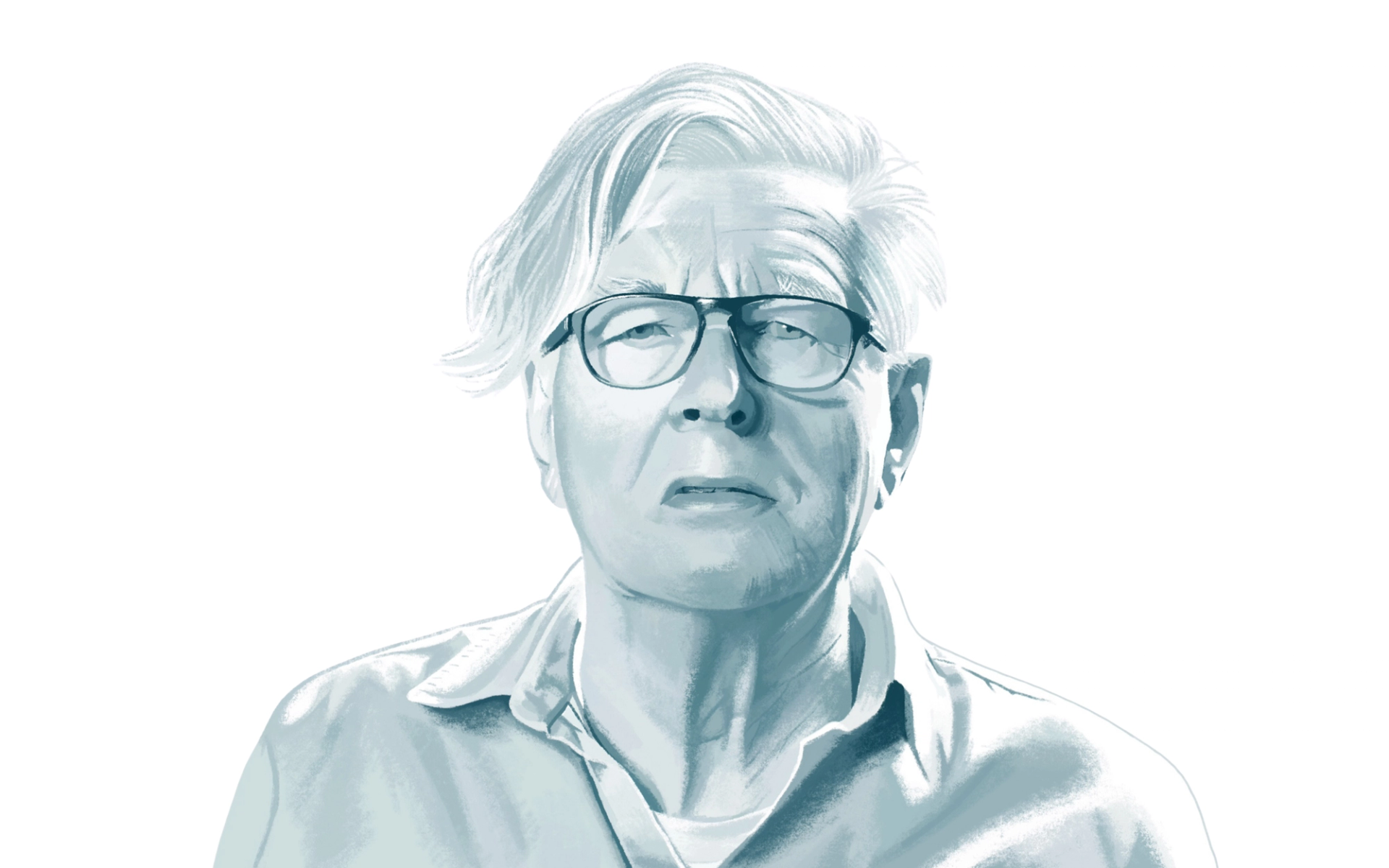
This interview was recorded in Piet Oudolf’s garden at Planting Fields, in Oyster Bay, New York, on Long Island, on October 16, 2026. The transcript has been slightly condensed and edited for clarity. The episode was produced by Ramon Broza, Olivia Aylmer, Mimi Hannon, Chelsea Debrot, Drew Arndt, and Johnny Simon. Illustration by Paola Wiciak based on a photograph by David Almeida.