Follow us on Instagram (@slowdown.media) and subscribe to our weekly newsletter to receive behind-the-scenes updates and carefully curated musings.
TRANSCRIPT
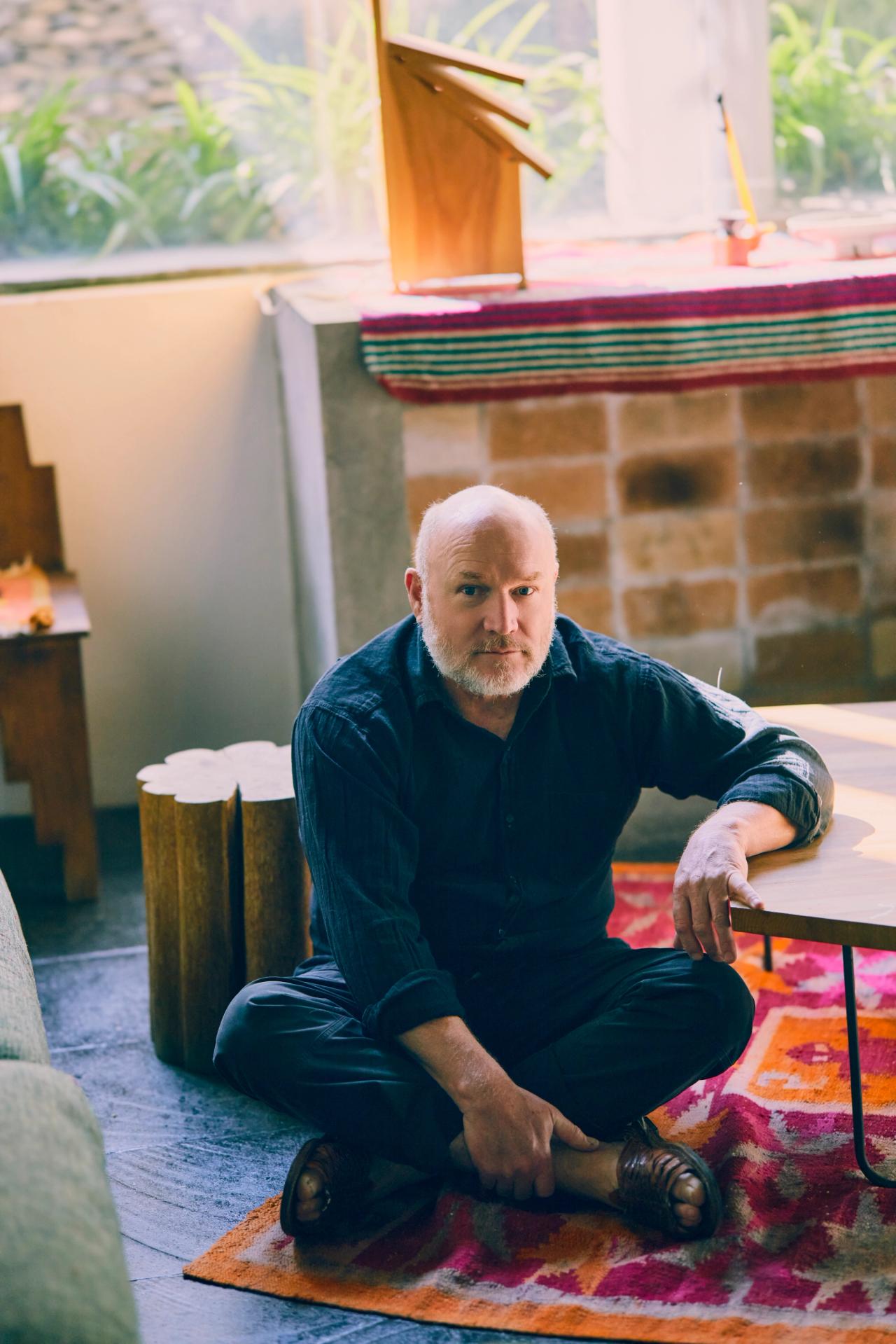
Alma Allen at his family’s home in Mexico City. (Photo: Pepe Molina for The Slowdown)
SPENCER BAILEY: Hi, Alma. Welcome to Time Sensitive.
ALMA ALLEN: Hello.
SB: Thank you for inviting me into this home and having the conversation here.
I want to start by getting your big picture view on time. You’ve previously said, “I have no idea what time is.” [Laughs] But time is central to your work and in multiple ways, right up there with materiality and atmosphere. Tell me a bit about how you think about time both literally and philosophically in your work, in your day-to-day life—and, I guess, even more broadly.
AA: I’ve never really been sure of... I grew up Mormon, and there’s a veil to reality, which I felt like they always taught me as a kid—it’s the only thing I kept from the religion, is that this isn’t their true reality. They believe this is some sort of test before your true real life. I’ve had moments when I felt like I’ve been able to see around the corners of that reality into another, which is why I started to make artwork. I love that meditative state where time would go away. We’d just work and work and be in this flow state, and then I’d find myself talking to someone who wasn’t there and walking down in a forest or doing something out of my body without being… I found that I could do that when I was making art when I was young. Or doing things like running jackhammers, doing repetitive, difficult labor, helped my mind sometimes go off. It was fascinating to me. I still look for it and try to do it. It’s harder.
I think that’s my feeling of time. I’m not convinced this is real life, either—whatever that is. Maybe we’re all just parts of a single consciousness experiencing, on vacation, in our little flesh suits or something. I don’t know. I’m not sure. If I was a physicist, I would be using the science of being a physicist to try to understand the nature of what reality is. But I’m an artist, so I use myself and my art to try to do the same thing, to try to intuit as much as— I don’t think you could know, because, of course, it’s beyond me knowing the true nature of reality. But intuiting it, maybe I could guess.
SB: You mentioned that you grew up in a Mormon family. You were in Utah, one of eleven kids. I know in your teens you’d go fishing at these nearby lakes and also go kind of searching in the red-rock hills nearby for these petroglyphs. Is that where art started for you, with those petroglyphs?
AA: The people that I knew as a child who made art were Native American people that lived near me. My family didn’t. Also the petroglyphs and the ancient culture, which is all over Utah and where I lived, was amazing to me. My parents didn’t really have much care for what I did. So I spent a lot of time in… My parents wouldn’t let us have television or nonreligious books, so hiking or going out in the woods and doing... Everywhere I’ve lived, you can find records of past peoples, even here, especially here in Mexico, but in all kinds of places, there’s always a trace. I loved that.
SB: To me, it’s profound that art wasn’t something in the home. It was something you discovered literally in the wild. There’s something so profound or even primordial about that experience of literally seeing cave paintings.
“Even before I started to carve things or make objects, I would just put stones in a row or make little stacks of wood.”
AA: I remember I would collect objects and arrange them. There was a natural instinct to find pleasure in arranging. Even before I started to carve things or make objects, I would just put stones in a row or make little stacks of wood. I used to make drawings in the dirt and little stacks of things that I would imagine that people would come across. I didn’t know anything about land art or anything about making art in general or contemporary art at all. I liked the idea of leaving something behind, like the petroglyphs were left behind. I would make little stacks of piles of sticks and arrangements of shotgun shells and little scenes.
SB: Were you in a way, looking at these markings—these ancient Indigenous artworks—were you in conversation with them in a way? Was that you trying to talk across time?
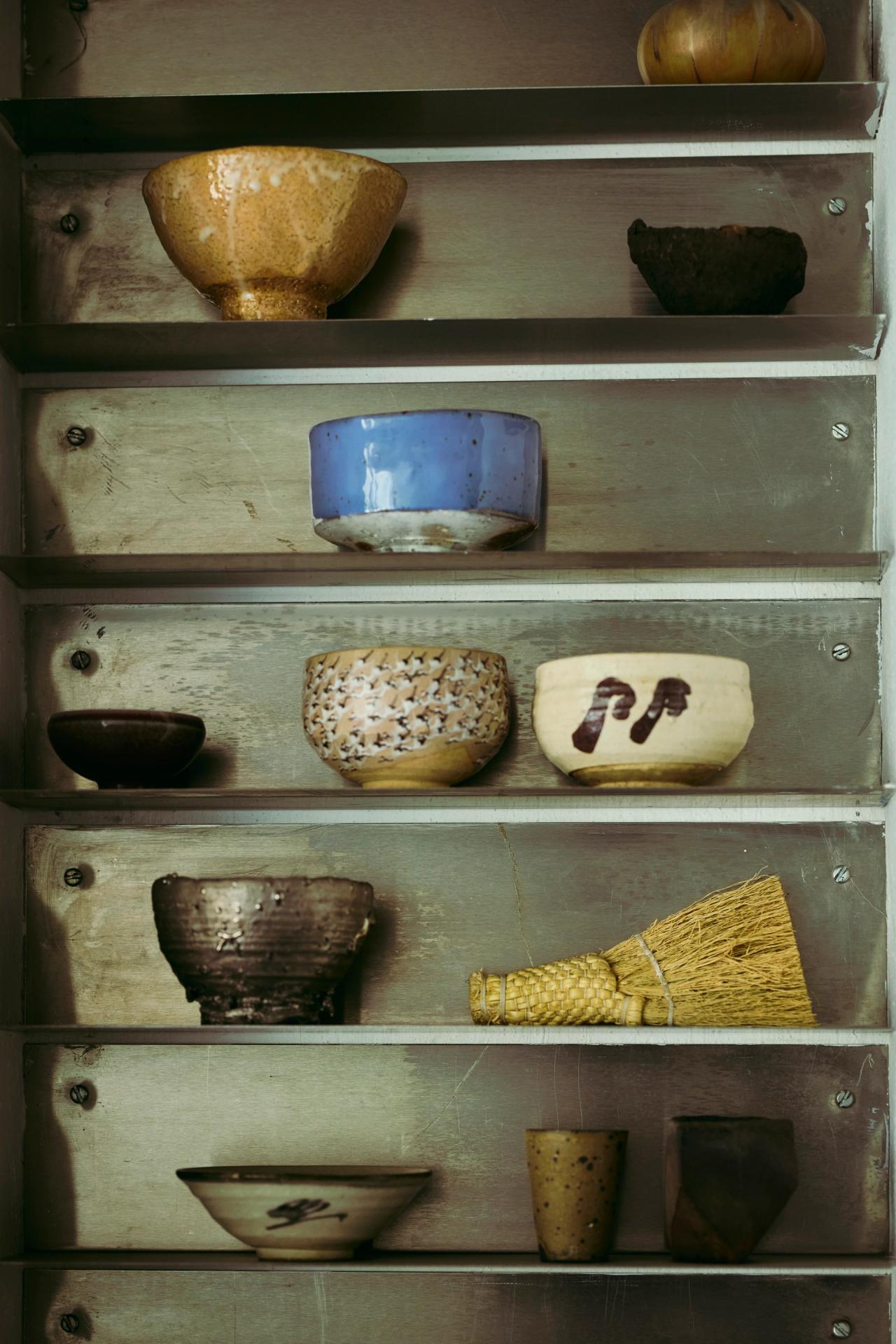
A shelf of bowls and molds inside Allen’s family home in Mexico City. (Photo: Pepe Molina for The Slowdown)
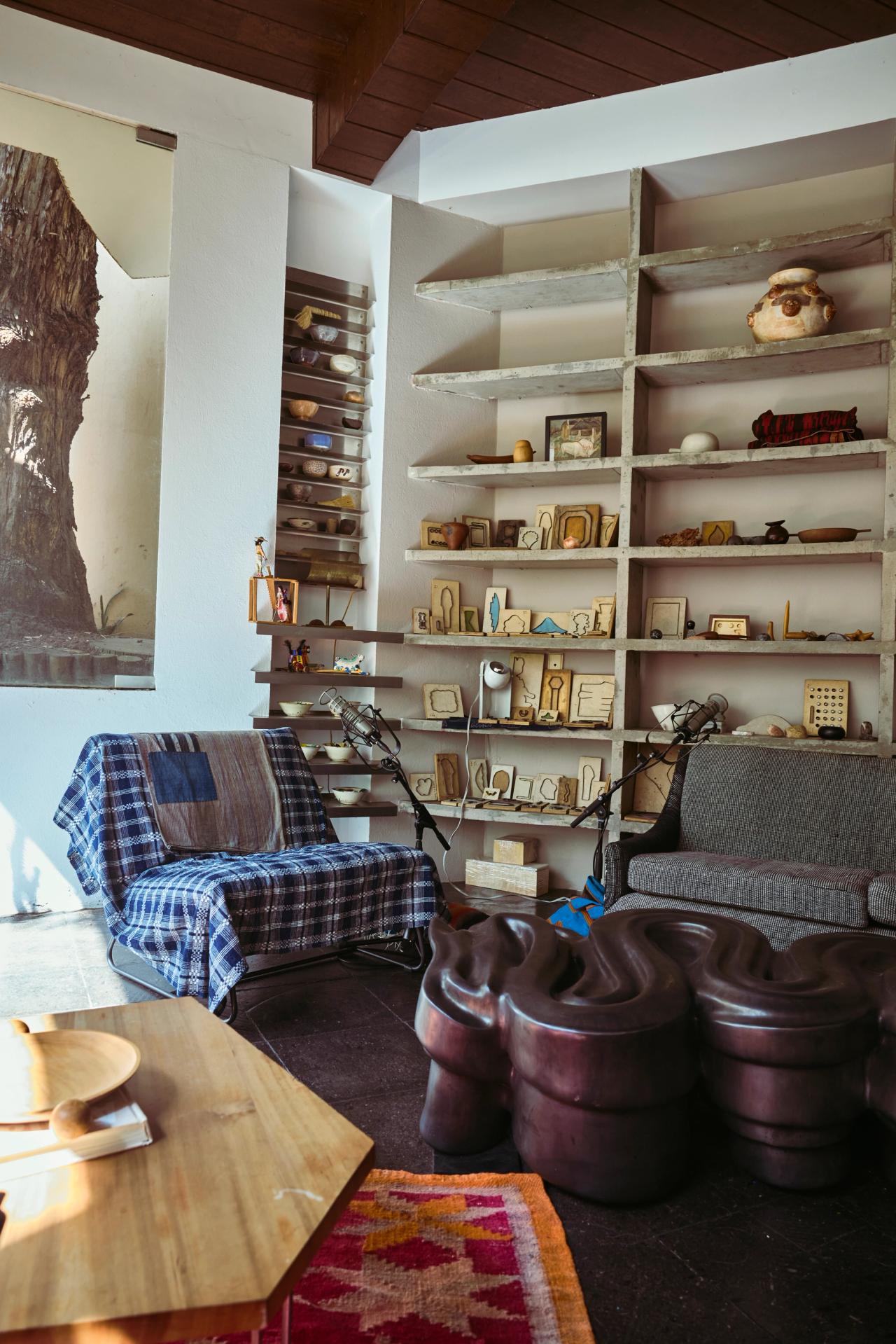
A view inside Allen’s family home in Mexico City, during his interview for the 150th episode of Time Sensitive. (Photo: Pepe Molina for The Slowdown)
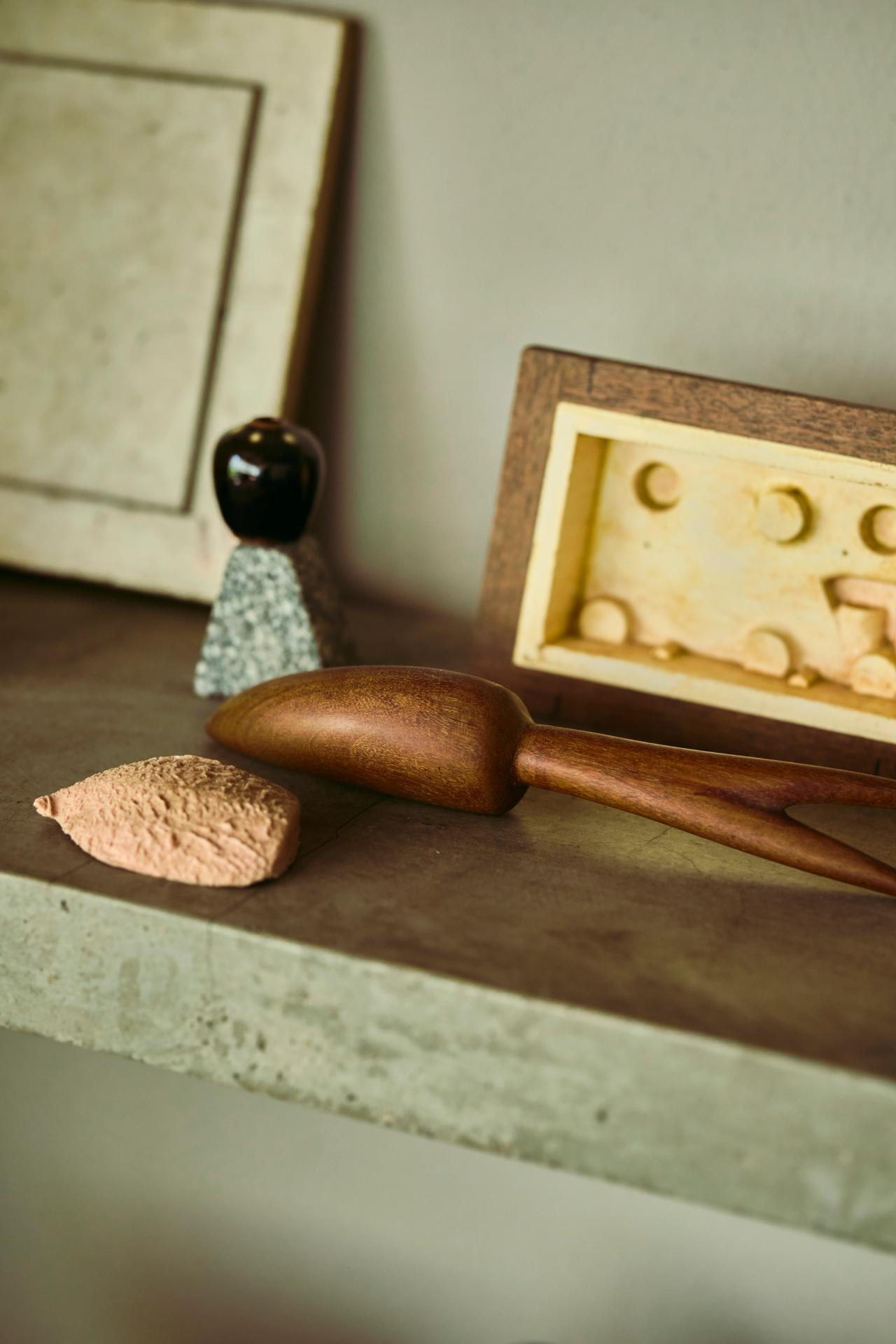
A shelf of small objects inside Allen’s family home in Mexico City. (Photo: Pepe Molina for The Slowdown)
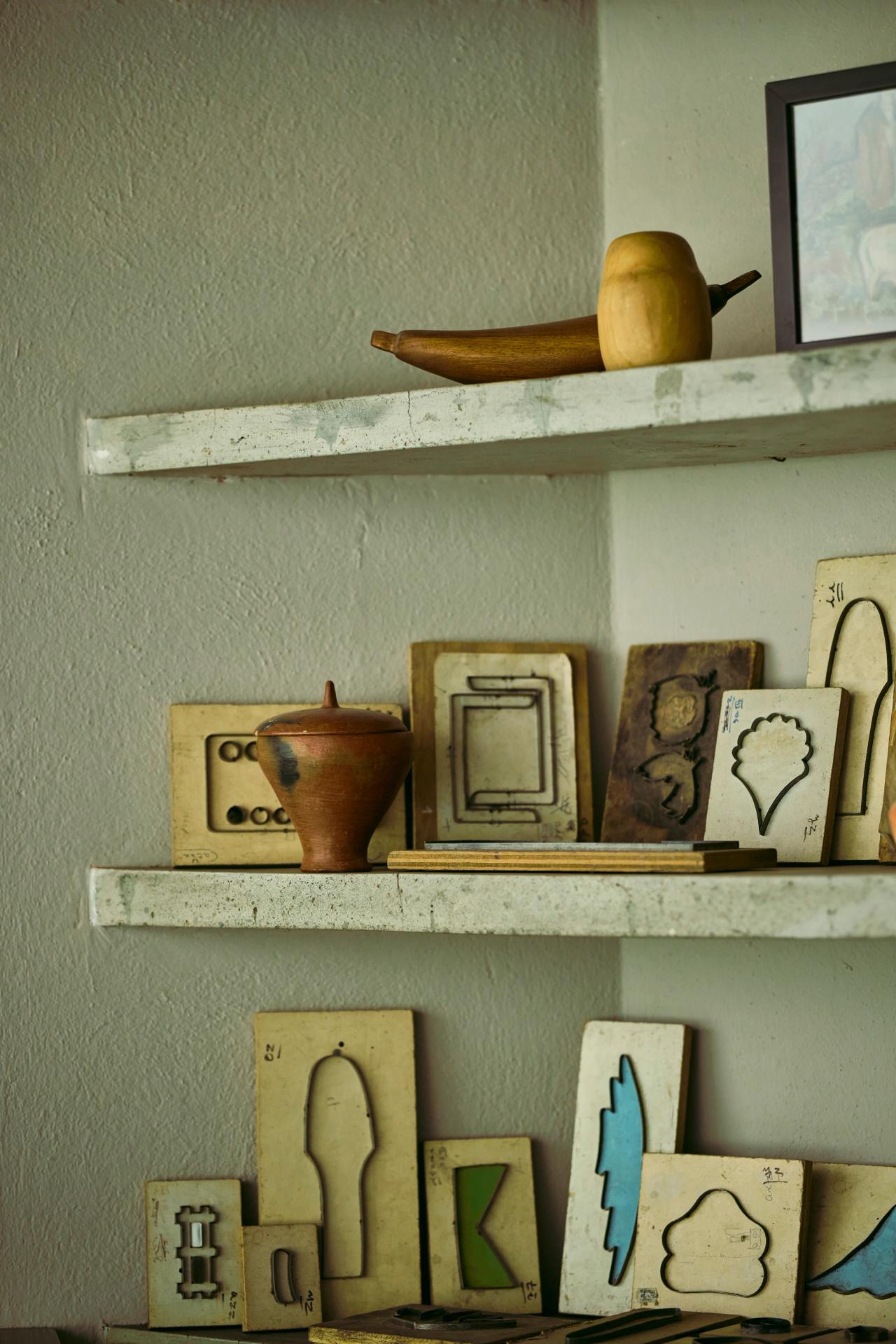
A shelf inside Allen’s family home in Mexico City. (Photo: Pepe Molina for The Slowdown)
A shelf of bowls and molds inside Allen’s family home in Mexico City. (Photo: Pepe Molina for The Slowdown)
A view inside Allen’s family home in Mexico City, during his interview for the 150th episode of Time Sensitive. (Photo: Pepe Molina for The Slowdown)
A shelf of small objects inside Allen’s family home in Mexico City. (Photo: Pepe Molina for The Slowdown)
A shelf inside Allen’s family home in Mexico City. (Photo: Pepe Molina for The Slowdown)
A shelf of bowls and molds inside Allen’s family home in Mexico City. (Photo: Pepe Molina for The Slowdown)
A view inside Allen’s family home in Mexico City, during his interview for the 150th episode of Time Sensitive. (Photo: Pepe Molina for The Slowdown)
A shelf of small objects inside Allen’s family home in Mexico City. (Photo: Pepe Molina for The Slowdown)
A shelf inside Allen’s family home in Mexico City. (Photo: Pepe Molina for The Slowdown)
AA: Yeah. I was convinced the people that made them were still there, but they were hidden and they wouldn’t come out, because they knew how much trouble everybody else was. The veil of reality, I’ve never been totally sure. I still have experiences sometimes where I’m not really sure.
SB: Mexico City’s a place of beautiful chaos, too. There’s so many realities at once when you walk out the door here.
AA: Yeah.I was recently in Peru and I was walking on a trail, and then I was in an old bus in the sunshine and I came back into... I couldn’t find my way back. I kept being like, “No, I’m walking on a trail with my children.” I kept flashing into this, “No, I’m on a bus, riding down this dusty road.” It was confusing because we were walking in the shade, but when I was on the bus, it was sunny, so it was very confusing. [Laughter] Sometimes when I’m in a meditative and calm state, I feel like there’s— I don’t know what it is; maybe we all have a shared memory that’s in the ether of the universe and sometimes your brain catches someone else’s memories. It’s like, “Oh, that was someone else’s experience that I’m having and accidentally, my brain is tuned in.” It’s loose and easy and it’s got the wrong signal.
SB: It’s a channeling. [Laughter]
AA: But anyways, that’s...
SB: We’re talking on March 20 and this episode will come out in late April. You’re about to present, I would say, your most highly visible exhibition yet, at the U.S. Pavilion at the Venice Biennale, which opens in early May. How are you thinking about this particular moment in time that we’re in right now?
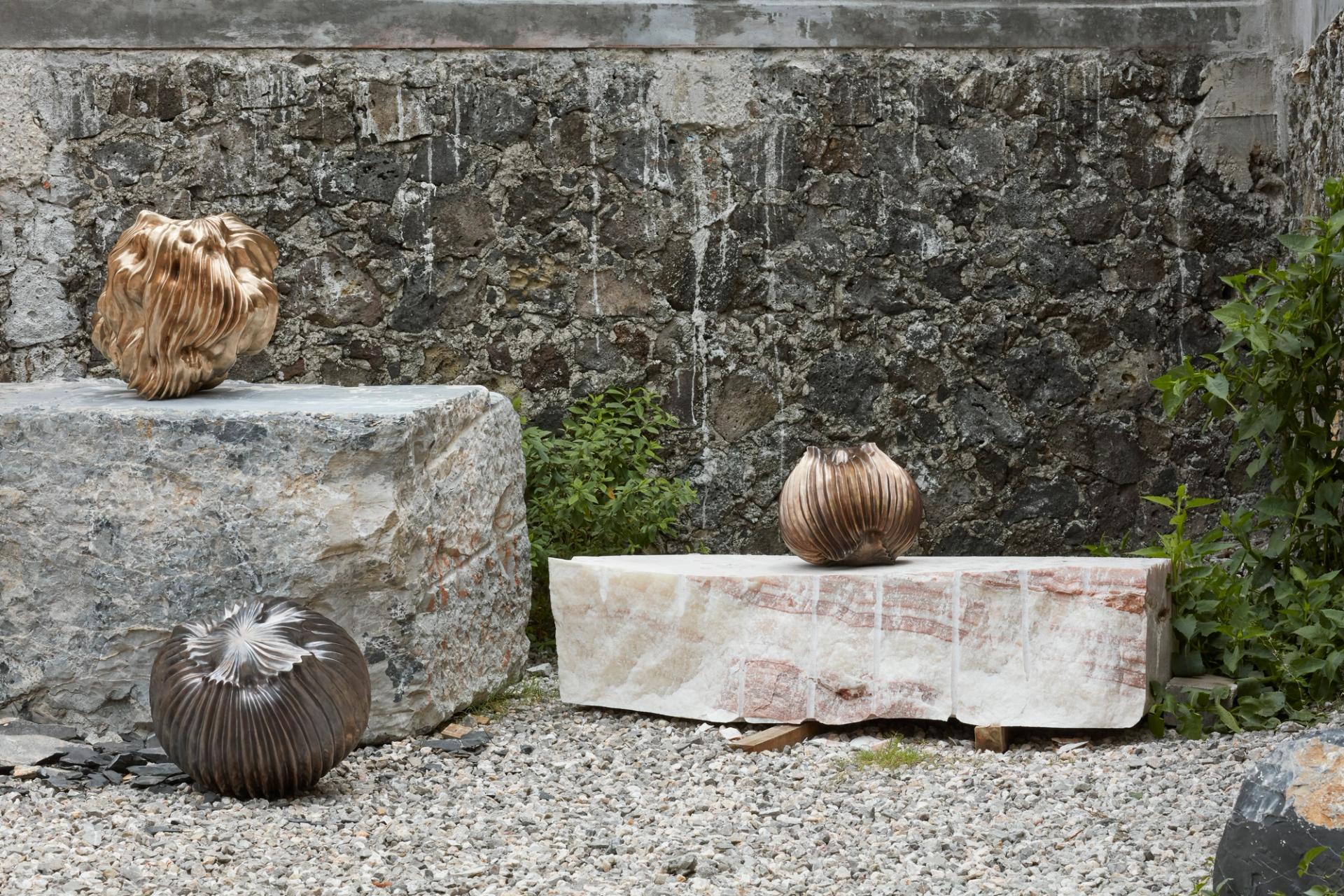
A selection of sculptures in Alma's studio in Mexico City’s Tepoztlán neighborhood. (Copyright: Alma Allen/Photo: Leslie Williamson)
“I show work because I want to communicate, and the possibility of having so much communication is fascinating to me as an artist.”
AA: The moment of my making the work of the Pavilion? I’m excited. I show work because I want to communicate, and the possibility of having so much communication is fascinating to me as an artist. I see communication as one individual at a time, engaging with your work, and their first moment of creation that I feel like is a combination that happens every time some new person sees it, where there’s a decision of what it is for themselves. That’s fascinating to have that. I wouldn’t not do it, because it’s interesting.
SB: Just to get this part out of the way—and I’m sure many listeners want to know—how are you dealing with all the noise around the U.S. Pavilion this year?
AA: Sometimes it’s hard. I don’t know. It’s a little bit confusing because the art world is so positive, usually. I don’t understand it. I couldn’t say why, necessarily. It’s been a little stressful, but it’s okay. It’s interesting, so it’s worth doing.
SB: It should be said here that you also appreciate friction. [Laughter] A recent New York Times article, which I think actually—and I just want to point this out—I feel like it unfairly and inaccurately refers to you as a “relatively unknown artist.” For someone who has shown in the Whitney Biennial and had museum and gallery shows, I don’t think that’s accurate. Anyway, in that piece, you said, “I love the difficult context. Honestly, it makes the work more interesting. If I could choose, I would always find a bit of a fraught situation to do work in.”
AA: I think so, for sure. I’ve enjoyed, outside of gallery contexts, making work—because I have meaning for the work, for sure. It’s fascinating having a complicated situation, a little pressure on people. On the viewer, too, not just on me to make the work, but also that moment of creation that I feel happens between the viewer and your work, hopefully, if it’s successful. This is an interesting situation, for sure. I can’t re-create it, though. Maybe I could. I didn’t purposefully do it. I didn’t seek out trying to have a conflicting ... Even though some of the work is about conflict. It’s just natural. It’s hard to avoid it.
SB: Is there anything you want to say about the selection process?
AA: I don’t know completely what it was about. I was asked to do it, and that was a great pleasure. That’s all. [Laughs] Of course, it’s interesting, so I’m not going to turn down something that’s so interesting.
SB: There’s a piece that the art magazine Apollo published earlier this year titled “In Defense of the Art of Alma Allen,” which I enjoyed. But I found the headline a little funny. I’m like, “Why do you need to defend the work of Alma Allen?” This is by the writer, curator, and critic Jonathan Griffin. In it, he writes about his deep appreciation and affection for your work, or as he describes it, your “heart-skippingly weird objects.”
AA: I appreciate it. I kind of feel like always in the art world—because I’m self-taught, and I’ve had to approach it in a way that a person approaches something when the gates are not open for them—you have to kind of flow with it, go around the river. You have to be in the wind. You have to make life happen naturally and what happens to you, you have to see it and move forward when it’s the right time. I didn’t go to college, so I don’t have any of that as the very basic thing. I don’t usually have that much institutional support. I’ve had curators who are supportive, which I really appreciate, but in general, I’m not supported by institutions. But that’s a lot of artists. I think most working artists have not been supported by institutions.
Maybe there’s a little bitterness because I’ve found a way through the door without being invited. But it’s okay. I’m there anyways. [Laughter] So are so many other artists that have not necessarily been invited in. They’re all... People do it for a lot of reasons. I think most people who are artists do it because they like making art. There’s something about the process of working on and making art that’s interesting.
SB: Yeah. Also in that piece, Jonathan quotes from ArtNews, which had kind of argued that your work “has nothing to say about the state of our country at the moment.” His reply was, “But why should it? It’s a grossly simplistic assumption that art is obliged to do any such thing.”
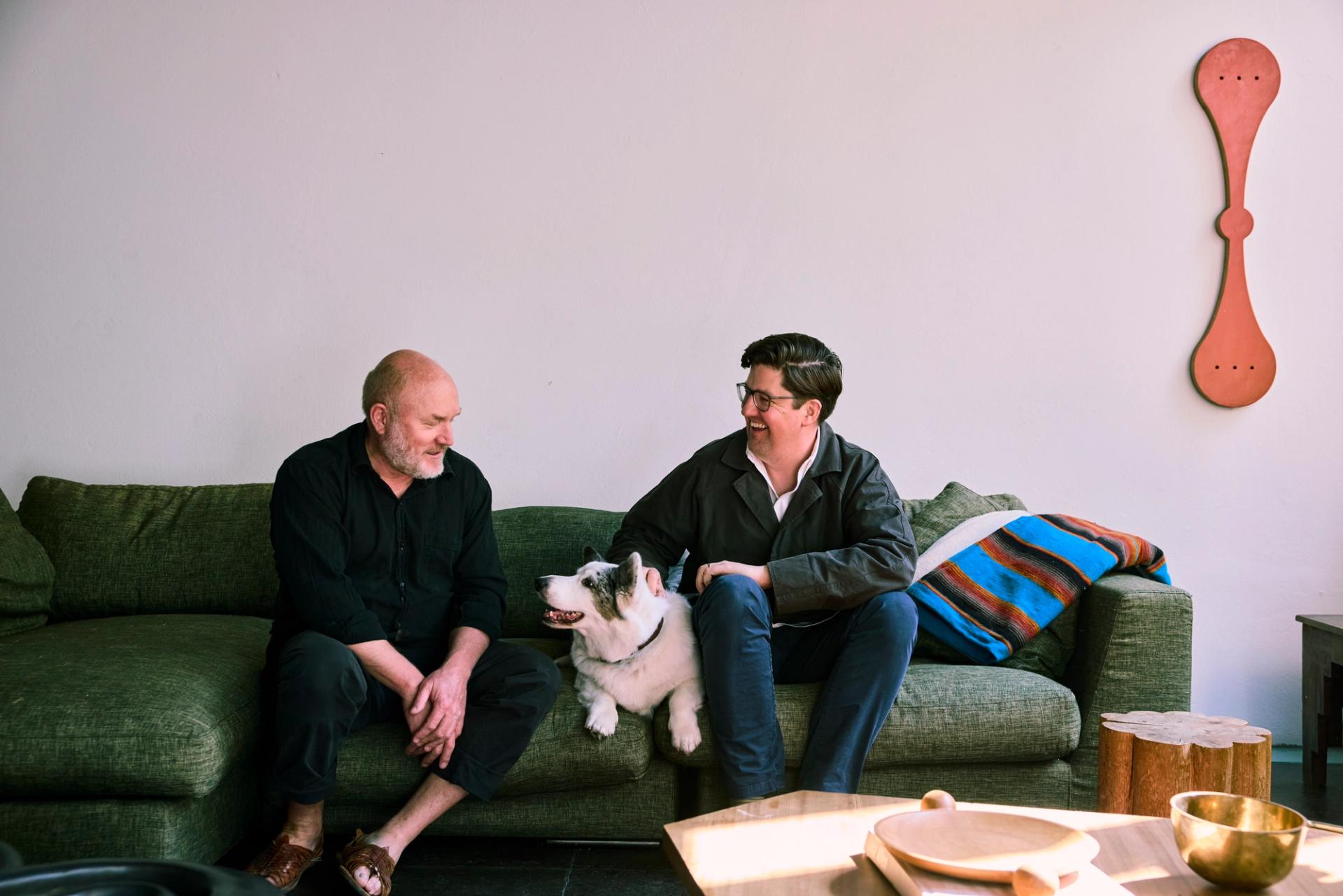
Allen, his dog, and Spencer Bailey inside Allen’s home in Mexico City during the recording of the 150th episode of Time Sensitive. (Photo: Pepe Molina for The Slowdown)
“I feel like if I tell everyone—like a propagandist—what to think, that’s boring. It’s not what I’ve ever done with my work. So it would be strange for me to start now.”
AA: Maybe it does. I think it does a little bit, but I don’t usually… I like that moment of creation between when a person comes to an untitled piece and titles it for themselves. I feel like if I tell everyone—like a propagandist—what to think, that’s boring. It’s not what I’ve ever done with my work. So it would be strange for me to start now. [Laughter]
But I think that there’s a lot that they can see as— there are pieces about conflict in the show. That’s a hint to some of it. Maybe all kinds of conflict. There’s a piece about surveillance that’s fairly obvious. They’ll understand. It won’t be that hidden. I’ve always made my pieces about…. I’m not a formalist in terms of… My way of making art—maybe foolishly—is I don’t title them, because I feel like titles distract a little bit.
SB: They’re all called, “Not Yet Titled.”
AA: Yeah… I could go through an example I’ve used—I’ve been talking about it—I made a sculpture. When I first moved to New York, I was there for a couple of months. I was working as a stonemason’s apprentice. I was run over by a truck, badly injured. I was in the hospital for a month. When I got out of the hospital, I ran out of money; I was going to become homeless. I had been homeless before—I ran away from home when I was young. I took sculptures that I’d been making that I’d never shown to anyone. I’d been making them on my part-time [schedule] from when I was a stonemason’s apprentice. I would run the saw, so I’d have tools to carve with. I was learning to carve stone as an apprentice, and I would make sculpture, and I’d make them on my weekends and on my free time. I took them to SoHo and I sold them in front of a post office because I was desperate.
SB: On your ironing board.
AA: On an ironing board, desperate for money. I did it for about two weeks when I was 22 or 23 years old, and I was totally desperate for money. It wasn’t like I was trying to get famous. I literally had nothing to eat. I was kind of humiliated by the whole idea of doing this. But in those two weeks, it was the first time I felt like I was recognized as an artist. I actually had never had another job again, like a normal job, ever. I had jobs freelance-designing housewares, dishes and things from people I’d met on the street who were supportive and for the first time saw me as an artist. A lot of those early collectors were people that worked in SoHo. They were fashion designers and people who were supportive of me.
SB: Didn’t Issey Miyake buy some of your—
AA: Yeah, a lot of people did. They were like Todd Oldham and Issey Miyake and Julio [Espada], a lot of fashion people, because that’s where they worked. They lived in SoHo and they bought pieces. It was only a couple of weeks and I was able to kind of... I feel like that moment of being injured… My second time showing my work on this street in New York was at Kasmin Gallery on the roof. There’s a large sculpture that I made that, to me… I don’t title it, but I’ll say it’s a broken leg. It’s a very large broken bone to me. It’s a foot, a leg that’s broken. It’s a trophy to luck of the broken leg for me, because I feel like if I had not been injured and had to be so desperate to sell my work on the street, I wouldn’t have really understood how to communicate through my work to become an artist in the way that I had been able to as a working artist for, at that point, twenty years. I feel that that moment of injury of the broken leg actually brought enormous benefit to me, but at the time... I made that piece as a trophy, because I was showing my work on the street in New York again for the first time since I’d been desperate.
SB: You see a tie in a way from that ironing board all the way to the Venice Pavilion?
AA: In a way, it’s all continual. I’m not sure. Like I say, I’m not sure about time. I think that it’s all one moment and it’s—
SB: It’s one continuum.
“When you’re in a meditative state, you flow into things and you remember things.”
AA: I’m not totally sure. Maybe you can convince me, but I’m not sure. [Laughter] I use all of the moments in my life to make work now and then. I don’t feel like it’s very representative for me to title a work and then have someone look at a picture of who I am now and try to define what that work is about when maybe it’s… I was making a piece about being a 7-year-old kid hiding from their angry father. For me, maybe remembering that moment and using that as the thing that I’m making the work about— Because, I try to work in a meditative state. When you’re in a meditative state, you flow into things and you remember things and it becomes… I don’t try to plan my work. I start working. Then I go in. I don’t make drawings or plans. I just start working, and it develops into something.
SB: I was thinking about this because, a few days ago for this podcast, I interviewed a fiction writer, novelist, short story writer, and then I was thinking about your work and, actually, the creative process is quite similar.
AA: I’m totally self-taught, and I haven’t had to explain myself to anyone very much, which is a great benefit. I haven’t been through critiques.
SB: Thank you for answering my questions.
[Laughter]
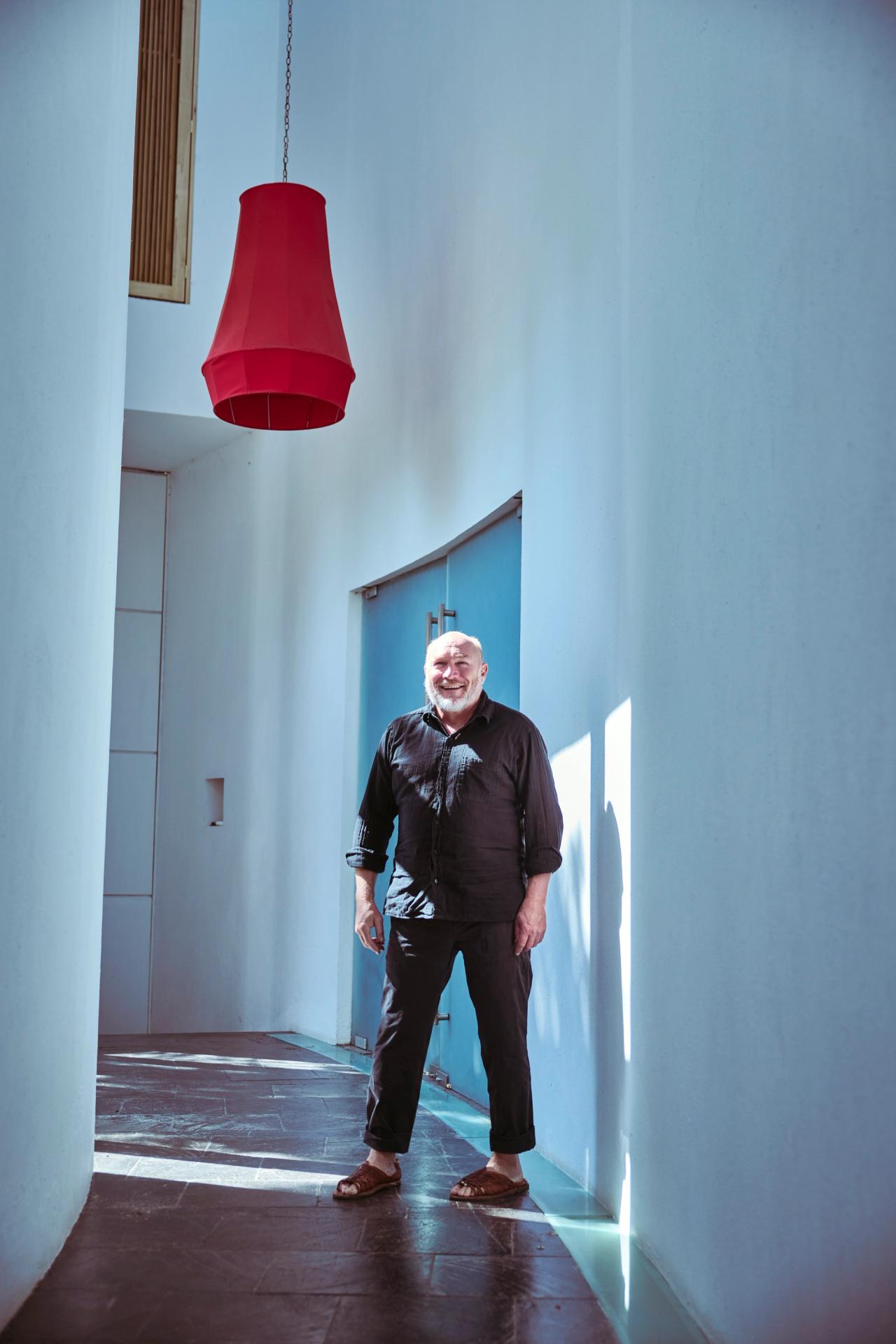
Allen inside his home in Mexico City. (Photo: Pepe Molina for The Slowdown)
SB: An expression, a feeling.
Going back to the U.S. Pavilion, it’s not lost to me that this year marks forty years since Isamu Noguchi was at the Pavilion, and he was the first artist to have a solo exhibition in the U.S. pavilion. He had accepted the invitation with the belief that he was representing the U.S. as a “nation of all nationalities.” Which reminds me actually of how you’ve also recently stated that you’re representing the U.S., not any administration. As with Noguchi’s work, you’re playing in abstraction. There’s a lightness and an ethereality.
AA: I titled the show “Call Me the Breeze” partially because I feel like my America, being born in a country that was so wealthy, that, even born in a poor situation, I could float and thrive in a place where that was possible. It’s that possibility that I appreciate so much. From my perspective, when you don’t have a lot of resources—and I didn’t have a privileged background—you have to just do what comes naturally. You have to follow the breeze around. You have to kind of drift from one place to another and move and make changes. And that’s how I’ve approached being an artist and being a person.
The luck of having done that in the United States made it a successful thing because it was such a fertile environment to be—luckily enough—born into. I don’t know that that has much to do with the current time—I’ve lived in Mexico for the last almost ten years—but that’s just part of my journey through life.
SB: Just thinking about Noguchi’s work, too, there’s this hybridity to your practice. I’ll quote here from Mauricio Rocha, the architect, who wrote an essay about your work saying, “Allen’s sculptures are reminiscent of the hybridity among figures and objects suspended in states of becoming, not only in terms of their form, but also their relationship to space.”
AA: I’m really happy he saw that. I have a propensity… I feel like I make things that are flowing and I stop them. I stop at a moment.
SB: It’s stopped time, in a way.
AA: I’m trying to freeze a single moment, usually. I see that as the opposite of a lot of sculpture. A lot of art is a pose, which is not stopping a moment. It’s creating a specific... I oppose the pose. No, I don’t, necessarily. But my interest is that little moment. You’ll see [in Venice] that there’s work that I do, where there’s a child; there’s a piece that’s a portrait of my daughter on her tiptoes as she’s looking on her tiptoes, because she can’t see into a case at a museum that I was with her. I love that, that moment of freezing—freezing time, if possible.
SB: Yeah. Your works feel animate. There’s an aliveness. It almost feels like there’s an energy inside them, in certain cases, wanting to push its way out of the material.
AA: I think it shows the way I work. I actually work in small scale and very quickly, using waxes and clays and softer and malleable materials in a... I don’t make plans or drawings, so I’m not— I’m just kind of always moving the things. I set up a situation where I can do work very quickly and then that act of creation is stopping and choosing at what point to stop the thing I’m working on and make the object.
SB: Yeah. I used the words lightness and ethereality earlier, and it’s amazing to me that something as solid as a lot of the marbles and stones that you work with feel so fluid.
AA: I’m cheating a little bit, that I have modern technology that helps a little bit.
SB: The robots.
AA: So it’s not—
SB: We’ll get to that.
AA: Before I was working with computers or robotics or the kinds of things I work with now, I did try to do the same thing. I was always interested in this flow state, when I’m working. That’s been the central reason for being an artist. I don’t know that— If that wasn’t part of it, there’s much better ways to make a living. I don’t know, don’t you think?
SB: [Laughs] To go back to your upbringing here, I know early on you were immersed in art books. That was your early education, going to the library and finding art books. I know also in those years you were reading novels; a teacher had given you Faulkner’s The Sound and the Fury. Tell me about just what role were books playing for you?
AA: Well, I didn’t have television as a child, so I had to read books. My parents wouldn’t let us have television or go to the movies, so it was books, and that was it. I had a teacher who, I was a brat and in sixth grade, I think, I was like, “These books are all stupid and boring.” Then he gave me The Sound and the Fury just to read and to do.
SB: Here’s some Faulkner. [Laughs]
AA: Which is a difficult book to understand a little, because part of it is you have to understand that it’s a little bit unintelligible from this point of view. It actually really got me interested in writing. In that state of consciousness that writers like Thomas Pynchon and many writers have, and including The Sound and the Fury. Writing as an art in and of itself, not necessarily the story, but the act of doing it, which like, Samuel Beckett, I feel is a very similar way to how I’ve tried to approach living. Also—not totally—but also making art, you can tell that there’s making and doing the thing and then the clarity comes at some point later, which is fascinating. It’s a thing I like to do.
SB: To look back?
AA: To look back, but also to start something and hopefully end up at a place I didn’t imagine going.
SB: You love that.—
AA: When I started.
SB: Not knowing.
AA: Yeah, because it’s interesting. I would get bored of me literally coming up with formal ideas that would make good artwork. I’m more interested… If it surprises me, I’m more happy. Sometimes if it disturbs me, it’s even better. [Laughs] That’s my interest. I want my life in the studio to also be interesting, not just practice.
SB: Your works exist in the in-between, and I guess you do, too.
AA: I hope so. I don’t know. It’s harder when you have kids and responsibilities. I can’t just take up and go somewhere. I did that for years.
[Laughter]
SB: At 16, you ran away from home and, if I have this story correct, you went to Salt Lake City where you worked restaurant and construction jobs.
AA: Actually, I went to Berkeley. I went to San Francisco first. I ended up back in Salt Lake City at some later points and I moved a lot. I lived in Portland, I lived in New Mexico, I lived in New Orleans, I lived in Chicago.
SB: All that before New York?
AA: Yeah.
SB: Wow.
AA: Salt Lake City. I just wandered—
SB: What were you doing to get by? What was your existence like?
AA: I did a lot of construction work. Usually I would do some construction work in the summers and I would get a restaurant job in the winter. That’s kind of a normal cycle for people and sometimes... I don’t know. I spent a year in a town called Truth or Consequences, New Mexico, because I literally ran out of money there and my truck broke down. [Laughs]
SB: Poetic.
AA: I just couldn’t leave. I had to work in a McDonald’s and I cleaned bathrooms in the truck stop and I finally saved enough money to get to New Orleans. But it was that kind of... There were periods where I was homeless a couple of times when I was 18 or 19. I injured myself once at a job and they fired me that day instead of taking me to the hospital, which kind of sucked. Then I couldn’t work, but I was living hand to mouth. Two weeks, a month of not being able to work because I had a cut with stitches in my hands [which] was enough to send me into homelessness for a few months. But that was an experience of the kind of... There were amazing things that happened because I was in this soup of America, this very thriving and strange world.
SB: Escaping this very hermetic background that you had come from.
AA: Yeah. My family was very religious and my father had problems with violence, so there were issues with that. I was happy; I was very eager to go out and see the world.
SB: You felt free.
AA: I wanted to get away. As soon as I could get out of there. It was more that it was just stifling, that lack of knowing what’s really happening in the world. I had been, my family, since I was a little bit troubled, maybe I’d lived with different relatives. They’d sent me to live with an uncle in San Francisco, which was a terrible idea. I knew about skateboarding and punk rock music. It was no good going back to the farm. It was like—
SB: I was going to ask, you were—
AA: I was going to go skateboarding and go to punk rock shows. [Laughs]
SB: Yeah, you were a skater. Tell me about that.
AA: It was more that at that time, a lot of kids that were—not homeless, but living in squat houses. San Francisco was full of kids whose parents were disapproving from a lot of Mormon, growing up Mormon or difficult childhoods, they washed down to the city at that time—especially in Berkeley. Since we didn’t have parents, we all skated all night. We’d go out to parking garages. It was kind of an amazing time to go out to spend your nights unsupervised as teenagers skateboarding around San Francisco instead of going to school.
[Laughter]
SB: Then in 1993, you moved to New York. I recall you once telling me that, on your first day in the city, you walked all the way from Park Slope to Harlem.
AA: Yeah, it was amazing. I was so excited because I’d read— New York is in fiction and it’s like such a big part of your life if you’ve read a lot of books, so I wanted to experience it. It was amazing. I walked the whole way and I took the A train, I think back. It took me... But I couldn’t stop. I didn’t mean to walk. I was just going to walk across the Brooklyn Bridge, but then I just kept going and going and going. But it’s not that far. It’s probably ten miles at the most or something.
SB: Yeah. You’re new to the city and it’s almost like you’re walking a dream in a way.
AA: Oh, for sure. The first time you’re in New York, if you’ve actually been interested in being in New York before, it’s amazing. That first day is always… it was amazing. And there’s a lot of energy. There’s so many things to see between, and then maybe even then, there were a lot of different worlds between Brooklyn and the bottom of Manhattan and Harlem.
SB: Not long after your arrival, as you mentioned, you were hit by this truck and immobilized and started making these...
AA: I’d been making those works for years. I had actually thought of myself as a painter at the time. So I had had shows in coffee shops and that sort of thing. I was making paintings, which I continued to do for another ten years after that.
SB: What were they like?
AA: They’re just messy and dark. A lot of them were just black.
SB: Pierre Soulages?
[Laughter]
AA: Pretty much, yeah. Actually, when I moved at one time, I had maybe a hundred paintings rolled up to fit in the moving truck. And I didn’t unroll them when I got to Los Angeles and I put them in the attic of a house, which then was a hundred and twenty degrees, and they fused together.
SB: So it’s one art—
AA: 10 years of my life’s work became a single fused mass of oil and linseed and—
SB: It’s a continuum, Alma.
[Laughter]
AA: So no one’s seen those because they totally fused.
SB: You should present it as one installation.
AA: I’d been making the little sculptures, but I’d never... I’d been doing them for when I was working at my jobs and then on the weekends. I was making quite a few of them, but it wasn’t what I saw as my artwork. I was trying to be a painter at the time, as much as I could figure it out. And I was working as a stonemason’s apprentice, which was how I ended up going to New York.
SB: In New York, of course, you have access to all these incredible museums. I imagine you were spending time at the Met.
AA: Yeah. For many years in New York, I was able to support myself from my work. I didn’t have a regular job, but it was amazing. I could go to the Met. I went once a week—you could pay what you choose. And the Met is one of the most amazing places.
SB: Were you seeing ancient sculpture there?
AA: Oh, for sure. I’m totally referencing in my mind a lot of pieces that are there, and I go visit them still. There’s a pair of yellow lips in the Egyptian section that I go see. Pretty amazing. [Laughs] There’s a lot of things in that museum which are great. I think it’s a resource for... One of the reasons I’ve tried to not title work is my experience when I was first introduced to contemporary art was when I was the runaway kid in San Francisco and going into the SFMOMA for the first time and seeing the Clyfford Still paintings. I know nothing about them—or anything about any of the art that I was seeing. I didn’t know anyone’s name or anything about their lives or who they were. That was very impactful to me. It took me—
SB: It was art on its own terms.
AA: On its own, totally. I didn’t know anything of what it was. It was like I had not been exposed very much to that kind of art. It was really interesting. I’ve tried to keep that moment of creation, which I was able to experience trying to understand what it was without context, without knowing anything about the person, which—maybe I’m foolish, but I really enjoyed that moment.
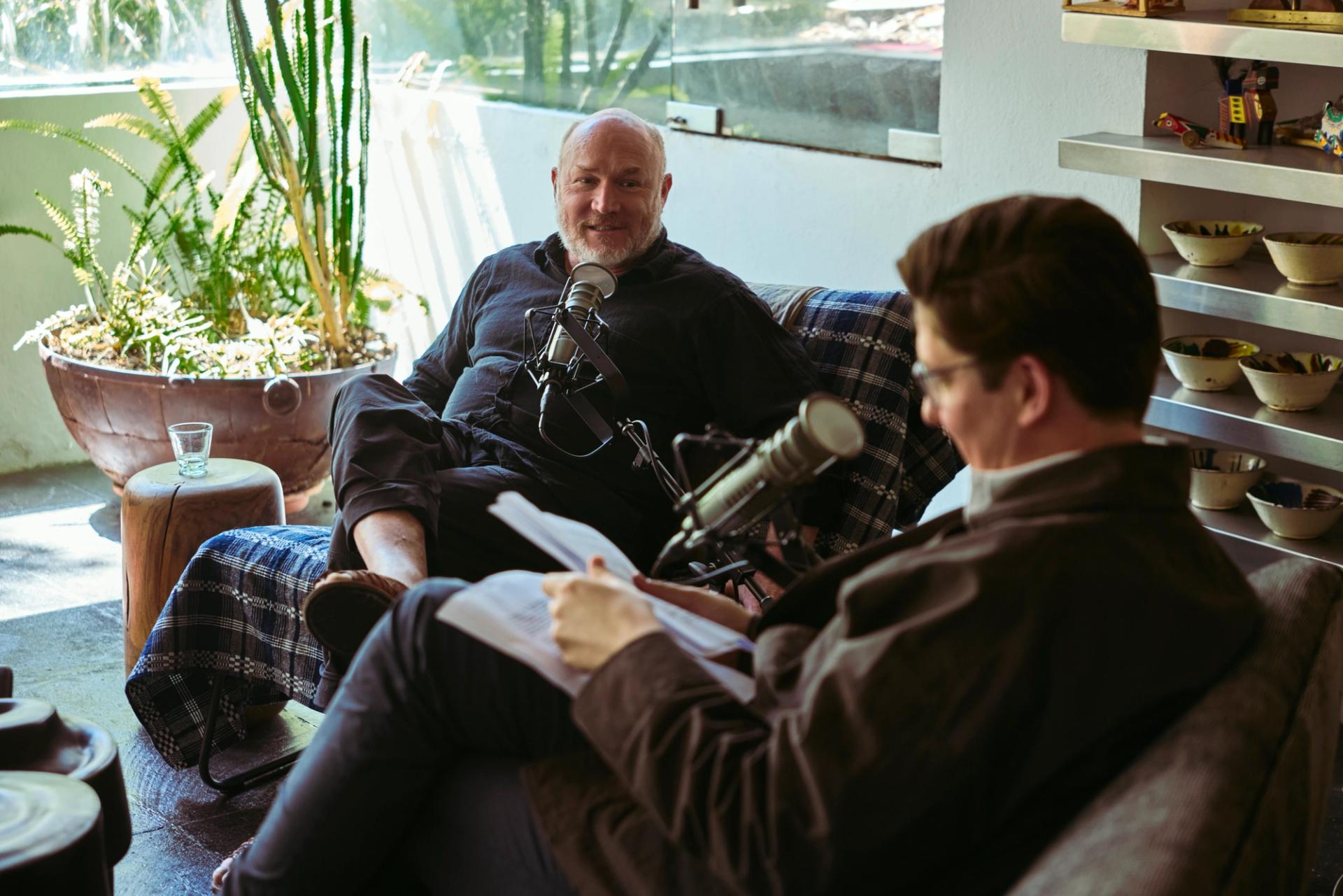
Allen in conversation with Bailey during the recording of the 150th episode of Time Sensitive. (Photo: Pepe Molina for The Slowdown)
SB: Reflecting on it now, how do you think about those New York years? What do they mean to you in your arc?
AA: New York was really great in that I worked a lot. It was at a time when it was less expensive. I lived in Williamsburg [in a] loft, crummy. It felt crummy, but maybe it wasn’t in retrospect.I worked a lot. I made hundreds of thousands, and I had good collectors. I had a couple of shows in galleries, but very little, but mostly, I eventually left because I’m agoraphobic and I couldn’t handle New York after because I have problems with crowds, but that’s another thing.
SB: Good luck in Venice.
AA: I know. I used to go a lot. One of my favorite New York days when I had time off was to ride my bicycle to the Noguchi and then wander along the river and I would find materials to carve. I had a basket on my bike and I’d fill it up with stones and pieces of wood and broken furniture and stuff to make things from. It was always that endpoint of the Socrates and Noguchi. It’s like somewhere to go at that far point and then work your way back to Williamsburg along the river.
SB: Interesting.
AA: Along the waterfront, that’s where I found a lot of my stones and materials, in abandoned waterfront, vacant lots and stuff.
SB: After eight years in New York, you moved to L.A. This was in 2001, and then in 2006 to Joshua Tree where you would live and work until 2017. What did this move west do for you? In what ways did you see your work change more, transform, in the time you were out in California, especially Joshua Tree?
AA: I loved the nature and I started to make. I still collected materials for my work at the time, but then it became larger scale and I would go to a lot of abandoned mines and quarries and still loved that process of finding and sometimes mining the pieces of stone that I would carve. I often would leave— I’ve never heard from them, I would make little bronze sculptures I would leave behind. When I would take a piece, I would leave it hoping, I don’t know why. It was confusing, but—
SB: They’re probably sitting in the desert somewhere.
AA: Probably. Somebody has them. They found a little snail. It’s like, “What’s this little snail doing here deep in this turquoise mine?” But I love that part of it. I actually used to have a Unimog, like a Mercedes Unimog truck. It was a very strong off-road truck that I used to take deep into the deserts and abandoned quarries and mines and that sort of thing. I moved to California because I was living in New York City and I bought a house in upstate New York and I spent one winter there and then I couldn’t do another one.
I was actually planning to move back to New York City. I’d sold my house and I was like, “I’m moving back to New York City.” I just couldn’t do it. I had the truck, I had my stuff in the truck and it was like, “I’ve never lived in L.A. before. I’ll go to L.A.” And it was like I had to call the U-Haul company and say, “Can I actually take the truck to Los Angeles instead of Brooklyn?” Because it was on a whim. I’d never been there. It was like just one morning I woke up and was like, “I can’t go back to New York.” [Laughs]
SB: How did you find Joshua Tree? What led you there?
AA: I started going out there collecting materials for making sculpture, so that’s how I learned about it. There’s a lot of abandoned mines and quarries in Joshua Tree, and then near there and in all of the areas. I wouldn’t go to places where no one had dug a piece of stone. There’s a lot of abandoned quarries and mines everywhere, all over the American West.
SB: Joshua Tree changed a lot during your time there.
AA: Yeah. I think it’s always been a little bit like the escape valve. I didn’t get to have the glory days when Brian Eno was there being... There’s always some glory days in the past in Joshua Tree, which is—it’s actually in the past, its glory days.
SB: An interesting part of this story, though, is that in large part you had to move out of Joshua Tree because this yoga retreat moved in.
AA: I got frustrated. I built a house and a studio that was going to be my life’s house and studio on a ten-acre piece of land that had no neighbors. Then a yoga retreat bought this abandoned house and then they turned it into a yoga retreat. Then they started doing petitions in town to close down my studio, because I had chainsaws and grinding and [was] working as a sculptor. They successfully had the county not allow me to work at my home and studio because they had made these petitions that it was like a factory, like a big factory with lots of employees. And it was not, it was just me. I did have a robot, so that was a problem.
SB: Let’s talk about it.
AA: It was hard to convince the county that I wasn’t— Because I did have an industrial robot in the studio... I actually left and sold the house and just decided to move away completely instead of trying to recreate this thing over and over again. And my wife, Sue, had come to Mexico and really loved it here and decided we would move here.
SB: Before we get to Mexico, tell me about the robot, because this came about by necessity. You had this debilitating form of carpal tunnel syndrome, right?
AA: Yeah. I had a lot of overwork because I had twenty years of obsessively carving stone. It’s common for a lot of people who work with their hands that when you hit 40 years old, they start to fail. I had stress fractures in my arms where you get little cracks in the bone and they don’t heal because you keep—and it just hurts. I was kind of becoming crippled. A collector who was supporting my work quite a bit at the time was frustrated that I wasn’t making enough stuff. He was like, “Why are you not making new sculpture? I want to get some more sculpture.” And I was like, “I can’t. My hands are like…”
He lent me the money and I bought a robot to make sculpture, to help me carve stone, which was amazing. Then I transitioned into using 3-D printing and 3-D scanning and could gradually, as that technology became available, continue to make sculpture when I had lost the ability to do it with my own hands. I worked for twenty years by myself with my hands and then the last fifteen years or so with help of other people and computers and robots, which has been a change—but also that’s how the robot is. I still have that robot.
SB: Yeah. It’s not so much about the robot or the technology, it’s what you—
AA: No, I’m not that interested in the technology. It’s a tool like any other tool. It’s like a grinder or a cutter or like any other tool. I’m interested in using those kinds of things to make art, but it’s not different than making art with your hands.
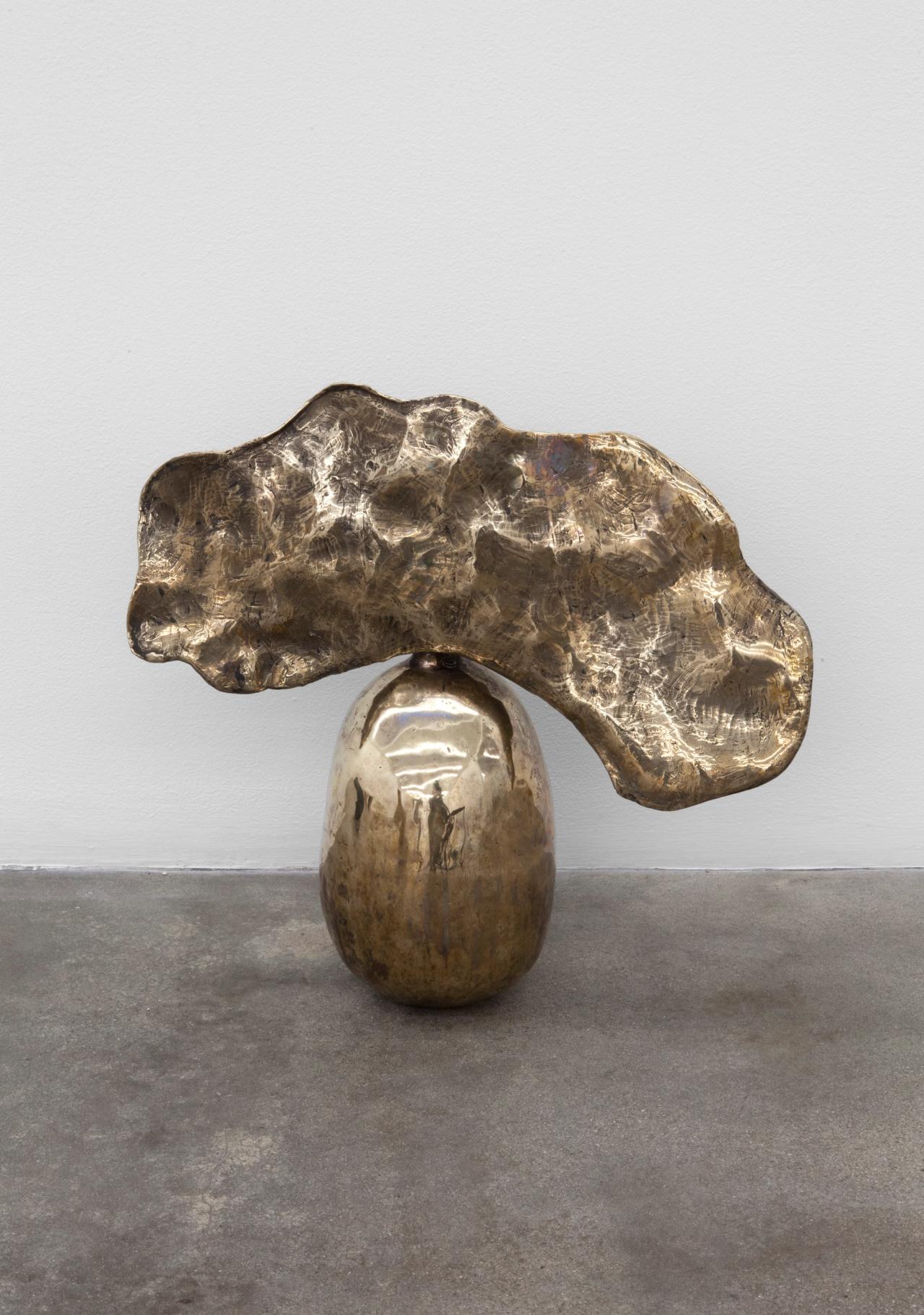
Allen’s “Not Yet Titled” (2014). (Copyright: Alma Allen/Courtesy of the artist and Blum &Poe/Photo: Sam Kahn)
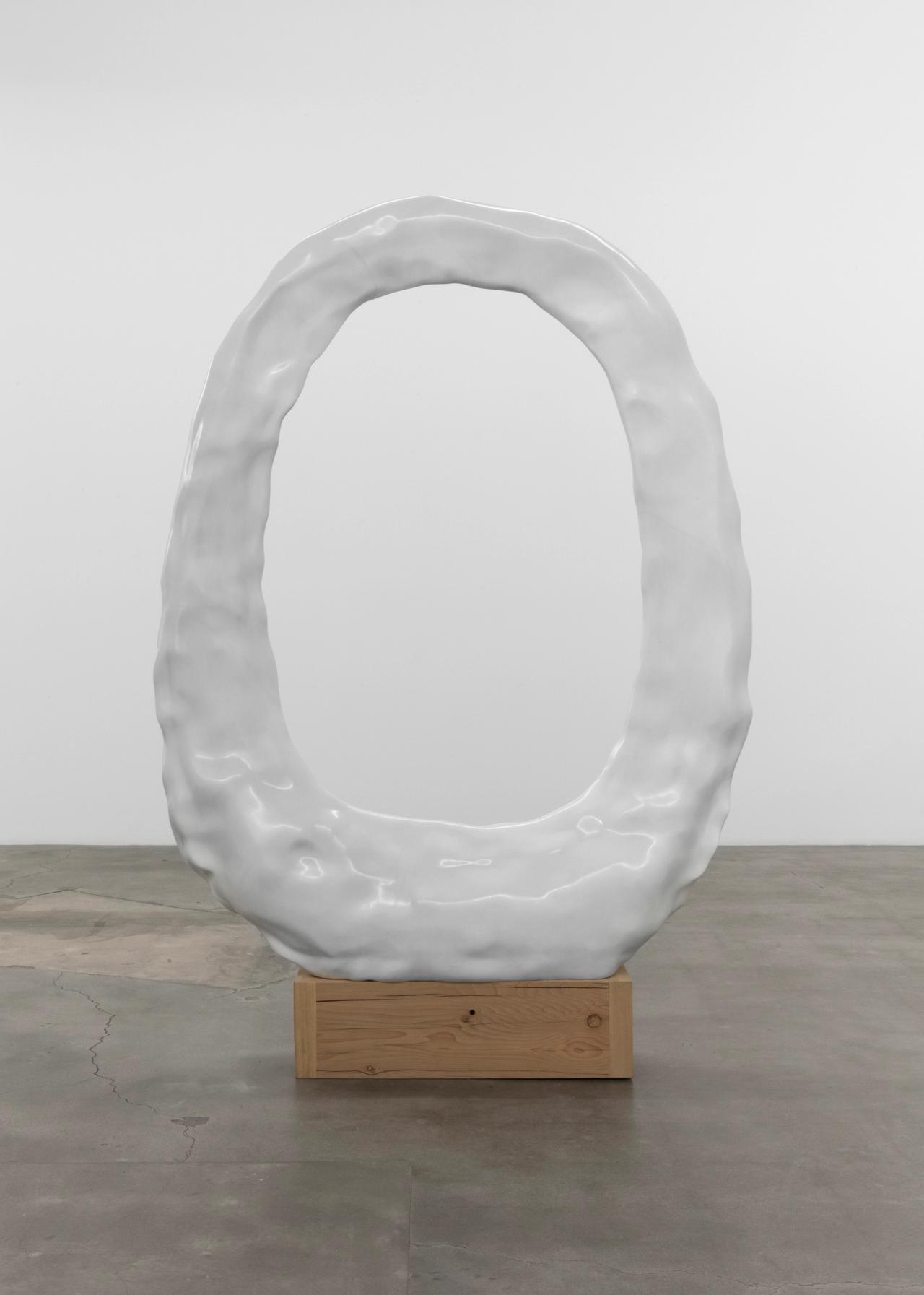
Allen’s “Not Yet Titled” (2014). (Copyright: Alma Allen/Courtesy of the artist and Blum &Poe/Photo: Sam Kahn)
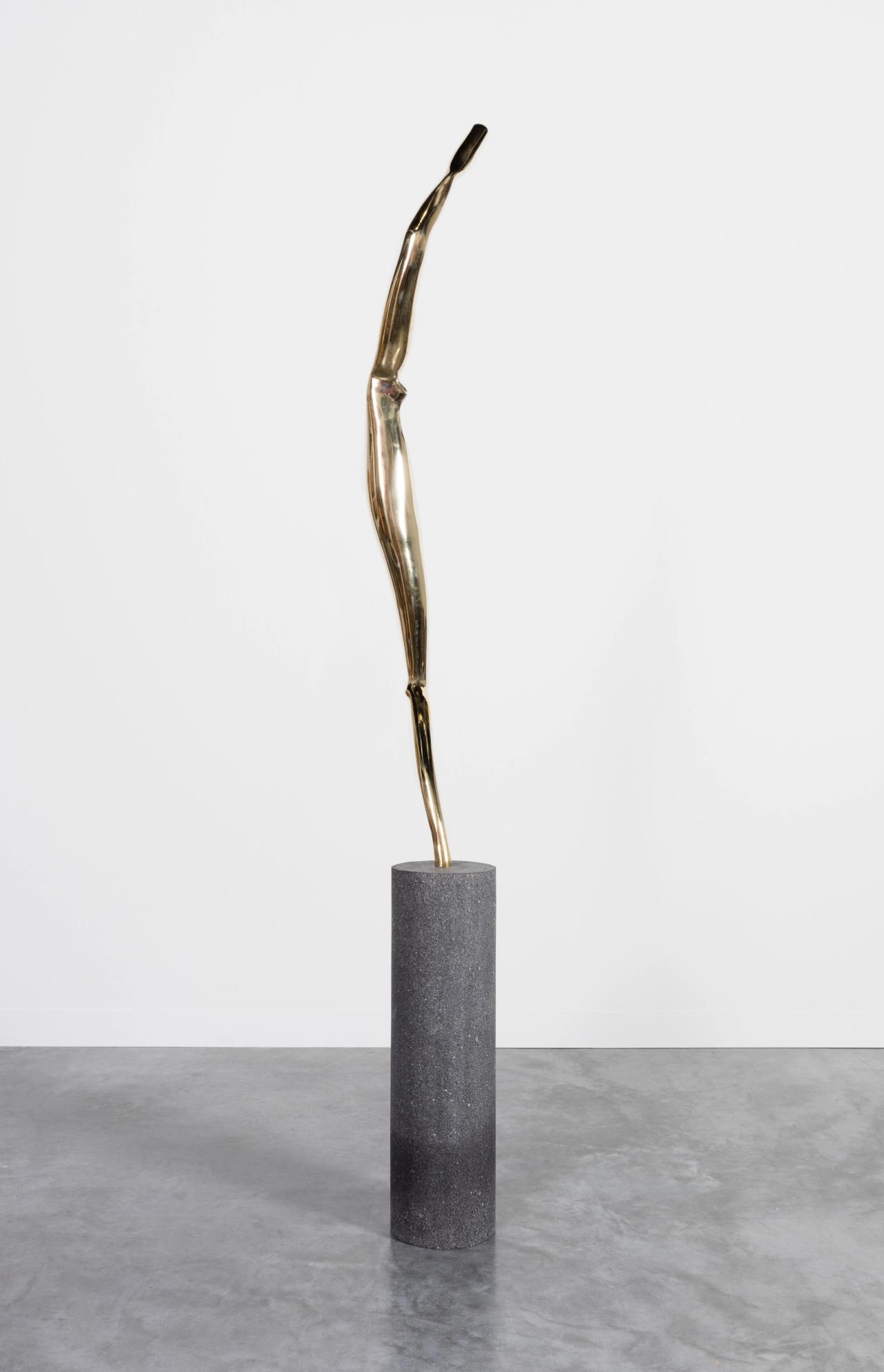
Allen’s “Not Yet Titled” (2017). (Copyright: Alma Allen/Courtesy of the artist and Blum &Poe/Photo: Andrea Rossetti)
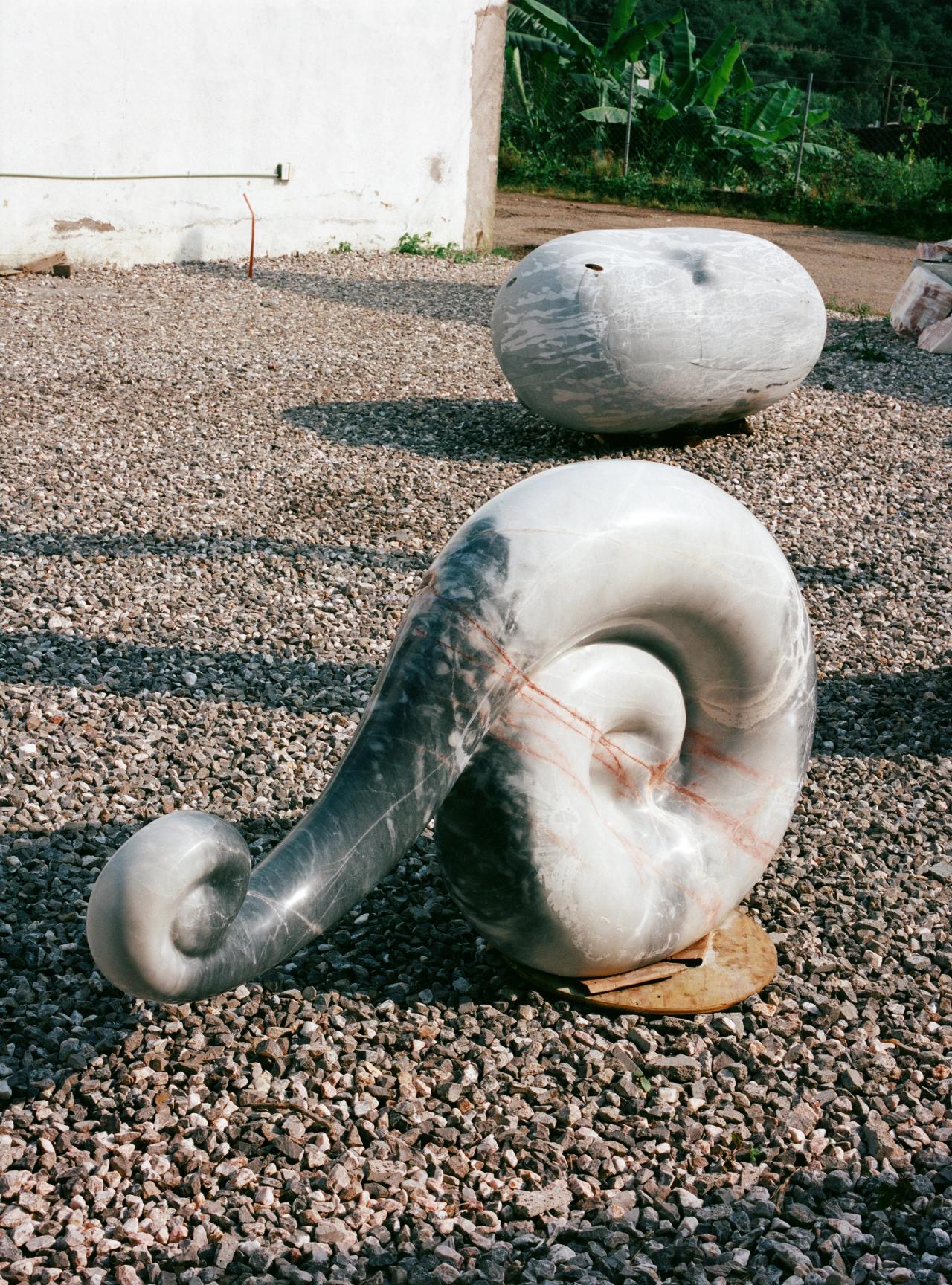
Allen’s “Not Yet Titled” (2019). (Copyright: Alma Allen/Photo: Pia Riverol)
Allen’s “Not Yet Titled” (2014). (Copyright: Alma Allen/Courtesy of the artist and Blum &Poe/Photo: Sam Kahn)
Allen’s “Not Yet Titled” (2014). (Copyright: Alma Allen/Courtesy of the artist and Blum &Poe/Photo: Sam Kahn)
Allen’s “Not Yet Titled” (2017). (Copyright: Alma Allen/Courtesy of the artist and Blum &Poe/Photo: Andrea Rossetti)
Allen’s “Not Yet Titled” (2019). (Copyright: Alma Allen/Photo: Pia Riverol)
Allen’s “Not Yet Titled” (2014). (Copyright: Alma Allen/Courtesy of the artist and Blum &Poe/Photo: Sam Kahn)
Allen’s “Not Yet Titled” (2014). (Copyright: Alma Allen/Courtesy of the artist and Blum &Poe/Photo: Sam Kahn)
Allen’s “Not Yet Titled” (2017). (Copyright: Alma Allen/Courtesy of the artist and Blum &Poe/Photo: Andrea Rossetti)
Allen’s “Not Yet Titled” (2019). (Copyright: Alma Allen/Photo: Pia Riverol)
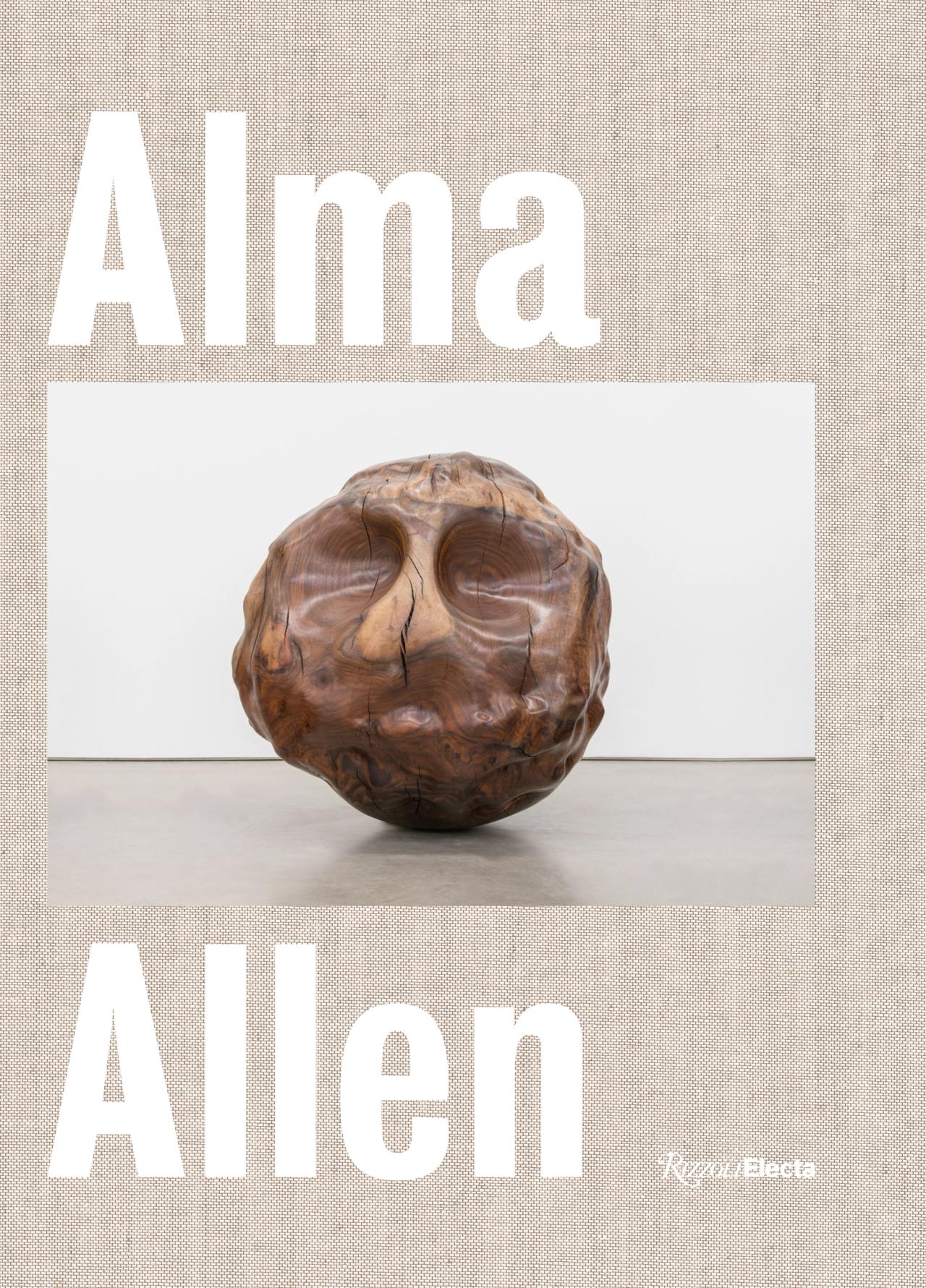
Cover of Alma Allen (2020). (Courtesy Rizzoli Electa)
SB: I wanted to return to the theme of friction here, because I feel like this is something very embodied in your work. The great scholar and historian Glenn Adamson has written, “Allen embraces difficulty, complexity, and the nonobvious. An aspect of that friction comes from material, skill and process, the artisanal dimension.” In that same piece, he later notes, “You’ll not find a sculptor working today whose output is more palpable, more saturated with material intelligence.” Very high praise.
AA: It’s very nice of him.
SB: Could you speak to how Joshua Tree facilitated this artisanal dimension and also material intelligence for you, because of the access you had to material there?
AA: Well, it did, and I reduced my material to fairly basic [things]. There was a Claro Walnut, which is from California. It’s a beautiful wood that I used quite a bit. I reduced it to just a few stones, which was an interesting period. And there was a Joshua Tree for several years there, I worked with my hands, too. There were several years when I was building my house, and then I would spend three or four months making sculpture, and then I could sell the sculpture and have enough money to work on my house for another three or four months and it took me five years to complete the house.
SB: Post–Joshua Tree, as you mentioned, you come to Mexico. How did that happen? How did you go from [that to] making your base here in Mexico City?
AA: Like we talked about, I was planning, I did try for a little bit of time to find a place to have my studio in Joshua Tree, but there’s no legal places to do it there. My wife had visited Mexico recently. She decided to, we were moving here. It was not me. Because the arts community is great and it was a very interesting, lively kind of place. And I think she was also bored of Joshua Tree. So we came here and made a life. I don’t know.
SB: It just felt like a natural progression, then, in a way.
AA: I didn’t have a studio, so I had to move somewhere. I had to do something. I had a period when I was continuing to work and I needed to figure out where I was going to work when the county was going to shut me down. It just happened to be in this moment when my wife, Suzanne, decided she would like to move to Mexico City. So I was like, “Okay.”
SB: Here, too, is the arid desert landscape with a lot of stone.
AA: Kind of. I tried to convince her to move to Mérida or Tepoztlán or somewhere else besides the city. I have a studio outside of the city, so it’s rural and quieter,—not that much quieter, but still. We’ve spent a lot of time exploring here. I’ve been lucky enough. I have a little old sailboat, so we spend a lot of time sailing, which has been really nice. And that’s become a place I work a lot now is on the sailboat. This year, with the Pavilion, I’m too busy, so I haven’t been to the sailboat.
SB: Is that how you got the title with “the Breeze”?
AA: Kind of. No, that’s a J.J. Cale song. I was listening to J.J. Cale and trying to come up with a name for the show. It’s very simple. He’s—
SB: Classic.
AA: Yeah. I feel always a kinship. In a funny way, my childhood was a little bit more like a hobo-y, older, that America from the past a little bit. I understand my wandering in a way that when you’re reading Jack Kerouac or [listening to] J.J. Cale songs. It actually makes sense for me, that America, because I had the dislocation—
SB: Like all those folk songs.
AA: Not being institutionally, it’s not about, I would do an MFA at Yale, that sort of thing. J.J., he didn’t do that. That wouldn’t have been the way that he came about writing “After Midnight.”
SB: More like Muscle Shoals vibes than-
AA: Tulsa.
SB: Yeah.
AA: Totally.
SB: Yeah.
AA: A lot of great musicians from Tulsa, but he might be the best one. Who knows?
SB: Your biggest breakthrough early on happened during the Joshua Tree time, which was your inclusion in the 2014 Whitney Biennial. What was that like for you? Could you speak to that moment?
AA: It was a surprise. The curator saw my work at someone’s house, which was great, and I was able to do that. It was my first experience in the art, art world. I knew people in that universe, but it was my first public exposure. I was a working artist the entire time, and I had good collectors, and I’d had some exhibitions before, mostly in Japan, but I had done— I was not unknown in a way, but it was my first into that institutional art world or into—
SB: Time magazine saying your work’s one of the best five things in the—
AA: That was very nice of them. They were very flattering. The whole thing was an interesting experience, but I didn’t know what to expect from it. Of course, it changed the trajectory of my working life a little bit, but I was kind of on that trajectory anyways.
SB: Right. Naturally, a few years later, you ended up having this exhibition pairing your work with JB Blunk. Another interesting moment for you to be paired with this artist. For those who aren’t familiar, Blunk was the sculptor based in Northern California, definitely had some similar—
AA: Some similar.... Yes, we both worked with the same wood, the same walnut from California. We both had this Claro Walnut, it’s the root stock of the almond for walnut trees, not almond trees, for walnut, but it’s a native to... It’s like a very beautifully colored wood that they use for the roots and then they graft on the English walnut for eating for the fruit. It’s a wood that Nakashima used a lot, J.B. Blunk used it a lot, I’ve used it a lot. I don’t use it anymore because I’m not in California, but I had not met him. And I had heard about his work from different friends and people were doing residencies at his old studio. I kept having people come like, “I’m in the…” I went to visit a couple of people two times, which was interesting. I didn’t know his work before that.
SB: Oh, really?
AA: I knew it before the exhibition, but he was fairly unknown. He was known within San Francisco, I think, but I don’t really know. I’m not a scholar of J.B. Blunk’s life. .
SB: Interesting Noguchi connection here, too, because Blunk and Noguchi were good friends. Blunk was with Noguchi when the Venice Biennale opened, actually.
AA: That makes sense. They both... Yeah. There’s not that many sculptors. Even if we don’t know each other personally, like in pure sculpture, people who were just pure sculptors, not regular… It’s a different thing than being an artist in a way. It’s being an artist, but it’s a different—there’s not that many of us. So you see them. There’s a couple hundred, there’s not that many.
SB: I was hesitant to even bring up comparisons even to Noguchi, but it’s fair to say your work also lies within the lineage of Brâncuși.
AA: Brâncuși and Lynda Benglis and Louise Bourgeois, for sure. A lot of—
SB: Yeah. I can even see connections to the late Thaddeus Mosley, who was a guest on this show.
AA: Yeah. Sculpture is a smaller world than— Pure sculpture, people who don’t... Yeah, there’s a pretty small world in the arts. And not that often does a new one come into the... They kind of all know each other’s work, I think.
SB: Do you view your work in direct dialogue in a way to, say, Noguchi, Brâncuși, Bourgeois?
AA: In periods of my life, for sure. Of course, it varies a little bit. I take a lot of the way of approaching making art from, I did it from Louise Bourgeois. The way she approaches asymmetry and also Lynda Benglis, they both approach making art from that frenzy of freezing a moment, which is not a formal way to approach it. And it often ends in asymmetric shapes and sorts of things that feel a little bit more alive, but also Brâncusi, which is almost the opposite. It’s like—
SB: Very slender.
AA: Totally not alive, but in a very beautiful and amazing and refined way. So it’s like—
SB: Noguchi’s like the in-between, kind of.
[Laughs]
AA: Yeah. Of course, I’ve looked at that work a lot in my life. I think it’s hard not to, but also Olmec and other things.
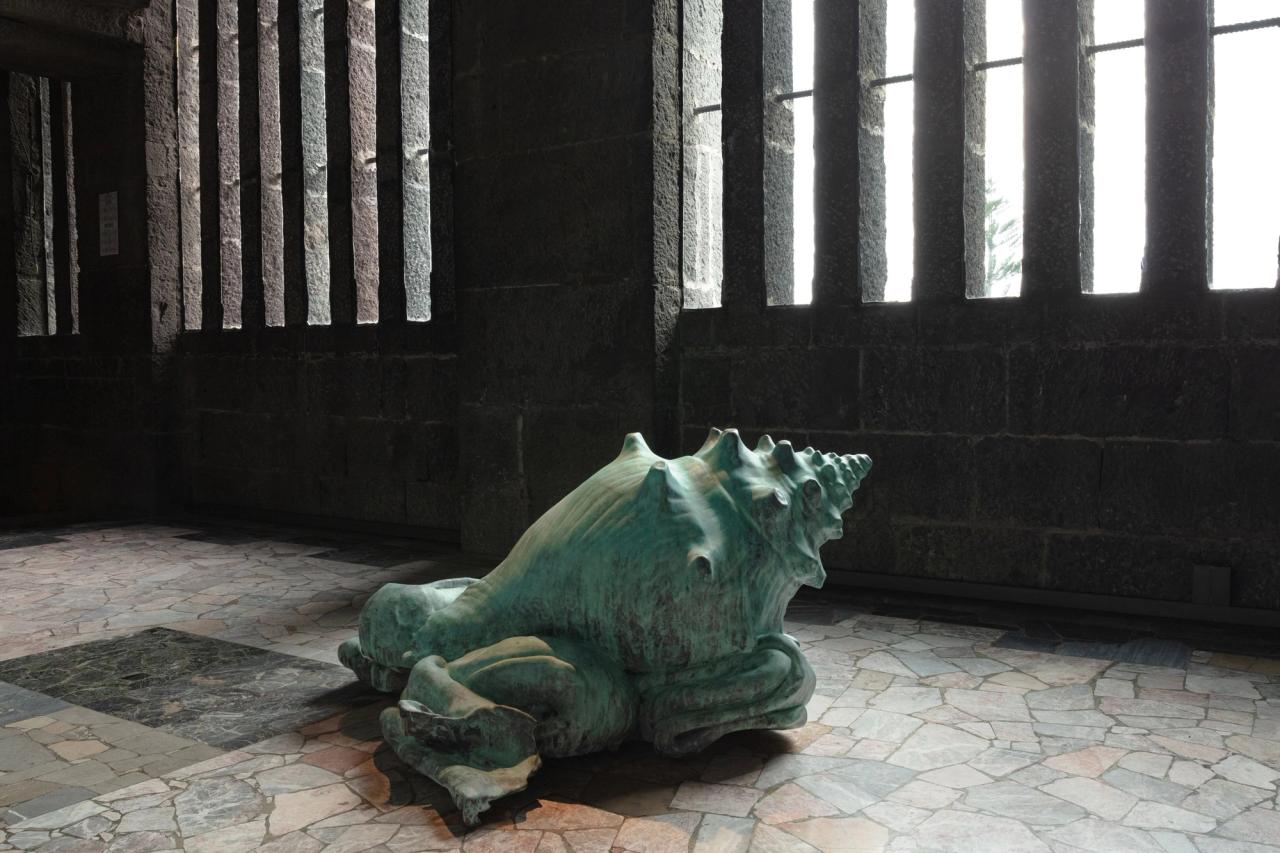
An exhibition view of Alma Allen’s “Nunca Solo” at Museo Anahuacalli in Mexico City’s Coyoacán neighborhood in 2023. (Photographer: Alejandro Ramirez Orozco)
SB: Yeah. Tell me about your Anahuacalli exhibition, this really special museum here in Mexico City.
AA: It’s a museum that was built to be Diego Rivera’s studio, his final studio, and it wasn’t finished in his lifetime, but his friend, architect Juan O’Gorman, supposedly with the help of Frank Lloyd Wright—I don’t know, some gossip I’ve heard from... But I don’t know. Anyways, it houses the collection of antiquities of Mesoamerican art of Diego Rivera’s. It’s amazing in that he doesn’t have any wall texts. There’s no dates, there’s no cultures. I love that about it, that it’s like you have to approach every little piece as its own thing without knowing where it’s from—
SB: Out of time.
AA: Or when it’s made. It’s totally... It’s a very rare thing in a museum and I always loved that part about it. It’s also almost all figures that are made for ritual and for experience. They have more power than just... Over time—I had two years to make the exhibition—I started to become involved. They let me into the archives. I saw pictures. I went to Egypt because I saw that Diego was a mason, there were these pyramids and was obsessed with Egypt and there were pictures of trips to Egypt. I was like, “I’ve got to go to Egypt to understand this exhibition as a research trip.”
SB: Good excuse.
[Laughter]
AA: “I’ve got to go to the pyramids.” I think at some point in everyone’s life, you’ve got to go to the pyramids and see what that’s all about.
SB: What did you find in Egypt?
AA: Oh, amazing stuff.I’m not sure about the veil of reality. Egypt puts that into another… We’re really not sure about what’s real and not real. That’s my feeling of Egypt. It’s an amazing place.
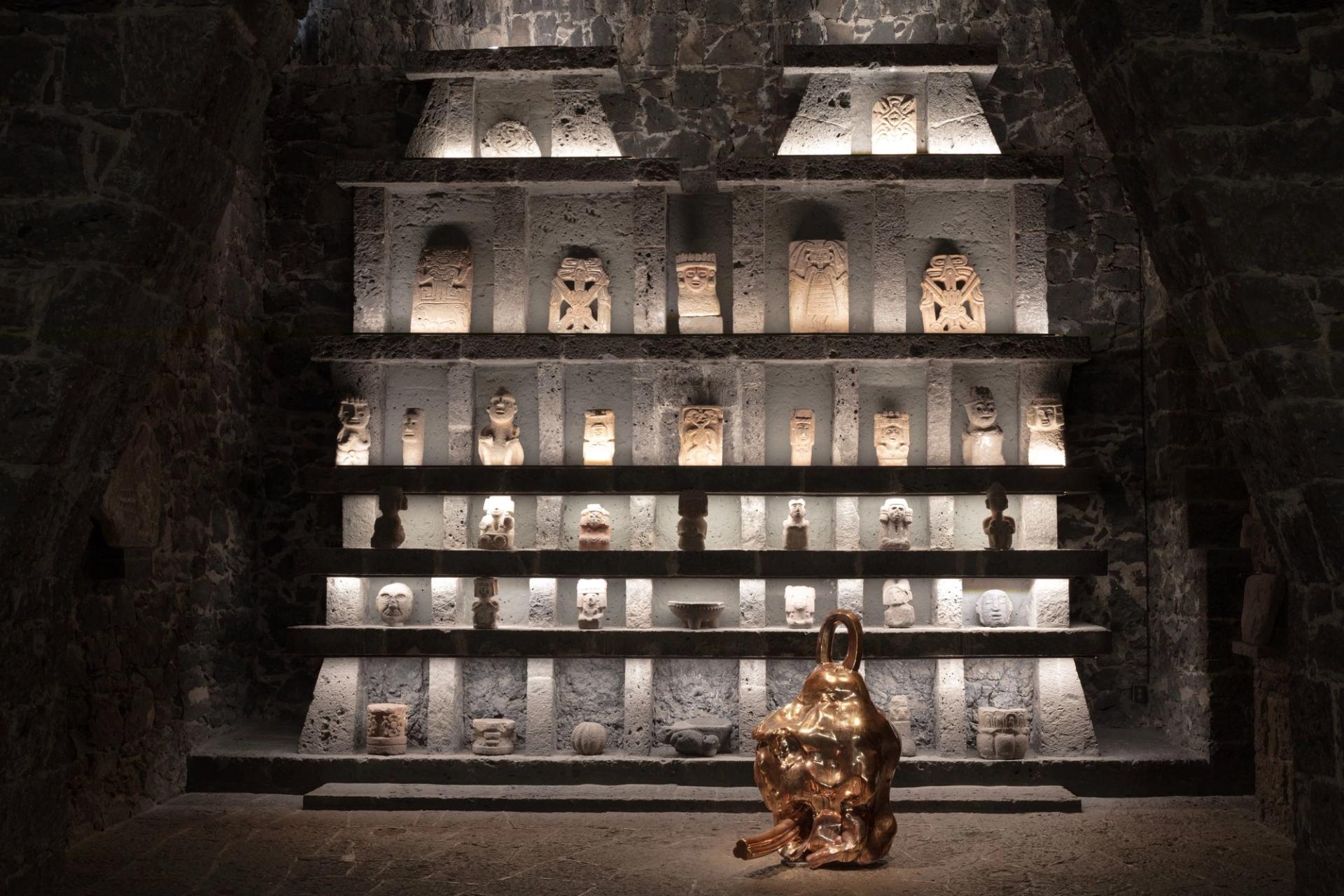
An exhibition view of Alma Allen’s “Nunca Solo” at Museo Anahuacalli in Mexico City’s Coyoacán neighborhood in 2023. (Photographer: Alejandro Ramirez Orozco)
SB: Where did you go there, specifically?
AA: We went on a standard two-week tour, but with a group of people. The person organizing the tour doesn’t believe the standard narrative, which is amazing.Instead of going to tours in the daytime, we’d go at night, when it was closed and they would pay a bribe to a guard and we’d go three floors down into the Step Pyramid and look in archeological active sights or into the Great Pyramid when no one else is there at midnight climbing into the sarcophaguses and crawling around in the... It was amazing, because there’s like a way to do an Egypt trip, which is weird, but amazing. I recommend someone find an alternative history guide, which I really loved because I’m not really sure about... that pyramid is strange, the interior of it. I’m not sure what it was for. But I had to see it to do the Anahuacalli show.
I had two years because of Covid. The show was scheduled for one year and then we had an extra year to produce work. So it ended up becoming really engaged with the museum. That museum is full of maybe a thousand figures or more because it’s all Mesoamerican figures. I eventually felt like I was making the show for them. For me, the audience of that exhibition was the museum itself. All of the people, mostly people, but animals and dogs and crabs and every kind of thing that lives there. Because it’s full of— Almost every object is an animal or a person or it’s imbued with like some spiritual power.
I felt like it... it’s dark in there and especially at night, I imagined them... I made the show for them. There’s portraits of Diego and Frida and like the whole existence and the story of how that museum happened and sort of pieces for specific locations. That was a really great experience, to have enough time and also have a complicated context like the Pavilion is a little bit.
SB: Yeah.
AA: Unfortunately, I don’t have two years to make—
SB: You didn’t have time to have time to think about...
AA: I would have loved to have two years to think about it, keep going back to Venice, seeing, reading about different... Making work in relationship to it, but it’s not that time. There’s quite a few new pieces, but not the entire show.
SB: Thinking about that Anahuacalli dialogue, let’s say, between the old works and your works, do you view it in similar terms to what you were doing as a kid?
AA: Sure, yeah. I’ve always felt like that, doing it in that way. I don’t really see why we have to separate out. A lot of art that’s court art, that’s like portraits of leaders, that’s always boring. It’s propaganda now and was then, and it’s not different necessarily, but there’s always little things that don’t make sense that are more artwork like what we do now or what we hope to do. I don’t know. I love that kind of work and don’t really, it influences me as much as contemporary art.
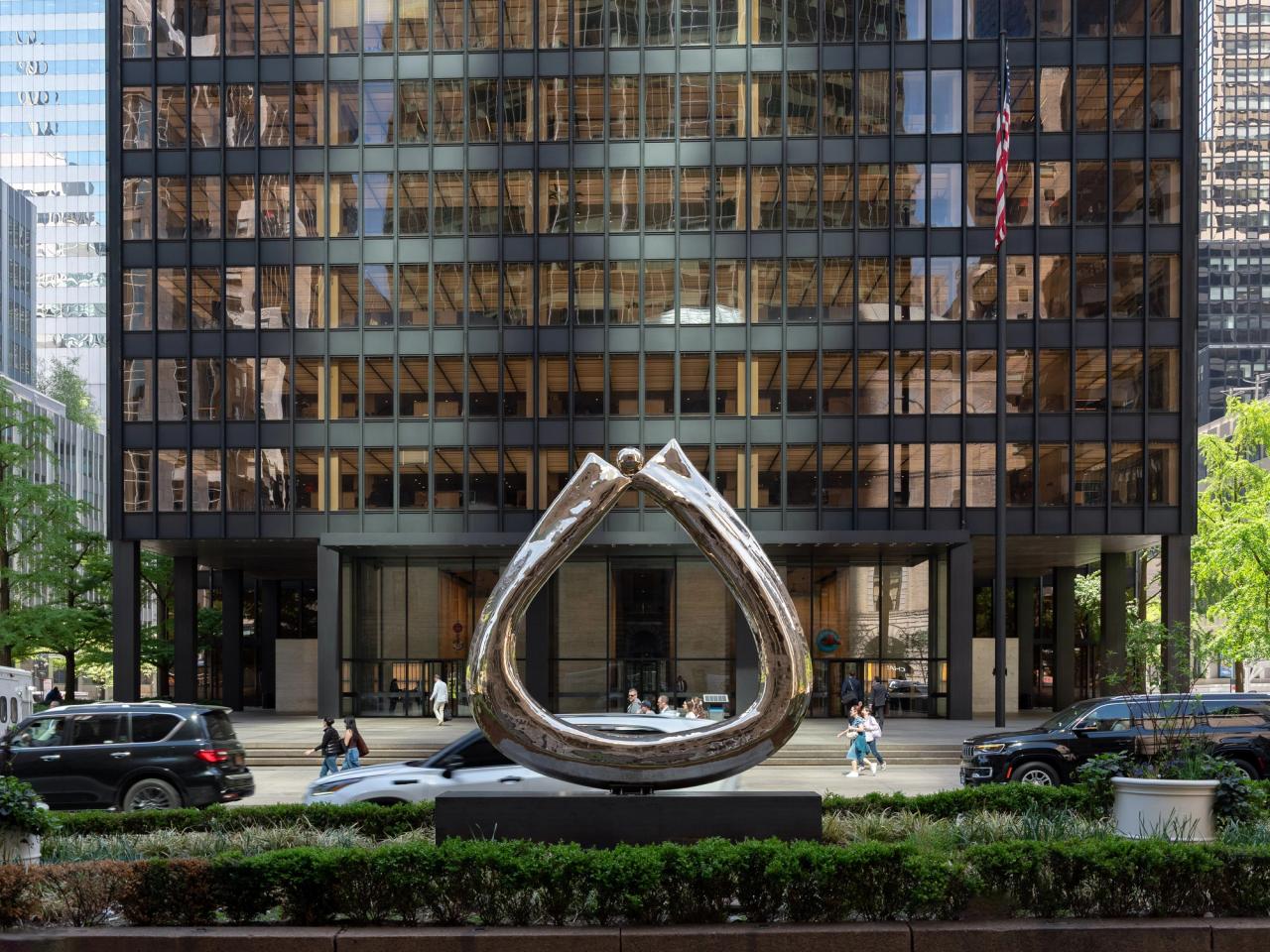
Allen’s “Not Yet Titled” (2025) installed on Park Avenue. (Photographer: Charlie Rubin)
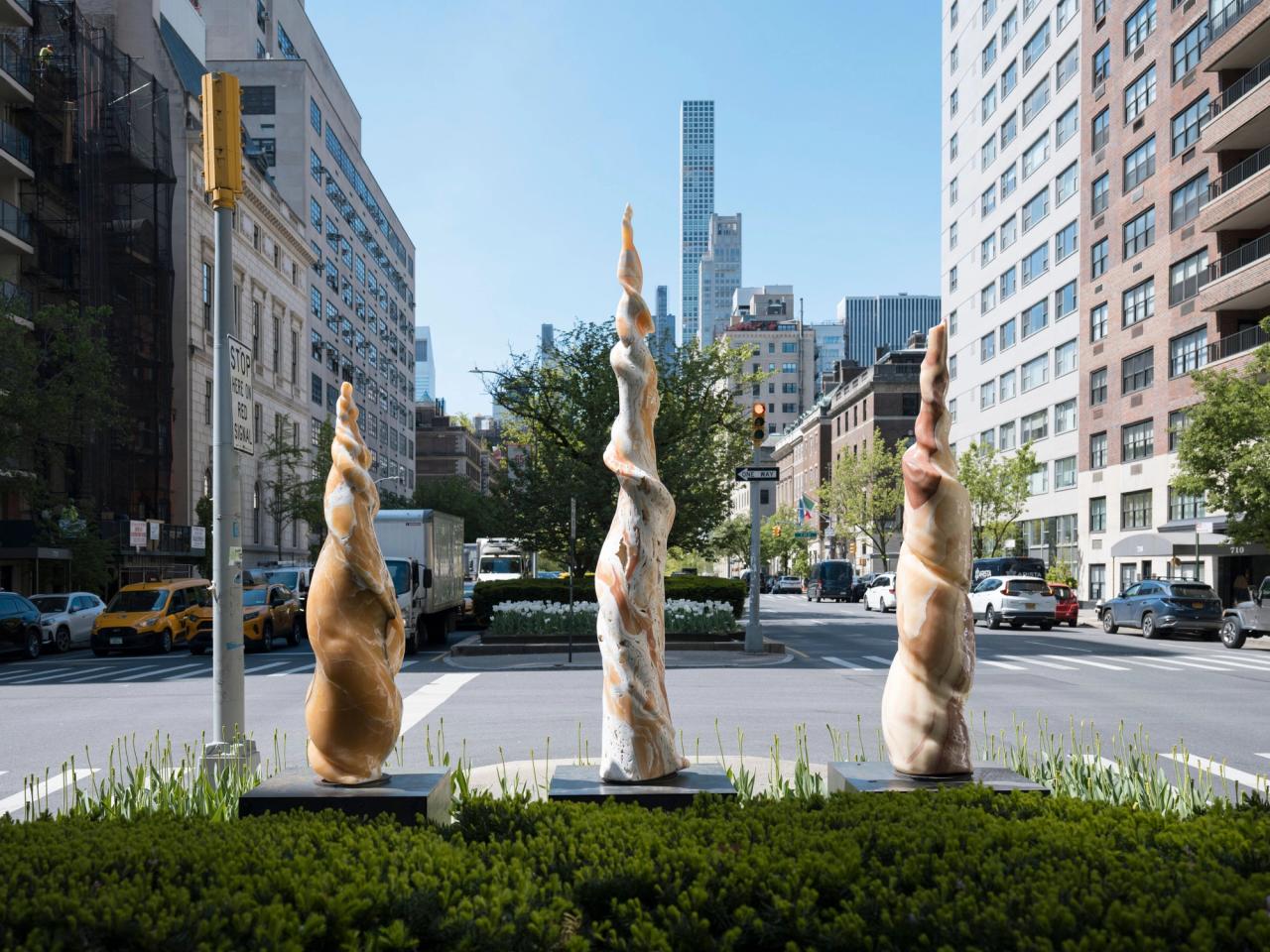
Three of Allen’s “Not Yet Titled” sculptures installed on Park Avenue, made in 2025 (left and center) and 2024 (right). (Photographer: Charlie Rubin)
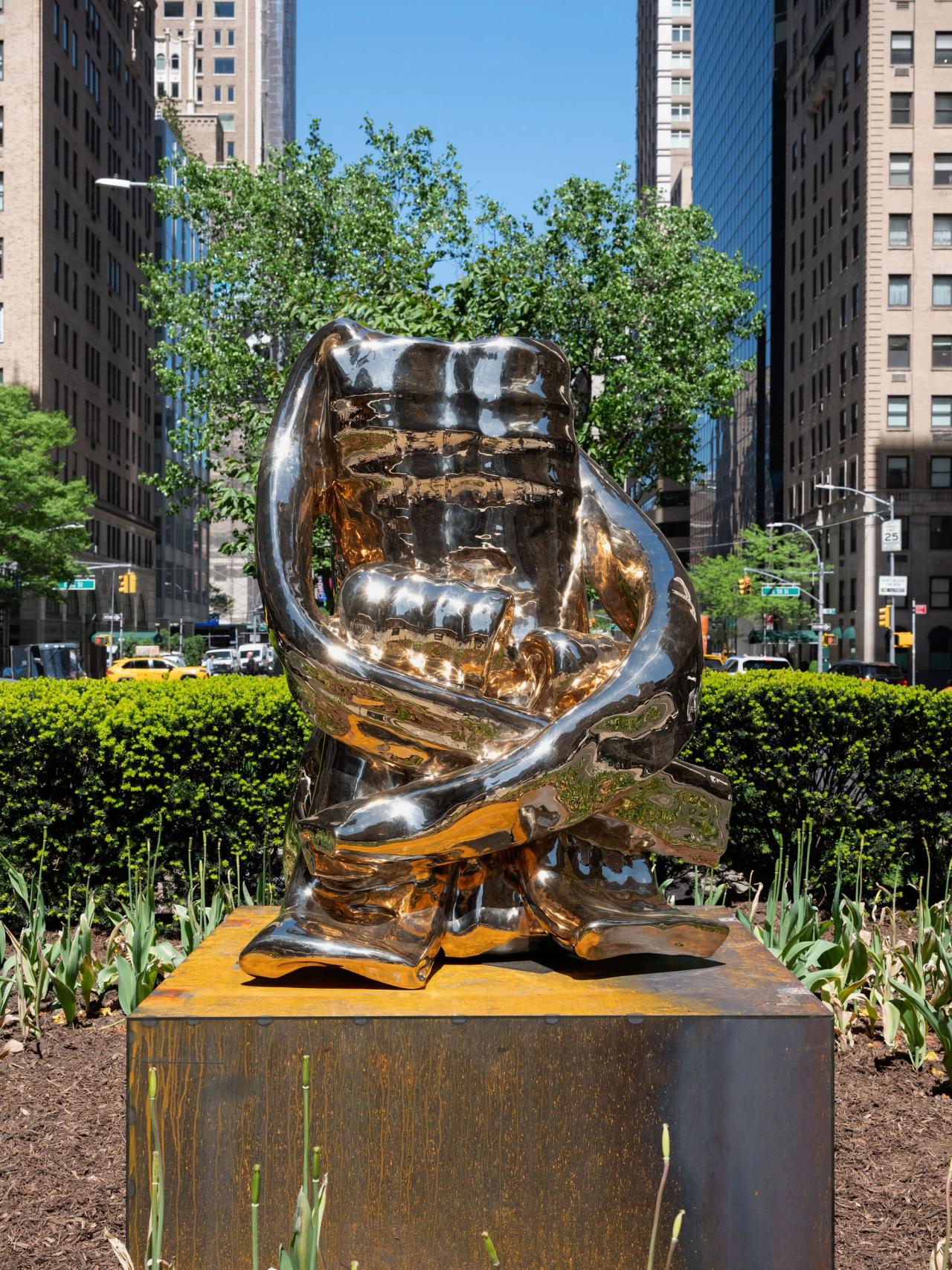
Allen’s “Not Yet Titled” (2025) installed on Park Avenue. (Photographer: Charlie Rubin)
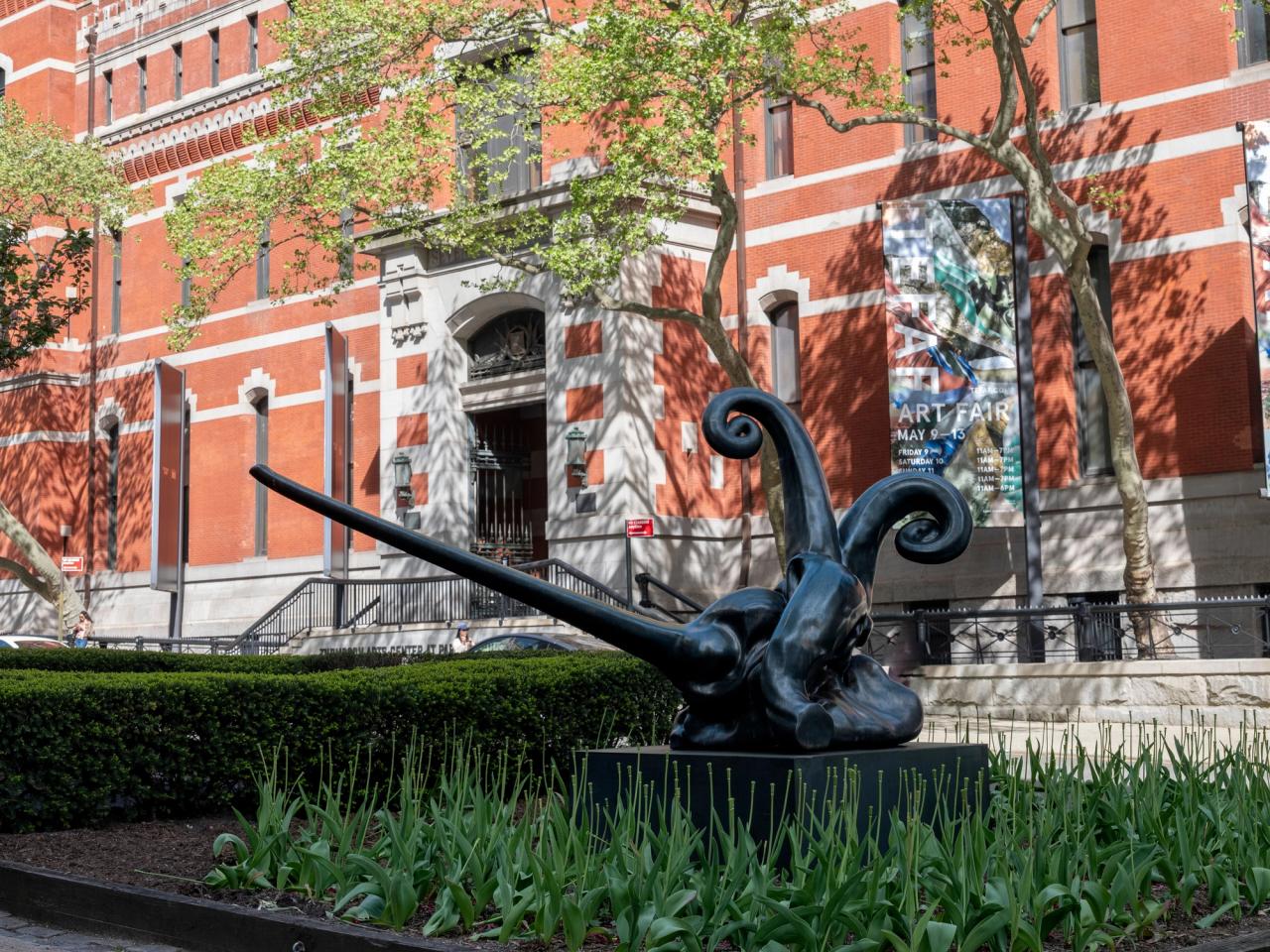
Allen’s “Not Yet Titled” (2024) installed on Park Avenue. (Photographer: Charlie Rubin)
Allen’s “Not Yet Titled” (2025) installed on Park Avenue. (Photographer: Charlie Rubin)
Three of Allen’s “Not Yet Titled” sculptures installed on Park Avenue, made in 2025 (left and center) and 2024 (right). (Photographer: Charlie Rubin)
Allen’s “Not Yet Titled” (2025) installed on Park Avenue. (Photographer: Charlie Rubin)
Allen’s “Not Yet Titled” (2024) installed on Park Avenue. (Photographer: Charlie Rubin)
Allen’s “Not Yet Titled” (2025) installed on Park Avenue. (Photographer: Charlie Rubin)
Three of Allen’s “Not Yet Titled” sculptures installed on Park Avenue, made in 2025 (left and center) and 2024 (right). (Photographer: Charlie Rubin)
Allen’s “Not Yet Titled” (2025) installed on Park Avenue. (Photographer: Charlie Rubin)
Allen’s “Not Yet Titled” (2024) installed on Park Avenue. (Photographer: Charlie Rubin)
SB: Tell me about Park Avenue, which you did last year. I think it was ten sculptures lined up along Park Avenue.
AA: Yes.
SB: That must have been a kind of full-circle thing, even thinking back to that walk you made on day one in New York.
AA: Yeah. Actually, it was the first time I did walk on Park Avenue, but I realized when I did the site visit to start designing the pieces was the only other time I’d walked like thirty blocks of Park Avenue, which was interesting, except for that one time when I first got to New York. I walked a long stretch of Park Avenue. Some of the pieces were already made. But some of the pieces were like trophies to capitalism, which is totally appropriate for Park Avenue.
SB: Right.
AA: I mean, there’s other things and other meanings in the pieces, too.
SB: You’re dealing with so much scale there.
AA: It’s New York. It’s like this city is so...
SB: Yeah.
AA: But it was an interesting context.
SB: I loved the dialogue with the Seagram Building, that work in particular.
AA: Yeah. I liked doing it. It’s an interesting context for sure. I wish everything, maybe I can for the rest of my— I’ll do shows in strange, like not normal spaces. We’ll see.
SB: I didn’t bring it up yet. I wanted to ask you about humor. I guess we’ve been laughing quite a bit, but your works evoke what the curator Douglas Fogle has called, “a rambunctious, humorous and intrepid dynamism.” Sometimes with a “vibe” that Jonathan Griffin in that same Apollo magazine piece describes as, “sort of cartoonish or hilariously so, as if Disney ears or noses or cactus petals are sprouting from rocks.” Do you view them this way? What role does humor play for you?
AA: Some of it. I find a lot of ancient art from Peru and from Mexico to be humorous, too. I’ve always found it… Like the Colima ceramic dogs and the little soldiers with ridiculous outfits and in Peru, there’s amazing stuff that’s very humorous and gentle, in a way. So yes, I like to make, maybe it’s just the state of mind I’m in when I’m making it.
SB: Were you able to still have some fun with the Venice pieces?
AA: Sure. There’s a lot of secret fun. A couple of the pieces are obviously influenced by Pokémon—my daughter has been obsessed with Pokémon—so we’ll see if that comes across.
SB: I guess this is a good place to end. Finishing this conversation back at the U.S. Pavilion, do you have hopes for how people see the work? You’ve previously said, “I usually assign myself an audience when I make the work.” Who’s the audience here? What do you hope people feel or think after they walk out of the pavilion?
“The way I approach making art is not dissimilar to improvisational music. I work with my hands over and over and over again until I find the thing that I’m making in the thing.”
AA: It’s hard for me, because I haven’t really been willing to talk about it very much. Also because no one’s really cared to ask either, so that’s part of it. I think it’s a lot like how writers work and how musicians [work]. I feel as much that it’s the way I approach making art is not dissimilar to improvisational music.... I work with my hands over and over and over again until I find the thing that I’m making in the thing. And since I’m a little bit suspicious that we’re all one single consciousness, if you’re going to actually use that single consciousness’s experiences to make something, that’s even better.
If I’m going to almost use my hands as a vehicle to make... Because if I’m surprised by the thing that I’ve made, it’s even more interesting. If I didn’t conceptualize it and literally— Because I have made sculptures where, stone carving takes a long time, so sometimes you’ll do a big-scale stone piece for many months and it’s not that interesting. [Laughs] I like to have an experience where something new is happening. , sometimes you can do it for that repetitive labor, have a moment of... That can be very pleasurable, losing track of time, like we talked about.
SB: I think this continuum thing also connects to this idea of you back looking at those cave paintings. There’s the primordial, the across-time nature of making art, of how your art connects to ancient art.
AA: I hope so. Yeah. I think of them as contemporaries— especially Olmecs. Obviously, they were making art for art’s sake. They weren’t even making art. There’s a lot of amazing ancient art that is not formal, not formal in the way that we do formal, but that’s court art, where it’s pictures of rulers or paintings of sculptures, of pharaohs or whatever. But there’s a lot of cultures in the past where it’s like, no, this is actually just art in the same way that I perceive it. They’re looking for something, maybe the little corner of when they sing around what reality is, maybe the same instinct.
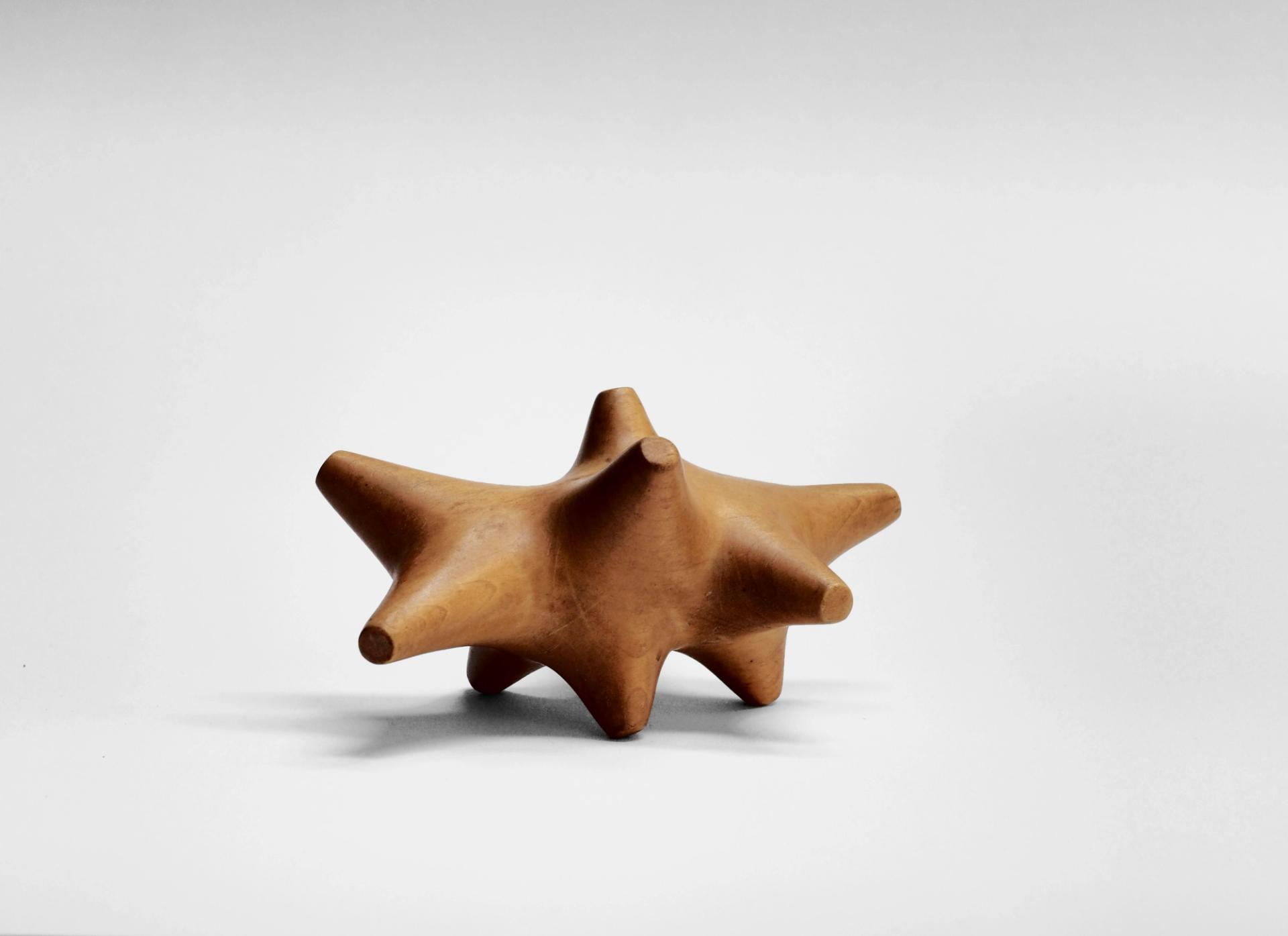
Allen’s “Not Yet Titled” (1999). (Copyright Alma Allen).
“Hopefully there will be some people who have no preconceived notion of what it means and who the artist is and don’t think it’s propaganda, don’t think it’s one thing or another, but approaches it openly.”
AA: In the past, a lot of times, it was a specific audience. This time, it’s a lot of people, but hopefully there will be some people who have no preconceived notion of what it means and who the artist is and don’t think it’s propaganda, don’t think it’s one thing or another, but approach it openly and for its own… That they come to the judgment on their own terms of what it is. That’s what I find interesting to make as art. My interest is that moment of creation between a viewer. Hopefully something that I did that opens up something for them to see differently. Sorry, this is my lack of practice at talking about my work.
SB: No, I totally get... art as a portal, I think the most profound art experiences are when you walk into something, experience it, and walk out changed.
AA: Yeah. It still happens to me all the time. Maybe I’m really easily swayed or something [laughs], but I love that part of seeing art. The last thing I’ll do is look at a wall text. I’ll go straight to the art, entire museums, and not read a single word. That’s my way of approaching art.
SB: Feeling.
AA: Then later, if I remember a piece, I’ll be like, “Who made that? Where did that come from?” And then I go back into understanding what it was, from the point of view of who made it, what did they intend by it, instead of purely looking at them as art disconnected from a specific person or a specific time period or a specific ideology..
SB: Let’s end there. Thanks, Alma. This is great.
AA: Okay. Thanks for having me.
This interview was recorded at Alma Allen’s home in Mexico City on March 20, 2026. The transcript has been slightly condensed and edited for clarity. The episode was produced by Olivia Aylmer, Ramon Broza, Mimi Hannon, and Johnny Simon. Illustration by Paola Wiciak based on a photograph by Luis Garvin.