Follow us on Instagram (@slowdown.media) and subscribe to our weekly newsletter to receive behind-the-scenes updates and carefully curated musings.
TRANSCRIPT
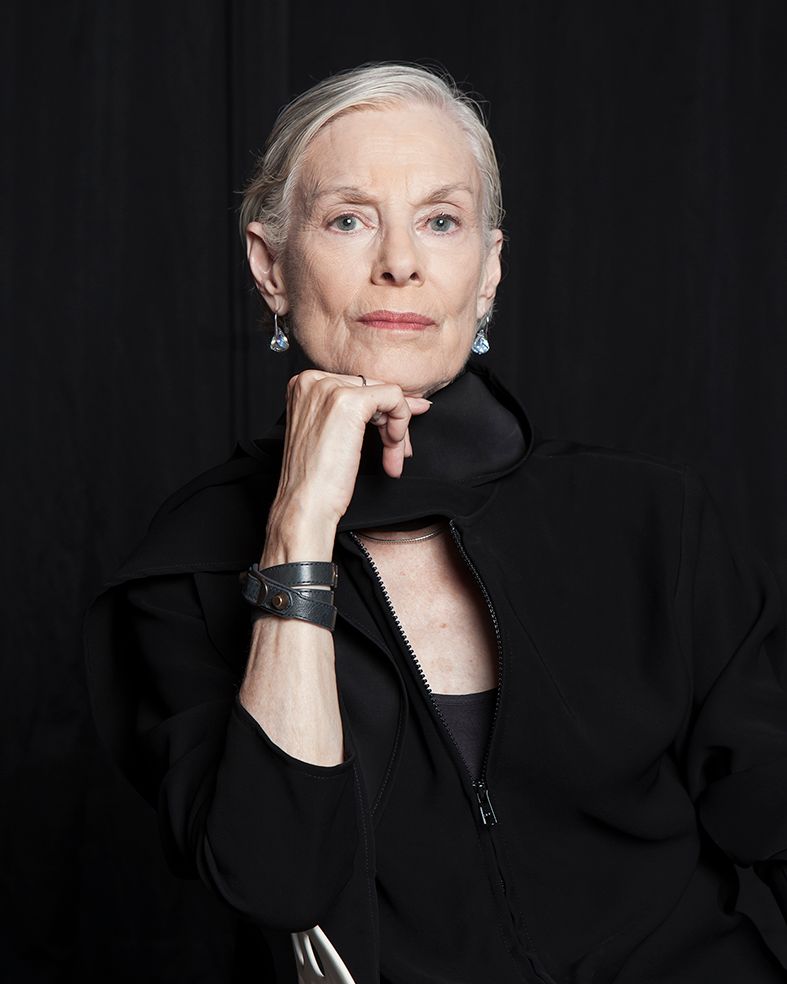
Lucinda Childs. (Photo: Rita Antonioli)
SPENCER BAILEY: Hi, Lucinda. Welcome to Time Sensitive.
LUCINDA CHILDS: Hi.
SB: I wanted to begin by asking how you think about time in your work, because often I’ve seen quotes or read things where you’re talking about space or geometry. But time is this really key element at play. It’s safe to say your work is known for its ability to almost dislodge people from time, at least in terms of how people perceive what they’re looking at. There’s certainly emotion, but it’s not dictating a particular emotion, I would say.
Could you just speak to this role of time or the temporal nature that underpins your practice or your work?
LC: Choreography, being a choreographer, it’s very time sensitive, of course, from every point of view. The fact that you walk in and you have a limited time with the dancers. All of that, there’s a lot of pressure. I, of course, try to prepare things. But ultimately talking about the product, which is the choreography itself, time is really an issue. It comes out of a nonnarrative structure—that is to say the minimalist structure of Philip Glass, for example, my first composer who I worked with.
The idea is that things are reintroduced in different ways. People can get into that or not into it as they wish. I’m not there to sort of spell out: “Okay, this is A and here’s B, but then A came back, but B is upside down.” I like the fact that it takes people out somewhere, that they don’t necessarily know where they need to be. It’s very open. I love this relationship that the work makes with the audience, that it’s really open.
People have different reactions and relate to it in different ways.
SB: Do you feel like this power of dance that you’re talking about—the ability for it to take us out of where we were before and where we may be going after a performance—feels like something that we could argue is vital in these times?
“It’s really for those people out there at that moment that we’re projecting and dancing and working toward that encounter.”
LC: Yeah, we have the two-dimensional versions of my work, which is, as you know, film and video. It’s not the same. It’s really meant to be there, with the people there, in that moment. That’s what makes it so special, and that makes it so fragile, in a way, as an art form. It’s really for those people out there at that moment that we’re projecting and dancing and working toward that encounter.
SB: Yeah. I think there’s an intense concentration required in the act of the dance, but I think also in the viewer, in some ways. Many critics have noted your performances have this profound presence. There’s a “pure movement,” I’ve seen it be called, this idea of these repetitive sequences of walking, running, turning, skipping, jumping—and so rigorously executed. There’s a hypnotizing quality that overtakes... I can’t speak as a dancer, but I can certainly speak as someone sitting in the audience. It overtakes you, and it almost distorts or takes you out of time. Do you see it that way?
LC: Well, I think that the movement material is simple, really. Some of it pedestrian, some of it slightly balletic. There is no “Lucinda Childs vocabulary,” really. It’s all found movement, a movement that kind of exists. It’s how it’s put together and how it’s structured and the style. That’s what is interesting for me to develop with these, as I say, pedestrian and balletic things. They’re both things that people wouldn’t necessarily say they would belong together, and they don’t. But in my work, they do.
SB: I want to talk about your early works, because they’re going to be re-presented soon at the Guggenheim Museum here in New York—five of them, out of the sixteen silent works that you created. You’ve coined a term for when the dancers are sustaining a pulse among themselves as a team. You call it “a cappella dancing.” I love this. I’d never heard this term before. I wanted to ask you about this notion of a cappella dancing. How do you define it, and how does it come to life for you?
LC: Before meeting Philip Glass, I didn’t have music at all. In fact, when I observed the [Merce] Cunningham [Dance] Company—before collaborating with John Cage, or in connection with the music of John Cage, which they sometimes didn’t even hear until performance. But in this case, just in the silent works, the dancers have to maintain a steady pulse, and it takes a lot of teamwork. I like the fact that we work with certain phrase material that has the same length, so different phrases can be contrasted together. It’s very demanding for the dancers. And the a cappella part of it is they don’t have a score. They really just have the whole memory of the piece in their head, and they share, as I say, the collective pulse of the music, which is the dancing, the sound that the dancers make.
SB: Yeah. Which, I guess, then becomes a form of keeping time.
LC: Exactly. Yeah.
SB: I also love that you called it pedestrian, this idea that you’re taking movements from pedestrian life.
LC: Yeah. As you said, the skipping, the walking around.
SB: This got me thinking, because I think we often walk outside and we don’t look at life as a dance or we don’t see the choreography of what’s happening around us. Given all your experience, all the thinking and work you’ve done as a choreographer, what do you think we could learn from looking at the world that way?
LC: Well, for me, the idea of looking at the world that way in my work is conceptual, because you can draw more attention to how it’s made or what kind of process they’re going through, as opposed to just content—you get a little bit beyond the content. Because the content, in fact, originally when these first works were performed, they would say, “All they do is run around and skip around. And very repetitive. They do the same thing over and over.” [Laughter] It’s not repetitive, although there are certain things that come back, but it never comes back in the same way.
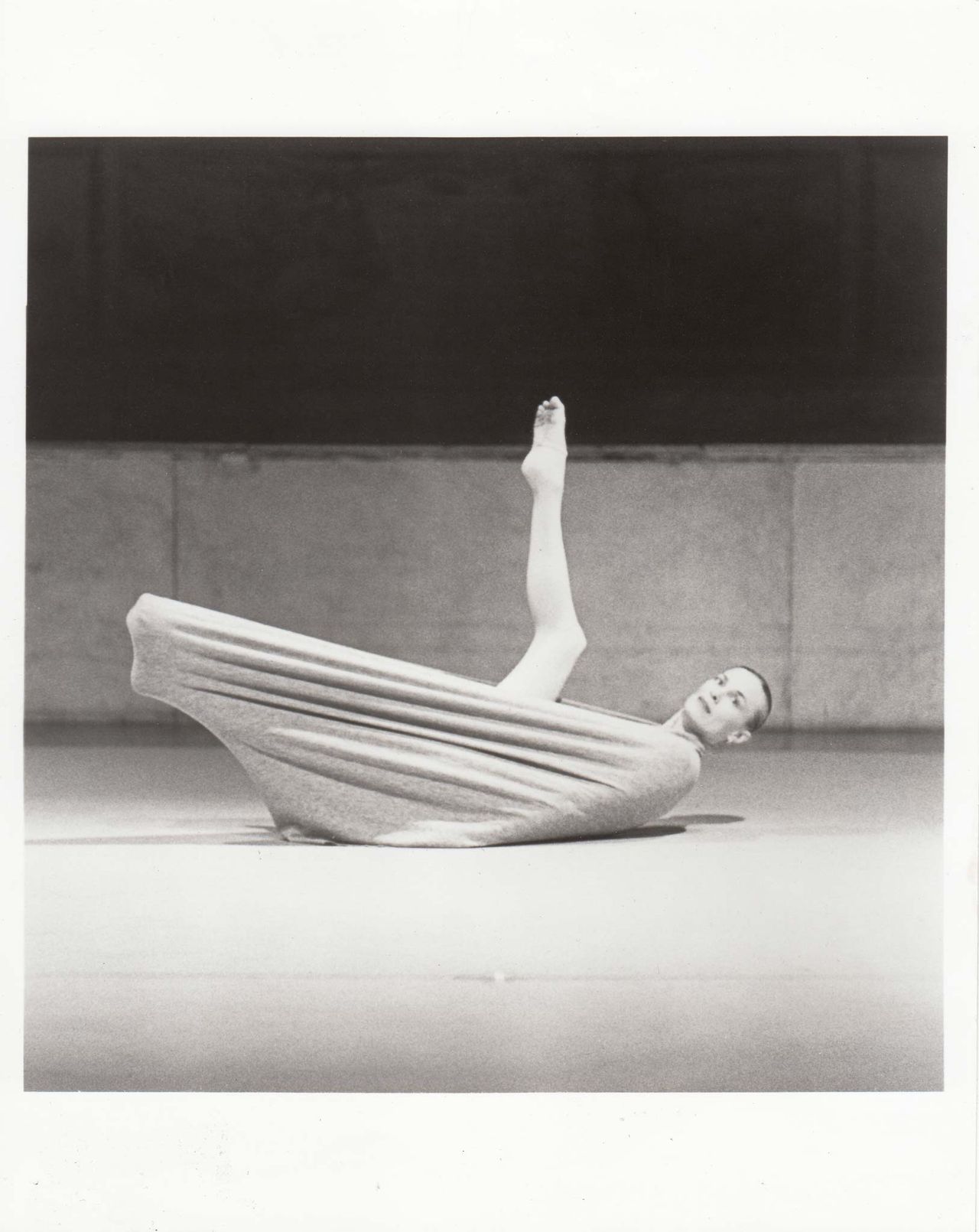
Lucinda Childs performing “Pastime” (1963) at the Judson Memorial Church in 1990. (Copyright Tom Brazil/Courtesy Lucinda Childs and The Pew Center for Arts & Heritage)
SB: So, turning to “Early Works,” I wanted to talk with you about some of the pieces that’ll be performed at the Guggenheim. Let’s start with “Pastime,” from 1963. In the original performance, you were reclining on the floor wrapped in this stretchable cocoon of blue fabric. This was your first solo piece and your first Judson Dance Theater work. Here, I think it would be helpful to share with the listeners a little bit about Judson Dance Theater, what that was, and the significance of “Pastime” for you.
LC: Well, I was at Sarah Lawrence College in 1959 and they announced the guest teacher would be Merce Cunningham. And we looked at each other, “Who?” I didn’t know Merce Cunningham.
[Laughter]
SB: Oh, wow. So you’d never heard of him?
LC: No.
SB: Wow.
LC: 1959. He hardly performed in New York, mostly in Europe with a small company. Anyway, I was just so thrilled with the class. I had to know, where was his studio? This is where I want to be. I want to work with him, I want to study with him, which I did.
Shortly thereafter, I ran into Yvonne Rainer, whose performance I had seen at the Judson, where she dances and walks and talks. And it was just an amazing performance and I was overwhelmed by her performance, completely. She told me, “Well, you should come to this group that we have over at this Judson Church. They’re letting us use their space.” And I said, “Okay.” It was so wonderful to be invited. It was so special to have that invitation to come. I decided to show them a piece that I’d been working on, with the tubular fabric, called “Pastime.”
I presented it to the group in the workshop and I would say the maître d’, the person who ran the company, Robert [Ellis] Dunn, who was a colleague of John Cage and also a composer, was running the workshops and helping us plan the programs. In fact, he was really deciding which kind of works could go together. There were these, not monthly, but almost bimonthly, every two or three months, we would do a performance at Judson, and he put me in the 1963 performance. It was my first time with the group. It was very, very exciting, and I was with the group for the duration of its existence.
SB: Tell me about “Pastime.” What did that mark for you in terms of being…?
LC: I think that, because of the influence of John Cage, which was massive and so important to us, how do you step outside of the dance vocabulary to include pedestrian movement? Do you just improvise? That was a lot of improvisation. I thought, “Well, maybe there are other ways also to look at it, to have movement determined by the manipulation of objects or fabrics.” I like that idea very much.
Moving on to the next piece, “Carnation” and so forth and so on. It was very much a way to develop material that’s outside the dance vocabulary. That was the biggest project for us, was to think in those terms and to explore that with the help, of course, of Robert Dunn, proposing different ideas for the company, different things to focus on for each week, for each presentation, every Monday night when we would meet.
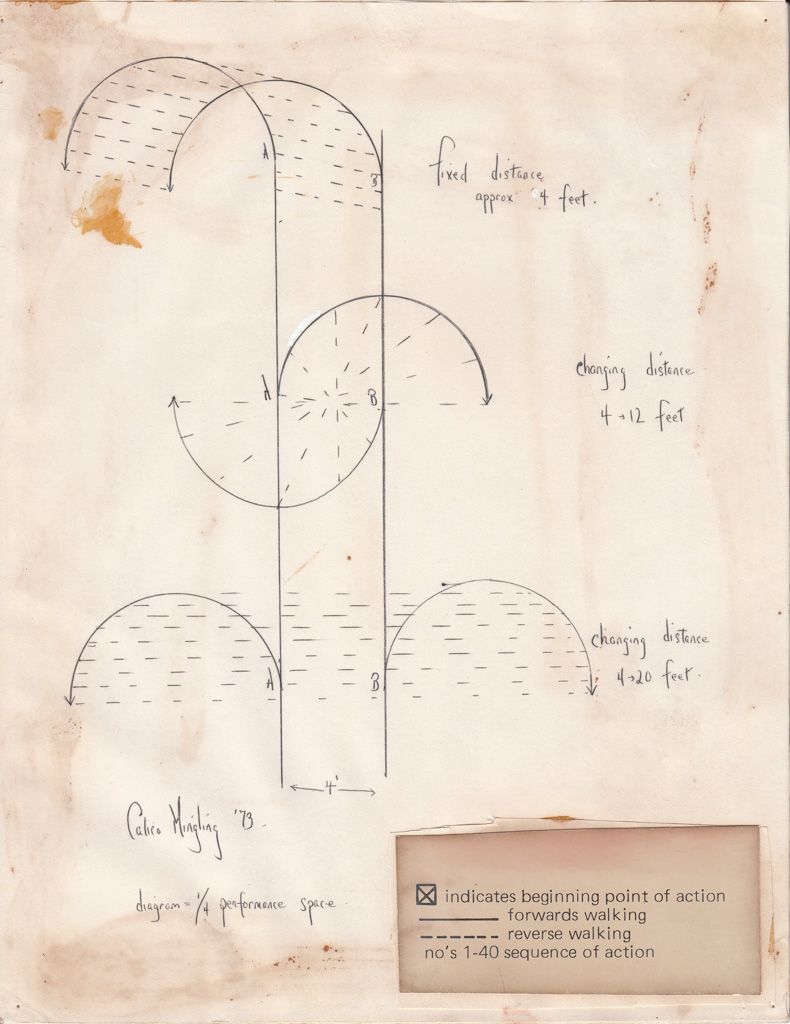
The score of Child’s “Calico Mingling.” (Courtesy Lucinda Childs and The Pew Center for Arts & Heritage.)
SB: The next work being performed at the Guggenheim is “Calico Mingling,” from 1973. This is an important year for you, for a number of reasons. One was that you had your first big performance at a museum, at the Whitney. This was “Untitled Trio,” and you also founded your eponymous company that year. Tell me about “Calico Mingling.” How did that fit into the larger context of your life and work at that time and what you were thinking about?
LC: Well, “Calico Mingling” was a very ... if you break it down, it’s very simple movement pattern of forward and backward walking six paces, semicircular and circular paths in space, six paces, and four different dances with a different score, in which they’re all together and combined together. So, they come together after forty sets of counts and then they reverse it or work on it in different ways.
But because of the presentation at the Whitney Museum, I was interested in the possibility of filming it. Number one, you can’t always hold onto the same dancers forever. I thought, what would happen if one of them leaves? I decided to design a score in case we had a change of cast and I had to know what each dancer did. The score consists of forward and backward lines and space and circular and semicircular path, and there are four different scores, one of them for each dancer.
I also, at that time, collaborated with Babette Mangolte, who decided to film it in the Robert Moses Plaza at Lincoln Center, but she was up on the seventeenth floor of the Fordham building with a camera looking down. People looking at my score, that’s the overhead view.
SB: Oh, wow.
LC: I like the fact that you can see the dancers from the overhead view. So, you can read the score simultaneously with seeing the dance.
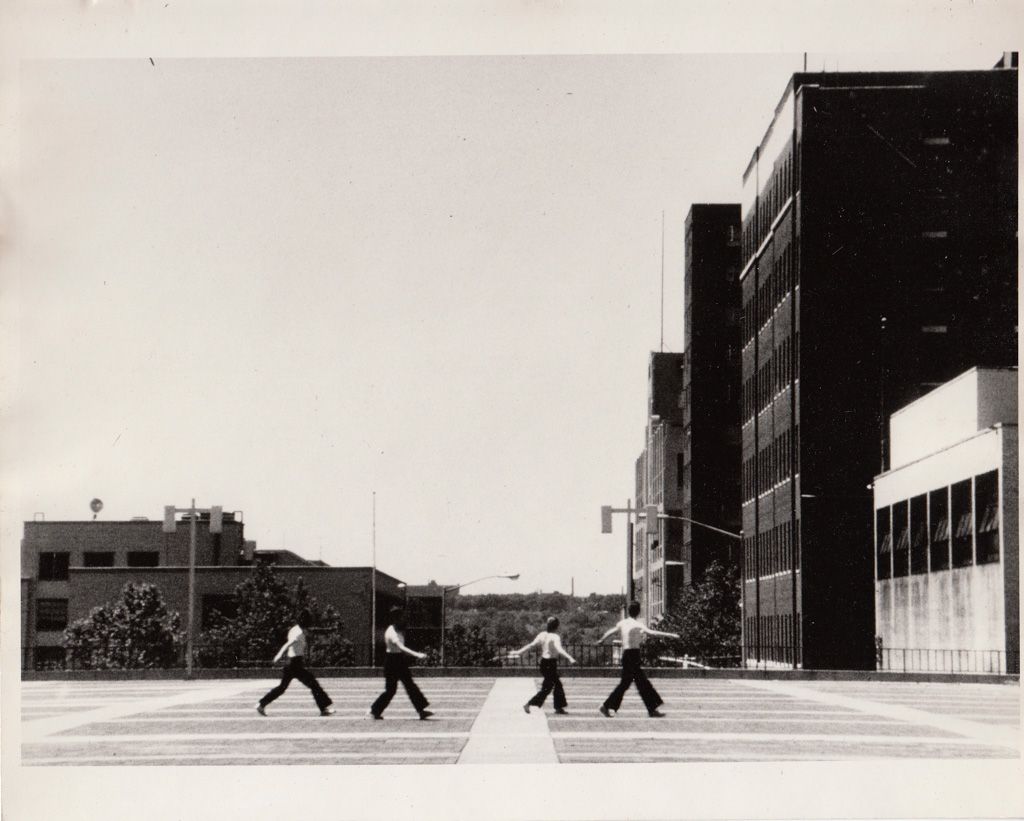
Child’s “Calico Mingling,” performed in 1973 at Fordham University’s Robert Moses Plaza in New York. (From left: Susan Brody, Childs, Nancy Fuller, and Judy Padow.) (Photo: Babette Mangolte/Courtesy of the artist, Gallery 1602, and The Pew Center for Arts & Heritage)
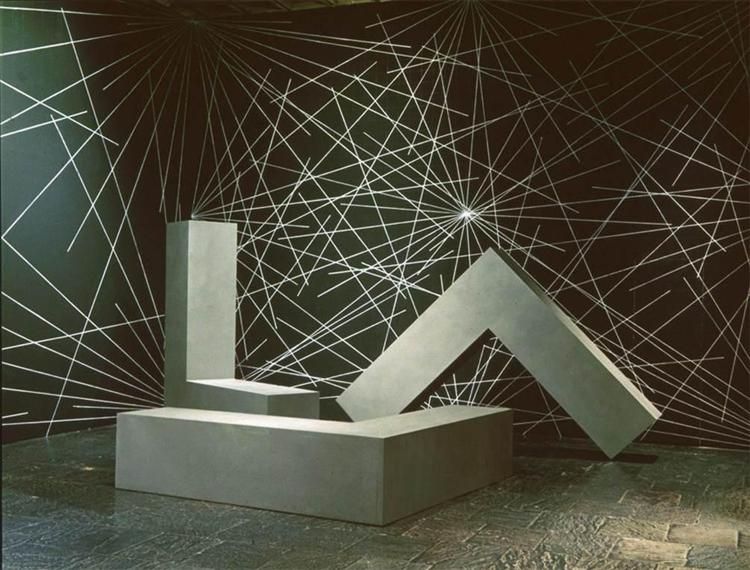
Robert Morris’s “Untitled (L-Beams)” (1965), the inspiration behind Childs’s 1975 piece “Reclining Rondo.” (Copyright Robert Morris)
SB: The next one at the Guggenheim is “Reclining Rondo.” This is from 1975. And I understand it was inspired by Robert Morris, a 1965 sculpture of his, “Untitled (L-Beams)” that consisted of these three identical forms oriented in different directions.
LC: The L-beams.
SB: Yeah. It connects, as Morris’s work does, too, to the philosophy of John Cage and Marcel Duchamp, this idea that the most important thing beyond the work is actually the mental processes that viewers go through looking at the work. Could you speak about how you translated your interests or fascination with this Morris sculpture into movement?
LC: I decided that for “Reclining Rondo,” which was inspired by that, I would use three different dancers focused in different directions... but similar, always the same orientation would shift between them, between north, south, east, west. In that way, you would explore. What happens with this kind of work is you realize that the possibilities are endless. It could just go on all night, if you explored all the possibilities. But I don’t explore all the possibilities. I choose some of them. “Reclining Rondo” is a little bit of a reduced version of what can happen with just these three simple orientations of three dancers in the space, working on these three different diagonals.
SB: I read also that you were pulling from years spent in ballet class, the studies you had with Merce Cunningham, thinking about your understanding of movement from these experiences. Could you elaborate on that a little bit? How your time in ballet class or studying under Cunningham informed this particular…?
LC: Well, I felt it was essential, because I remember once auditioning for Lucas Hoving, one of the famous [José] Limón dancers for some of the works that were being presented at the Y in New York. I thought, well, I’ll audition. I probably won’t want my work, but I’ll just audition anyway. Lucas Hoving, he looked at us, several of us came to audition for this and he said, “These people study ballet. Why on earth do they study ballet?”
Well, it’s our training. We’re dancers. We have to continue to train. Even if I’m going to a Yvonne [Rainer} rehearsal and I’m carrying mattresses, it doesn’t matter. You go to ballet class and then you go there. I just felt I have to keep my training. I can’t just let that go. It’s who I am. It’s what we are as dancers.
SB: I also wanted to bring up, because “Reclining Rondo” was so complex, it resulted in you having to create a visual score, this diagrammatic chart, which is almost like showing the architectural elements of the dance. You’ve done that since, more or less, for all your dances. Tell me about that moment of realizing you had to draw a chart and also its impact on your thinking and process.
LC: Well, during a rehearsal, I could scribble some notes, but I needed a way to refer to the work, the progress. Because of the visual arts community [being] so close and my involvement, I knew Robert Morris, and Rauschenberg, of course, was also involved. I felt that I wanted to take the time to see what it looked like carefully placed in the way that Sol LeWitt—one with one, one with two, one with three, one with four, all the way through and then two with two, two with three—to put in boxes so that you can look at it all together and experience it collectively. It’s a version of the dance with the element of time removed, because you can just see it in a flash. You can see it in a few seconds. I liked also that this gives you another way to look at the dance.
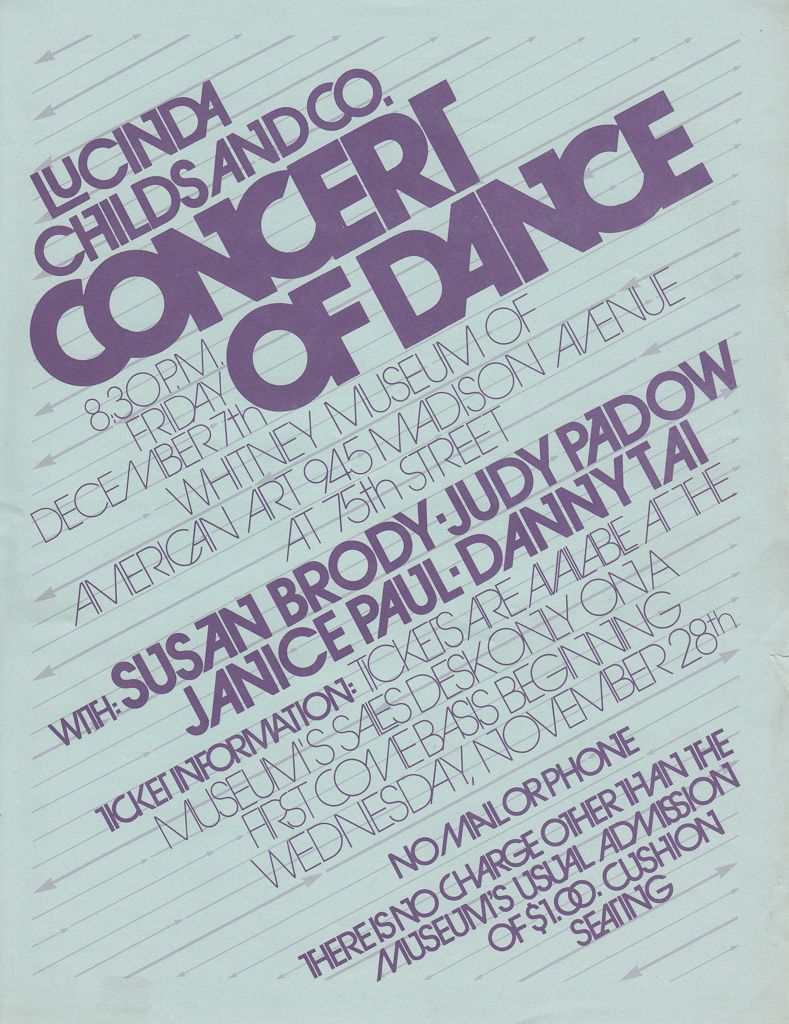
The program cover for the Lucinda Childs Dance Company’s performance at the Whitney Museum of American Art in 1973. (Courtesy Lucinda Childs and The Pew Center for Arts & Heritage)
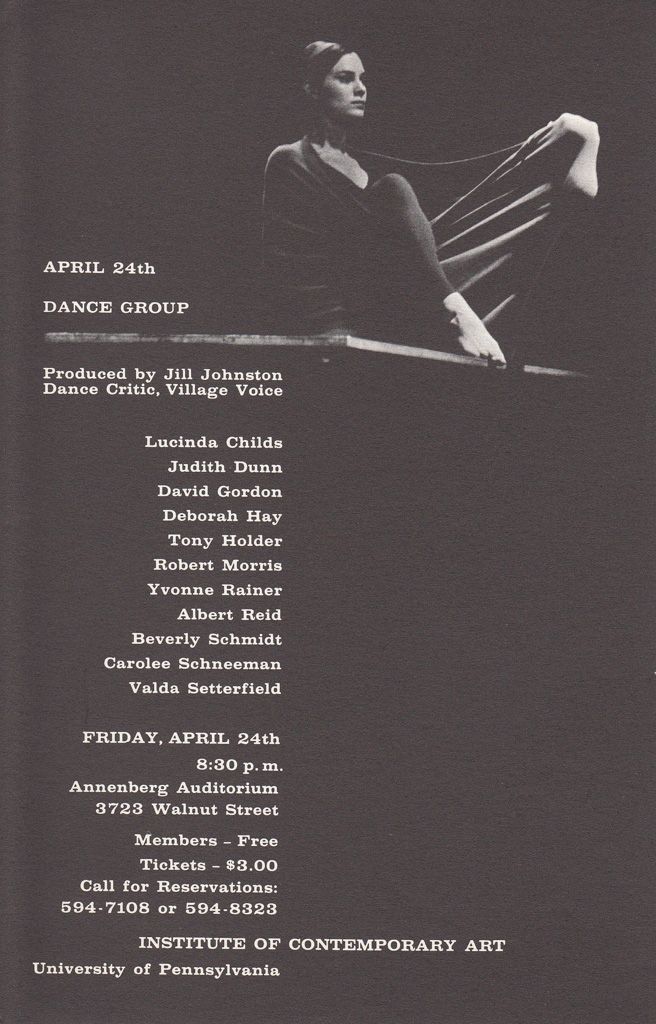
The program cover for Childs performance of her solo “Carnation” at the Institute of Contemporary Art in 1964. (Courtesy Lucinda Childs and The Pew Center for Arts & Heritage)
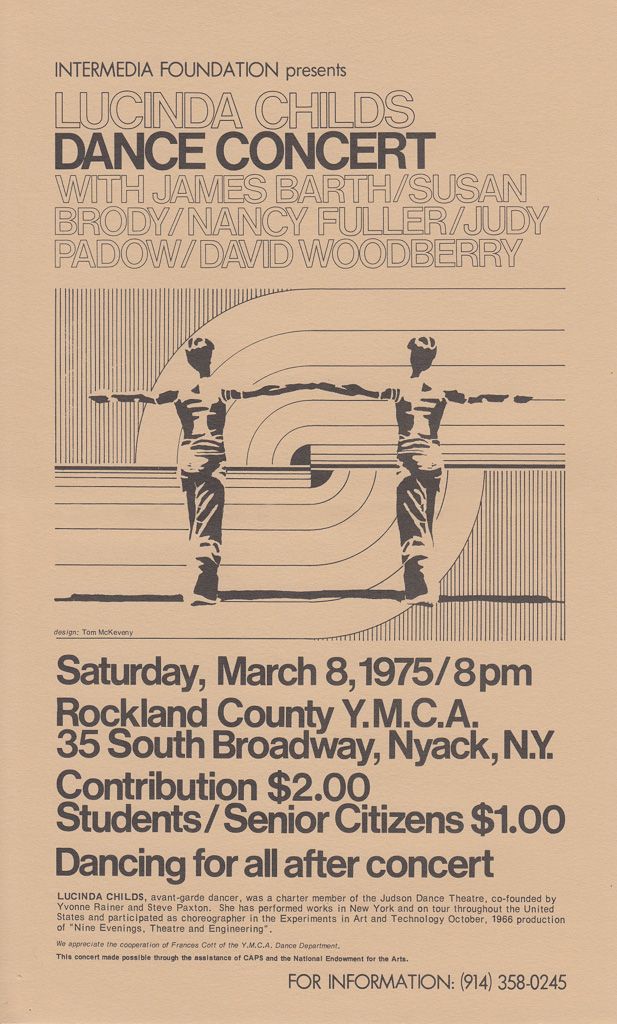
The program cover for the Lucinda Childs Dance Company’s performance at the Rockland County Y.M.C.A. in Nyack, New York, in 1975. (Courtesy Lucinda Childs and The Pew Center for Arts & Heritage)
The program cover for the Lucinda Childs Dance Company’s performance at the Whitney Museum of American Art in 1973. (Courtesy Lucinda Childs and The Pew Center for Arts & Heritage)
The program cover for Childs performance of her solo “Carnation” at the Institute of Contemporary Art in 1964. (Courtesy Lucinda Childs and The Pew Center for Arts & Heritage)
The program cover for the Lucinda Childs Dance Company’s performance at the Rockland County Y.M.C.A. in Nyack, New York, in 1975. (Courtesy Lucinda Childs and The Pew Center for Arts & Heritage)
The program cover for the Lucinda Childs Dance Company’s performance at the Whitney Museum of American Art in 1973. (Courtesy Lucinda Childs and The Pew Center for Arts & Heritage)
The program cover for Childs performance of her solo “Carnation” at the Institute of Contemporary Art in 1964. (Courtesy Lucinda Childs and The Pew Center for Arts & Heritage)
The program cover for the Lucinda Childs Dance Company’s performance at the Rockland County Y.M.C.A. in Nyack, New York, in 1975. (Courtesy Lucinda Childs and The Pew Center for Arts & Heritage)
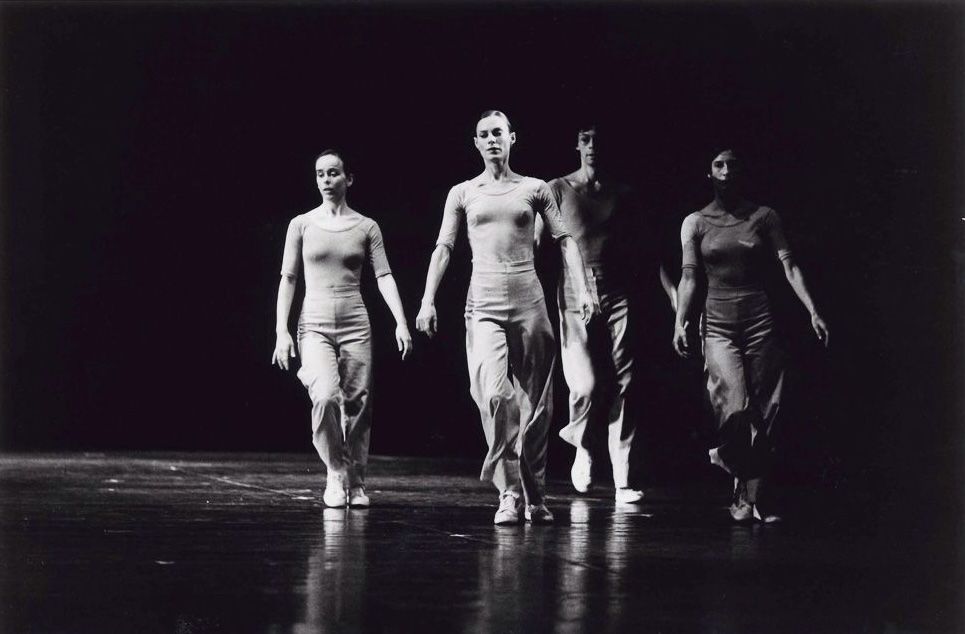
Childs (second dancer on the left) performing in “Radial Courses” (1977) as part of the Festival International de la Danse at the Théâtre Champs-Elysées in Paris. (Copyright: Babette Mangolte/Courtesy the artist, Gallery 1602, and The Pew Center for Arts & Heritage)
In addition, these scores are very useful and very important and help us when we’re asked, for example, to go to the Guggenheim and reconstruct something, the dancers can use the score. They understand what it means. They can work with it. They can understand it.
SB: Yeah. It’s not unlike a musical score, in a way.
LC: Exactly, yeah.
SB: The final two pieces that’ll be performed—or reconstructed—at the Guggenheim are “Radial Courses,” from 1976, which is the same year Robert Wilson, Philip Glass, and you would debut Einstein on the Beach. We’ll talk about that during this conversation. And also “Katema,” which premiered at the Stedelijk Museum in Amsterdam in 1978. “Radial Courses,” as highly complex as it is, is about as minimalist as it gets. It’s practically reduced to just these mesmerizing patterns of walking.
LC: And skipping.
SB: And skipping and turning in a circle.
[Laughter]
LC: Right.
SB: There’s actually a great [Vimeo] video of some people performing this that I recommend everybody go look at online if they haven’t been able to see this dance.
And then “Katema” was your last dance in silence. Over five sections, it follows this simple walking pattern combined with pivots and backward walking and turns. What’s the significance of these latter two works for you?
LC: Well, again, “Radial Courses” is a very simple spatial pattern, to say if four dancers are moving on a semicircular or three-quarter-circle path, they’re dispersed on the circle in different ways throughout. Each section illustrates many of the options possible if you maintain that simple rule that they don’t ever do a full circle. They do only a half circle or a three or three-quarter circle, and the distribution of the dancers on the circle is what fascinated me. How many different kinds of ways, depending if they’re going clockwise or counterclockwise, how many dancers are doing a semicircular, where they begin the circular from twelve o’clock, three o’clock, six o’clock, nine o’clock. It was really an exploration, which I developed into a dance because, again, if you try to do all the options, you’d be there all night. There are so many possibilities.
SB: Well, and there’s this beautiful pulse that it creates. It does remind me of some of Philip Glass’s music. There’s this... I don’t even know how to describe it. It’s pulsing for sure. It’s a pulsating sound, rhythmic, ever shifting, almost like the sound of a wave...
LC: Well, the dancers, my company, they get very concentrated before the piece, because if someone goes off, it does kind of fall apart. [Laughs] They try to avoid that. When the other students sometimes learn the piece, I said, “Don’t worry, you can always reset.” Somebody can just say, “Oh, let’s go back, top of section two.” But my dancers, they don’t want to do that—and they don’t, fortunately, never have to. No, they’re wonderful, but they are so concentrated. Don’t ask them how they are, because they don’t want to talk about it.
[Laughter]
SB: Let’s turn here to your upbringing. You grew up on the Upper East Side of New York and your father was a doctor. Your mother was a model. I read that, for you, practicing dance was a way of being at least mildly rebellious. Could you just speak a bit to that? When did dance come on your radar?
LC: I think when I was 16, I wanted to go out to a place in Steamboat Springs that had a theater and dance camp. Somehow I managed to talk them into letting me go. It was my first time going to dance class every day and having theater class every day, not to mention all the other activities, but I was so thrilled with that and I told one of my teachers that when I’m back, my parents really don’t let me go to dance class every day.
I have to do my homework or I have to... She said, “Well, practice by yourself.” And I did. It was wonderful advice. So, I practiced by myself.
SB: I read that you also did get to go see some performances like Alvin Ailey, Martha Graham Dance Company. What are some of those early memories that sit with you still?
“It was wonderful to be in New York and to see ballet and to see Balanchine, to see Graham, to see Alvin Ailey. It was an amazing place to be, to grow up.”
LC: Well, Alvin Ailey was extraordinary, just to see him dancing. I think I was really very lucky to have that experience. It was so special, so powerful. And the same with Martha Graham—so special and so powerful. Even though, in terms of my aesthetic, I moved away from this territory. But it was wonderful to be in New York and to see ballet and to see Balanchine, to see Graham, to see Alvin Ailey. It was an amazing place to be, to grow up.
SB: Before dreaming of being a dancer, you wanted to be an actor, right? When did that come into the picture for you? What were you training or studying to be an actor as a child?
LC: Well, the teacher out in Steamboat Springs, when she told me, “Practice by yourself.” I practiced by myself every day. I also auditioned for her for it to be in a piece. She put me in, and I was really thrilled. And I felt this at Sarah Lawrence also, that I was among... Some of these dancers were professional. They were already in the Graham Company or Paul Taylor Dance Company, Carolyn Adams, for example. I always felt I had to work very hard to keep up to that same level.
SB: The New York City Ballet dancer Tanaquil Le Clercq had a particular impact on you. Could you share a bit about what it was like to meet her and the importance of that encounter?
LC: Yes. My sister and I were, again, in— Not something that happened during the week, it was on the weekend, that we were in a place where they were training in theater and dance. She came in to teach, and I could just faint... She was so beautiful, like a goddess, as far as I was concerned. It was just one of those things that this very small school was able to have someone like that come in. Once in a while—not all the time—but it was just an incredible experience. And then finally to see her performing later on in “Afternoon of a Faun,” that’s the first time I saw her perform. To put those two things together was quite an experience.
SB: You also got to meet and study under the choreographer Hanya Holm.
LC: Yes.
SB: This was also essential to your evolution, in the sense that it was through her that you would meet Merce Cunningham and also, I guess, in turn, Yvonne Rainer. Tell me about Hanya and her—
LC: Hanya, yeah.
SB: It seems like she had quite a totemic presence at the time.
LC: Well, she was a very important teacher, not just for dancers in New York, but for actors, Valerie Bettis, all kinds of people would be in the Hanya Holm class. And I was always there. I was allowed to go on Saturday to the Hanya class. This is before college; I was still in high school. And I loved being able to work with her because she did a lot of improvisation. She developed material through improvisation. She used a drumbeat, and it was a fantastic sense of rhythmical structures going forwards and backwards in space on a figure-eight pattern, this kind of thing. I was also able to go out to Colorado College, where she was teaching full time, and be in a class every day that was following the experience in Steamboat Springs. I was able to study with Hanya, which was just amazing to be with her every day.
SB: And Colorado isn’t necessarily known as the center of dance, but—
LC: No.
SB: Here were these two pinnacle experiences.
LC: I was on the Greyhound bus to get out there.
[Laughter]
SB: Incredible. Well, there’s something I wanted to quote here from a piece you wrote during your Judson Dance Theater years about, in essence, the profundity that can occur within a twenty-second interval. And you write, “If one were to look out of a window and record what could be seen and heard within twenty-second intervals, in one interval, one might notice only wind blowing the leaves of trees, in another a car honking, a child crying, someone shouting, et cetera. There are infinite solutions given the twenty-second interval.” Given this is a show about time, I didn’t even know where to place this question in this interview, but I had to quote from this and bring it up. I was wondering, hearing it now, what it brings up for you.
LC: When I teach, I love to work with that idea, that the possibilities of students just taking a moment in time to sit and frame something for themselves and then interpret it in space, whatever the experience is—doesn’t have to be literal, can be done in any way that you want. Just to get them started on dealing with observation, dealing with what’s around us, and being able to translate that in some way into movement.
SB: On the Judson years though, I did want to ask, because you alluded to it earlier, John Cage, Rauschenberg, you were surrounded by such an incredible community of people. It was during these years you also met Andy Warhol, who directed this film with you called “Shoulder.” Could you share a bit about that experience? What do you remember of Andy and of that film?
LC: Well, he invited all kinds of people to come and do a movie and work with him or whatever. Some of us also were involved with the parties at the Factory. I didn’t, of course, go regularly, but I would go once in a while. It was a fantastic place to be. Meet people, an amazing space.
Anyway, in the invitation that I had, it was my shoulder. I thought, “Well, this is taking an awfully long time.” Turns out he was doing an image of me, not knowing it was not my shoulder anymore. I look like I’m frowning. It ended up being the thirteen most beautiful women, which is sort of hilarious, because Andy, he’s looking around the room and it’s as if he’s forgotten that he turned on the camera, and he’s talking to somebody and everything’s very casual. I just sort of sat there and I was having this long, what I thought was a film of my shoulder, where there is a film of my shoulder, but it also turned into something else.
SB: Also during this time, you met Susan Sontag, who you’ve said that her book of essays, Against Interpretation, was really important to you, that a lot of the ideas underpinning that really informed some of your work. Could you share a bit about that—Sontag, meeting her, and the importance of that work for you?
“If you’re going to do something, go about it for all it’s worth. Don’t hesitate.”
LC: The most important thing was Against Interpretation came out in the sixties and this was the book to read, as far as I was concerned, with Marguerite Duras, the important female figures in our community. The thing that struck me was that it’s okay to be serious, that you can... It’s essential. If you’re going to do something, go about it for all it’s worth. Don’t hesitate. You don’t have to hesitate. Just keep going. Move through whatever it is that’s in the way—there’s always things in the way—and try to get to what you really need to find.
I didn’t meet [Sontag] until considerably later on. I guess it was in the years of Einstein, in the seventies, because this is in the sixties, that, of course, I read Against Interpretation. I met her, and she knew Bob Wilson and she was working on a film, a commission in Italy, from RAI, the TV station. Marguerite Duras and Susan Sontag had been commissioned to make films, and it was through Bob that she asked me to be part of the film. I was in Paris at the time working on a theater production, but anyway, I got away to Venice to meet Susan to talk about this film. I was terrified. She asked me who my favorite poet was. I said who was my favorite poet at the time, and still, in many ways, is Wallace Stevens. She was very impressed. Here’s this choreographer from New York talking about Wallace Stevens. [Laughter] Anyway, we just hit it off, and we had a wonderful time and we got to be friends and I loved working on the film, and we worked together after that.
SB: Well, now I have to ask, what was it about Wallace Stevens’s work that...
LC: “She sang beyond the genius of the sea…” I’m not going to go on, but I know this, it just takes you in to some special place. I’m just very moved by his poem [“The Idea of Order at Key West”].
SB: You later created a work “Description (of a Description)” in 2000, a solo piece based on a Susan Sontag short story.
LC: Yes. It’s actually an essay about Nietzsche. Susan was very interested in Nietzsche. I don’t think she went anywhere without some Nietzsche material. She was always traveling with a lot of books. I found this piece that she wrote, which is a fragment from a diary of Nietzsche where he says, “A man was walking down the street,” and then there’s another sentence later on. In between these sentences of this diary, she fills in, with her own information, what these sentences mean to her or bring to mind. It’s called “Description (of a Description),” which it is. It’s her describing what he’s describing, but in a different way. She agreed to let me use it as a theater piece for performances, which I have done recently, actually, still, even though it was originally created in 2000.
SB: I love how these encounters have such long afterlives. [Laughter]
Let’s talk Einstein on the Beach. This was such an important work for not only you, but also Bob Wilson and Philip Glass—I guess everyone who experienced it in a way, although there was some interesting critical reception. [Laughter] It was this interval-free show that lasted five hours, with every gesture, every word timed perfectly. Even Philip Glass himself has called it, “This profoundly different way of relating to musical theater.” Hilton Als called it, “a landscape of apocalyptic horror and beauty.” Reflecting on it now—fifty years have passed—what do you make of this experience, this extraordinary intermingling of art and ideas and performance?
LC: I think in 1974, Wilson was in New York with A Letter for Queen Victoria, and I had a friend who said, “I think you should go see it.” Because he had been, I think, at BAM doing some Sigmund Freud piece, which I never saw. It was my first chance to see anything of Bob Wilson. And here I was, someone... We worked exclusively in alternative spaces. We did not work in a proscenium space. We did not use music, we did this, we did that. Suddenly I see this amazing aesthetic come through, which was fascinating in terms of the construction of the theater. He does everything. He does the scene design, he does the lighting, he does the concept, and he works with Christopher Knowles, of course, for the text and these wonderful actors. I loved the performance. I just loved the performance. I met him shortly after, and he said he would like to meet with me to talk about Einstein. We set up a meeting that was supposed to be at two o’ clock in the afternoon and I kept getting phone calls. “Yes, Mr. Wilson is held up a little bit, but he’s on his way.” This went on for hours, of course. [Laughter] He did finally arrive, and he did drawings of the entire opera. Of course I was delighted to work with him. I was thrilled to work with him, and we began to work together.
SB: Did you ever anticipate the, let’s say, long-term reaction to Einstein on the Beach would be the sensation that it was?
LC: Not necessarily. No, I think that also working with Philip Glass for the first time was a huge transition for me, and Philip was not accepted in those days in the way he is now. Some people would just say, “Oh, this music is repetitive. I hear the same thing over and over.” The same criticism of me. I thought, “Well, we share the same criticism.” [Laughter] People just think we do the same thing over and over.
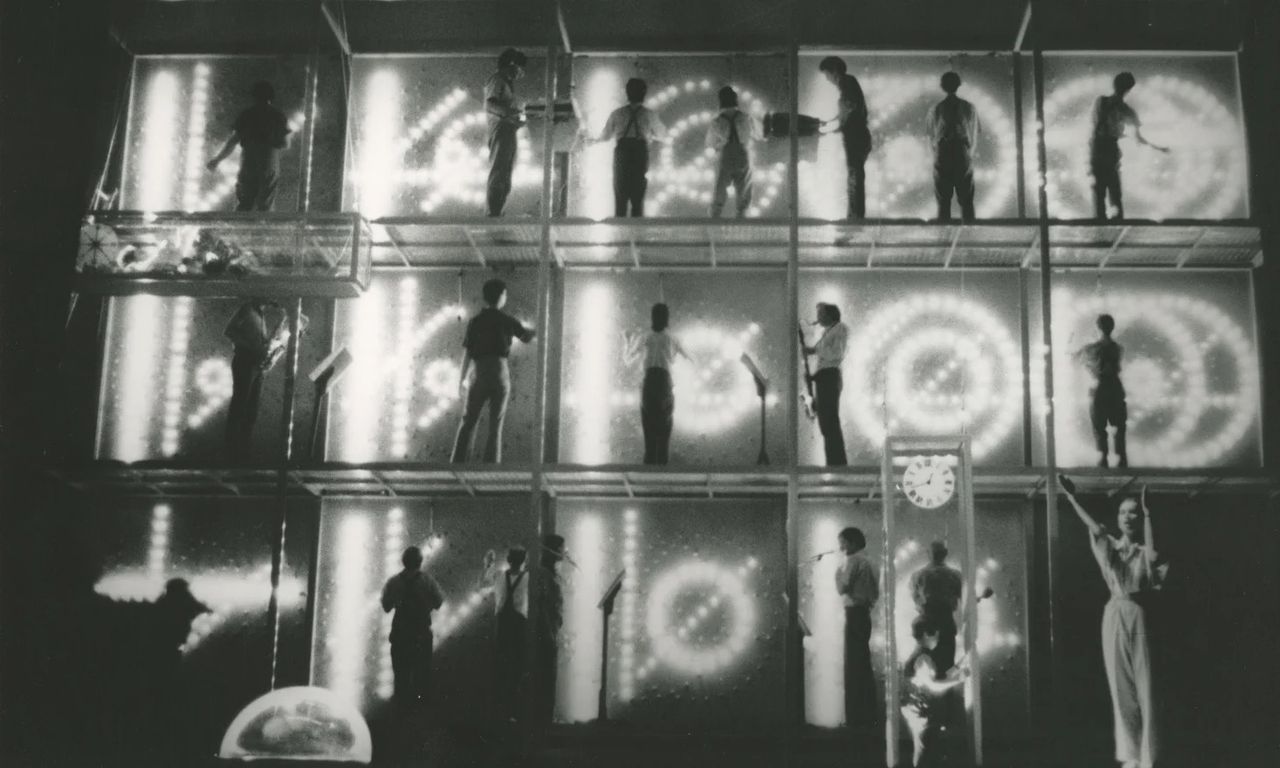
A view of Einstein on the Beach (1976) at the Opéra Comique in Paris the year it premiered. (Copyright Philippe Gras)
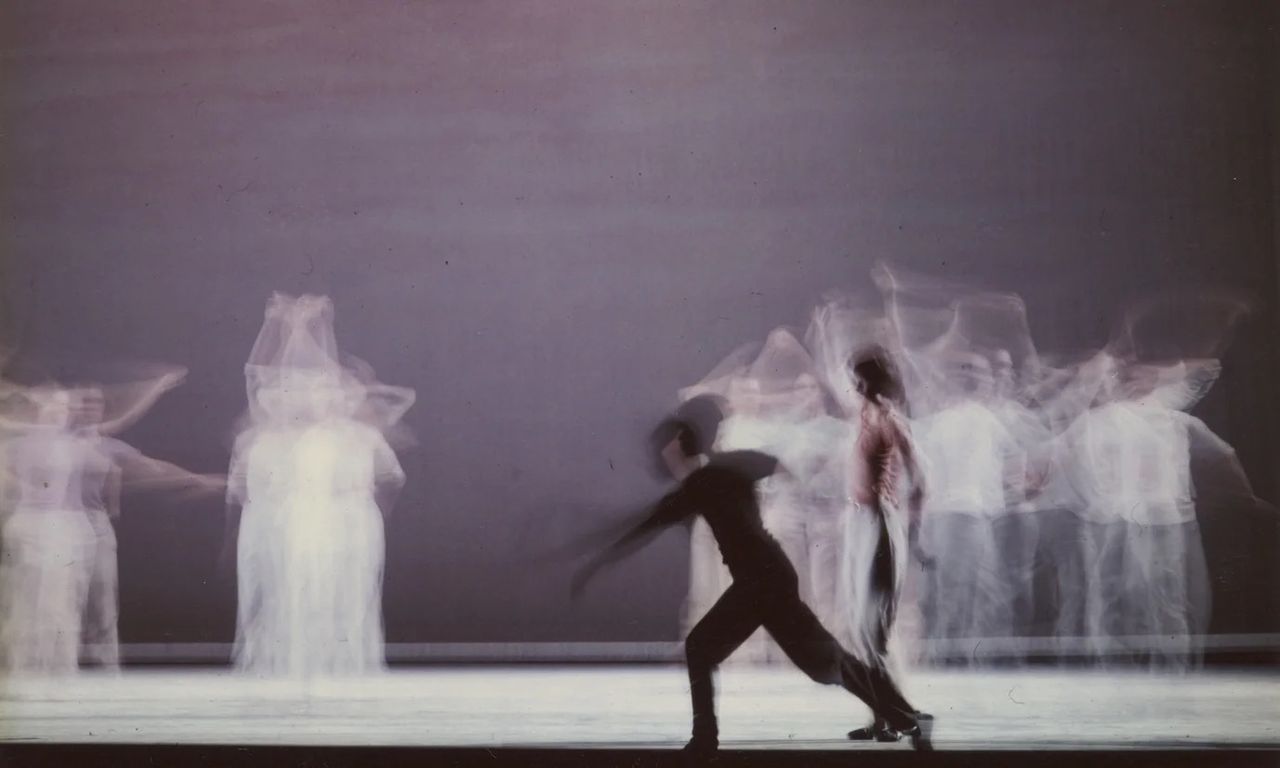
A view of Einstein on the Beach (1976) at the Metropolitan Opera in New York the year it premiered. (Copyright Byrd Hoffman Foundation)
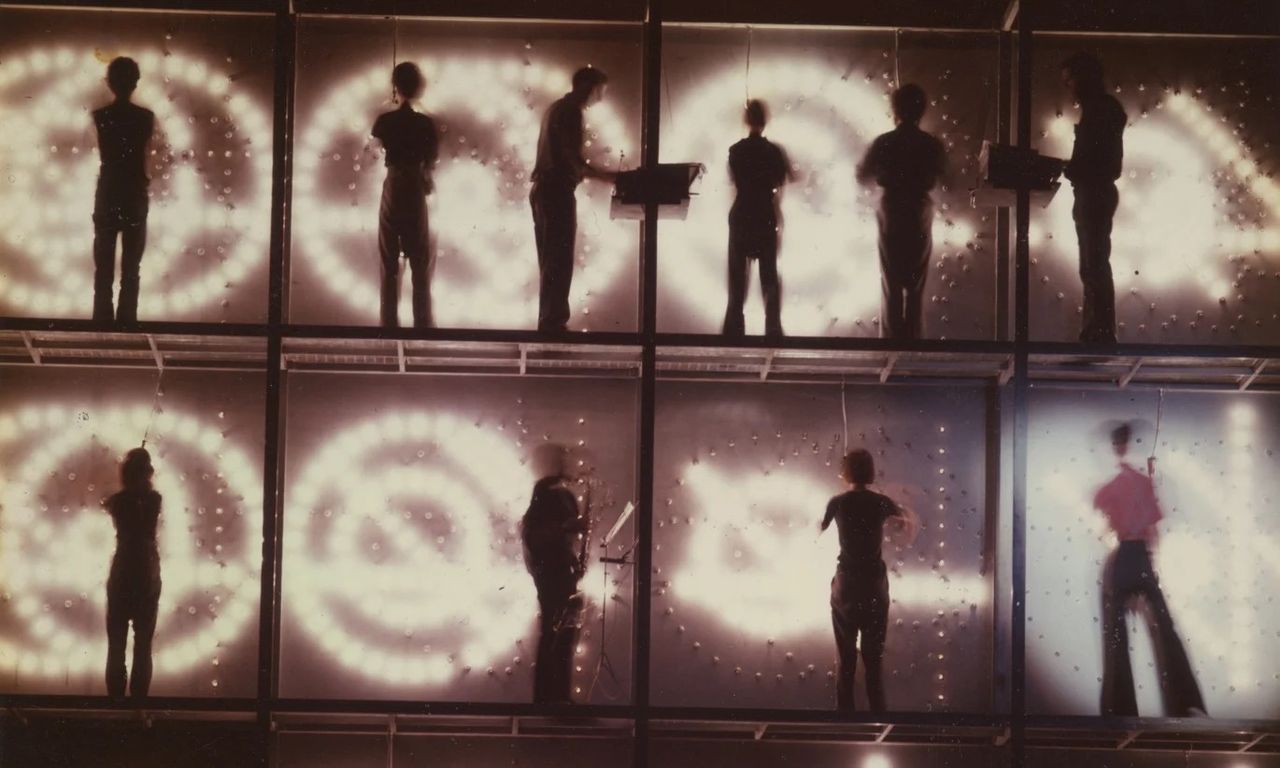
A view of Einstein on the Beach (1976) at the Metropolitan Opera in New York the year it premiered. (Copyright Byrd Hoffman Foundation)
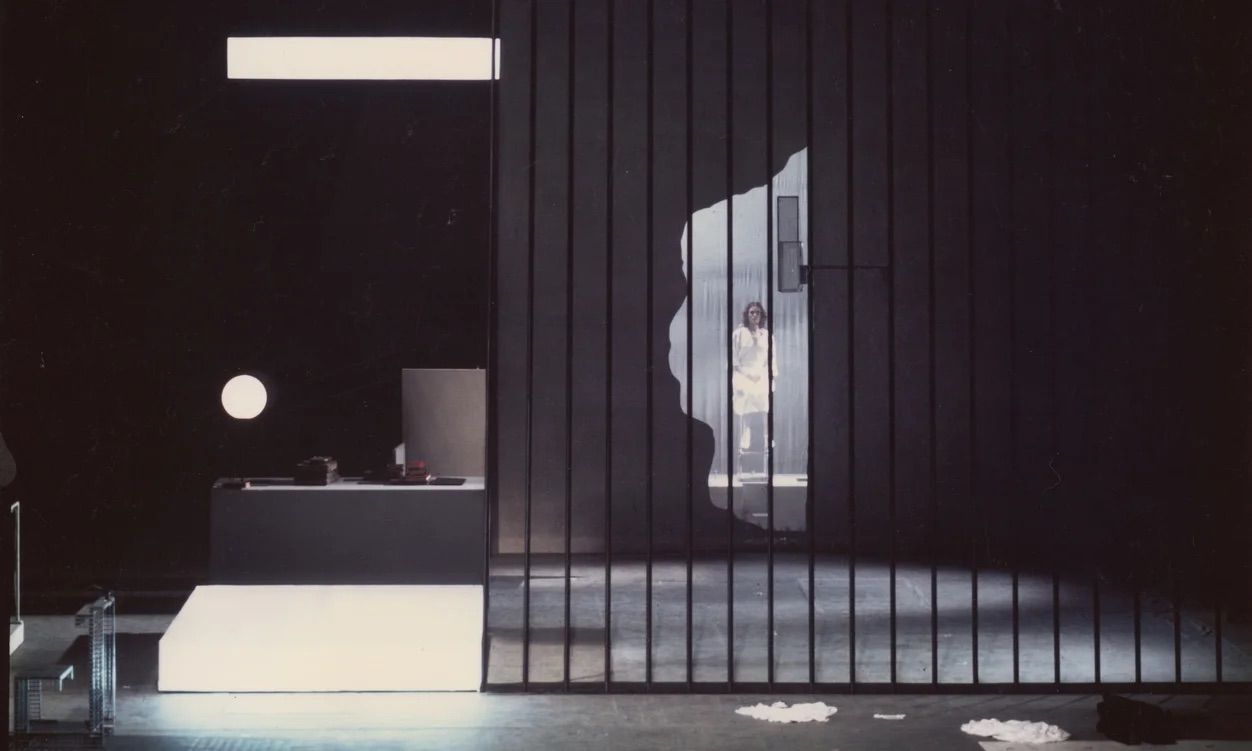
A view of Einstein on the Beach (1976) at the Metropolitan Opera in New York the year it premiered. (Copyright Byrd Hoffman Foundation)
A view of Einstein on the Beach (1976) at the Opéra Comique in Paris the year it premiered. (Copyright Philippe Gras)
A view of Einstein on the Beach (1976) at the Metropolitan Opera in New York the year it premiered. (Copyright Byrd Hoffman Foundation)
A view of Einstein on the Beach (1976) at the Metropolitan Opera in New York the year it premiered. (Copyright Byrd Hoffman Foundation)
A view of Einstein on the Beach (1976) at the Metropolitan Opera in New York the year it premiered. (Copyright Byrd Hoffman Foundation)
A view of Einstein on the Beach (1976) at the Opéra Comique in Paris the year it premiered. (Copyright Philippe Gras)
A view of Einstein on the Beach (1976) at the Metropolitan Opera in New York the year it premiered. (Copyright Byrd Hoffman Foundation)
A view of Einstein on the Beach (1976) at the Metropolitan Opera in New York the year it premiered. (Copyright Byrd Hoffman Foundation)
A view of Einstein on the Beach (1976) at the Metropolitan Opera in New York the year it premiered. (Copyright Byrd Hoffman Foundation)
“I always had a structure, but it didn’t look like a structure, which was the most important thing to me. It looked like a dialogue between the movement and the dancing.”
I found, with Philip’s music, the first time to work with the music, I have to think about it almost mathematically. If his count is a six, I can count seven, and if he’s a seven, I can count six. Anyway, six times seven is forty-two, so we’re going to meet up. No, I need to know where I am in the music. So, it would be mathematically arranged. I wouldn’t just let myself loose in the music. I always had a structure, but it didn’t look like a structure, which was the most important thing to me. It looked like a dialogue between the movement and the dancing.
SB: What was it like for you to embody those five hours? It must have been extraordinarily trying, I would say.
LC: Well, there was the whole construction of the piece in Wilson’s loft, together, partly improvising, partly suggesting things. He told me he wanted the opening of Act One to be a dance on three diagonals with the approaching of a train, leading into these three different parts of the space. It just went on and on like this and kept developing and developing and developing. I loved the opera. I loved this way of working, working with Philip, how Bob worked, sort of spontaneous. You never knew what to expect, really, how he would organize the time or what he would want to work on or how he would want to work on it. It developed into this five-hour piece, which we all were so fully committed to. We didn’t really think about it being five hours. It was just long. [Laughter]
SB: Yeah. I think back to that presence, though—you had to be so fully present.
LC: Well, it also brought out in me the whole thing of being on stage, not just as a performer in the dance terms, but also to have text. I like that very much.
SB: Well, beyond Einstein on the Beach, you had this incredible five-decade–long collaboration with the late Bob Wilson, who I’m so happy to say was a guest on this podcast and I had the pleasure of getting to interview. The work you created together encompassed everything from the theatrical production of I Was Sitting on My Patio This Guy Appeared I Thought I Was Hallucinating, from 1977, to “Video 50,” this 1978 video sketchbook of thirty-second vignettes and time-based portraits, to his 1988 production of Heiner Müeller’s “Quartett”, to his 1996 production of Marguerite Duras’s The Malady of Death (La Maladie de la mort). I could go on. You guys did a lot together. At this point in time, I was wondering what comes to mind for you when you think about Bob, when you think about his legacy and all the things you got to do together?
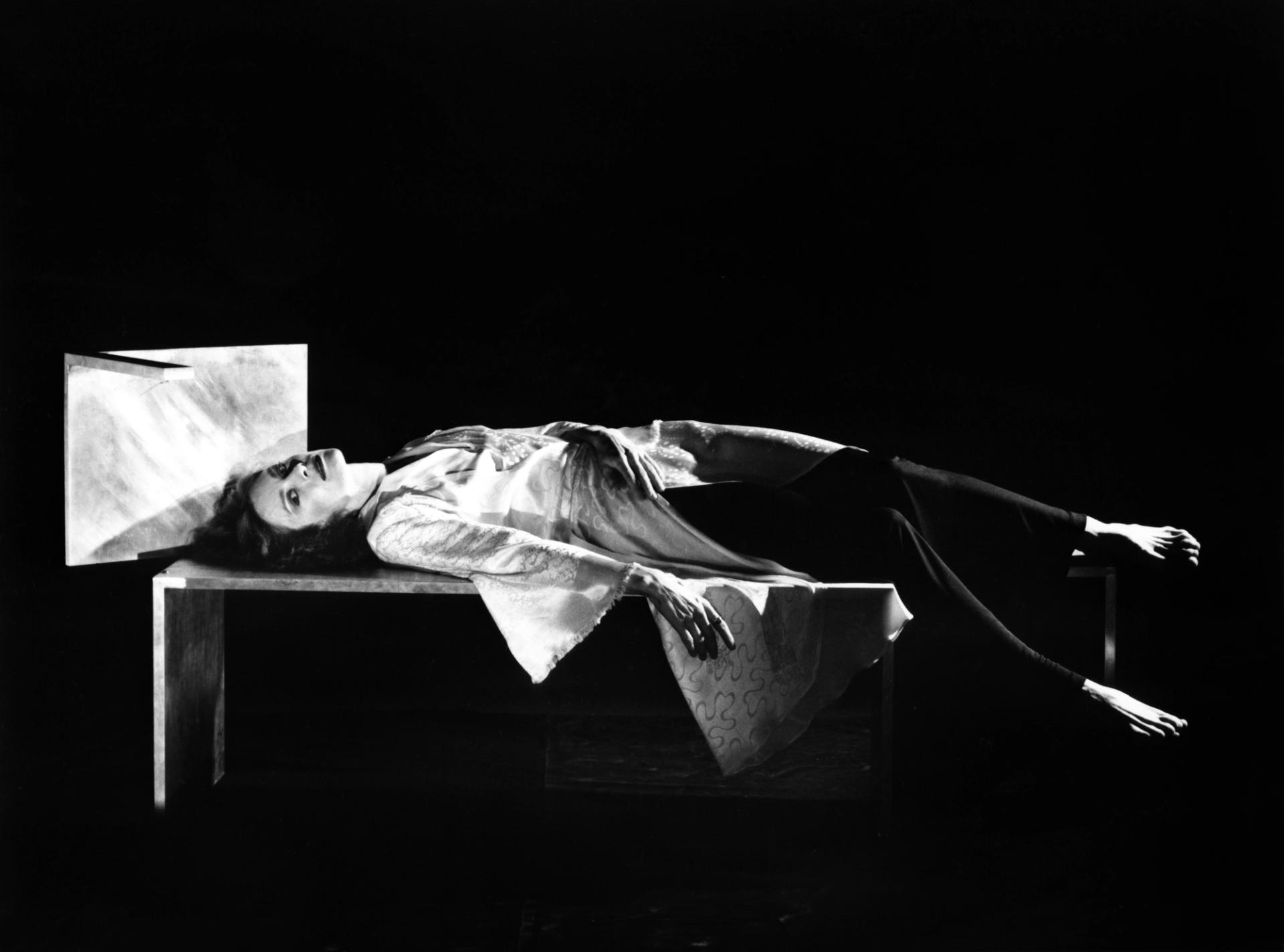
Childs performing in “I Was Sitting on My Patio This Guy Appeared I Thought I Was Hallucinating,” the 1977 production she co-directed with the late Robert Wilson, at Eastern Michigan University in Ypsilanti, Michigan. (Courtesy The Watermill Center)
“From the moment we met, something happened that opened up so many things for me. First of all, the work itself—and Bob [Wilson] is kind of a mysterious figure. You’re never quite sure what he’s thinking.”
LC: Well, I think it was, from the moment we met, something happened that opened up so many things for me. First of all, the work itself—and Bob is kind of a mysterious figure. You’re never quite sure what he’s thinking. The travel in Europe was incredibly important—amazing to have the opportunity to do that so early in my career in the seventies.
I think the most moving thing he’s ever said, when we were working together in Hamburg recently, on a production about Steve Hawking—It was a production called H—100 Seconds to Midnight, a beautiful production with German actors. I’ve always loved to see him working with the German actors, and they love him, and you can understand why they love him. But he said to the group at one point, he’s introducing everybody, and he said, “Well, Lucinda and I, we speak the same language, so we understand each other. So we don’t really talk very much.” [Laughter] Which is true. I think we had enormous trust in each other.
SB: Very telling. He was a man who loved silence, too. He loved long pauses.
I also wanted to bring up Philip Glass because of his music, you’ve said you lose the sense of time. You don’t feel, “Oh, now it’s two hours.” You don’t even think in those terms anymore. Could you just speak to this context of working with Philip and maybe here speak to “Dance,” the 1979 work you created, which had this accompanying film by Sol LeWitt? This was your first choreographed piece to music.
LC: Collaboration. First collaboration working with visual artists. All the things that I had rejected came into being in a very classical way, because all the artists are completely contemporary. But Philip and I talked about, after Einstein, working together again, doing a production together again. Then, of course, we turned to Sol LeWitt, because if we’re going to do a production in a theater space with the ensemble... It’s true, I think that my answer is actually very good, better than... You do lose a sense of time. But for “Dance,” we decided, because of my dancers, I said twenty minutes is about the maximum they can sustain as an ensemble with my work. Then there’s my solo that gives them a break. And then there’s another section of dance that’s broken up with the solo in between, in the middle.
Sol LeWitt came to the studio and was able to follow my score and really designed the film from my score and from watching the rehearsals. In a way, he edited the film before he even filmed it, which was wonderful.
And Phillip’s music is just... It’s so special. There’s nothing like it. I loved the fact that this was my first composer. I still work, making new pieces to this day. There’ll be a new piece coming out [the North American premiere], this summer [at Bard’s Fisher Center], called “Distant Figure,” one of my most recent works with Philip.
SB: Could you speak to some of these other composers you’ve also gotten to work with? John Adams, Arvo Pärt. You’ve gotten to work with some really incredible musicians and composers.
LC: Yes. The Museum of Contemporary Art in Los Angeles commissioned a work for me, after seeing dance is the collaboration with Phil Glass and Sol LeWitt. And they said it was... Julie Lazar was the curator at that time. She said, “We have a list of many of the artists on the West Coast. We hope that’s not a problem.” And I said, “Well, can I see the list? John Adams is on this list? Oh my goodness. I’d be thrilled to work with John Adams. Frank Gehry? Oh, I’ve never met... My goodness, to meet Frank…” I was thrilled to see these artists, the possibility of a collaboration. Those were the two artists that I began to work with. So John composed a piece for the Contemporary Contemporary, originally called “Available Light,” [from 1983] which also was in my company’s repertory in recent years.
SB: You’ve noted that one of the beautiful qualities of this score is that “...there’s no apparent metric system; in its place, there are a lot of accelerations and decelerations and periods of time where there’s no actual pulse.” So, the dancers have to kind of create it out of each other, working as a team to maintain this timing.
LC: But the thing is, because of the silent work, we knew there were time periods and time spans when they could sustain with exact timing coming out of something, into something, and knowing exactly where they are. That really has to do with the a cappella period, being part of it. But some of it’s very, very rhythmic. Some of it’s very, very rhythmic, but some of it isn’t. That was a wonderful challenge to combine those two qualities.
SB: Just to go back to “Dance,” this was after Einstein, really another one of these I guess we could call it tipping point moments for you. It was Alan Kriegsman writing in The Washington Post at the time called it “a genuine breakthrough, defining for us new modes of perception and feeling and clearly belonging as much to the future as to the present.” I was thinking about that quote, because it almost... I got to see a version of this performance a couple years ago. I would say that that quote holds nearly forty-five, fifty years later. It’s incredible to think about, across time, how some of these works endure.
LC: Well, it was pretty amazing, because we performed it in Washington, so he was able to see it there. He was very special, because there were a lot of reviews that were not like that at all. It was just the opposite.
SB: Yeah. I guess that’s—
LC: What are they doing? And so forth and so on. But it was wonderful to have that and to... I was very proud of it. Also to credit him with making a statement like that. That’s something that was never seen before really, exactly, as far as I know.
SB: To also do such radical work. How did you persist in doing that? What was your internal compass that allowed you to keep going? Because, like you said, the reception wasn’t always like Alan’s. In fact, I think I read or saw you talk somewhere about having eggs thrown at the dancers at some point in time. It wasn’t always big applause.
LC: No, the eggs. That was interesting, because they don’t sell eggs in the lobby. [Laughter] So this person just made the decision before he came, he wasn’t going to like it. I don’t know. Or something like that. I don’t know. But that helped the dancers, because they were very upset, and I tried to cheer them up.
SB: Well, where do you think you found your internal compass to keep going, keep making, keep—
LC: I guess it’s because of the company of Wilson and Glass. It’s who we were. We tried different things and we moved to the left and to the right, but basically, our center is what holds.
SB: Thinking about the past I would say two to three decades, how have you seen your work evolve post this “Available Light” moment, I guess? You’ve done a lot more in opera. Could you talk just a little bit about how your work has evolved over the decades since?
LC: Yeah. In recent years, I’ve been invited, for example, for Satyagraha and for Akhnaten with the opera in Nice. That’s a lot, it’s huge. You have the ballet, you have the singers, you have the chorus, and the whole production.
But I’ve also had the opportunity in Strasburg to collaborate with some people, [on the John Adams opera] Doctor Atomic, for example, have done that project together. Some of the people I’ve worked with for a number of years, I have a team of people. Taking on those kinds of projects has been possible because I have a team of people that I work with in Europe who are wonderful, and we work together and we exchange ideas. That has been very important to me. I’ve been very happy to have these opportunities in opera, especially.
SB: Well, I believe it was in 1977 that you had your first performance in Paris. Is that right? I think it was.
LC: Yes. Something like that.
SB: So, we’re coming up on fifty years. I wanted to ask the significance of that, being that I think Paris and the French have been so receptive to Bob Wilson’s work and your work. I was just hoping you might be able to speak to that, the importance of French culture here at play in welcoming you or accepting you, eventually.
LC: Yes. Well, Wilson was already very, very famous in France in ’71 with Deafman Glance and the twenty-four-hour piece. And Einstein was more or less produced by the Festival d’Automne, in Avignon. The performances—it came back to France many times. It just so happens that we have been their guest all these years. It’s not as though I moved to France, but they just keep bringing us back. It’s been tremendously important for the work that I do, that I can continue to do it. I don’t think I would have the same career if that hadn’t happened, that I didn’t have that connection, especially with France.
SB: When I was going through preparing for this, I came across this writing from the poet and writer Elena Alexander, that she had described about experiencing your dance company at the Joyce Theater. And she said that it “[left] me feeling as though fresh oxygen had been pumped through my body.”
I just think about the power of the work that you do. Again, to go back to what we were talking about at the beginning of this conversation, this hypnotic nature that almost overpowers you. What do you hope people get from your work? Is there anything that you would hope that somebody experiencing your work comes away from?
LC: Well, my job is to put it out there and to project. It’s not for an empty room. It is meant for the people there. And I know that they all react differently—and they should. Why should they react in the same way? How would we know? But it’s in more recent years that people are latching on to it in a certain way. They’ve seen it before. They come back to see it again. But the initial reaction was very often... Way back in the seventies, we had to fight our way through a lot of negative reaction, which is fine, because as I say, I felt committed to what I was doing and I had the support of my peers, of Bob and Philip and Sol LeWitt and so forth and so on. Oh, and also, BAM—Harvey Lichtenstein presented my company very early on. A silent program... And continued to present. “Dance” was first presented at BAM. Harvey Lichtenstein was very important also for our growth and development.
SB: What are your hopes writ large for dance, now and in the future? What do you hope may occur in terms of the larger spectrum of how people—
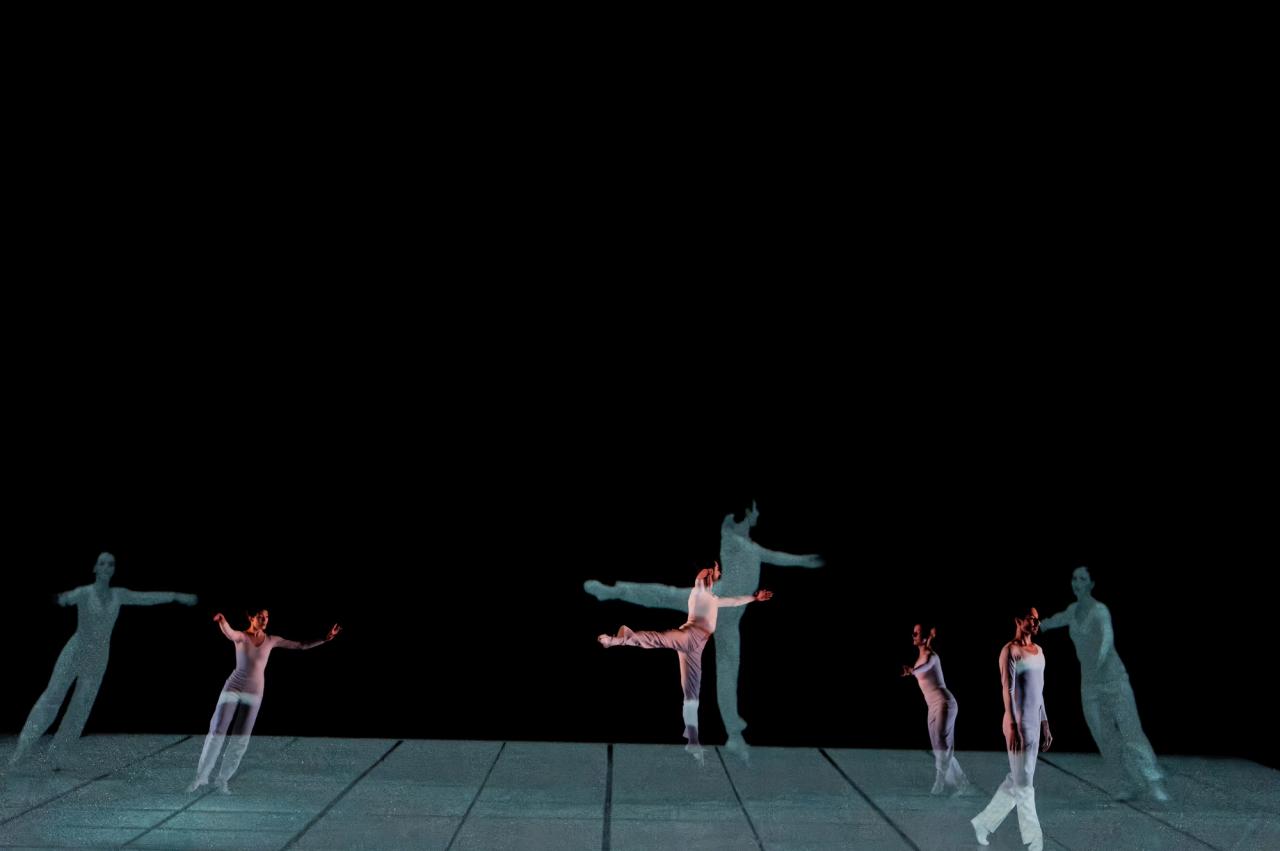
The Lyon Opera Ballet performing Childs’s “Dance” (1979) at New York City Center in 2023. (Photo: Agathe Poupeney/Courtesy Lyon Opera Ballet)
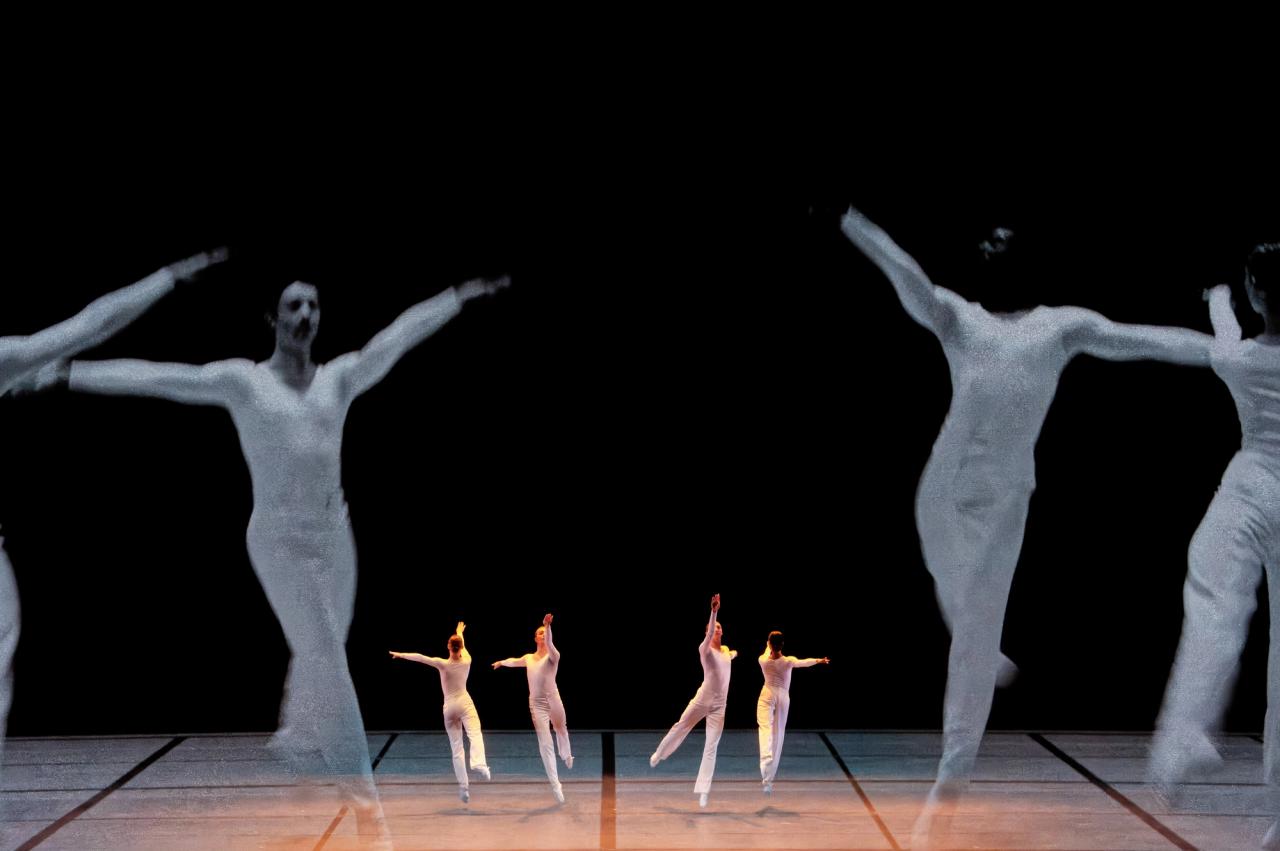
The Lyon Opera Ballet performing Childs’s “Dance” (1979) at New York City Center in 2023. (Photo: Agathe Poupeney/Courtesy Lyon Opera Ballet)
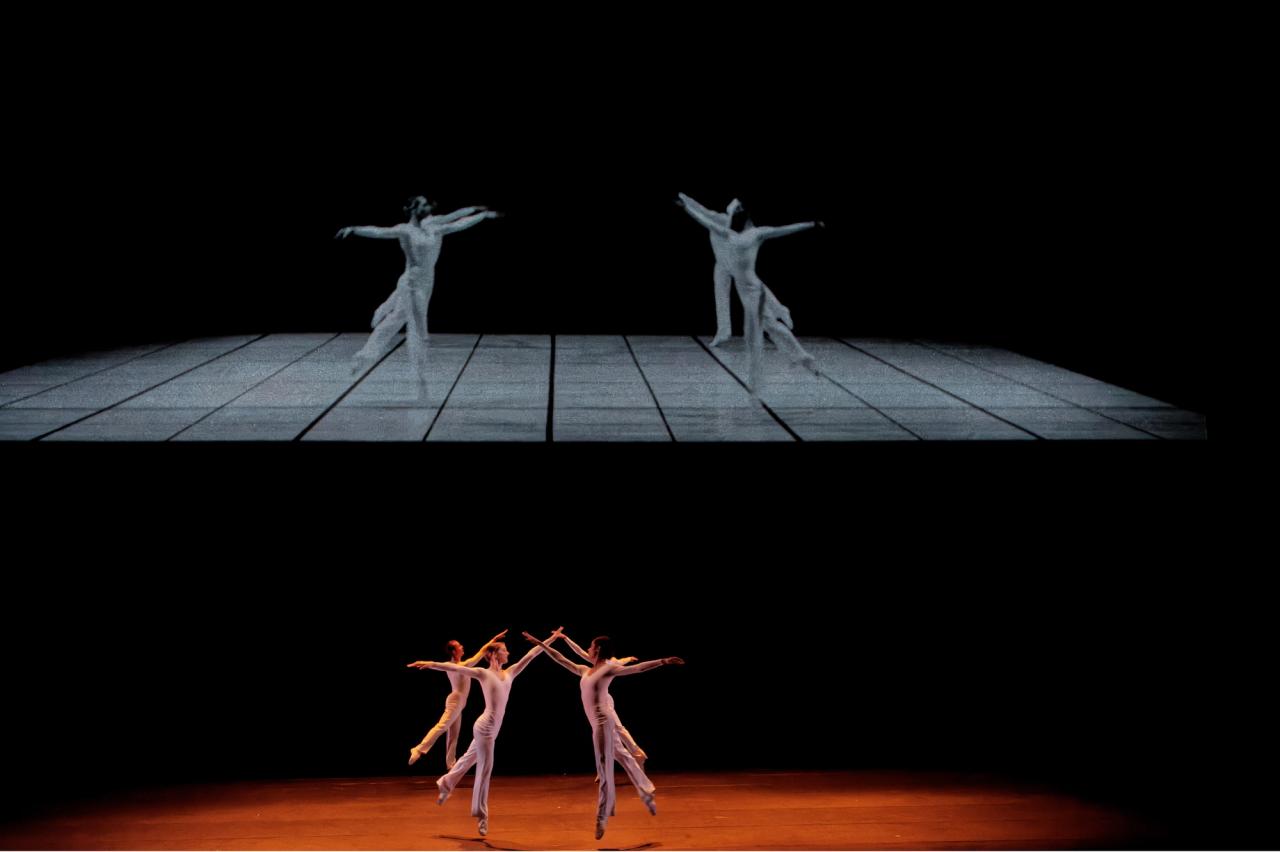
The Lyon Opera Ballet performing Childs’s “Dance” (1979) at New York City Center in 2023. (Photo: Agathe Poupeney/Courtesy Lyon Opera Ballet)
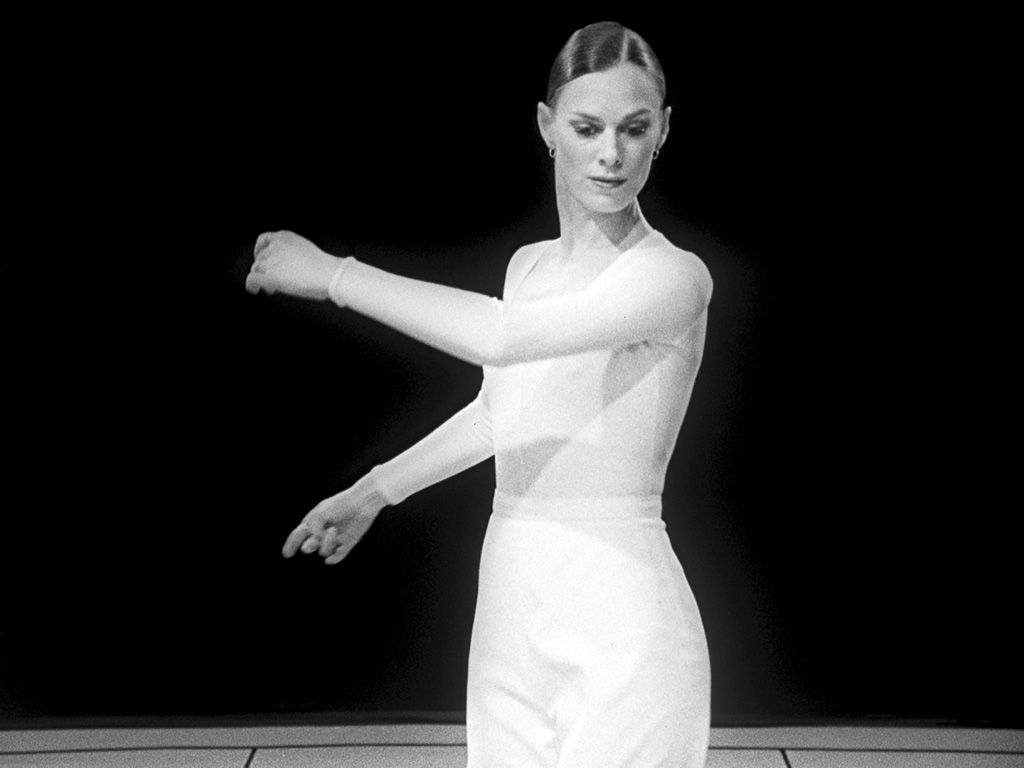
Childs performing in “Dance“ (1979). (Copyright Nathaniel Tileston/Courtesy of Pomegranate Arts and The Pew Center for Arts & Culture)
The Lyon Opera Ballet performing Childs’s “Dance” (1979) at New York City Center in 2023. (Photo: Agathe Poupeney/Courtesy Lyon Opera Ballet)
The Lyon Opera Ballet performing Childs’s “Dance” (1979) at New York City Center in 2023. (Photo: Agathe Poupeney/Courtesy Lyon Opera Ballet)
The Lyon Opera Ballet performing Childs’s “Dance” (1979) at New York City Center in 2023. (Photo: Agathe Poupeney/Courtesy Lyon Opera Ballet)
Childs performing in “Dance“ (1979). (Copyright Nathaniel Tileston/Courtesy of Pomegranate Arts and The Pew Center for Arts & Culture)
The Lyon Opera Ballet performing Childs’s “Dance” (1979) at New York City Center in 2023. (Photo: Agathe Poupeney/Courtesy Lyon Opera Ballet)
The Lyon Opera Ballet performing Childs’s “Dance” (1979) at New York City Center in 2023. (Photo: Agathe Poupeney/Courtesy Lyon Opera Ballet)
The Lyon Opera Ballet performing Childs’s “Dance” (1979) at New York City Center in 2023. (Photo: Agathe Poupeney/Courtesy Lyon Opera Ballet)
Childs performing in “Dance“ (1979). (Copyright Nathaniel Tileston/Courtesy of Pomegranate Arts and The Pew Center for Arts & Culture)
“Dance is a career where the dancers and people who are involved, they’re there because they love it and they just have to do it. There’s nothing else to draw them in except a real love and commitment to the work.”
LC: Well, it’s not looking very good. [Laughs] Somehow, because dance is a career where the dancers and people who are involved, they’re there because they love it and they just have to do it. There’s nothing else to draw them in except a real love and commitment to the work. We always find a way somehow… The younger generations might be very discouraged right now. I can understand that. We never had an easy time, but never was there a time like this. Perhaps that’ll bring something out in the young world of expression in choreography. Perhaps that will develop and be important in a certain way. I hope so. I hope people are not crushed, because this is a terrible time that we’re in.
SB: I think you’re somewhat of a guide here, or at least somebody who has shown that through your center of gravity, you’ve created an incredible body of work that I think is going to stand the test of time. Thank you, Lucinda. Thank you for coming here today.
LC: Thank you.
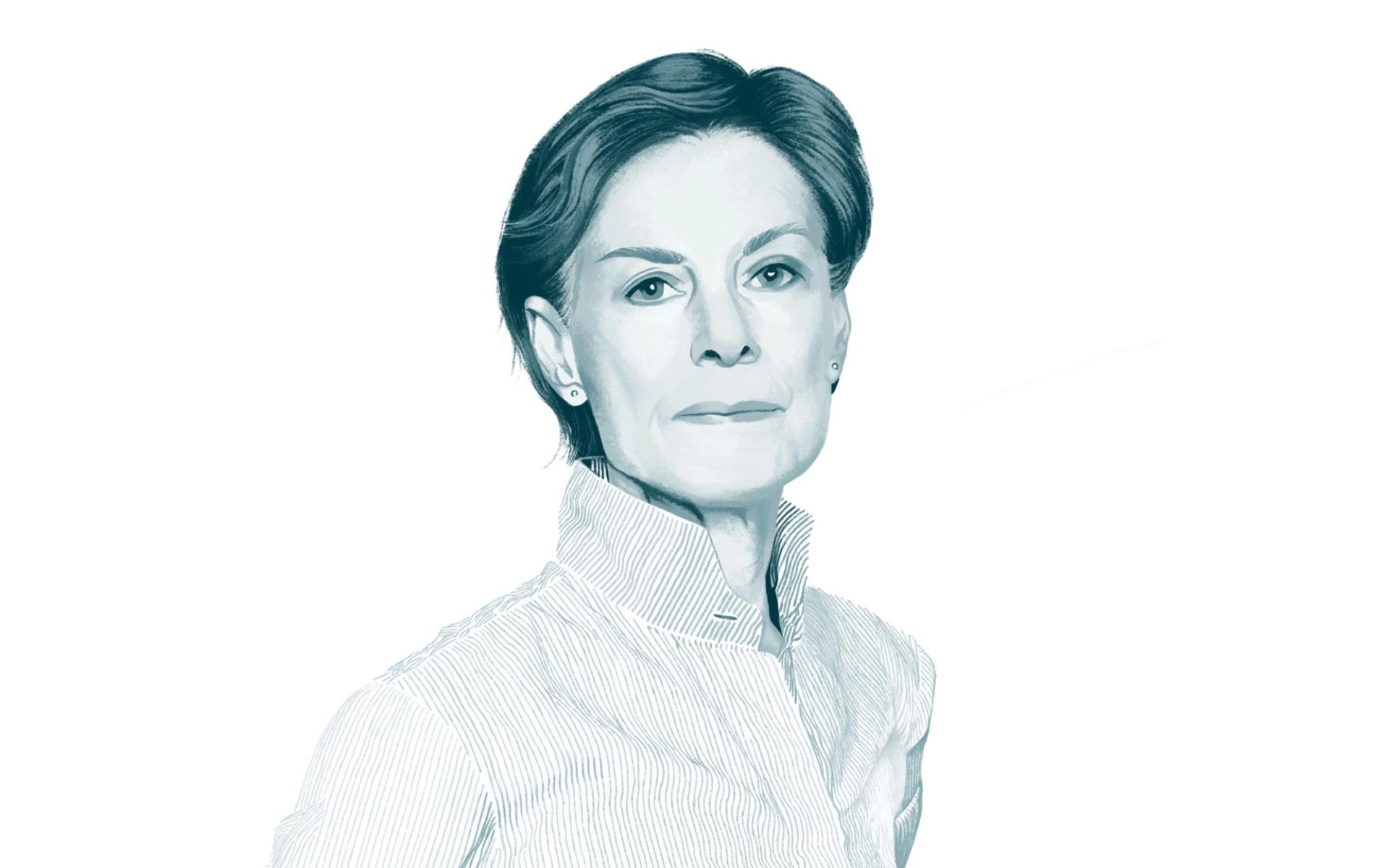
This interview was recorded in The Slowdown’s New York City studio on February 9, 2026. The transcript has been slightly condensed and edited for clarity. The episode was produced by Olivia Aylmer, Ramon Broza, Mimi Hannon, and Johnny Simon. Illustration by Paola Wiciak based on a photograph by Cameron Wittig.